


12,99 €
Mehr erfahren.
- Herausgeber: Ventil Verlag
- Kategorie: Geisteswissenschaft
- Sprache: Englisch
In »A Dysfunctional Success« Eric Goulden writes with an acute eye for detail about growing up in the 60s and 70s in suburban South East England, discovering music and girls; life as an art student in the frozen north eastern town of Hull; the formation and dissolution of bands with desperate equipment, a homemade ethos and not much idea; his move to London in 1976 and subsequent recording debut on the newly formed Stiff Record label. This is an honest coming of age story from both sides of instant pop success: bands, squalid flats, menial jobs, making records, the rise to the point of fame and falling off into poverty and alcoholism in Thatcher's Britain, where Goulden ultimately survived the 1980's to achieve his own kind of success. Twenty-one years after its original publication, in a time when pop stars telling their own hard stories was a comparative rarity, A Dysfunctional Success rings truer than ever, reminding readers how we all come from somewhere, pay a high price for our dreams, and enjoy modest glories in return for staying the course. »I think I was hoping for insight into the early Stiff Records days, which I didn't get. What I got was much better, and a great deal more interesting: a shambling, acutely observed, very funny-sad-true-sharp autobiography …« – Neil Gaiman
Das E-Book können Sie in Legimi-Apps oder einer beliebigen App lesen, die das folgende Format unterstützen:
Seitenzahl: 455
Veröffentlichungsjahr: 2024
Ähnliche




















Eric Goulden
A DYSFUNCTIONALSUCCESS
The Wreckless Eric Manual(written by the author)
First published 2003 by The Do-Not Press Limited
Copyright 2003 & 2024 by Eric Goulden
Copyright of this edition by Ventil Verlag UG (haftungsbeschränkt) & Co. KG, Mainz, 2024
In Cooperation with Tapete Records
Use of this material, in full or in part, is only permitted with expressly agreement of the publisher. All rights reserved.
ISBN print 978-3-95575-223-1
ISBN epub 978-3-95575-630-7
Cover design: Chalkley Calderwood
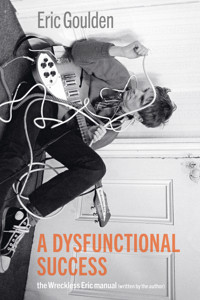
Cover photograph: David Corio
Ventil Verlag, Boppstr. 25, 55118 Mainz, Germany
www.ventil-verlag.de
For Tiger, Sunny and Wren when they’re older
Contents
Foreword
Sussex by the Sea
Hull
Melody Road
The Slippery Slope
2 Up Too Down in the Medway Towns
Acknowledgements
Selected Album Discography
About the Author
Foreword
(the bit at the front that no one bothers to read)
IT’S OVER TWENTY YEARS since this book was first published. I started writing it in Brighton in, I think, 1999. I bought a second hand Mac – very up to the minute, except that this one was worn out in every way. My original publisher, Jim Driver at the Do Not Press, advised me to treat the writing like a part time job, so I’d write in the mornings. I’d close the blinds – the only way I could see what was on the very dim screen of the clapped-out Mac – and set to. A thousand words a day.
I was diligent but it didn’t last long. I split up with my long-term partner and moved to Norfolk. I bought a houseboat, a wonderful old art deco cruiser which I had moored on the river Yare just outside Norwich. I was going to live on it and write my autobiography bobbing on the river to the accompaniment of lapping water and quacking ducks. That idea didn’t last long – the boat needed more work to make it habitable than one man could achieve in a lifetime, so I rented a house in a far-flung suburb of Norwich, and in just about every way possible, started again.
I got without the big old Mac – I remember taking it to the rubbish tip where it sat proudly amongst a cluster of old TV sets and defunct microwaves, a minor monument to the idiocies of the modern world. I bought a laptop, a brand new Sony Vaio. It cost a fortune but it had an astonishing sixteen gigabyte hard drive. I didn’t know what a hard drive was at the time but people who did were very impressed. I’ve still got it somewhere – small and clunky in businesslike dark blue plastic. Last time I switched it on the screen did a passable impression of a still from 2001 A Space Odyssey. It’s beyond repair but I can’t get rid of it – I wrote this book on it.
I moved house again. I liked the suburb where I was living, so when a house came up for sale that was exactly like the one I was renting, but better, I secured an interest-only mortgage and bought it. Far-flung bungalow suburbs are good places to work – no distractions, an absence of grooviness. Day to day life makes a good backdrop. I left Brighton because I was tired of being surrounded by endless creativity and artiness. Everyone I encountered was making an album, writing a book, curating an exhibition … and they were all keen to talk about it. ‘I just want to live somewhere where people talk about gutters’ I explained to a friend. The day after I moved to the final house in Norwich I met the lady who lived opposite. We had a chat during which she confided in a lowered voice: ‘Of course, thanks to my neighbour I’m having terrible trouble with my gutters’.
Work on the book gathered momentum. I had gigs to do but on the days when I wasn’t playing I’d write. I budgeted on a thousand words a day for four days a week. It worked well. Some days I’d start as early as eight o’clock in the morning, a thousand words would flow with little effort, and the rest of the day would be mine to do whatever I wanted. Even when it was going well I never pushed for more than a thousand words. I’d quite deliberately cut myself off so that I’d have something to look forward to the following morning – I’d wonder what was going to happen next. I found I did my best writing when I was entertaining myself – sometimes I’d be falling about laughing, other times I’d feel unbearably sad. And sometimes it’d be four o’clock in the afternoon and I just couldn’t make any headway. I always tried to be honest, and resist urges to glorify or embellish.
My childhood wasn’t always happy so it wasn’t always easy to tell the story. I was a naive young man who, instead of growing up, became a drunk, an alcoholic. I suffered from depression and carried a terrible anger around with me that was perhaps in part genetic, but was largely due to my upbringing.
My mother lived in Manchester as a teenager during the blitz of World War II. She survived the nightly bombing, but that, and, as it transpired, an abusive childhood, left their mark. She was a delightful person and I absolutely loved her – at her funeral I described her as my first friend – and she was a friend for life. But she was never easy.
My relationship with my dad was complicated. He died shortly before I started writing the book and even though I was trying to keep a lid on it, as much for my mother’s sake as anything, my resentment was close to boiling over. I have a much greater understanding now of why he was like he was.
He was addicted to steroids.
The addiction wasn’t his fault. When I was two years old he was diagnosed with a chest disease called sarcoidosis. The condition was treated with massive doses of steroids that left him with a lifelong dependancy. Steroids have terrible side effects – even the drug companies admit to it now – but in the 1950s and 60s, we didn’t know this. He was dark, moody, bad-tempered, negative, detached, disinterested … I grew up thinking that grown men were very scary. Even when they were being nice they grunted and grumbled, and when they were in a bad mood the whole fucking world was plunged into misery. He was actually a very kind man who cared deeply for his family but I feel I only saw the real man in occasional glimpses – the kindness and caring were largely concealed behind a steroid mask. I wish I’d understood this earlier.
I found my youth easy to remember – my life was punctuated by pop records. Pop music was in its infancy, there wasn’t as much of it as there is now. When a new record came out you could pretty much guarantee that there had never been a record that sounded like it before. Every record was a milestone. While I was writing the book I listened to a lot of records. They put me straight back in time and place. I bought a book – The Best Book Of Hit Singles Ever! All the Top 20 Charts for 45 years. If I was unsure of anything I’d use this book for verification. I was very rarely wrong. I hardly needed it. Twenty years later I wouldn’t need it at all, I’d just look it up on the internet and enjoy a certain righteous indignation if I thought the information I found was wrong.
I enjoyed doing the research. I slipped into the Ocean Hotel in Saltdean and spent an hour or more soaking in the last vestiges of 1970s Butlins before security caught up with me and showed me out. I walked around neighbourhoods, sat in doorways and on garden walls, remembering. I’d linger until someone called the Neighbourhood Watch. I was questioned and moved along by a lot of policemen. I broke into the old Lewes County Grammar School For Boys during the school summer holidays. Remodeling was taking place. I was delighted to come across a gang of workmen who were demolishing parts of the school hall. ‘Give me a pick axe and a hard hat and I’ll join in!’ I was escorted out. I got in through the window of one of the old classrooms but I left by the front door.
I was hard on the Grammar School but I think I was right. There was a wealth of hypocrisy there.
A few years ago, at a social event in Lewes, Amy and I encountered Mr Knight, the maths teacher. Amy was quietly thrilled in that lovely, naive way that some Americans have about them. Her eyes were shining:
‘So you taught Eric mathematics!’
Mr Knight shrugged, looked disgruntled: ‘Ha, well, I tried …’
‘Well, perhaps you should have tried a bit harder’ she said.
Mrs Knight however was very nice. She used to be the school secretary. She took me aside and told me how bad she’d felt for me every time I had to wait in her office to see the headmaster.
At the same event I met the school bully. I hadn’t seen him since I was eighteen, on the last day of school, when I finally stood up to him and hit him over the head with a school bible. In the meantime he’d metamorphosed into an affable teacher at a comprehensive school. He was wearing a crash helmet because he’d come on a moped, and when he took the helmet off his thick black Hero of the First Fifteen mop was gone – he was completely bald and he appeared to have shrunk in size. Had I grown or had he diminished? I don’t know. We had a pleasant conversation – the old school days were barely mentioned but his whole being seemed to be transmitting a message: ‘Hey – I’m not that guy anymore, I’m really sorry, I’ve changed …’ I wanted to hug him, I wanted to be friends, I wanted to tell him it was all okay, but I couldn’t because I was overcome with a peculiar shyness.
Jim Driver’s original brief was really simple – he phoned me and asked me to write a book for him. An autobiography perhaps. I could write anything I wanted as long as I mentioned both Stiff Records and Whole Wide World somewhere in it so that people would know who I was and we’d sell a few copies. I persuaded him to give me an advance, not so much because I needed the money – I want to be obligated to him because I knew that was the only way I’d get it done. As it was I moved house three times and he had to keep ringing me to ask me if I was going to stick to the deal.
There weren’t so many autobiographies written by musicians at the time. Publishing a book was a complicated business – no easy route, no print on demand. Old fruits and Hollywood celebrities wrote autobiographies – indeed, as Viv Albertine says in her fabulous 2014 autobiography Clothes, Music, Boys: ‘Anyone who writes an autobiography is either a twat or broke.’ Her excuse was being broke. I just admitted in the last paragraph that I didn’t need the advance – it wasn’t a lot, but … I suppose that makes me a twat. Damn.
Viv Albertine is absolutely right of course.
The charity shops were full of autobiographies – amongst the most ubiquitous were the books of Dirk Bogarde who may have been broke when he started his writing career, but was certainly not a twat. His books were an inspiration. I started to buy them when I lived in the French countryside where books written in English were often in short supply. I would always find copies of David Niven’s autobiography, The Moon’s A Balloon – I was once so desperate for something to read that I actually read it. I told Jim mine was going to be called The Sun’s A Bun in tribute to David Niven’s effort. Jim would call me: ‘How’s The Bun coming on …?’ I actually had a very snappy title for the book but I can’t remember what it was now because it was suddenly obvious to me that it had to be called A Dysfunctional Success. Jim requested a subtitle, The Wreckless Eric Manual, so that people would know it was me, and I added (written by the author) because I was already tired of being asked if I had a ghost writer. It was very important to me that I told the story in my own voice.
At some point Jim decided the book needed to be edited and largely rewritten by a professional, and to this end he sent me the first few pages edited into what he thought it should be: a sort of bland, mate-speak version of my own writing. I hit the fucking roof. We had arguments, we had rows, telephones were slammed down, and if we’d been in the same room at any point I think there would have been a punch-up.
I told him he was destroying my voice. ‘Huh!’ he said, ‘writers always think they have a voice but very few of them do.’
‘Fuck you’ I said, ‘I’m one of the very few – I’ve already proved myself as someone with a voice – that’s why you want my book.’
I’m so thankful that I found the arrogance to say that. I refused to deliver the manuscript. I gave it up at the last moment when there was no time for a rewrite, barely time enough to proof read it (which was evident to me when I was preparing the manuscript for this edition). Jim and I go back a long way. He was my booking agent before he was my publisher, and my friend before any of that. We had a tearful reconcilliation. He was glad I’d held out against the rewrite. He told me he was proud of me, and that’s always meant a lot.
I had some help in putting the book together from an old friend, Kathie Jenkins, who was actually my art history tutor when I was at art college in Hull. It was just like the old days, but perhaps a bit more convivial. We sat in armchairs and I’d read the manuscript aloud. Kathie would stop me and ask for clarification, or interrupt with ‘Irrelevant!’ or ‘Boring!’, and I’d either agree, make a note to rewrite, or argue my corner. My friend Karen Hall was also a great help and support, she would drop by most evenings and I’d read to her what I’d written. Reading aloud was an important part of the process – I think when you read in your head the brain does subtle editing, but when you read aloud the tongue gets twisted by ambiguous and lumpy sentence constructions, and lack of sense or intent becomes painfully obvious.
I remember the day when copies were finally delivered to my house. I unpacked them and sat holding a copy in absolute shock. I’d made quite a few abums by then but I’d never felt the same thrill at the arrival of a finished record. This was so much more. I grew up in the days when pop records were regarded as throwaways – we never would have imagined that all those records by the Beatles, the Rolling Stones, the Kinks, the Who and all the rest would be revered fifty of sixty years later – the idea was ridiculous. Books on the other hand … books were forever.
The reviews were all positive. At least in the British press they were. A Swedish journalist gave me a bad review and sent me an email with a translation of the review along with an explanation and the offer of a right of reply. He would have given the book the maximum of ten stars, but as it was he could only give it five because I neglected to write about what everyone wanted to hear, that being the story of Stiff Records and my (brief) affiliation with Nick Lowe and Elvis Costello. I enjoyed exercising my right of reply. I pointed out that if I wrote about Stiff Records it would become a book about Stiff Records and this was very clearly an autobiography, and was as such, and by definition, a book about me. If he couldn’t accept that he was very much like a man who goes into a hardware store, buys a screwdriver, and takes it back the next day complaining that he can’t bang nails in with it.
I was very clear in my intention when I started writing. I had a story to tell but it wasn’t necessarily the tale of the meteoric rise and demise of Wreckless Eric. I was more concerned with my upbringing and the social background that shaped me and led to this meteoric rise and demise. And I wanted to write about what happens when the firework fizzles out. Bright lights, showbiz gaiety – the glamour and the gritty stuff – endless journeys in freezing vans, the three encores and a shag in a two star hotel – they’re really best left to the imagination – there’s nothing in those stories that is at all unique.
I recently found an American website where A Dysfunctional Success was lambasted as the worst music biography ever written. I personally disagree – there are far worse, but I won’t go into that here. One of my critics actually complained that I wrote about the house I grew up in and I didn’t write about any of the stuff these people wanted to know about. There’s a simple answer to this: if you don’t want to read what I have to say about my life then don’t buy this book. And if this book doesn’t say what you want it to say you can fuck off and write one of your own.
A Dysfunctional Success ends in 1985 at the point in my life where I stopped drinking. I think I made it clear that it wasn’t an end to the story – I lurched through one crisis or drama to another for years. Somehow I remained sober, and carried on making records. My daughter, Luci, who was born towards the end of the book, is now a woman approaching forty with three children of her own. (I’m a grandad!) She’s a psychiatric nurse and I’m immeasurably proud of her. I’ve been married for I can’t remember how many years to a wonderful woman, the writer, musician and legendary songwriter, Amy Rigby. We lived in France for a few years – as Amy once announced onstage: ‘For our third date we moved to France …’ We’ve lived in America, in upstate New York, for over twelve years. As soon as I'm done writing this foreword I have to start packing up to move to England – yes, I know, but these days, if you have a choice, you might as well choose the hell that suits you best. I should write another book but I know how hard it is now, so don’t hold your breath. In the meantime, I hope you enjoy reading or re-reading this one.
Eric Goulden
Catskill NY
January 2024
Sussex by the Sea
My dad worked in a factory
I tried it too but I couldn’t do
With the tedium of the everyday
I flunked out I’m not ashamed to say
While he was steady I was a flake
I lived my life from scrape to scrape
Now I’m older I’m a lot like him
A history that’s coming back again
I’ve got this name and it doesn’t fit
I don’t know what I can do about it
They say the child is the father to the man
I’ll just do what I can
Started out on the factory floor
Worked his way through the boardroom door
Voted for the right wing all his life
Though I tried hard he couldn’t see the light
I loved my dad but I don’t want to be him
A history that’s coming back again
I’ve got this name and it doesn’t fit
I don’t know what I can do about it
They say the child is the father to the man
So I’ll just do what I can
Father To The Man
Eric Goulden / Wreckless Eric
from the 2019 album TRANSIENCE
IT’S DIFFICULT TO KNOW where to start, so I think I’ll begin at the beginning and see how I get on …
I was born in Newhaven, Sussex, on May 18th, 1954, in the living room of a rented terraced house – 22 Railway Road – opposite the railway station. My dad was a draughtsman, working for the Parker Pen Company that was just a little bit further down the road.
I’ve often thought my birth would make a good beginning for a rock opera or a musical: I was born at twenty past five on a Tuesday afternoon. While I was being delivered (an unfortunate turn of phrase – delivered – it gives the impression that I came in a van, when in fact I was coaxed out of my mother by a no-nonsense local midwife) my dad was in the garden playing football with my three-year-old sister. Moments after the happy event, the factory siren sounded and he stood at the front gate, holding my sister in his arms. As his workmates filed past on their way to the railway station and town centre he said, over and over again, ‘It’s a boy, it’s a boy …’
Of course, it’s all very well beginning at the beginning but I can’t really remember much. I was only a baby after all. I can only remember things in bits and pieces – it’s as though it slowly dawned on me that I was alive. I remember the garden, a creamy white knitted blanket, and earthworms.
The boy next door was called Colin. He lived with his grandparents. He was a bit older than me. One afternoon he tipped earth over me and went off to play with the fat kid, John, who lived next door to him on the other side. John was a bit slow – he wore thick glasses.
He wasn’t all there, whatever that meant.
Colin had a red pedal car. I always wanted to have a go in it but I don’t think I ever did. We used to play in the alleyway at the back of the houses. Colin, John, me and my sister. There might have been some other girls too but I wasn’t that interested in girls so I can’t remember.
We wee-weed up the wall, but the girls couldn’t do that. Then we weren’t allowed to play in the alleyway because there was a tramp living in the empty house.
They sat me on the draining board and I saw trains going past through the kitchen window. Steam trains and trains without steam that were just passenger carriages with no engine.
At night I heard the sound of shunting in the goods yard. I knew what that sound was because I’d seen it in the day. There was a bridge over the river with a railway track in the middle of the road. The train came out of a gate – a great big black locomotive led by a man with a red flag. It went through some big corrugated iron gates at the other side of the bridge behind the bus shelter.
Shopping with my mum. They gave me biscuits and tried to make me smile but I never would. I just sat there in my pushchair making car noises. There was a big trapdoor in the middle of the floor. The man in the shop wore a white coat and sometimes he disappeared through the trapdoor into the floor.
I gave myself a haircut, just like daddy at the hairdressers, covered with a blanket and chatting as I snipped. They didn’t know where I’d got the scissors from.
I pulled the radio down on top of my head. It was mended with Sellotape and glue.
We moved house when I was nearly four – to a bungalow in Peacehaven. Bungalow meant no stairs, nowhere to play at buses.
No more Colin.
I listened to the radio – the BBC Home Service, Listen With Mother:
‘Are you sitting comfortably?’
‘No.’
‘Then I’ll begin …’
Other times I watched the television – Watch With Mother.
Monday was Picture Book – boring.
Tuesday was Andy Pandy – better – he wore a stripy one-piece thing but I never knew what it was all about.
Wednesday was Bill & Ben – ‘Bill and Ben, Bill and Ben, Flowerpot Men.’ When the gardener went to have his dinner they climbed out of flowerpots, one each side of the Weed. Then they mucked about for ten minutes until the Weed said ‘Weeeeed’, which meant that the gardener was coming back. I was very worried in case they didn’t get back into the flowerpots in time. But they always did. Bye-bye Bill, bye-bye Ben.
Thursday was Rag, Tag & Bobtail – I couldn’t begin to understand what it was about but it didn’t matter.
And the week ended with The Woodentops: ‘… Sam who worked on the farm and the BIGGEST SPOTTY DOG YOU EVER DID SEE!’ That was my favourite. I could have stayed home forever.
I had a red bus. It was a big red plastic one with a friction motor. I loved my red bus. I took a psychotic dislike to it. I screamed and threw it down the step onto the kitchen floor in the old house. Frustration and fury. After several such episodes they hid it. It reappeared when my mum was clearing out a cupboard. I was delighted. ‘Ooh, there’s my red bus!’ It hit the kitchen floor, ‘I Hate It …’
My sister went to a convent school in Rottingdean. Soon I went there too. The place was run by nuns. My sister was in the big class but I was in the kindergarten. The nuns were all very frightening, apart from the round, friendly Sister Mary Pauline and Sister Jan Elizabeth who was only frightening when she was cross, and she was only cross when she caught us talking about bottoms and other rude things.
I didn’t like going to school. It was always winter, and they made me sit in the dining room and eat everything on the plate even though I hated semolina and it was playtime outside.
We had to go with Mrs Freeman, the dentist’s wife.
The Freemans lived on the South Coast Road in a big house that was also the dentist’s surgery. They had identical twin sons, Roy and Neil, who were the same age as my sister. Mrs Freeman took us all to the convent in a light blue Austin Cambridge estate. She called us ‘chaps’ – I think that was because she came from New Zealand. I didn’t want to go. My mum had to drag me along the South Coast Road screaming and crying through rain, wind, snot and tears. I wasn’t always a happy child.
Sister Jan Elizabeth started teaching me to draw numbers and letters and one day she said she was going to teach me to read, and suddenly I could.
And suddenly I was seven, and then I was eight.
I couldn’t really understand why we went to a Catholic school. Our family wasn’t Catholic, we were Church of England. I found the Catholic business confusing. All the Hail Marys and statues of Our Lady and rosary beads, and the school chapel with the china thing in the wall full of cotton wool and holy water, and crossing yourself and going down on one knee. We had to learn the catechism. I didn’t know what it was but it started: ‘What is God?’ and the whole class said ‘God is love!’ And then the questions got more complicated and so did the answers.
As well as being Church of England agnostic, my family, both sides of it, were also northern working class. They came from the surrounding areas of Manchester, particularly Oldham. My mother’s parents managed to save enough money and bought a newsagents shop.
Life in the newsagency business was hell on earth – cramped accommodation, early mornings, frayed tempers, customers. But it was a start, and by the end of the 1940s they were able to sell up and move south. They bought another newsagents in Shoreham-by-Sea, Sussex, and the whole family moved down to help run it.
My dad’s family stayed in the North.
Until I was nine or so I was only aware of my dad’s mother as a vague concept known as Grandma in Oldham. Then I went up there for a week with my dad. My mother and my sister went somewhere else. I don’t think there was a row about it but my mother had always made her feelings quite plain – Grandma in Oldham was a troublemaker. I couldn’t wait to meet her – she got such a bad rap she had to be worth seeing.
We had an old 1930s Morris Ten. It used to belong to a master carpenter who’d converted it from a van into a ‘shooting brake’ by adding windows and rebuilding the whole back in seasoned timber. I was slightly ashamed of it – to me it was a poor approximation of a Morris 1000 Estate. In fact, it was a really cool looking Woody, but surfing wasn’t popular in England back in 1963.
The front seats had been replaced with modern vinyl tip-up ones, and the original front seats, bucket seats they were called, were bolted together, covered with a blanket, and shoved in the back. The vehicle literally weighed a ton. It had big, flaring mudguards at the front, with the headlights stuck on top like backward facing bosoms.
The windscreen wipers came down from the top of the screen and were driven by a large electric motor mounted inside the cab, or if that failed you could work them by hand, using the lever provided. The indicators were illuminated orange arrows that folded out of the sides of the door posts. They weren’t very reliable – if they came out at all they tended to get stuck, and you had to bang the door post to make them go back in again, so it was best to do hand signals as well. It was a family car in the truest sense – the whole family was involved: pulling the lever to make the wipers work, checking the indicators, and either banging the door post or performing hand signals, according to what was required. Other than that it was entirely unsuitable.
We had an accident in it once, coming back from a family outing to Bodiam Castle. The spokes in one of the back wheels had rusted through. They were no longer holding the wheel together. The world went topsy-turvy, there was a big crash, and the thing was lying on its side with us in it. A nice man arrived in a Bedford Dormobile, opened the driver’s door like a hatch, looked down at us and asked if we were all all right. Then we were lifted out to safety. We sat at the side of the road until the ambulance came. My mum was concerned that people would think we were gypsies. Shock, I suppose. We were lucky to be alive – by some miracle none of us were hurt, except my mum who had cuts all up her left arm from the broken glass.
It was pretty sensational – the old Morris lying on its side like that. A policeman threw earth over the road to soak up the oil, then a bunch of strong men set to and pushed the thing upright where it did the best it could, lame in one back wheel. It came back to us a week later with new glass in the windows and all the dents knocked out. The spokes had been repaired too. Which was just as well because we were going to Oldham in it.
I was sworn to secrecy about the accident because it might worry Grandma, it might set her off.
It took an awful long time to get to Oldham. The Woody/Brake/Morris Thing did a top speed of forty miles an hour and was really only happy cruising at fifteen. It took two days, and we had to stay in a bed and breakfast hotel in Kenilworth. We had an itinerary, specially prepared by the RAC. Why we couldn’t be in the AA like all the other boys’ dads I just don’t know. We even met an AA patrolman somewhere on the way. My dad seemed to know him and they had one of those boring conversations that seem to last for hours when you’re a kid.
Why did we have to be in the RAC? Dinky did a really good AA patrolman on a motorbike with a sidecar, just like the one we’d met in the lay-by, but they didn’t do an RAC vehicle. I don’t think Corgi did either, though Matchbox might have.
When we got to Oldham it was just like Coronation Street, which was just like they said it would be. Grandma in Oldham was a bit of a disappointment. She lived on her own in a gloomy terraced house with a front door that opened straight off the pavement – 68 Orme Street. The streets where I came from didn’t have names like ‘Orme’. There was something infinitely depressing about the word ‘Orme’.
Grandma in Oldham was a widow. Her husband, Walter, died not long after I was born. Unkind relatives said she nagged him to death. They said she wore him out with her hypochondria. Over the next few years I grew to – I can’t say hate, because I don’t believe in hatred, I can’t think of anyone that I actually hate – but to loathe and despise Grandma in Oldham. For now she was a mere disappointment.
I don’t really remember much about that stay in Oldham. My cousins had adenoidal mouths and big teeth. Grandma took us to a cemetery as a treat. She was a very morbid woman. We had to go into a crypt. There were a lot of panels, which were actually drawers with names and dates on them. One of them said ‘Walter Goulden’ followed by a date. The one next to it was blank. Grandma smiled, ‘That’s where they’ll put me when I die.’ It was only a small drawer and I wondered how they’d get her in there.
When we got home I told my mum all about it. She was incensed. ‘Imagine,’ she said, ‘showing that to a nine-year-old.’
After this visits from Grandma in Oldham became a regular event, or occurrence as she would say. She came to stay on the flimsiest excuse. One year she came to measure the teapot because she was knitting us a tea cosy. Holidays came in two measurements: Just The Ten Days and The Full Fortnight. Grandma stayed for The Full Fortnight.
When she’d gone home the resentments all came out and the rows started – she’d driven my mother mad while my dad escaped to work. He didn’t know the half of it – the old besom always made trouble. She sat in the kitchen all day, chain-smoking Park Drive filter tips. She smoked and smoked and smoked, and as she smoked she talked and talked and talked. Grandma in Oldham had two major obsessions – death, and anything to do with going to the toilet.
While my mum tried to get the lunch ready Grandma would recount the tale of some lingering illness that resulted in hideous death and a funeral:
‘… and when we got to the cemetery all the Co-op Bakery bread vans were lined up, and as the procession passed through the gates they all sounded their horns and flashed their lights’.
‘Why did they do that, Grandma?’
‘Oh,’ she smiled, ‘it was the girl that iced the cakes, she died.’
My dad always came home for lunch. He washed his hands and face, sat down and ate, went in the bathroom and brushed his hair. He came back and drank a cup of tea out of the saucer, because it was too hot. By this time he was late for work because lunch hadn’t been quite ready because Grandma in Oldham wouldn’t shut the fuck up and my mum couldn’t think straight. Then he’d roar off in his Volkswagen beetle. Back to work in a bad mood. I was always there because Grandma invariably came to stay during the school holidays.
It seemed to me that any time I walked into a room she’d be in the middle of saying: ‘and then he died …’ and my mum would be making polite listening noises, ‘Oh’, and ‘Oh, really?’ and ‘Mmm, aha’, trying to keep the lid on the mounting tension that erupted from time to time with a hissing ‘Christ!’ or ‘Bugger!’ addressed to the inside of the oven.
Grandma in Oldham was at her worst in the mornings. Her arrival was heralded by the flushing of the toilet. Then the shape of Grandma would appear behind the frosted glass panels of the kitchen door. She’d take forever to turn the handle and open it. You could hear the springs in the lock moaning in sympathy. And there she was – wearing a dark blue pac-a-mac over a blue brushed nylon nightdress, topped off with a hairnet. It was as though Death itself had just walked into the kitchen. She always wore the pac-a-mac because a dressing gown would have taken up valuable space in her suitcase. The suitcase was huge – heavy with floral print summer frocks, pink and blue Trivera two-piece combinations, denture glue, and for all we knew, her own tomb-stone.
‘Morning,’ she bleated – never ‘Good morning’ – that would have been too positive. Being a well brought up boy, I’d spring up, put the kettle on and offer her a cup of tea. She lived on tea, drained it down by the pot-load. Cold, stewed or two hours old, any condition, it didn’t matter. The Oldham contingent were all the same in that. They’d burst through doors, all teeth, gums and lips and go, ‘TEA?’
But Grandma didn’t always want tea first thing – particularly if she’d had A Bad Night. A bony, arthritic hand would descend on my shoulder and Death would say, ‘Don’t worry about me, love, your grandma’s feeling a little bit hazy this morning.’ She’d put a tremble into the word ‘hazy’, and swoon ever so slightly.
One morning she staggered into the middle of breakfast and announced that she’d just left half her insides down the toilet. She kept a mental tally of who was ‘on the toilet’ at any one time – never the tasteful ‘in’, always the more graphic ‘on’.
‘Have you seen my dad?’ I’d ask.
‘He’s on the toilet,’ she’d reply triumphantly.
She’d sit down, light up the first Park Drive of the day, and cough all over the breakfast table. And then we were off – one death would lead to another, interspersed with little gaps for appreciation of the distant flushings of the toilet (‘… that’ll be our Doreen …’), and then she’d be on to the pensioners’ club, of which she was Entertainments Secretary – ‘Last week we had a penis. He was very good’.
She was also a staunch supporter of the Conservative Party. The Oldham Conservative Association presented her with an engraved silver cigarette lighter in appreciation of twenty-five years loyal service. The local paper took a photo of her wearing a two-piece and a string of pearls, smiling with all her dentures, and holding up the lighter. She died of heart disease bought about by smoking.
My dad was a Conservative too. He probably joined the RAC because of the blue and white badge – the black and yellow AA badge would have spoken to his subconscious of flaccid Liberalism. He left school at the age of fourteen and became an apprentice toolmaker. He worked his way through the engineering business from the shop floor upwards. He worked for the Parker Pen Company for thirty-seven years. As I got older I began to encounter men who had worked for him. They held him in god-like esteem. He was legendary – he was the manager who came downstairs, took off his suit jacket, stepped into a set of overalls and sorted the problem out in a no-nonsense Yorkshireman sort of way. He was a dark and moody Pennine man, the stuff of TV serials. In some ways I was actually very proud of him. But I could tell that these men thought he was slightly ridiculous and I was thankful that they couldn’t quite believe I was his son.
He could be the most joyless human being in the world. He held the view that Christmas and birthday presents should always be something useful, like a scarf, a torch, or a couple of pairs of socks. His manners were impeccable. A friend of my mum’s was most impressed when he declined an invitation to go for a drink with them one evening because he’d been painting a window frame and he’d got paint on his hands. The real reason was that he didn’t like her, but he was a gentleman, so he made an appropriate excuse.
I don’t think he liked anyone that much, except for my sister, me most of the time, and sometimes my mum. He didn’t have any friends. He was badly infected by the Protestant Work Ethic and all the deep joylessness and self-denial that comes along with it. As I got older I sometimes caught glimpses of the real man trying to get out. After my sister and I had left home my mum took things in hand – they moved to Brighton and she forced him to take holidays – they went to Greece where, apparently, the difference in him was astounding.
I wish he’d learnt to enjoy life earlier on, but he was a workaholic. Outside of work he lived in a world of his own. He didn’t have any hobbies, just work. When he came home he fell asleep in an armchair. While we had dinner, or ‘tea’ as it was called, he listened to the news on the Home Service. Any attempt at conversation was met with a glaring ‘Sshhh!’.
But it wasn’t all deep joylessness by any means and in 1963 my parents bought a record player. It was a milestone in my life – a Bush record player in two-tone grey vinyl finish, with a white speaker grill across the front. The controls were recessed underneath: on/off/volume, treble, bass. The interior contained an ice-blue Garrard turntable, and a smell of wood glue and electricity. The inside of the lid said B U S H in white plastic letters. It came from the electrical shop at the bottom of our avenue on the South Coast Road.
The shop was called Haydyn Williams. That kind of shop hardly exists now. It sold steam irons, television sets, kettles, electric blankets, transistor radios, torches, and batteries to make the torches and transistors work. In 1964 the window display included the first LP by PJ Proby – I Am PJ Proby on the Liberty label, with PJ Proby on the front cover in his night-shirt against a red velvet curtain. I coveted that record, but all I could afford were singles at six shillings and eightpence each, and the occasional EP – extended play – two tracks on each side. At eleven shillings it seemed like quite good value but they were never quite as loud, and a lot of them wore out quickly. The EPs I find now at car boot sales are generally completely shagged – sad looking bits of smooth, dark grey plastic with a label saying what used to be on them.
The record player was placed on the table in the corner of the lounge, next to the electrical socket. When not in use it had to be switched off and unplugged from the mains at all times, and the man who delivered it warned my parents that it would be extremely foolhardy to plug it into the shaver socket and use it in the bathroom. When I thought about that later it seemed to me that listening to music while you were having a bath was a really good idea. But I couldn’t imagine doing that in our bathroom. We had a white bathroom suite and brown Marley tiles on the floor. It wasn’t a very sexy bathroom. The window faced north and in windy weather the draught from the fanlight made the Polyglaze flap backwards and forwards.
Polyglaze was a cheap ’60s double-glazing substitute. It was basically just sheets of plastic stuck to the window frames with double-sided tape. It was very popular. It didn’t work.
I didn’t know much about music. It had always been there on the periphery. Sometimes it was happy – the soundtrack to the summer holidays. (‘Six weeks this time!’) My sister and I made tents in the back garden by draping old sheets over the clothes line and weighing the sides down with stones from the rockery.
The rockery was a desperate affair – an ant infested bank topped off with a ratty and sporadic hedge, dividing our garden from next door’s. There was a lot of rubble left over after they’d built our bungalow, lumps of concrete with bits of brick sticking out of them, that sort of thing. And these were set into the bank with spaces in between for plants to wither and die in.
We sat in the tent, which was very hot and smelled strongly of the shed. A contralto voice sang: ‘I want an old-fashioned house and an old-fashioned fence and an old-fashioned millionaire’.
My mum rushed out into the garden to tell us that Ringo Starr had got married. Another Beatle down. But that was later on, when I knew about music.
Sitting on the floor in the living room of the old house in Newhaven – black and white TV set (they were all black and white then) with the shiny brown casing – unnatural wood finish. ‘Over the points, over the points, the Six Five Special’s coming down the line, the Six Five Special running right on time …’ Rushing down the black and white railway line in shades of grey, and then the train – the front of the train – rushing towards the living room – I shut my eyes in terror as it cleared the TV screen. Then I sat on my mum’s knee while a group who’d just been kissed by a girl sang, ‘Ain’t a gonna wash for a week’. I asked my mum why – ‘Because they’re very silly young men’ she said. They looked quite old to me – they were called The Brook Brothers.
When my dad left for work the horrible radio was tuned to the Light Programme. Housewives’ Choice. The theme music was ideal for winding the mangle that sat on top of the Hotpoint washing machine. That was Mondays.
Monday was Washing Day.
The washing machine was wheeled out and filled up with sheets, washing powder and water. There were a lot of rubber hoses. They popped off the ends of the taps, spraying water everywhere. The washing machine jitterbugged wilfully across the kitchen taking the big grey hose with it so that soapy water pumped out all over the floor instead of into the sink.
And all the time the theme from Housewives’ Choice jangled cheerfully away.
In the afternoon it was Victor Sylvester, his Orchestra, and the vacuum cleaner – a combination that held me on the edge of tears.
We made a special trip to Brighton to buy some records. Hanningtons department store. The assistant put the record on a turntable behind the counter and directed us to a listening booth with dark brown woodwork and white pegboard walls. The sound came from a speaker up near the ceiling.
They didn’t have Telstar, and the Shadows’ guitars sounded like they were full of water, so I chose Globetrotter by the Tornadoes. It sounded magical in the booth. It was the sound that the listening booth made, and when I got it home it became the sound of the record player.
My sister chose A Children’s Introduction to a World of Good Music. A deep, crackling voice introduced the instruments of the orchestra in their separate sections. They each played the first line of Twinkle Twinkle Little Star up to ‘how I wonder what you ARE’.
By the time the voice had got through the bassoon and the oboe and started on the triangle, it was all becoming a bit tedious. But fascinating nonetheless. Then the Whole Mighty Orchestra came together and performed The March Of the Toys – Toyland.
One record led to another and pretty soon we had a collection. My mum gave my dad The Shadows’ Greatest Hits, a mono copy on the Columbia label. I’ve still got it: Apache, 36-24-36, Stars Fell On Stockton, Wonderful Land, The Savage, Man Of Mystery … with musical direction and orchestral accompaniment by Norrie Paramor.
My parents subscribed to the Readers Digest Record Club, the source of many a dreary record. Strauss Waltzes, Brahms Hungarian Dances and Beethoven’s Fourth Symphony played by a budget orchestra. Twenty minutes squashed onto a seven inch record and packaged in a gaudy sleeve, laminated with “Clarifoil”. Nobody listened to them – they just sat there in the red wire record rack, reminding us that life was somehow better than it used to be.
Listening to music didn’t come naturally to my parents. Not the classical stuff anyway. My dad became a Kathy Kirby fan, which made a lot more sense than all that Record Club shit. As the record sleeve said, she was a young, curvaceous, effervescent blonde, and he liked that sort of thing. Not that he had a roving eye or anything like that.
Kathy Kirby had that pseudo Latin-American thing that was popular at parties. We didn’t have parties but sometimes we’d go to one at someone else’s house.
Peacehaven in the ’60s. ‘Through’ lounges and hire purchase furniture. Cheese and pineapple on cocktail sticks, bowls of salted peanuts, cheese straws, cocktail sausages. The grown-ups rifled their children’s record collections and pushed the settee back against the wall to facilitate dancing. The Shadows, Chubby Checker, Joe Loss & His Orchestra, The Teddy Bear’s Picnic, Goodness Gracious Me …
Grannies waving their arms stiffly in the air and saying, ‘Ooh, we do like the pops!’ Dads flinging off suit jackets to reveal bri-nylon drip-dry shirts, perspiring and doing that botty-wiggling dance that mums seemed to find so seductive and kids found so embarrassing. Everybody having a great time – except the kids of course, sitting grim-faced on the sidelines.
I’m sure there was a healthy wife-swapping scene too – car keys in the middle of the coffee table and all that. But there was no way that my parents could have broken into that scene, even if they’d wanted to, not with the old Morris Eight. You needed a Vauxhall Victor or a Hillman Minx for that sort of thing. And anyway we didn’t have a through lounge, or a coffee table. But the furniture was all bought and paid for, quality G-Plan.
I came home from school and watched Blue Peter. It was boring. I never wanted to make any of the junk that Valerie Singleton knocked up, I somehow knew it wouldn’t come out the same. ‘You’ll need a cardboard tube …’ (what she meant was a toilet roll, but you weren’t allowed to say that on television because it was rude), ‘… a washing-up liquid bottle, which you’ll have to cut … like … this – these modelling knives are rather sharp so ask mummy or daddy to help you. To save time I’ve got one I made before the programme started …’
I couldn’t get my parents to help – my dad came home and fell asleep, and my mum was completely impractical – she once sustained a near-fatal electric shock stripping wallpaper. And anyway, I didn’t want to make a useful decorative thing that you could hang inside a wardrobe. Blue Peter was for children in another dimension. There was a parallel universe that only existed in the pages of Boy’s World and Meccano Magazine. I couldn’t break into it.
I had Spam Fritters for tea and watched Day by Day, the Southern TV regional news programme. The Beatles were on. They played From Me To You. Suddenly the whole world was Beatles: Beatle scrapbooks, Beatle wallpaper, Beatle bubblegum cards with pictures of John, Paul, George and Ringo in wacky bathing costumes – having fun in go-karts – George in leather at the Cavern – John hates having a haircut – Paul in a thoughtful moment – the Ed Sullivan show – Carnegie Hall. The triumphant return to Liverpool – they’d conquered America. Four lads who shook the world. There’d never been anything quite like this before. Everybody loved The Beatles.
They played at the Hippodrome in Brighton. I wasn’t allowed to go. I wrote them a letter telling them how much I liked their records and invited them round for tea in the afternoon before the concert. I had a bit of a bad day at school but I knew it was going to be all right because when I got home John, Paul, George and Ringo would all be sitting in the lounge having a cup of tea and waiting for me to arrive. I didn’t say anything but I felt slightly let down.
They put a piece of wood across the arms of the barber’s chair to make it high enough for boys to have their hair cut. Mr MacNeish cut my dad’s hair, then he cut mine. I wanted a Beatle haircut but I got what I was given. Yeah yeah yeah.
The racing finished, and they turned over to the Light Programme and I heard the latest Beatles’ single, I Want To Hold Your Hand. Had they blown it this time?
I hoped not because Mr MacNeish was halfway through his version of a Beatle cut.
PJ Proby sang Hold Me. My sister bought it. She liked the ballads – Gene Pitney, I’m Gonna Be Strong. She had a poster of Tommy Quickly from Fabulous 208 magazine. She also had a poster of the Rolling Stones. She’d labelled them all – Blondie, Curly, Toothy, Charlie and The Other One. I was three years younger but I was beginning to understand that she’d somehow missed the point.
Tommy Quickly didn’t really bother me one way or the other. The Rolling Stones did. They appeared on Sunday Night At The London Palladium. I’d never seen them before and I thought Brian Jones was a girl. Groups never sounded like the records on the telly – the sound was always rough, ill-balanced and dangerously out of tune. My dad got up and turned the television off.
‘That’s not entertainment,’ he said.
My sister and her friends liked Cliff Richard – they all went to see Summer Holiday at the pictures. She could do the Shake, the Twist, the Hully Gully and the Slop but I’m sure she didn’t feel what I felt when I heard The Who. ‘I’ve got a feeling inside – can’t explain …’
Dizzy in the head and I feel blue
Things you said well maybe they




