


Erhalten Sie Zugang zu diesem und mehr als 300000 Büchern ab EUR 5,99 monatlich.
- Herausgeber: John Donald
- Kategorie: Geisteswissenschaft
- Sprache: Englisch
Writing on a small island in the Firth of Forth in the 1440s, Walter Bower set out to tell the whole story of the Scottish nation in a single huge book, the Scotichronicon - 'a history book for Scots'. It begins with the mythical voyage of Scota, the Pharaoh's daughter, from Egypt with the Stone of Destiny. The land that her sons discovered in the Western Ocean was named after her: Scotland. It goes on to describe the turbulent events that followed, among them the wars of the Scots and the Picts (begun by a quarrel over a dog); the poisoning of King Fergus by his wife; Macbeth's usurpation and uneasy reign; the good deeds of Margaret, queen and saint; Bruce's murder of the Red Comyn; the founding of Scotland's first university at St Andrews; the 'Burnt Candlemas'; and the endless troubles between Scotland and England. Weaving in and out of the events of Bower's factual history, like a wonderful pageant, are other subjects that fascinated him: harrowing visions of hell and purgatory, extraordinary miracles; the exploits of knights and beggars, merchants and monks; the ravages of flood and fire; the terrors of the plague; and the answers to such puzzling questions as what makes a good king, and why Englishmen have tails. In 1998 Donald Watt and his team of scholars completed the first modern edition and translation of Scotichronicon in nine volumes. It has been described as 'a massive achievement for Scottish cultural history' (Sally Mapstone) and 'an open invitation to join a voyage of discovery' (Books in Scotland). This selection from the whole of Scotichronicon puts Bower's epic of Scotland into the hands of the general reader. It is a marvellous and unforgettable story. Perhaps its importance is best summed up by Bower himself, who wrote at the end of it: Non Scotus est Christe cui liber non placet iste - Christ! He is not a Scot who is not pleased with this book! A History Book for Scots is selected from the complete edition of Scotichronicon by Walter Bower, edited by D E R Watt and a team of scholars, in nine volumes. This monumental work of scholarship, in which the original Latin text appears side by side with a translation in modern English, was completed in 1998. Extensive introductory material and notes guide the reader through the complexities of Bower's history and its background.
Sie lesen das E-Book in den Legimi-Apps auf:
Seitenzahl: 731
Veröffentlichungsjahr: 2019
Das E-Book (TTS) können Sie hören im Abo „Legimi Premium” in Legimi-Apps auf:
Ähnliche



















The selections in this book are taken from
SCOTICHRONICON
by
WALTER BOWER
New edition in Latin and English with notes and indexes
General Editor: D E R WATT
Vol 1 Books I - II (1993)
Vol 2 Books III - IV (1989)
Vol 3 Books V - VI (1995)
Vol 4 Books VII - VIII (1994)
Vol 5 Books IX - X (1990)
Vol 6 Books XI - XII (1991)
Vol 7 Books XIII - XIV (1996)
Vol 8 Books XV - XVI (1987)
Vol 9 Critical Studies and General Indexes (1998)
This selection from Scotichroniconfirst published in 1998 by Mercat Pressand reprinted 1999 and 2007
This edition published in 2012 by John Donald, an imprint of Birlinn Limited
West Newington House
10 Newington Road
Edinburgh
EH9 1QS
www.birlinn.co.uk
© University of St Andrews 1998, 2012
All rights reserved. No part of this publication may be reproduced, stored or transmitted in any form without the express written permission of the publisher
ISBN: 978 1 788853 26 2
British Library Cataloguing-in-Publication DataA catalogue record for this book is available from the British Library
Typeset in Times New Roman 10.5 point at Mercat Press
Printed and bound in Great Britain by
Bell & Bain Ltd., Glasgow
Contents
Preface
Introduction
Prologue
The beginning of the book called Scotichronicon
Preface to the work
Book I
The legend of Gaythelos and Scota
The islands north-west of Europe
Simon Brecc and the Stone of Destiny
The origins of the Picts
The arrival of the Scots in Albion
King Fergus I of the Scots
Book II
War between the Britons and the Scots and Picts
‘Fulgentius’, the Emperor Severus and the Wall
A quarrel over a dog
St Regulus and the relics of St Andrew
Book III
King Fergus son of Erc
St Columba and St Kentigern
Why the English have tails
The proper cure of souls
The murder of King Fergus by his wife
Charlemagne
St Bridget’s rules about fighting pagans
The Pictish royal succession
Book IV
The Scottish royal succession
The stratagem of King Kenneth son of Alpin
The church at Abernethy
King Hungus and the battle at Athelstaneford
King Indulf and the Danes and Norwegians
King Kenneth II and the succession
The assassination of Kenneth II by Finuele
A satire on the dress of the English
Kingly right
The vice of treachery
The prodigality of King Malcolm II
The life and death of King Duncan I
The duties of a king
The rule of Macbeth and the exile of Malcolm
The exile of MacDuff
Book V
Malcolm III defeats Macbeth
The marriage of Malcolm and Margaret
The virtuous works of Malcolm and Margaret
A judicial duel involving Edgar the Ætheling
King Alexander I and Alexander Scrimgeour
Alexander I and Scone
The last days of King David I
The saintly King David I
Book VI
The young St Waltheof
St Waltheof’s vision of a baby
Fordun’s address to the Scottish kings
Maurice bishop of Le Mans
St Waltheof at Melrose
Bower’s abhorrence of perjury
The division of the see of Dunkeld
Bishop Walter Trayl of St Andrews
Prior Robert de Montrose of St Andrews
Prior James Biset of St Andrews
Book VII
The vision of Dryhthelm of Melrose
The vision of the Emperor Charles the Fat
Two beggars and the body of St Martin
William Rufus and new shoes
King William’s dream and death
The conversion of a Cistercian monk
How parents should be honoured
Thunder at Dunfermline
Book VIII
Malcolm IV and Henry II
Pope Adrian IV on the misery of power
Epitaph on Malcolm IV
The sin of pluralism
The captivity of King William I
The council at Northampton 1176
King William and Donald MacWilliam
Philip II and the Jews
Philip II and the abbacy of St Denis
More examples of simony
Fighting in Galloway
Peace in England and Scotland 1193-99
Philip II and a vineyard
A bishop of Paris and his mother
William I and Harald earl of Caithness
Diplomatic relations with England 1209
Flooding at Perth in 1209
William I and Guthred MacWilliam
King William’s problems with King John
Book IX
King William’s death; inauguration of King Alexander II
King Philip II and virtuous recreation
Scottish churchmen and legates 1217-18
Cistercian monks and the eating of meat
The murder of Adam bishop of Caithness
More stories about King Philip II
King Alexander II attacks Galloway
King Louis IX and the Jews
The Bissets
Epitaph on Alexander II
Book X
Inauguration of King Alexander III
The translation of the mortal remains of St Margaret
Good and bad counsellors
The Comyns seize Alexander III
The battle of Largs
End of Norse rule in the Western Isles
Robin Hood and Little John
The right regard of prelates for royal authority
Gamelin and William Wischard bishops of St Andrews
Wischard and the canonical offence of pluralism
The Bruces earls of Carrick
Bagimond the papal collector, and stories about papal legates
Second marriage and death of Alexander III
The merits of Alexander III: the prophecy of Thomas the Rhymer
Book XI
The Interregnum and Great Cause
The humiliation of John Balliol
The Siege of Berwick
Battle of Dunbar; Balliol and Bruce; King John’s abdication
William Wallace
Book XII
More on William Wallace
Stirrings of Bruce
Bruce and Comyn
Bruce’s inauguration and desperate deeds
Reflections on Bruce’s hardships
The ups and downs of worldly honour
The capture of Perth
The Battle of Bannockburn
James de Douglas and William de Sinclair
Edward de Bruce; Celebrations at St Andrews
Book XIII
Tit for tat 1322
Death of Robert I
The Guardian Thomas Randolph
James de Douglas and King Robert’s heart
The perfidious English
Siege of Loch Leven castle
Inchcolm and English raiders
Black Agnes of Dunbar
Robert Prenderguest and sanctuary at Holyrood
Alan Steersman and Guardian Andrew de Moray
William de Douglas and William Bullock
A Bruce imposter and a Seton heiress
Book XIV
The battle of Neville’s Cross
The Black Death: first and second occurrences
A papal appointment to Dunfermline Abbey
The battle of the Thirty
The Burnt Candlemas
Sons of Lindsay and Kirkpatrick
Floods at Haddington
A revolt against David II; plans for his succession
Choice of a wife
Good wives
Queen Margaret Logie
Robert II and his family
The Peasants’ Revolt in England
An English invasion 1384
Invasion of Scotland by Richard II 1385
The prowess of William Douglas
The battle of Otterburn
Book XV
Aftermath of the coronation at Scone 1390
Clan fight at Perth
The pseudo-Richard II
Death of the duke of Rothesay
The character of Robert III
Founding of the University of St Andrews
Storks at St Giles in Edinburgh
Scottish forces in France
‘Le qwhew’
The battle of Verneuil
Joan of Arc
Robert duke of Albany
The merits of the mass
Book XVI
Address to King James II
The marriage of Princess Margaret
Reflections on taxation
Reflections on legislation
Reflections on a battle in Strathnaver
The burning of Paul Kravar
A debate over foreign policy
The assassination of James I
The merits of James I
A poetic epitaph on King James I
Epilogue
Index
Preface
The very extensive literary work in Latin called Scotichronicon compiled in Scotland by Walter Bower in the 1440s has rightly been described as one of the country’s national treasures. It was designed for reading by Scots—in those days Latin was not for educated people the barrier to understanding that it has become in recent times—but it contains not just a history of Scotland. The author ranges widely back in time to the days of the ancient Roman Empire, and to later developments on the Continent that had their effects on thinking and action in Scotland. And he offers reflections on the implications of these developments for the Scotland of his day. Hence the whole work adds up to ‘A History Book for Scots’, which is the title chosen for this book of extracts, through which modern Scots in their turn may hope to enlarge their understanding of their nation’s characteristics.
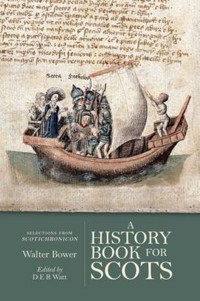
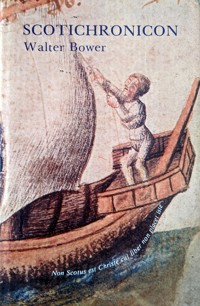
The translated passages selected here from the full work provide a taster of the variety of the whole. Their presentation is enhanced by the design of the book’s cover, which is based on aspects of an illustration of the departure of the mythical Scota and Gaythelos from Egypt which was inserted in the manuscript that was Bower’s own working copy of the book. This is now MS 171 in the library of Corpus Christi College, Cambridge, and the illustration is used here by kind permission of the Master and Fellows of that College. More information about this and the other illustrations in this manuscript is to be found in the volumes of the full edition of the Scotichronicon published between 1987 and 1998 (see details opposite the title-page above).
Introduction
Walter Bower (1385-1449) was born and brought up at Haddington in East Lothian. About 1400 he joined the community of Augustinian canons who served the cathedral at St Andrews. He was one of the first students of the university there after its foundation in 1410, gaining degrees in both canon law and theology. Then in 1417 he secured a papal appointment as abbot of the small Augustinian monastery on the island of Inchcolm near the north shore of the Firth of Forth opposite Aberdour in West Fife. As holder of this office for thirty years until his death, he was one of the magnates of Scotland who attended the king’s councils and parliaments, and was employed by King James I from 1424 onwards on financial and judicial business of the government. The assassination of the king in 1437 led to much confusion in public affairs during the long minority of the young heir James II. Though Bower still went out and about in the years that followed until his death, he must have devoted most of his time to literary work, whether on Inchcolm or using the monastic libraries that were available in such places as nearby Dunfermline Abbey and his old community at St Andrews Cathed-ral. This was the period when with the help of at least one of the canons of Inchcolm as his scribe he compiled the massive historical work which he called the Scotichronicon.
We do not know why he adopted this ambiguous title for the very extensive composition which he produced in two versions—a full version running to sixteen sections called ‘books’, and an abridged and re-arranged version divided into forty shorter ‘books’. But the whole work does not add up to just a history of Scotland, even if that is certainly part of its characteristics. Bower was concerned also to inform his fellow-Scots about aspects of European history from the time of the late Roman Empire onwards which he thought they should know about, so that more familiar developments in Scotland should be appreciated in context. He does sometimes refer to people and events in England; but his focus is much more on the Continent and beyond—even as far away as Palestine in the days of the Crusades. Some space is allocated to critical stages in the history of the medieval Empire and of the Western Church as a whole under the Papacy; but Bower’s main Continental emphasis is on developments in France. This can reasonably be explained as a cultural offshoot of the Franco-Scottish Alliance that was a central feature of Scottish policy from the end of the thirteenth century onwards, and was no doubt a consequence of the fact that most of the university teachers at St Andrews in Bower’s time as a student were graduates of the University of Paris. This aim of putting Scottish history into a meaningful context, which characterises Bower’s whole approach, justifies the choice here of an interpretative title for this collection of extracts from his curiously-named composition. These extracts are intended not just to illustrate Bower’s narrative style or analytical skill, but also his thoughts about the past in terms of lessons to be learned for his own day. Modern readers can regard this collection as a trailer for dipping into the complete Scotichronicon, or as an illuminating work in its own right. Certainly Bower hoped that readers of any period would learn things to their advantage from his writing, whilst at the same time deriving pleasure from it. Non-Scots are of course welcome to share in this benefit!
How does this work by Bower fit into the Scottish historiographical tradition? We know that he incorporated with additions an earlier chronicle put together in the 1360s by John de Fordun, a supposed chaplain of Aberdeen cathedral. This covered in finished form the story of the Scottish nation from its mythical origins down to the death of King David I in 1153, and Fordun collected also some more scrappy annals covering the further two hundred years to his own time. His work remains of fundamental importance for study of the early centuries of Scottish history; but he did not include all the information that was available in his day, for Bower was able to find and incorporate materials (not least official documents) supplementary to Fordun’s annals from 1153 onwards which provide a story down to the death of King James I in 1437 on a much more substantial scale than Fordun was able to offer.
It is characteristic of both writers that they sought to develop the literary effect of their chronicles by offering quotations from the Bible and the works of both classical and medieval authors, which were intended to broaden the reader’s appreciation of the significance of the historical information that was being provided. Fordun is not known to have had a university education; but Bower’s much wider literary range is first-hand evidence for the wide scope of the intellectual training offered from its beginning by Scotland’s first university. Scottish readers were through his work introduced to an impressive range of helpful allusions and parallels, however it was that Bower had come across them. He was also a practised preacher who had collections of telling anecdotes to hand (especially those put together in France in the mid-thirtenth century by Vincent of Beauvais and Thomas of Cantimpré), from which he selected vivid illustrations of points that he wished to make. These anecdotes certainly help to make the Scotichronicon a good read.
Bower’s work was compiled a few decades before the invention and spread of printing. We are fortunate in the survival of his manuscript working copy (kept since the Reformation in Corpus Christi College, Cambridge), for it helps us to understand how this vast work was put together. Manuscript copies of both this full version and the abridged version (especially the copy made originally for Coupar Angus Abbey before 1480) were commissioned by various individuals and religious institutions between Bower’s death in 1449 and 1510. The work appears to have then fallen out of fashion, for no more manuscript copies are known to have been made, and it was only in the 1750s that the first full printed edition of the Latin text (without a translation) was published in Edinburgh in two folio volumes. That edition has served academic Scottish historians well for more than two hundred years. But then about twenty-five years ago a move was made by a group of some dozen scholars to share in the production of a fully modern edition of the Latin text with an English translation and a wealth of explanatory notes, so that now readers both in Scotland and the world over can sample the five thousand pages of this new edition in nine volumes which were published between 1987 and 1998.
The interest of each item in this collection of extracts from this new English translation is explained in the introductory notes. The choice of items is entirely subjective. Some deal with vital personalities or stages in the history of Scotland, from the telling of which the reader can form a view of Bower’s interests and attitudes—his hostility to the English reflects the outlook of educated Scots who took part in public affairs in the fifteenth century. Then writing as a holy abbot he reveals his own priorities as a leading churchman, probably quite typical of his time with his views and prejudices. He is also a man who, though he is not known ever to have travelled outside Scotland, demonstrates a broad appreciation of matters of the intellect that must surely have been typical also of the interests of those who took part in the great experiment of founding the first university in their native country. His literary standards in so vast a Latin work are being studied seriously now that a modern edition is available: they should not be harshly judged on the basis alone of the translation made available here, for the aim of the editors of the new edition has simply been to reproduce the meaning and style of the Latin as accurately as possible, even if the English is sometimes ponderous and complex. The text follows closely the corrections made by Bower himself in his Latin working copy; where he introduced further revisions for his abridged version, or where the editors have used their discretion to clarify puzzling passages, such variations from the norm are marked by inclusion within square brackets.
St Andrews
September 1998.
Prologue and Preface
Prologue
Bower announces right away that he intends to incorporate in his book called Scotichronicon the materials collected in the 1360s by John de Fordun, whose work in fact has no title in the surviving manuscripts, but is known to historians today in two sections usually called his Chronicle and his Annals. Bower incorporated his own additions from the beginning, so that in the end by far the bulk of the work is his. It is notable that the work was commissioned by the presumably literate layman Sir David Stewart, the laird of Rosyth in West Fife and so a neighbour of Bower at Inchcolm. (The Piso family in classical times were patrons of the poet Horace.) Any presentation copy for Sir David may or may not have been ready before his death early in 1444; certainly it does not exist now; but we do have the working copy that was kept in the library in Inchcolm Abbey with many marginal additions made after that date. In this copy he takes the trouble as described here in the first five books to distinguish passages from Fordun’s Chronicle from his own additions; but he drops this practice when he comes to incorporating the Annals.
The beginning of the book called Scotichronicon
Lest I write what is worthless, guide, Holy Virgin, my hand. Guide my hand, direct my heart, Virgin Mary, I pray.
Here begins the book called Scotichronicon, begun by sir John de Fordun, chaplain of the church of Aberdeen, of worthy memory, and also continued, compiled and completed by the venerable father in Christ Walter Bower, abbot of the monastery of Inchcolm, also of worthy memory etc.
I am, I confess, a debtor, not through necessity but compelled by love. The debt-collector ought not to be harsh in compulsion, when the debtor is ready and willing to pay. So I must pay what I promised, and I have agreed to satisfy the urgent requests of the noble knight Sir David Stewart of Rosyth, that is to transcribe the following famous historical work recently and excellently begun by the venerable orator sir John Fordun, priest, clearly and elegantly written as a chronicle in five books. And not only, as I said before, to transcribe but also to continue the work right up to the present day, particularly since after completing his fifth book he left a great deal of written material, which had however not yet been everywhere arranged, but by means of which a careful investigator could easily continue the work to the aforementioned time. To him therefore after God will be ascribed the glory of the work, the elegant style of which I would judge to deserve not only the praise but also the admiration of the wisest men. Accordingly I shall insert at this point the following story. On a certain occasion when some men knowledgeable in scholarly matters met together, and were discussing the merits of the compiler of this book, there was among them a certain venerable scholar who said: ‘I was well acquainted with the man whom you are rating so highly, the author of the book about which you are talking and almost boasting. He was an undistinguished man, and not a graduate of any of the schools.’ He was given the following answer in my presence by one of those listening: ‘This work of which he was the author is sufficient proof of the quality of his scholarship. In this work he puts into practice what Seneca says in an epistle. It is not the education of the schools but incessant reading that he calls learning. He would say that the man who expresses the most meaning in a few words is the best orator. This in my opinion at any rate is what the author of the work has done.’ And this is how that book won the approval of all educated men, gaining for him the title of scholar and the name of orator, although he was not looking for it. ‘I am a liar,’ says Jerome, ‘if Horace does not also feel the same as I do for instructing those Pisos and for restraining us.’ That is to say that some people are always learners and never attain knowledge. While they criticise the judgment of others, they are happy with their own, and think that they know something. But just as teachers listen only to themselves, and boastfully rely on their own feeble intellects, so they set no value or very little on the writings or speeches of other people, but value their own very highly. Yet on the contrary it is the mark of the wise and well-educated man to compare his own writings with those of a master, and to derive form and method in them and with them and from them, and to imitate the arrangement both of the ideas and of the actual words, and to follow the construction. And so in my own case I feel that I am [following] far behind in a very different landscape; yet I am imitating the style of those I wish to emulate in the zeal of God, but especially imitating the style of the author of this book; and if I have not been able to achieve such great scholarship as he or those [other authors] either in this work or in other exercises, I have nevertheless wished to follow [in his footsteps], and I shall go on following him. But in the material which I add, may my patron forgive me if it should happen while I am transcribing this historical work that I insert here and there what occurs to me while I am writing. Since this task has been undertaken for myself and for the place in which by the will of God I serve, I intend that it should be deposited with the librarian, especially since I am not intending (Heaven forbid!) to disparage even in the slightest such an excellent work, executed with such careful attention and such eloquent style, because when I insert something of my own in his work as it now stands, I shall preface it with the attribution ‘WRITER’, since not I but another is the ‘AUTHOR’. Also whatever of my own I have interposed, I shall distinguish with a different style of handwriting, <or I shall mark with a line whatever I put in of my own up to the point where I affix the note ‘AUTHOR’ or ‘WRITER’,> so that in this way my patron the knight or anyone else whosoever who wishes to copy the present manuscript will easily be able both to omit my insertions, and bring the work begun by the master to completion on its own.
Preface to the work
Bower presents his readers with his literary creed and his ambitions as an historian. (Ennodius was a sixth-century writer in Italy.) The book is designed as a useful guide for leaders of society in general, but also as a good read for anyone.
As Ennodius bishop of Pavia writes: ‘To write more than one needs to is vanity; to suppress what is necessary shows disdain.’ So that I may avoid the infamy of the first fault, and not neglect criticism arising from the second fault, and trusting in God’s help, I set my hand joyfully to valiant deeds in accordance with my promises, so that I may be able to complete this work successfully, since I consider that, as someone says: ‘Joy gives eloquence which is denied by cleverness’, and that application is the mother of arts, but carelessness is the stepmother of learning. Therefore to the honour of God, to the comfort of the king and the kingdom, and also to satisfy the request of the renowned knight who urges me on to attack a work to which I am so unaccustomed, and also to refresh myself in clear intervals, worn out and beset as I may be at times by various cares, and as a warning to and for the edification of future readers I attack this work. To begin with:
I beg the reader to ask Christ with faithful lips
that He may give the writer after death the joys of Heaven.
Let each pray that the writer may be given for his reward,
may be given sound faith, a good conscience and grace.
In particular I shall not aim in my writings at beauty of style with brilliant diction, but I shall try to devote my attention to the true riches of different historians and to events known to me otherwise. Indeed the chronicles by themselves are so brilliant, vouched for by the names of the writers, that they do not need the lustre of an elaborate style to delight the hearts of readers. In addition to this the artlessness of an uncultivated style has usually removed all suspicion of falsification. For how could anyone who is quite unable to produce a polished style know how to fabricate fiction? In this volume, I believe, rulers will find how to avoid the dangers of war and uncertain issues, religious will learn the rudiments of the monastic life, laymen will learn fruitful lessons, preachers will find tales with a moral. By force of its example kings will become more cautious, religious will be instructed more in accordance with their rule, and all those who are depressed will be given over to joy by reading it.
Book I
The legend of Gaythelos and Scota
Bower (following Fordun) cites many variants of the foundation legend of the Scottish kingdom. The following selection of extracts threads its way through the main story. Pharaoh Chencres cannot now be identified. Brigantia is the modern Corunna in north-west Spain (i.e. not in fact on the river Ebro, but looking north to Ireland). The explanation of the division between Gaels and Scots comes from Gerald of Wales, Topographia Hibernica.
From various writings of ancient chroniclers we deduce that the nation of the Scots is of ancient stock, taking its first beginning from the Greeks and those of the Egyptians who were left after the rest of them had been drowned in the Red Sea along with their king.
In the third age in the time of Moses there was a certain king of one of the kingdoms of Greece called Neolus or Eolaus. He had a son who was good looking but mentally unstable, Gaythelos by name. Since he had not been permitted to hold any position of power in the kingdom, he was provoked to anger, and with the support of a large company of young men he inflicted many disasters on his father’s kingdom with frightful cruelty. He greatly outraged both his father and the inhabitants [of the country] with his violent behaviour. So he was driven out of his native land and sailed off to Egypt; and there, since he was outstandingly brave and daring and also of royal descent, he was united in marriage with Scota the daughter of the Pharaoh Chencres.
The aforesaid Pharaoh was drowned with his armies including 600 chariots, 50,000 cavalry and 200,000 infantry. Now those who survived by staying at home, hoping to be freed from the servitude of the corn-tax formerly imposed by Joseph in time of famine, unexpectedly drove the king’s son-inlaw Gaythelos Glas (who wished to pursue the innocent Hebrews) right out of the kingdom along with his followers for fear that he might establish dominion over them. So all the nobles both Greek and Egyptian alike whom the voracious sea had failed to devour were cruelly driven away by peasants enrolled in a servile uprising.
So Gaythelos gathered together all his followers and left Egypt with his wife Scota. Because he was afraid to return to the regions from which he had come to Egypt because of old feuds, he directed his course westwards, where he knew there were fewer and less warlike peoples with whom he would have to fight, since the men there were untrained in fighting.
The legend of St Brendan: ‘Now Gaythelos was driven from Egypt and after sailing in this way over the Mediterranean Sea he landed in Spain. He built a tower on the River Ebro, having seized by force from the inhabitants a place for his settlement called Brigantia. There his descendants multiplied greatly…He summoned his sailors and ordered them to take arms, to provision small ships with all speed and to explore the boundless Ocean in search of uninhabited lands. They went off to their ships, unfurled their sails and left the Spanish shore. Leaving behind the known, they made for unknown regions over the sea. After sailing with good speed and guided by the favour of the gods they saw an island rising up in the distance surrounded on all sides by salt sea. They put into a nearby harbour on this island and after beaching their ships went all round exploring the island. After seeing as much of the island as they could they sailed quickly back to Brigantia, reporting to their king Gaythelos on the very beautiful tract of land that they had found in Ocean.’
But Gaythelos was overtaken by sudden death. Before this he urged his sons to invade the aforesaid land with armed force, accusing them of laziness and cowardice if they gave up such a notable kingdom which they could enter without fighting or any danger.
The legend of Brendan says: ‘One of the sons of Gaythelos called Hiber, young in years but strong of purpose, was roused to war and took up arms. He got ready an expedition as best he could and approached the aforesaid island. He killed some of the few inhabitants whom he found and enslaved the rest, but he claimed the whole land as a possession for himself and his brothers, calling it Scotia after his mother’s name.’
In the book of the miracles of Ireland I have found it written as follows—that the Hibernians are also called Gaitheli and Scoti.
As ancient histories record, after the confusion of languages in Nimrod’s tower [Babel] Gaythelos the grandson of Phenius became highly skilled in a variety of languages. Because of his skill the king Pharaoh gave him his daughter and heir Scota as his wife. So since the Hibernians are originally descended from Gaythelos and Scota, they are named Gaitheli [Gaels] and Scoti [Scots] according to their birth. Gaythelos, so they say, invented the Hibernian language which is also called Gaelic, that is to say compiled from all languages.
The reason for what was once upon a time called Albany now being called Scotia is found in the same passage: ‘The northern part of the island of Britain is called Scotia because that land is known to have been inhabited by a people originally descended from the Scoti. This is demonstrated by the affinity of both language and culture, of arms and customs right up to the present day.’ (c.1, ll.1-4; c.9, ll.1-12; c.11, ll.4-13; c.12, ll.20-24; c.15, ll.17-21; c.16, ll.21-32; c.17, ll.9-13; c.18, ll.21-27, 47-62)
The islands north-west of Europe
Bower is careful to avoid any suggestion that Scotland had ever been dominated by Britain or formed part of England. Thule has been variously identified. Kilrymont is the old name for St Andrews in Fife. Bower himself presided over the Augustinian canons of Inchcolm.
Europe also has many large islands, the largest of which is Albion situated in Ocean in the north-west. Its southern and larger part was once inhabited by Britons and called Britannia, but its name now is England. The northern part was inhabited from antiquity by the Scots and was called Scotland, which at the present time also is a kingdom ruled by its own prince under the protection of God. The Scots also have many islands to the number of one hundred or more in their possession from ancient times. Beyond their shores in the north-west there is no land to be found except for a certain island, so men say, called Thule seven days’ sailing time away from them. One day’s sailing time beyond that, they say, the sea is motionless and solid.
Of these islands the following are said to be and are royal islands namely Iona or I or I Colmekill, on which St Columba built a monastery, and which was the burial place and royal seat of the kings of Pictavia and Scotland right up to the time of King Malcolm the husband of St Margaret. Also the island of Bute on which there is a royal castle. Also the Isle of Man on which there is a royal castle and monastery. Also the Great and Little Cumbrae islands, Inchmarnock, the island of St Blaise of Pladda and Ailsa Craig. Besides the royal islands the larger islands are these—Islay, Tiree, Lewis, Skye, Oronsay, where there is a monastery of the Black Canons which St Columba founded, Jura, Gigha and St Kilda, which is known to be to the west-north-west on the very edge of the world, beyond which no land is to be found in these regions.
There are also other islands in an arm of a sea of Ocean which is called the Firth of Forth, namely Bass, Fidra, May, where the priory is a cell of the canons of St Andrew of Kilrymont, and where St Adrian is buried with his companions the hundred holy martyrs. There is another island twelve miles from there which is called Inchkeith, on which St Adomnan formerly ruled as abbot. He received St Servanus and his companions with honour on that island at his first arrival in Scotland. There is a third island as well towards the west six miles distant from Inchkeith, which is called Emonia, between Edinburgh and Inverkeithing, commonly called Inchcolm, on which there is a monastery of Black Canons of the order of St Augustine. There are also very many more islands scattered over Ocean, all of which I need not enumerate.
Also beyond Britain in Ocean between Britain and the west lies the island of Ireland where the Scots established their first settlement. (c.6, ll.9-45, 47-48)
Simon Brecc and the Stone of Destiny
Many supposed generations later comes a version of the story of Simon Brecc and the Stone of Destiny. The simile of an anchor is a variant of the classical metaphor of the ship of state. The particular place called Tara that is mentioned is uncertain. The prophecy about the influence of the whereabouts of the Stone in the future relates to the situation after 1296 when Edward I of England removed it from Scone to Westminster. But neither Fordun nor Bower could have imagined the Union of the Crowns of 1603—nor the return of the Stone to Scotland in 1996!
Now there was a king of the Scots in Spain called Milo who had several sons. Yet he loved one of them whose name was Simon Brecc more than all the others, although he was not the oldest nor the heir. So his father sent him to Ireland with an army, and presented him with a marble throne of very ancient workmanship, carved by a careful craftsman, on which the kings of the Scottish people in Spain used to sit. So it was kept carefully in its own particular place to be as it were an anchor. Now this Simon Brecc set out for the aforesaid island accompanied by a great crowd of people, and after subduing it under his rule he reigned there for many years. He placed the aforesaid stone, that is the throne, in a place in his kingdom of some height which was called Tara. For the future this was to be his royal seat and the chief place in his kingdom, and there the kings descended from his line used to have their seat throughout many ages, adorned with the insignia of royalty.
One story is that Gaythelos took this seat with him from Egypt to Spain together with the other royal appurtenances; but others say that Simon Brecc let down anchors from his ship and secured them in the sea near the Irish coast. When he was forced by adverse winds to pull them up again from the stormy waves, he only just managed to do so with the utmost possible effort, and along with the anchors he raised from the depths of the sea and pulled into the ship a block of marble cut in the shape of a chair. So he accepted this stone as a precious gift bestowed on him by the gods and as a sure omen that he would be king, and beside himself with excessive joy he gave solemn thanks to his gods with such great fervour, as if they had absolutely handed both the kingdom and the crown over to him. He also received there a prophecy about it from his gods, as is affirmed in writings, that in future in whatsoever kingdom or lordship they found the stone after it had been forcibly removed from them through the power of their enemies, the prophets bade them regard it as certain that they and their descendants would reign thereafter in that same place. This has been expressed in prophetic verse as follows:
If destiny deceives not, the Scots will reign ’tis said
in that same place where the stone has been laid.
And this according to the claims of popular opinion up to the present day is shown to have been true on many occasions in the early wanderings of the Scots. (c.28, ll.1-38)
The origins of the Picts
The version of the origin-legend of the Picts given here associates them with south-west France (and later specifically with the province of Poitou), and suggests that they moved from there via Ireland (already occupied by the Scots) to mainland Britain (called Albion here). Alternatively the Picts were thought to have originated in Scythia (i.e. the Ukraine).
After a long time had passed in which the Scots lived in peaceful and quiet prosperity, a certain unknown people, afterwards called the Picts, appeared from the lands of Aquitania and landed on the Irish shores from their ships. They humbly asked the elders for permission either to live by themselves in an uninhabited region or to live side by side with the Scots all over the island. For they said that they had recently been driven out of their own country by the strong hand of their enemies, although they had done nothing to deserve it, and they had been up to then afflicted by great and fearful dangers from storms at sea. The Scots would not however allow them to remain among them on the same island; but after admitting them to friendship and the protection of their peace they sent them across to the northern limits of Albion, hitherto uninhabited, along with some men given to them as companions. So, as the Picts began to inhabit the lands there and since they did not have any women of their own race with them, the Scots gave them their daughters as wives under a pact of eternal alliance and a special agreement about dowry. (c.30, ll.1-17)
The arrival of the Scots in Albion
The Scots crossed over from Ireland at first as wives of the Picts, but then in ever-increasing numbers of both sexes. This led the Picts to fear for their predominance and to attempt to drive the Scots out. A thousand years later they were themselves to be destroyed by the Scots under Kenneth son of Alpin in the mid-ninth century.
The daughters and other female relatives of the Scots whom the Picts took as their wives were gradually brought by their husbands to their own land. They were followed by countless numbers of their kinsfolk, fathers and mothers, brothers and sisters, nieces and nephews, and also many others who were not only motivated by love for a daughter or sister, but rather they were very strongly attracted by the grassy fertility and abundant pasture for their herds in the land of Albion for which they were heading. The number of people of both sexes following them and taking their cattle with them who went off in a short space of time to live with the Picts was larger than has ever been recorded as having left their own land without a leader. But their number was also increased by an endless succession of criminals, because anyone who was in fear of incurring the penalty of the law went off to live with the Picts scot-free. Then they sent for their wives and children and remained there peacefully never again to return. Meanwhile the Picts bitterly resenting the arrival of such large numbers (for they were gripped by fear of the Scots) ordered it to be proclaimed that in future no foreigner was ever to obtain permanent settlement in their land. And to those who had previously agreed to stay with them of their own accord, they gave every opportunity to depart. For when they first came into the island, they understood from oracular responses made by their gods (or rather demons) to whom they sacrificed before engaging in any kind of action, that if they did not succeed in overcoming the Scots, they would be utterly destroyed by them. And so observing that the number of Scots in their midst was increasing, they began to be more and more afraid and drove them out of their land with violence. This [prophecy] was proved true, not immediately but a thousand years later, when their race together with their language was then utterly destroyed by the Scots. (c.32)
King Fergus I of the Scots
It was to provide assistance to the Scots who were being persecuted by the Picts in Albion that Fergus came over from Ireland to well-wooded Argyll to establish himself as first king of the Scots there.
Moreover while the Picts were inflicting injuries and hardships of this kind on the Scots colonists, news was secretly brought to the chiefs of their nation concerning the nature and extent of the misery the Scots were living through because of the Picts. And also at the same time certain people arrived who described to them the beauty of a region so extensive and of such great fertility in which there were only birds, wild beasts and animals, and which could easily be brought into cultivation. So when a certain nobleman Fergus son of Feraghad or Ferard who was descended from the line of ancient kings heard that a tribe of his own nation without anyone to lead or govern them were spending their time wandering through the desert wildernesses of Albion, after having been thrown out by the Picts, he began to blaze with anger in his heart. He had in addition been greatly attracted by the good report concerning that region in which he had perhaps the intention to rule, which was pronounced to be very fertile by those who had seen it, except for the fact that all the ground at that time was covered with very dense forests. We have clear proof of this right up to the present day whenever huge tree roots and trunks happen to be found underground, often even in the most level places, where the earth has been dug out or excavated by chance and that too where you would say that there is not a sign that forests had ever grown before. So inspired by these encouragements and by the ambition to rule he gathered to his side a great company of young men and proceeded immediately to Albion. There he separated out the Scots already living there from among the Picts and settled them along with those he had brought with him in the western territory of the island and set himself up as the first king over them in that place. (c.36)
Book II
War between the Britons and the Scots and Picts
Bower follows Fordun’s account of a long period of strife (vaguely dated 53-208 A.D.) between the Britons under Roman occupation and the Scots and Picts. In fact the Romans never invaded Ireland—the suggestion here that they did is an example of sources being misunderstood at some stage.
Around about this time, that is in the twelfth year of Claudius’s reign, the war of the Britons against the Scots and Picts is said to have arisen. It continued for one hundred and fifty-four years right up to the fifteenth year of Severus’s reign without any intervening interval of stable peace. At any rate it began in this way as follows: Vespasian was sent across to Britain with various legions by the emperor Claudius. After all rebellion had been stamped out, he reimposed the annual payment of tribute on the Britons, and returned to Rome. He left part of his army there to defend the country, with instructions to force subservience on the Irish people with the help of the Britons, and likewise on the Scots and Picts, or else to destroy them. Finally the Britons in company with the Romans advanced on Ireland, where various defeats were inflicted and suffered on both sides, but they achieved little or no success. From there they returned to the neighbouring regions of the kingdom of the Scots and the Picts, and because these peoples refused to submit to the Romans, they spread destruction everywhere with fires, slaughter and rapine. Meanwhile as the wars waged by the Romans and the Britons intensified, the fierce nations of the Irish, Picts and Scots, who were driven by the same need to act together, united in a very strong alliance against the Romans, since a three-ply rope is difficult to break, and began to devastate the whole of Britain. For with the Irish bursting in from the west, the Scots from the west-north-west, and the Picts from the north, they divided the various parts of the kingdom amongst themselves, and destroyed the people with pitiable slaughter. They spared neither women nor the tender age of children, but consumed everything that they laid hands on either with the edge of the sword or with fire. Not unnaturally the Romans in their turn did all they could to inflict a comparable disaster on them, and burnt to the ground everything in sight except for earth and stones, or slew everyone everywhere with the sword.
Then there was a most savage war between them, the like of which had never been heard of before, nor has anything as cruel as or more cruel than it ever been recorded in the histories of the whole world. The ordinary people of both nations, whose proper pursuit was just agriculture, not killings and wars, were absolutely exposed on all sides to plundering and pillage. These wretches, the scum of the common herd, who did not know how to be of use to the city dwellers or to do any harm to the enemy, were slain without mercy. The remnant of the people, who were able by any means to escape the sharp edge of the sword, deprived as they were of any protection, lurked silently in mountains, caves and remote corners. They supported life miserably, well content with grass roots, fruit, the leaves and bark of trees, with acorns and wild honey, which was found in tree trunks or among reeds, or with the milk of any animal they might happen to have. And so it happened that, once the tillers of the fields had been cut down by the sword, as described above, or had run away, the citizens, shut in behind the strongest city walls, and the guardians of the towns were reduced to such great deprivation of famine and hunger that with no thought of their homes and all their wealth and possessions, but wishing to save themselves, their wives and their children from this disaster, they took them off to remote regions far away. Meanwhile the cities, having been quite often stripped of their defenders in this way and abandoned except for a few simpletons who were devoid of all skill in defence, were surrounded by the enemy. Their ferocity did not give the cities peace for very long. They united their forces and easily climbed the walls, which were immediately utterly destroyed. They scattered the stones in the ditches, and levelled the walls with the ground. And the witnesses for this disaster are the strongest cities of the Britons, namely Agned, which was restored by Aed king of the Scots, and was later called Aedinburgh or Edinburgh, Carlisle also and Aluclud or Aldclide, which is now called Dumbarton, and very many towns which they levelled with the ground, and which have not yet been rebuilt by anyone. (c.28 - c.29, ll.1-34)
‘Fulgentius’, the Emperor Severus and the Wall
Bower takes over Fordun’s development of the story (dated 180-211) of ‘Fulgentius’, a supposed leader of discontented Britons against their Roman masters (in fact a character invented by Geoffrey of Monmouth), who allied with the Scots and Picts. The Emperor Severus restored the defences of the wall erected by Hadrian in 122-8 in an attempt to defend the province of Britain from attacks from the north. This did not prevent an invasion by boats across the river Tyne and the death of Severus at York in 211.
In the time of the preceding emperor Commodus civil dissension began to arise in Britain among the Britons because of the payment of tribute. For after the death or disappearance, as we find elsewhere, of their own king Lucius, after whom their royal line ceased to reign in Britain, tribunes were appointed there by the Romans instead of kings. Meanwhile the consul or duke of the Britons of Albany, Fulgentius, who was descended from the lineage of their ancient kings, refused under any circumstances to pay tribute to the Romans, and denied that he had any obligation to do so, since he had never sworn any submission or allegiance to them. This made him unpopular with his fellow-citizens, and they determined to force him to pay his share of the tribute by seizing his lands. But he repaid them with interest, by not only repossessing his own land but also by plundering theirs in frenzied attacks upon them. Afterwards as a result of this there followed fierce pillages, seditions and arson with no mercy shown on either side, and they everywhere devoured everything and everyone in turn, and the Britons of the south were completely divided from the Britons of the north. The Scots together with the Picts in their usual way laid waste and devastated the territories of Fulgentius that were nearest to them with frequent incursions, carrying off countless plunder. Fulgentius could not endure this, since he was being assailed with wars on all sides, and so he entered upon an agreement with the Scots for the time being. And when peace had been established by this pact, he concentrated all his efforts on attacking the patricians of the Romans, who were ruling the country at that time, and their British allies. While these troubles arising out of civil dissension were taking place in Britain, the customary payment of the tribute, that was usually sent to the Romans each year, remained completely unpaid. Many of the Britons gave up their allegiance to Rome, following the example of Fulgentius and hoping in this way to be freed from subjection to the tributes.
When Severus succeeded to the imperial throne, as has been said, he found the state in complete confusion everywhere, and endeavoured with great exertions to restore order. So after he had put Pescennius Niger to death, as he was attempting to rebel in the regions of Egypt and Syria, he defeated and pacified the Parthians, Arabs and Adiabeni. He also crushed the Jews and Samaritans, while they were planning another rebellion; and, after putting down many rebellions throughout the whole of the Roman world, he defeated and killed Clodius Albinus, who had appointed himself emperor of the Gauls, in the city of Lyons. So civil wars were stamped out everywhere with the greatest diligence, while Britain alone remained out of control because of Fulgentius’s revolt. The emperor summoned his council, and asked who among the generals of all the armed forces would consent to take command of the legions and go with him to Britain. When he failed to hear anyone saying that he was ready to go, he took up his sword and said: ‘I am ready. Everyone of you make your preparations, and follow me. You will go with me.’ And so he immediately set out for Britain. The reason for his coming did not however escape Fulgentius, but he was given advance warning by friends through messengers sent secretly ahead that he had no hope at all of standing up to the attack of such large numbers of combatants. Therefore he hurried off into Scotland, and entered upon a firm agreement of perpetual peace with the kings of the Scots and the Picts and of eternal fellowship with their nations, leaving behind his two sons as hostages meanwhile. Then, supported by a very large army, he returned to Britain to join battle with all speed. He went back and forth frequently on this kind of expedition, until he was prevented by the fortification of a very broad vallum built by Severus across the island, and then at first for a short time he ceased activity.
The emperor Severus at that time, after he had defeated Fulgentius and forced him to flee to Scotland, had built a vallum across the island between the two rivers the Tyne and Esk at either end, to prevent the appearance in future of an open area for his unrelenting enemies the Scots and the Picts or even the Britons of Albany to launch an attack upon his allies, as they had been accustomed to do. So Fulgentius, realising that his route overland to York had been cut off by the vallum, quickly got ready small boats laden with food, instruments of war and cavalry. The infantry and the rest of the commanders of the land army went with Fulgentius to the river, and constructed for their present purpose coracles, that is portable skiffs with frames made by weaving together rods and withies, which were then covered all round with tightly sewn skins. Each one of them was able to take across two men or at any rate one armed man and an oarsman. They successfully crossed the river before daylight, either rowing in these coracles or swimming in the darkness of night. Then when all the units had been marshalled, Fulgentius laid strong siege to the city of York, which he had previously lost, when it was attacked by Severus, and received back certain of his nobles who had previously deserted him, and now returned to their former allegiance to him. Encouraged by the great numbers of fighting men who accompanied him, they preferred to be on his side rather than that of the Romans. So a few days later while Fulgentius was intensifying the siege, and was diligently mounting an assault with large numbers of siege engines that had been previously prepared for scaling or breaching the walls of the city, the same Roman emperor, high-spirited as he was, rushed upon them with his men in a sudden attack, and was killed, after joining battle with Fulgentius.
Bede records that Severus died a natural death in the same city. But Geoffrey [of Monmouth] testifies in what follows that he was killed by Fulgentius, just as in the account given here. (cc.36-38)
A quarrel over a dog
This story of how a long peace, supposedly of five hundred years, between the Scots and Picts came to an end in the time of the Emperor Diocletian (284-305) with a quarrel over a hunting dog has not been traced further back than Fordun.
In the time of this Diocletian or a little before, while the nations of the Scots and Picts were living peacefully together in their two kingdoms, and protecting their regions on all sides with united strength, it happened by chance that on a pre-arranged day certain noblemen from both nations met together, as was their custom, on the borders of the [two] kingdoms for some hunting. While the dogs were unleashed and they were running about in all directions chasing wild beasts for about the length of a day, a certain hound, which used to follow the scent on the tracks of the beasts, was stolen away by the Picts, and was immediately discovered in their possession. When the Scots demanded it back, [the Picts] refused to return it. A dispute arose, and [the Scots] tried to snatch it from them by force. But the Picts for their part made no attempt to mitigate their wrong-doing by giving them satisfaction, but rather made matters worse by even greater savagery, and they lost no time in starting to fight. As a result many on both sides of those who had met together were slain by each other’s swords. For this was the occasion and beginning of the first dispute between them, as we read, after they had lived together in unbroken peace for five hundred years, and had joined harmoniously together in resisting all other nations with their united power. But soon after this, just as formerly their friendship with each other was keenly fostered by frequent exchange of kind services, by the alliances between their children, by the strong bonds of matrimony and also by frequent reciprocal dinner parties, as if they were one people, so with all the more savagery their enmity increased from day to day with plunderings, arson, slaughter and ambushes, and various disturbances and eruptions. And although secure peace and terms of truces were frequently agreed between them, the situation deteriorated daily, so that the one people was exerting all its determination to destroy the other. (c.42, ll.17-46)
St Regulus and the relics of St Andrew
Bower elaborates Fordun’s version of the Scottish legend of St Andrew, dating it in the mid-fourth century. The arrival of Andrew’s relics in east Fife is made to precede both the establishment of the Scottish monarchy there and also the foundation of the other Scottish episcopal




