


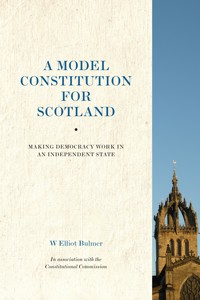
9,59 €
Mehr erfahren.
- Herausgeber: Luath Press
- Kategorie: Geisteswissenschaft
- Sprache: Englisch
A Model Constitution for Scotland sets out a workable model for Scotland's future and includes detailed constitutional proposals and informed discussion on the topic. The independence debate has to break out of political elites and address the 'after independence' question. Elliot Bulmer's book is an important contribution to this exploring how we make Scotland constitutionally literate, and how we shape our politics in a way which reflects who we are and what we aspire to be. Bulmer rightly argues that independence has to aspire to more than abolishing reserved powers, Holyrood becoming a mini-Westminster, and nothing else changing. A must read for independentistas, thoughtful unionists and democrats. Gerry Hassan, author and broadcaster. BACK COVER: Scotland is a free, sovereign and independent commonwealth. Its form of government is a parliamentary democracy based upon the sovereignty of the people, social justice, solidarity, and respect for human rights...The constitutional debate in Scotland has, until now, focused primarily on the relationship between Scotland and the rest of the United Kingdom. This treatise goes beyond the sterile arguments of nationalists and unionists to envision a new and more democratic political system constructed in an independent state. W. Elliot Bulmer A Model Constitution for Scotland sets out a workable model for Scotland's future and includes detailed constitutional proposals and informed discussion on the topic.
Das E-Book können Sie in Legimi-Apps oder einer beliebigen App lesen, die das folgende Format unterstützen:
Seitenzahl: 230
Veröffentlichungsjahr: 2013
Ähnliche



















W ELLIOT BULMER graduated with an MA(Hons) in Arabic and Politics from the University of Edinburgh in 2000, and then joined the Royal Navy as a Logistics Officer. He saw service at sea in ships and submarines and spent six months leading a special operations (PSYOPS) team in Iraq. On leaving the Navy in 2006 he embarked on post-graduate studies at the University of Glasgow, focusing on constitutional design, while teaching undergraduate courses in comparative politics, history of political thought and nationalism. In addition to his research, teaching and writing, he has since 2008 been involved in the Constitutional Commission, of which he is currently Research Director and Vice-President. He is married and lives in Dunblane, where he enjoys communing with nature, reading, real ale and learning the banjo.
Luath Press is an independently owned and managed book publishing company based in Scotland, and is not aligned to any political party or grouping.
A Model Constitution for Scotland:
Making Democracy Work in an Independent State
W ELLIOT BULMER
In association with the Constitutional Commission
LuathPress Limited
EDINBURGH
www.luath.co.uk
First published 2011
Reprinted 2012
eBook 2012
ISBN (print): 978-1-908373-1-37
ISBN (eBook): 978-1-909912-18-2
The author’s right to be identified as author of this book under the Copyright, Designs and Patents Act 1988 has been asserted.
© W Elliot Bulmer
Table of Contents
Author Biography
Title Page
Copyright Page
Acknowledgements
The Constitutional Commission
Research
Education
Promotion of Citizenship
Preface
Introduction
SECTION ONE – A Civic Approach to Democracy
SECTION TWO – What is a Constitution?
SECTION THREE – Consensus vs Majoritarian Democracy
SECTION FOUR – A Normal European Democracy
PART TWO – Explanatory Notes
Preliminaries
Head of State
Parliament
Council of Ministers
Judiciary
Local Government
Ombudsman, Auditor-General and Independent Commissions
Fundamental Rights and Freedoms
Miscellaneous Provisions
Adoption and Amendment of the Constitution
Final Considerations
End Notes
A Model Constitution for Scotland
Article I – Preliminaries
Article II – The Head of State
Article III – Parliament
Article IV – The Council of Ministers
Article V – Judiciary
Article VI – Local Government
Article VII – Ombudsman and Auditor-General
Article VIII – Independent Commissions
Article IX – Fundamental Rights and Freedoms
Article X – Miscellaneous Provisions
Article XI – Adoption and Amendment of the Constitution
Acknowledgements
I WISH TO THANK the following people, without whom this book would not have been written: my supervisors at the University of Glasgow, Dr Thomas Lundberg and Prof. Andrew Lockyer, for their advice and guidance; Ian McCann for permission to access the SNP archives; the staff of the National Library of Scotland and of the University of Glasgow Library for their patient assistance; John Drummond of the Constitutional Commission for his positive vision and radical optimism; my parents and family for their encouragement and support; and, above all, my loving wife Eva Dominguez, who has helped in ways far too numerous to mention.
The Constitutional Commission
THE CONSTITUTIONAL COMMISSION was founded in 2005 by John Drummond (former Convenor of the Independence Convention) and Kenyon Wright (former Convenor of the Scottish Constitutional Convention).
It is an independent, non-partisan charitable organisation dedicated to ‘the advancement of education, citizenship and community development through a better understanding of constitutional structures, processes and improvements’.
Research
At a time when independence, fiscal autonomy and other options are on the agenda in Scotland, the Constitutional Commission aims to understand the constitutional options available, to appreciate their nuances and their consequences, and to make recommendations which would improve the quality of our democratic life. We also seek to monitor institutional changes at the UK level from a Scottish perspective and to understand their effect on Scotland.
Education
Scotland lacks constitutional literacy. The constitutional debate in Scotland is often partisan, short-sighted and ill-informed – hardly ideal conditions for bringing about a lasting democratic solution. The Constitutional Commission seeks to bring together academics from several disciplines, politicians from all parties, civic organisations and members of the public from all walks of life, in order to increase constitutional literacy, to digest research, and to deliberate and reflect on constitutional options.
Promotion of Citizenship
The Constitutional Commission promotes democratic citizenship by highlighting the connection between a sound constitutional structure, effective democratic practices, and beneficial policy outcomes that serve the common good. We aim to promote understanding of the roles and responsibilities of citizens in a democratic Scotland.
www.constitutionalcommission.org
Preface
THE IDEA FOR THIS book emerged shortly after the elections of May 2007, which brought a minority SNP Government to office in Holyrood. Although welcoming the Scottish Government’s ‘National Conversation’ on Scotland’s future, and keen for independence to be put to the people, members of Constitutional Commission were uneasy at the prospect of an independence referendum being held without prior thought being given to the Constitution of an independent Scotland. It was felt that achieving independence without constitutional reform could potentially reverse the democratic advances made since devolution, such as proportional representation, the balance of power between executive and legislature, and protection of human rights. In the absence of a proper written Constitution, an independent Scottish Parliament would be in a position of supreme, unlimited authority; a lamentable situation, that could easily lead to the concentration of excessive power in the Scottish Government, to the weakening of parliamentary and extra-parliamentary accountability mechanisms, and to the erosion of our civil liberties and human rights.
In response to these concerns, the Constitutional Commission decided that the most constructive way to bring these issues to the attention of decision-makers, opinion-formers and a wider Scottish public, was to elaborate detailed constitutional proposals in the form of a Model Constitution for Scotland. Producing a Model Constitution would facilitate a systematic exploration of all questions arising out of the design of a Constitution, providing comprehensive (if not final) answers, and offer a workable blueprint around which democrats could unite.
In offering support to this project, the Constitutional Commission is not necessarily endorsing independence, but is affirming its commitment to civic democracy and constitutionalism in the event of independence. The opinions expressed in this book are those of the author alone; they do not necessarily represent the views of the Constitutional Commission, nor those of its trustees, members or supporters.
John Drummond
Convenor, Constitutional Commission
Introduction
THE CONSTITUTIONAL DEBATE in Scotland is focused almost exclusively on the ‘status question’ – the relationship between Scotland and the rest of the United Kingdom. The Scottish Government’s ‘National Conversation’ has framed the debate solely in terms of a sliding scale of Scottish autonomy, ranging from the devolved status quo, through implementation of all or part of the Calman Commission proposals and some sort of ‘Devolution Max’, to independence. Little thought has been given to constitutional form of that future Scottish State might take in the event of achieving such independence.
If the painful political history of the 20th century teaches us anything, aside from the superiority of liberal-democracy over all forms of closed and tyrannical society, it is that independence and freedom are not synonymous. Too many States have achieved independent Statehood only to become entangled again with the yoke of bondage; their struggles for national independence have often been followed by a period of instability and violence, culminating in ideological tyranny, personal dictatorship, military rule, or a narrow squabbling oligarchy. If Scotland is truly to flourish, we need much more than just independence: we need a robust liberal-democratic polity, with an open, representative, accountable and constitutional form of government. We need to establish a civic and democratic order in which the common good can be discerned and realised.
While the chances of a stable democracy taking root in Scotland are also contingent upon many cultural and socio-economic factors which are outside of our immediate control, the quality and longevity of a democracy can be greatly influenced by its constitutional structure. It could even be argued that a good Constitution – not just in the form of words on a page, but as a living reality – is of first-order importance to the peace, freedom and well-being of the nation. Stable liberal-democracy under a good Constitution is what separates the success stories of 20th century independence (Finland, Norway, Ireland, Iceland, Malta) from the failures (Zimbabwe, Pakistan, Burma).* Since this is the case, the absence of serious and informed debate on the future Constitution of an independent Scotland is a cause for concern.
* The reputation of Iceland has been damaged by the financial crisis of 2008– 2009. It is true that Iceland overstretched itself: the bubble burst, as all credit bubbles must do. However, the argument that these setbacks undermine the case for the independence of small nations cannot be accepted. Iceland, as long as she retains her democracy and independence, is well-placed to regain moderate prosperity in due course. If she is not, for the time being, part of the ‘Arc of Prosperity’, she remains a member of a more august and privileged club, the ‘Arc of Democracy’ – and democratic liberty is true wealth.
This absence of debate on Scotland’s constitutional future appears to be particularly puzzling when one considers the intellectual origins and the motivating ideas of the Scottish independence movement. The desire for Scottish independence has never been a narrowly nationalistic, ethnic, or separatist movement. Rather, it is a movement that, from the start, has advocated democratic renewal and constitutional government. What is called ‘nationalism’ or ‘separatism’ can perhaps better be understood as a campaign for democratic renewal and civic self-government.
The Scottish independence movement has been based on a tradition of the sovereignty of the people. This tradition sees sovereignty as inherently belonging to the ‘whole community of the realm’, in contrast to a key ‘Hanoverian’ concept of the British State – namely, the ‘sovereignty of Parliament’. The origins of this tradition can be traced to the Declaration of Arbroath of 1320, in which the king was explicitly bound by and to the whole people. It also found expression in the Reformed tradition, with its concern for ‘covenanted’ relationships based on mutual responsibility and the limitation of all power by law. This is, of course, an historical fiction; there never was a medieval Scottish Republic, and there has never been a democratic Scottish Constitution that fully embodies the principle of popular sovereignty. Yet, if sovereignty of the people was never an historical reality, it has nevertheless become an incontrovertible moral claim that has been used to critique the authority of Westminster.
The SNP’s commitment to liberal-democratic principles (and more specifically to a moderated, balanced form of democracy, characterized by power-sharing and genuine parliamentarism) was amply demonstrated by its development of a draft Constitution for an independent Scotland. When first published in 1977, the SNP’s draft Constitution, known as the MacCormick Constitution, in honour of its principal author, Professor Neil MacCormick, marked a radical break from the then-prevailing British constitutional orthodoxy. It featured a Parliament elected by proportional representation, designed to encourage coalition government and to bring an end to artificially reinforced single-party majority rule. The Parliament was to be elected for fixed four-year terms, so that the Prime Minister would no longer be able to call snap elections to suit his own party’s fortunes, nor cajole Parliament with the threat of arbitrary dissolution. In place of a hereditary or appointed second chamber, the Constitution proposed a novel ‘minority-veto referendum’ procedure, whereby two-fifths of the members of the Parliament would be able to suspend a bill, other than a money bill, for between 12 and 18 months. This delaying veto could, however, be overruled by a referendum. The monarchy was retained, but many prerogatives of the Crown were abolished or restricted. Instead of Westminster conventions regarding the appointment and removal of the Prime Minister, which could be problematic where no party has a clear majority, MacCormick’s draft recommended a formal electoral process, whereby the Prime Minister would be chosen by a parliamentary vote, and would hold office unless removed by a vote of no-confidence. It also recommended that control of war-making and treaty-making powers be vested in the Parliament of Scotland, rather than in the Crown. The judiciary was also to be reformed. The MacCormick draft provided for the Court of Session to be given the status and authority of a proper Supreme Court, including the power to review the validity of legislation under the Constitution, and judicial appointments were to be made on the advice of an independent commission, whose members would be in part elected by Parliament. The Constitution contained a Bill of Rights closely modeled on the European Convention, and the whole Constitution was presented in the form of a single, codified supreme law, which would be amendable only by a three-fifths majority vote of Parliament followed by a referendum.
Later versions of the SNP’s draft Constitution made a number of minor changes, adding an article on local government, and increasing the prominence of socio-economic rights, but the underlying principles of the SNP’s constitutional policy have remained unchanged for more than 30 years. These principles amount to a rejection of the Westminster model of politics in favour of a more ‘Scandinavian’ or ‘Continental’ alternative, which puts limits on the power of the Government and ensures greater accountability, representativeness, and protection for citizens’ rights. In place of Westminster’s disproportional single-party majorities, the SNP has always insisted that Scotland should have an inclusive Parliament elected by proportional representation. Instead of replicating in Scotland Westminster’s autocratic Prime Minister and ineffective Parliament, the SNP has long demanded a more equitable balance of power between Government and Parliament in an independent Scotland – curtailing the Prime Minister’s prerogatives and increasing the legislative and scrutinising role of Parliament. Likewise, in place of parliamentary sovereignty, the SNP has always demanded an entrenched Constitution to protect the rights of citizens and to clarify the ground-rules of political life.
In 2002, an SNP policy paper accompanying the most recent version of MacCormick’s draft Constitution stated the party’s commitment to these reformist principles in unequivocal terms:
In line with practically every other country in the world, an independent Scotland will have a written constitution. A written constitution is necessary to protect the rights of every Scottish citizen and to place restrictions on what politicians can and can’t do. A written constitution for a free Scotland provides us with an opportunity to enshrine fundamental human rights in Scotland’s basic law and ensure a government truly accountable to the people of Scotland.1
Neil MacCormick described these ideas as the ‘common stock of democratic thought in Scotland today’2– the foundation on which the Scottish State must be built.
However, the Scottish Government’s White Paper, ‘Your Scotland, Your Voice’ (2009), while putting forward a strongly convincing case for independence, made only indirect, lukewarm commitments to democratic constitutionalism. According to the White Paper, Scotland could gain independence with only a few incidental changes to our current political institutions. All that would be required is the repeal or amendment, by the Westminster Parliament, of the offending parts of the Scotland Act and the Act of Union: abolishing the concept of ‘reserved matters’, prohibiting appeals to the British courts, and, in short, giving the Scottish Parliament sovereignty over all aspects of policy (subject, as applicable, to EU law and to the European Convention on Human Rights). There would, of course, be many incidental matters to be settled as part of the transfer of sovereignty, from the apportionment of national debts, through the status and pensions of UK civil servants in Scotland, to the division of military assets, but none of these would affect Scotland’s form of government.
If that were the end of the matter, it would be wholly unacceptable. Independence under such conditions would merely replace the sovereignty of Westminster with that of Holyrood. No sincere democrat, who believes in the sovereignty of the people, recognises the importance of democratic accountability, and acknowledges the need to protect human rights from the expediency of those in power, could, in good conscience, accept such an outcome. A plenary transfer of power to a sovereign Scottish Parliament would only perpetuate the worst failings of the Westminster system, and do little or nothing to establish a just democratic order based on concern for the common good. This would not only squander a rare and valuable opportunity for reform, but would also betray the democratic values which, as noted above, have for decades been central to Scotland’s grievance against the UK.
Fortunately, however, that is not the end of the matter. The SNP has not changed its policy; it maintains its long-standing commitment to liberal-democratic constitutionalism and remains pledged to the adoption of a written Constitution based on the draft prepared by Neil MacCormick. Full assurances to this effect have been given by Scottish Ministers3. The White Paper, although framed in the cautious and less emphatic terms of a Government, rather than a party, document, even hints in this direction:
An independent Scotland could consider further progress, for example... ...formulating and agreeing a fully codified and written constitution. These issues would be decided within Scotland, either by the Scottish Parliament, or, as at the moment for major constitutional change, through a referendum.4
So a Constitution for Scotland is still very much on the agenda, but the detailed elaboration of the new Constitution appears to have been postponed until after independence. In some ways, this postponement is quite understandable. It reflects, in part, a desire to focus on what is seen as the central question – that of independence – without the distraction of other, post-independence, constitutional issues. In other ways, however, it could indicate a worrying lack of constitutional concern and awareness amongst senior civil servants, parliamentarians and other policy-makers – an inability to appreciate the fundamental difference between a ‘sovereign Scottish Parliament’ and a ‘sovereign Scottish people’, a misplaced belief that the mechanics of constitutional design are irrelevant to the health of a democratic society, or a cavalier expectation that the ‘fiddly details’ of constitution-making can be left to the discretion of constitutional lawyers.
Postponing the design of a Constitution until after independence is a risky and unsatisfactory course of action. A newly-independent Scottish State will suddenly have to deal with a range of immediate and practical problems, ranging from the establishment of embassies and the organisation of the armed forces to the issuing of postage stamps. Good constitutional design, so essential to the health of our polity, is likely to be forgotten in the rush.
Moreover, after three centuries of rule from Westminster, Scotland is ill-prepared for the delicate task of designing a new Constitution. We are a constitutionally illiterate country. We lack any direct experience of life under a Constitution, so we struggle to imagine how a constitutional government might operate in this country. We do not, generally speaking, even possess a basic constitutional lexicon – the framework of words and concepts with which to engage in the detailed discussion of constitutional questions. Most of us (and not just ordinary members of the public, but also many lawyers, politicians, civil servants, journalists and academics) have never seen or read a Constitution. Perhaps this is part of the reason why so few can see over the horizon of independence to consider what sort of Constitution Scotland will need thereafter. While not lacking in common sense or goodwill, we simply lack the knowledge to make good judgements on matters of constitutional design. That lack of knowledge breeds uncertainty, fear and avoidance of the issue. Even many of those who, in principle, support the idea of a Constitution are unsure about what a Constitution should contain, or else see it as a question of administrative detail, to be worked out by lawyers and civil servants, rather than as the fundamental political self-expression of a free, civic community.
This failure to ‘grasp the thistle’ of constitutional design, ahead of any referendum on independence, would enable the opponents of independence to claim (with some justification) that independence would be hazardous, as it would hand over indeterminate power to the Scottish Government without any thought of the consequences. It is too easy for the unionists to say that the implications of independence have not been properly thought through – that the people of Scotland are better off as they are, and that the campaign for independence is motivated only by the ego of ‘narrow-minded separatists’, rather than by a genuine hope for a better political system.
Furthermore, postponement increases the danger of ending up with a poor quality Constitution. The Constitution of a State must be well-designed from the outset. If this is not done, the parties and other vested interests will inevitably choke necessary reform; old abuses will continue, new ones will arise. Such an ill-set Constitution will give pain and discomfort for years to come. This being the case, the Government’s failure to publish a Constitution for Scotland before the independence vote should be a matter of some concern to all supporters of Scotland’s freedom.
The time to think about the future Constitution of an independent Scotland, and to build a broad political and public consensus around an agreed constitutional text, is now, before a referendum on independence is held. This ought to be a matter of priority for the Scottish Government, for the SNP, and for all who support independence. It ought also to be given due consideration by those who would rather not see an independent Scotland, but who, if it happens, want to make it work. An effort should therefore be made to reach out to forward-looking and moderate unionists, who might not necessarily desire independence, but are willing to accept it and to work with it if it happens.
The purpose of this book, then, is not to offer arguments for Scottish independence, but to examine the best form of Constitution for Scotland in the event of independence. In dealing with this question, the book adopts an uncompromisingly and unapologetically normative tone; it is concerned not only with the mechanics of a technically sound constitutional design (although that is crucial), but also with the moral and political principles that make a Constitution ‘good’ rather than ‘bad’. Liberal-democracy is presented not just as a procedural framework of decision-making, but also as a humane ethos and civic culture that governs how public decisions ought to be made. The aim is to ensure that an independent Scotland is also a free, flourishing and fair Scotland – a Scotland that enjoys stable civic-democratic politics, that empowers the people while protecting the rights of each person, and that promotes justice, peace, moderate prosperity and the common good.
These democratic ethical principles are rooted in the Scottish civic tradition, and are likely to be welcomed by a broad spectrum of Scottish opinion, transcending the divisions of class, geography, region and party politics. But principles only go so far. We may talk about the importance of representativeness, the rule of law, or accountability, but such talk is empty unless we can create the constitutional institutions through which these principles can be translated into political, social and legal practice. For example, if we agree on the desirability of democratic accountability, we must turn our attention to such dull details has how parliamentary committees are to be formed, how the auditors to inspect public finances are to be appointed, and what powers the ombudsman and public enquires ought to have. Likewise, if we agree on the need for participatory politics and a stronger civic spirit, we must study those constitutional devices that enable and encourage greater participation, such as referendums and the devolution of power to our cities.
The Model Constitution presented in this book is intended to give the principles of civic-democracy some precise institutional shape. It is a diligent attempt to apply the ‘best practices’ of constitutionalism and of parliamentary democracy to the current circumstances of Scotland and to practical realities of Scottish statehood. It is a ‘Model’ Constitution in the sense of being an example: it shows the people of Scotland what a good Constitution for Scotland might look like. It is also a model in the sense of being comprehensive ‘working model’, complete in every detail, which if desired could be adopted as it stands without requiring any further legal draftsmanship. It shows, therefore, that a good Constitution is not only possible, but also, given a basic understanding of the subject, quite easy to achieve. The term ‘Model’ does not, however, imply any pretence to perfection. The author does not claim the final word on this subject, but merely hopes to excite public interest and spark a more constructive constitutional debate, from which further improvements may well result.
Those who design a Constitution for a new State must make choices on several levels. First come the macro-choices, the ‘choices of principle’ which determine the purposes of the Constitution. Only then can we consider which meso-choices (‘choices of structure’) and micro-choices (‘choices of detail’) are best suited to achieve those purposes in a given time and place.5The first part of this book therefore discusses the principles and basic structures of a Constitution for Scotland. The second part deals with the detailed provisions of the Constitution, including the composition, organisation and terms of office of Parliament, the electoral system, the formation and removal of the Government, the judiciary, the ombudsman, local government, the role and functions of the Head of State, the rights of the people, and the means of holding the Government to account. Throughout, a constant theme of the book is that the best case for independence rests not on appeals to nationalism, but on a commitment to a vision of Scotland based on the universal ethical principles of democracy.
PART ONE – Introductory Notes
SECTION ONE – A Civic Approach to Democracy
BEFORE COMMENCING THE design of a Model Constitution for Scotland, we must address the essential question: ‘What sort of country should an independent Scotland be?’ This question leads us to consider the basic assumptions, aims, values and principles of the political, legal and socio-economic regime. Is Scotland to be an authoritarian one-party State? A feudal monarchy? A military dictatorship? A Soviet Republic? A Calvinist theocracy? An oligarchy of international bankers and corporate interests? Or is it to be a constitutional and civic liberal-democracy?
It is quite tempting to reject all but the last of these regime-types out of hand, and thus to assume that the nature and the advantages of liberal-democracy are self-evident. After all, we claim to live in a liberal-democracy (albeit an imperfect one), and support for liberal-democracy unites almost all parties and interests in Scotland. Scottish politics has long been inspired by liberal-democratic motives, and public demand for constitutional change in Scotland, from the Chartist movement to the Claim of Right of 1989 and the setting up of the Scottish Parliament, has consistently been in the direction of more liberal-democracy, not less.
Yet the moral case for liberal-democracy still needs to be made. Popular acceptance is of course necessary, but it alone cannot make an unjust regime just. When distinguishing between good forms of government and bad or corrupt forms, it is necessary to consider the nature, purpose and effect of the regime, and not merely its popular acceptance. We need to understand why liberal-democracy is a good thing, and why an elected dictatorship, even if endorsed by a large majority, cannot be regarded as a legitimate or just form of government.




