


64,99 €
Mehr erfahren.
- Herausgeber: John Wiley & Sons
- Kategorie: Geisteswissenschaft
- Sprache: Englisch
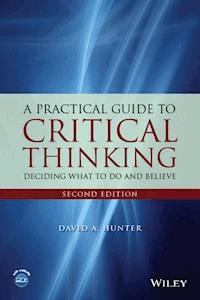
A thoroughly updated introduction to the concepts, methods, and standards of critical thinking, A Practical Guide to Critical Thinking: Deciding What to Do and Believe, Second Edition is a unique presentation of the formal strategies used when thinking through reasons and arguments in many areas of expertise. Pursuing an interdisciplinary approach to critical thinking, the book offers a broad conception of critical thinking and explores the practical relevance to conducting research across fields such as, business, education, and the biological sciences. Applying rigor when necessary, the Second Edition maintains an informal approach to the fundamental core concepts of critical thinking. With practical strategies for defining, analyzing, and evaluating reasons and arguments, the book illustrates how the concept of an argument extends beyond philosophical roots into experimentation, testing, measurement, and policy development and assessment. Featuring plenty of updated exercises for a wide range of subject areas, A Practical Guide to Critical Thinking Deciding What to Do and Believe, Second Edition also includes: * Numerous real-world examples from many fields of research, which reflect the applicability of critical thinking in everyday life * New topical coverage, including the nature of reasons, assertion and supposing, narrow and broad definitions, circumstantial reasons, and reasoning about causal claims * Selected answers to various exercises to provide readers with instantaneous feedback to support and extend the lessons A Practical Guide to Critical Thinking Deciding What to Do and Believe, Second Edition is an excellent textbook for courses on critical thinking and logic at the undergraduate and graduate levels as well as an appropriate reference for anyone with a general interest in critical thinking skills.
Sie lesen das E-Book in den Legimi-Apps auf:
Seitenzahl: 544
Veröffentlichungsjahr: 2014
Ähnliche




















A PRACTICAL GUIDE TO CRITICAL THINKING
Deciding What to Do and Believe
Second Edition
DAVID A. HUNTER
Department of Philosophy Ryerson University Toronto, ON, Canada
Copyright © 2014 by John Wiley & Sons, Inc. All rights reserved.
Published by John Wiley & Sons, Inc., Hoboken, New Jersey. Published simultaneously in Canada.
No part of this publication may be reproduced, stored in a retrieval system, or transmitted in any form or by any means, electronic, mechanical, photocopying, recording, scanning, or otherwise, except as permitted under Section 107 or 108 of the 1976 United States Copyright Act, without either the prior written permission of the Publisher, or authorization through payment of the appropriate per-copy fee to the Copyright Clearance Center, Inc., 222 Rosewood Drive, Danvers, MA 01923, (978) 750-8400, fax (978) 750-4470, or on the web at www.copyright.com. Requests to the Publisher for permission should be addressed to the Permissions Department, John Wiley & Sons, Inc., 111 River Street, Hoboken, NJ 07030, (201) 748-6011, fax (201) 748-6008, or online at http://www.wiley.com/go/permission.
Limit of Liability/Disclaimer of Warranty: While the publisher and author have used their best efforts in preparing this book, they make no representations or warranties with respect to the accuracy or completeness of the contents of this book and specifically disclaim any implied warranties of merchantability or fitness for a particular purpose. No warranty may be created or extended by sales representatives or written sales materials. The advice and strategies contained herein may not be suitable for your situation. You should consult with a professional where appropriate. Neither the publisher nor author shall be liable for any loss of profit or any other commercial damages, including but not limited to special, incidental, consequential, or other damages.
For general information on our other products and services or for technical support, please contact our Customer Care Department within the United States at (800) 762-2974, outside the United States at (317) 572-3993 or fax (317) 572-4002.
Wiley also publishes its books in a variety of electronic formats. Some content that appears in print may not be available in electronic formats. For more information about Wiley products, visit our web site at www.wiley.com.
Library of Congress Cataloging-in-Publication Data:
Hunter, David A., 1965– author. A practical guide to critical thinking : deciding what to do and believe / David A. Hunter, Department of Philosophy, Ryerson University. – Second edition. pages cm Includes bibliographical references and index. ISBN 978-1-118-58308-1 (cloth) 1. Critical thinking. I. Title. BF441.H86 2014 121–dc23
2014012671
For Jane, my beloved and my friend.
CONTENTS
Preface
Preface to First Edition
Note to Instructors
1 The Nature and Value of Critical Thinking
1.1 The Nature of Critical Thinking
1.2 Critical Thinking and Knowledge
1.3 Knowledge and Truth
1.4 Knowledge and Belief
1.5 Knowledge and Justification
1.6 Good Reasons are Sufficient and Acceptable
1.7 When Evidence Conflicts
1.8 Critical Thinking and Personal Autonomy
1.9 Critical Thinking in Practice
2 Clarifying Meaning
2.1 The Place Of Definitions In Critical Thinking
2.2 Assertion
2.3 The Assertion Test
2.4 Constructing And Evaluating Definitions
2.5 Give A Slogan
2.6 Expand On The Slogan
2.7 Give Examples
2.8 Identify Contrasting Ideas
2.9 Thinking Critically About Frameworks
2.10 Clarifying Beliefs And Problems
2.11 Technical Definitions
2.12 Meaning In Advertisements
2.13 Critical Thinking In Practice
Notes
3 Sufficient Reasons
3.1 Critical Thinking and Arguments
3.2 IDentifying Premises and Conclusions
3.3 Dependent and Independent Premises
3.4 SUB-Arguments
3.5 Evaluating Logical Support
3.6 Missing Premises
3.7 Piling on Independent Premises
3.8 Critical Thinking in Practice
4 Acceptable Reasons
4.1 Reliable Sources
4.2 Undermining and Overriding Evidence
4.3 Observation
4.4 Memory
4.5 Testimony
4.6 Advertising
4.7 News Reports
4.8 Measurement
4.9 Surveys
4.10 Critical Thinking in Practice
Notes
5 Reasoning About Alternatives and Necessary and Sufficient Conditions
5.1 Reasoning About Alternatives
5.2 The Meaning of Disjunctions
5.3 Reasoning by Denying a Disjunct
5.4 False Disjunctions
5.5 When are Disjunctions Acceptable?
5.6 Exclusive Disjunctions
5.7 How to Criticize Reasoning About Alternatives
5.8 Reasoning About Necessary and Sufficient Conditions
5.9 The Meaning of Conditionals
5.10 Valid Reasoning About Necessary and Sufficient Conditions
5.11 Invalid Forms of Reasoning About Necessary and Sufficient Conditions
5.12 Making Necessary and Sufficient Conditions Explicit
5.13 When are Claims About Necessary and Sufficient Conditions Acceptable?
5.14 Reasoning with Definitions and Standards
5.15 Necessary and Sufficient Causal Conditions
5.16 Reasoning with Causal Claims
5.17 Discovering Causal Conditions
5.18 Critical Thinking in Practice
6 Reasoning by Analogy
6.1 REASONING BY PERFECT ANALOGY
6.2 IS REASONING BY PERFECT ANALOGY VALID?
6.3 WHEN IS AN ANALOGICAL CLAIM TRUE OR ACCEPTABLE?
6.4 REASONING USING REPRESENTATIONAL ANALOGY
6.5 REASONING WITH SAMPLES
6.6 WHEN ARE SAMPLES REPRESENTATIVE?
6.7 REASONING WITH MODELS AND MAPS
7 Critical Thinking in Action
7.1 Thinking Critically About a Discipline
7.2 Identifying a Discipline's Sources of Evidence
7.3 Identifying a Discipline's Forms of Reasoning
7.4 Critical-Thinking Questions
7.5 Thinking Critically in Your Own Decision Making
7.6 Thinking Critically in Discussion
7.7 From Theory to Practice: Applying What We Have Learned
Appendix A Critical Thinking Mistakes
Appendix B Critical Thinking Strategies
B.1 General Purpose Critical Thinking Strategies
B.2 Strategies for Being Reflective About Meaning
B.3 Strategies for Analyzing Reasons and Arguments
Index
End User License Agreement
Guide
Cover
Table of Contents
Preface
Pages
xiii
xv
xvi
xvii
xviii
1
2
3
4
5
6
7
8
9
10
11
12
13
14
15
16
17
18
19
20
21
22
23
24
25
26
27
28
29
30
31
32
33
34
35
36
37
38
39
40
41
42
43
44
45
46
47
48
49
50
51
52
53
54
55
56
57
58
59
60
61
62
63
64
65
66
67
68
69
70
71
72
73
74
75
76
77
78
79
80
81
82
83
84
85
86
87
88
89
90
91
92
93
94
95
97
98
99
100
101
102
103
104
105
106
107
108
109
110
111
112
113
114
115
116
117
118
119
120
121
122
123
124
125
126
127
128
129
131
132
133
134
135
136
137
138
139
140
141
141
142
143
144
145
146
147
148
149
150
151
152
153
154
155
156
157
158
159
160
161
162
163
164
165
166
167
168
169
170
171
172
173
174
175
176
177
178
179
180
181
182
183
184
185
186
187
188
189
190
191
192
193
194
195
196
197
199
200
201
202
203
204
205
206
207
208
209
210
211
212
213
214
215
216
217
219
220
221
222
223
225
226
227
228
229
230
PREFACE
In preparing this Second Edition, I have benefited from many people's advice. First, I would like to thank all of the students at Ryerson University who have taken my critical thinking courses, and all of the graduate students who have worked for me as a TA. I have learned a lot from you all about how to organize, simplify, and present this material. I have also benefited from detailed and constructive comments on every chapter from my colleague, Klaas Kraay.
PREFACE TO FIRST EDITION
This book has been a long time in the making, and has benefited from the influence of a huge number of colleagues, friends, and family. Here is an inevitably incomplete accounting of some of these debts.
I first began to think systematically about the nature, value, and pedagogy of critical thinking as an assistant professor of philosophy at Buffalo State College and it would be difficult to overstate the influence of my colleague George Hole on my thinking. He is one of the most gifted philosophy teachers I have ever known and I learned a good deal from him on how to teach philosophy. But even more than this, I am indebted to him for the way he so easily mixes philosophy, wit, and good humor in equal parts. I learned more from him than from anyone about how to teach critical thinking, and about the central role it ought to play in education and in a full life. I also owe a great deal to Gerry Nosich, whose work on critical thinking is without equal. Gerry joined us at Buffalo State College as we were designing and implementing a required first-year critical thinking course, and his gentle and wise advice proved invaluable. While with SUNY, I worked on a statewide committee to design a rubric for the assessment of critical thinking. I learned a lot in this time about the importance of teaching critical thinking across the curriculum, and I am especially indebted to Shir Filler.
Since beginning the writing of this book, I have learned a good deal from my new colleagues at Ryerson University, where the philosophy department teaches several sections of a critical thinking course that is required by students in several programs. I owe special debts to Andrew Hunter, Klaas Kraay, David Ciavatta, Jim Dianda, and Paul Raymont.
I am indebted to Steve Quigley, my editor at Wiley, for gently persuading me to write the book; to Jackie Palmieri, an editorial assistant at Wiley, for gently persuading me to complete it on time; and to several anonymous referees who provided useful feedback on my initial proposal.
I am enormously indebted to my family. I learned as much about how to think critically from my parents as from anyone. They showed me that critical thinking begins at home, and that is a lesson that Miranda and Emily, my wonderful daughters, now champion with exhausting ingenuity.
My greatest and deepest debts, however, are to Jane, whose love and support have never been conditional on sufficient and acceptable reasons or on anything else.
NOTE TO INSTRUCTORS
Teaching students to think critically is more about imparting a set of skills and habits than about teaching bits of theory. In developing this textbook, I tried to incorporate several features that I thought would make teaching critical thinking both easier and more effective.
Most significantly, I steered clear of any formal notation aside from the very simplest. It is not that I doubt the value of learning formal logic. In fact, I think that many students thrive while studying it. But in my experience there is so much that most students need to learn before they can see the value of mastering a formal system, and so much more benefit they can derive from a non-formal approach to critical thinking. Instead, I tried to think of this text as like an introduction to practical or applied epistemology: offering systematic advice, and lots of practice, on the best way to go about deciding what to believe and what to do.
It is worth noting here that I treat what is sometimes called enumerative induction as a form of reasoning by analogy. It seems to me that using samples to draw a conclusion about an entire group or population just is reasoning by analogy, and that it can be usefully taught as such. I also say, and this perhaps is more controversial, that reasoning by analogy can be valid. Of course, I do not mean that it is formally valid in the way that modus ponens is formally valid. Reasoning is valid when it is not possible for the premises to be true and the conclusion to be false. The fact that some reasoning can be known to be valid just from its form alone is, of course, important, and I discuss some of these forms in chapters 5 and 6. But it is important to keep in mind that not all valid arguments are formally valid, (e.g., The table is blue, therefore it is colored), and not all arguments that are formally invalid are really invalid (e.g., If Jones is a male, then he is a bachelor; Jones is a bachelor; so, Jones is a male.) Judgment is always needed, it seems to me, in assessing the strength of a piece of reasoning, and this judgment is better taught by focusing on the idea of validity itself. I also think that what I say in Chapter 6 makes a reasonable and pedagogically responsible case for my view that reasoning by analogy can be valid.
I had originally planned to dedicate a chapter to thinking critically about what to do. But I worried that much of it would simply repeat points that had been made earlier and, in so doing, would make deciding what to do seem like a lesser cousin to deciding what to believe. As I worked (and then re-worked) the first 6 chapters, it seemed to me that I could elegantly discuss deciding what to do as we went along, when the topic at hand seemed relevant. I have thus included several “boxes” discussing various aspects of deciding what to do.
The book includes several other kinds of boxes as well. Some identify important mistakes that a good critical thinker ought to avoid. Some provide summaries of the discussion in the body of the text. Some offer examples of critical thinking across the curriculum. Some offer practical tips and rules of thumb. All are intended to make the text more readable and the concepts and skills more accessible.
I also decided that rather than dedicate a chapter to informal fallacies, I would discuss them in what struck me as their proper context. It seems to me that there is no easy way to organize the different kinds of mistakes into a small number of categories without distorting their differences or exaggerating their similarities. Some of the mistakes have to do with clarifying meaning; others with ascribing views to others; some with assessing evidence; others with assessing validity. Several mistakes can occur at several otherwise quite distinct stages in deciding what to do or to believe. Rather than try to force the various mistakes into artificial categories, it seemed to me better to discuss them as we went along. For easy reference, though, I have collected them all in an appendix at the end of the book.
Careful training and repeated practice are crucial to learning any skill, and critical thinking is no exception. I have tried to include a large and varied collection of exercises. But I strongly encourage you to bring your own exercises to class and to encourage your students to seek out arguments and reasoning to share during the class time. In my experience, students learn far more when they are required during class time to participate in the construction, analysis, and assessment of examples of reasoning about what to do or believe. I have included, at the end of most of the chapters, exercises that are specially designed to help students transfer the concepts and skills they are learning to other corners of their lives. My thought is simply that there is little point in teaching someone to think critically if they see no place for it at home, in their own discipline, or at work. Over the years I have experimented with all of these exercises, making adjustments as I went along. The exercises are in a form that I find to be both effective and not overly intrusive. But I encourage you to adjust, alter, add, subtract, and modify as you see fit. The important thing is to find ways to help students see that they are learning skills and concepts that have application and value after the final exam.
1THE NATURE AND VALUE OF CRITICAL THINKING
This book is a practical guide to critical thinking. It might seem unnecessary to be reading a guide to something you do all the time and are probably already pretty good at. When I tell people that I am writing a book on critical thinking they sometimes tell me that they consider themselves to be very good critical thinkers. At the very least, they say that they consider critical thinking to be very important. I am sure that they are right on both counts. We think critically a good bit of the time, and on the whole we do it pretty well. Still, I think there is always something to learn from thinking hard about what one is already good at.
In this chapter, we will explore the nature and value of critical thinking. We will ask what critical thinking is and how it differs from other kinds of thinking. We will explore what it means to think critically; what makes that kind of thinking critical. As part of this, we will consider whether critical thinking varies from one discipline to the next. Is critical thinking in geology different from critical thinking in design or in humanities? We will see that while the concepts, methods, and standards may differ from one discipline to the next, there is a basic essence or core of critical thinking that remains the same across all disciplines. Whether one is doing chemistry, design, astrology, or philosophy, there are common standards that you should strive to maintain, and practical strategies to help you make sure that you do. This book is designed to introduce you to this essential core of critical thinking while at the same time providing you with the tools you need to identify the concepts, methods, and standards distinctive of different disciplines.
Lesen Sie weiter in der vollständigen Ausgabe!
Lesen Sie weiter in der vollständigen Ausgabe!
Lesen Sie weiter in der vollständigen Ausgabe!
Lesen Sie weiter in der vollständigen Ausgabe!
Lesen Sie weiter in der vollständigen Ausgabe!
Lesen Sie weiter in der vollständigen Ausgabe!
Lesen Sie weiter in der vollständigen Ausgabe!
Lesen Sie weiter in der vollständigen Ausgabe!
Lesen Sie weiter in der vollständigen Ausgabe!
Lesen Sie weiter in der vollständigen Ausgabe!




