


66,99 €
Mehr erfahren.
- Herausgeber: John Wiley & Sons
- Kategorie: Fachliteratur
- Sprache: Englisch
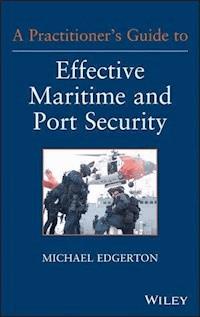
Sets forth practices to ensure security and foster international trade Written with an international perspective, this book analyzes the complex set of factors affecting the security of port and maritime operations, including shipping, politics, economics, crime, and terrorism. Author Michael Edgerton critiques current approaches to maritime and port security based on his more than twenty-five years of experience in the field. He not only points out vulnerabilities in today's practices, but also provides a set of proven and tested recommendations that recognize the role and interests of both government and the private sector in enhancing security while ensuring the flow of international trade. Readers may be surprised to learn that, with greater efficiency, they can actually improve security while reducing the cost of security at the same time. Using real-world case studies to support its analyses and recommendations, A Practitioner's Guide to Effective Maritime and Port Security: * Reviews the core components of the international maritime operating environment * Assesses the potential threats to ports in the maritime environment * Examines approaches to maritime port security in the United States, European Union, and around the world * Presents principles for effective, risk-based maritime and port security At the end of the book, two appendices provide a framework for conducting security risk assessments and threat assessments. There's also a third appendix to help organizations assess their "risk appetite." Recommended for students and professionals responsible for the safety and security of ports and maritime trade, this book reframes port and maritime security as a key component of a multidisciplinary system in which secure and efficient trade is the objective.
Sie lesen das E-Book in den Legimi-Apps auf:
Seitenzahl: 282
Veröffentlichungsjahr: 2013
Ähnliche



















Contents
Cover
Half Title page
Title page
Copyright page
Dedication
Introduction
Acknowledgments
Foreword
Part One: The International Maritime Operating Environment
Chapter 1: Unique Characteristics of Ports and International Shipping
Introduction
The Multinational Nature of Shipping and Business Drivers in Port Operations
Flag States
Port States
References
Chapter 2: The Criticality of Ports: Why and How They Matter
Introduction
Geopolitical Considerations
Ports
References
Part Two: Threats to Ports and the Maritime Domain
Chapter 3: Threats
Introduction
Threats by States
References
Part Three: Current Approaches to Maritime and Port Security
Chapter 4: Approaches to Security Policy Development
Introduction
Political Considerations
Measuring the Effectiveness of Security Measures
Lack of a Risk Approach
References
Chapter 5: A Critique of Current Maritime Security Measures and Approaches
Introduction
References
Part Four: Principles for Effective Maritime and Port Security
Chapter 6: Security as an Enabler
Introduction
References
Chapter 7: Standards and Regulations
Introduction
Review of the ISPS Code
ISPS Code 2.0
Reference
Chapter 8: Assessing and Managing Risk
Introduction
References
Chapter 9: Measuring Effectiveness
Introduction
Chapter 10: Conclusion
Appendices
Appendix A: Conducting Security Risk Assessments
Introduction
Risk Assessment Steps
Conducting Risk Assessments
Appendix B: Conducting Threat Assessments
Introduction
Consistency with ISO 31000
Appendix C: Tips for Assessing Risk Appetite
Introduction
Defining Risk Appetite
Index
A PRACTITIONER’S GUIDE TOEffective Maritime and Port Security
Copyright © 2013 by John Wiley & Sons, Inc. All rights reserved
Published by John Wiley & Sons, Inc., Hoboken, New Jersey
Published simultaneously in Canada
No part of this publication may be reproduced, stored in a retrieval system, or transmitted in any form or by any means, electronic, mechanical, photocopying, recording, scanning, or otherwise, except as permitted under Section 107 or 108 of the 1976 United States Copyright Act, without either the prior written permission of the Publisher, or authorization through payment of the appropriate per-copy fee to the Copyright Clearance Center, Inc., 222 Rosewood Drive, Danvers, MA 01923, (978) 750-8400, fax (978) 750-4470, or on the web at www.copyright.com. Requests to the Publisher for permission should be addressed to the Permissions Department, John Wiley & Sons, Inc., 111 River Street, Hoboken, NJ 07030, (201) 748-6011, fax (201) 748-6008, or online at http://www.wiley.com/go/permission.
Limit of Liability/Disclaimer of Warranty: While the publisher and author have used their best efforts in preparing this book, they make no representations or warranties with respect to the accuracy or completeness of the contents of this book and specifically disclaim any implied warranties of merchantability or fitness for a particular purpose. No warranty may be created or extended by sales representatives or written sales materials. The advice and strategies contained herein may not be suitable for your situation. You should consult with a professional where appropriate. Neither the publisher nor author shall be liable for any loss of profit or any other commercial damages, including but not limited to special, incidental, consequential, or other damages.
For general information on our other products and services or for technical support, please contact our Customer Care Department within the United States at (800) 762-2974, outside the United States at (317) 572-3993 or fax (317) 572-4002.
Wiley also publishes its books in a variety of electronic formats. Some content that appears in print may not be available in electronic formats. For more information about Wiley products, visit our web site at www.wiley.com.
Library of Congress Cataloging-in-Publication Data:
Edgerton, Michael, 1961– A practitioner’s guide to effective maritime and port security / Michael Edgerton. pages cm Includes index. ISBN: 978-1-118-09991-9 (cloth) 1. Harbors—Security measures. 2. Shipping—Security measures. 3. Maritime terrorism—Prevention. 4. Harbors—United States—Security measures. 5. Shipping—United States—Security measures. 6. Maritime terrorism—United States—Prevention. I. Title. VK203.E34 2013 363.28’9—dc 23
2012048236
To my family with love
Introduction
This book is designed for practitioners as well as students of maritime security, maritime transportation, and international business. The book provides an overview and analysis of the current factors that affect the security of the maritime operating domain, where shipping, international politics, economics, crime, and terrorism intersect in ways that have far-reaching global impacts. The book also provides a critique of the current approaches to maritime and port security that have been implemented by nations, the private sector, and the international community. The critique is an overview of the current state of maritime and port security as well as an assessment of potential challenges or weaknesses. This book provides actionable recommendations to enhance security while facilitating trade and improving the resilience of companies and governments.
In policy discussions, most of the current critiques of homeland-security measures and programs focus on national-level policy and do not differentiate between modes of transportation or infrastructure domains. This book is specifically focused on the maritime-security environment and proposes measures and approaches that will make international trade and maritime transportation more secure while enhancing efficiencies that can reduce the cost of security for ship operators, customers, and governments.
As part of this approach, the book assesses the business case for security and provides recommendations that are consistent with a focus on efficient, yet effective, security measures. The book is written for the private sector or government practitioner, as well as academic and government policy makers. Because of the inherently international nature of maritime commerce, this book takes an international approach to possible maritime and port security solutions without bias toward or against any approach advocated by a particular nation or organization.
The book is divided into four major sections. The first is the context, which provides an overview of the basic components of the international maritime operating environment. These components include the multinational nature of shipping and multinational drivers in port operations, the criticality of ports from several perspectives, including geopolitics, ports as potential targets, and ports as potential conduits for illicit activity. The contextual section will also cover the issue of port connectivity to other modes of transportation and the intermodal nature and linkages of port and maritime security.
The next section assesses threats to ports in the maritime environment. These threats can take several forms, including state-sponsored threats, conventional state military threats, terrorism, criminal actions, embargo violations, and corruption and lack of transparency. Understanding threats is essential to being able to implement effective maritime security measures.
The third section of the book provides a critique of the current approaches to maritime port security. This critique will look at the United States, the European Union, and other international measures and approaches. Specifically, this section will identify the prism through which authorities make port security policy and some of the factors that affect policy-making and the establishment of current programs and their strengths and weaknesses.
The fourth and final section of the book lays out suggested principles for effective, truly risk-based maritime and port security. These principles focus on the need for security to be more than an objective but in addition a key enabler for legitimate maritime trade. The book reframes port and maritime security as a key component of a multidisciplinary system in which secure, resilient, and efficient trade is the objective.
ACKNOWLEDGMENTS
This book was made possible only through the excellent editorial guidance and assistance of Virginia Howe and the late Dodge Woodson as well as the outstanding graphics support of Ben Spear. I am indebted to my employer, Good Harbour International, for supporting my efforts. I also need to acknowledge those with whom I served in September 2011, especially Joe Coccia, Mike Ferullo, and Paul Kohl. While they may not agree with everything in this book, we struggled to implement security measures on the fly with little or no guidance. As a result, they taught me some of the key lessons found in the book. This book wouldn’t be possible without the support of my colleagues in government and the private sector with whom I’ve been privileged to work, all of whom have in some way, contributed.
MICHAEL EDGERTON
Foreword
A century ago when America thought about its security, much of its attention focused on its harbors. A large component of the US Army was then a branch called Coastal Artillery. That organization operated an extensive network of large fortresses that guarded America’s harbors. Today those forts are historical relics turned into parks. Yet America today is far more dependent upon what comes in through its ports than it was a century ago. Then America was largely self sufficient; today it relies upon “just in time delivery” of millions of containers. Freight ships and tankers are our lifeline to the world, carrying vastly more than the small fraction of trade that moves by air cargo. Despite that shift in the importance of what comes through our harbors and what moves on ships, until relatively recently maritime security did not figure importantly in America’s national security agenda. Not any more.
Today America’s security and that of many other nations is intimately entwined with maritime security and governments now are recognizing that. The priority given maritime security has increased significantly in the last decade. Maritime security in the twenty-first century, however, is not a matter of large stone forts on harbor islands. What does comprise modern maritime security is the subject of this timely and comprehensive volume by my friend and colleague Michael Edgerton.
Mike has personal experience with maritime security in the U.S. military and in Department of Homeland Security. Now as a private sector consultant, Mike has examined various approaches to security risk. He has been able to identify leading best practices that could be adopted for worldwide implementation. His methodology reflects globally accepted approaches to risk management and the need for security to contribute to the broader resilience of the maritime transportation system.
In his work on maritime security issues, Mike has developed a sophisticated approach to maritime security that recognizes the role of both government and the private sector. Much of his work has focused on the critical importance of implementing security measures that are complementary to the broader requirement to drive the continued operation and resilience of the maritime domain under all but the most severe threat conditions. This book analyzes the components of the maritime transportation-logistics system, reviews the security measures which have been put in place, and offers a fresh, comprehensive, yet flexible approach to managing maritime security risks without unduly restricting the need for rapid and efficient transportation of goods and people. It is a valuable contribution that governments, corporations, and maritime operators can all benefit by taking to heart its insights and recommendations.
RICHARD CLARKE
Richard A. Clarke is an internationally recognized expert on security, including homeland security, national security, cyber security, and counterterrorism.
Clarke served the last three Presidents as a senior White House Advisor. Over the course of an unprecedented 11 consecutive years of White House service, he held the titles of:
Special Assistant to the President for Global Affairs
National Coordinator for Security and Counterterrorism
Special Advisor to the President for Cyber Security
Prior to his White House years, Clarke served for 19 years in the Pentagon, the Intelligence Community, and State Department. During the Reagan Administration, he was Deputy Assistant Secretary of State for Intelligence. During the Bush (41) Administration, he was Assistant Secretary of State for Political-Military Affairs and coordinated diplomatic efforts to support the 1990–1991 Gulf War and the subsequent security arrangements. In a Special Report by Foreign Policy Magazine, Clarke was chosen as one of The Top 100 Global Thinkers of 2010.
PART ONE
The International Maritime Operating Environment
CHAPTER 1
Unique Characteristics of Ports and International Shipping
INTRODUCTION
International shipping operates in one of the most lightly regulated domains in the world. Huge ships staffed by a minimal number of crewmembers transit the high seas, which are outside of the jurisdiction of any country, and often fly the flags of countries that are largely unable to exert jurisdiction or protect the vessels that are their legal territory. There are about 40,000 ships that engage in international trade. These ships provide over 90 percent of imports to North America and carry about 80 percent of trade worldwide. The total volume of global trade is expected to double over the next two decades, with a particular focus on containerized cargo.
Lesen Sie weiter in der vollständigen Ausgabe!
Lesen Sie weiter in der vollständigen Ausgabe!
Lesen Sie weiter in der vollständigen Ausgabe!
Lesen Sie weiter in der vollständigen Ausgabe!
Lesen Sie weiter in der vollständigen Ausgabe!
Lesen Sie weiter in der vollständigen Ausgabe!
Lesen Sie weiter in der vollständigen Ausgabe!
Lesen Sie weiter in der vollständigen Ausgabe!
Lesen Sie weiter in der vollständigen Ausgabe!
Lesen Sie weiter in der vollständigen Ausgabe!
Lesen Sie weiter in der vollständigen Ausgabe!
Lesen Sie weiter in der vollständigen Ausgabe!
Lesen Sie weiter in der vollständigen Ausgabe!
Lesen Sie weiter in der vollständigen Ausgabe!
Lesen Sie weiter in der vollständigen Ausgabe!
Lesen Sie weiter in der vollständigen Ausgabe!
Lesen Sie weiter in der vollständigen Ausgabe!




