


Erhalten Sie Zugang zu diesem und mehr als 300000 Büchern ab EUR 5,99 monatlich.
- Herausgeber: Sallux Publishing
- Kategorie: Fachliteratur
- Sprache: Englisch
The political landscape of Europe is more fractured today than at any time since the Second World War. There are such strong polarising forces that the rhetoric of unity sounds increasingly empty. At the same time, European Christian Democracy has lost its distinctive identity and it threatens to be incorporated into one or other of the competing sides. Is there a promising way forward? This book sets out a relational vision that can act as a revitalising and unifying force. By reaching beyond the cultural and traditional roots of Christian division, we find in the biblical text a unique source for political common ground. So often the Bible has been used in a divisive way; but at its heart is a message that establishes and sustains relationships at every level of society. With this publication we can begin to see how this relational vision becomes reality.
Sie lesen das E-Book in den Legimi-Apps auf:
Seitenzahl: 168
Veröffentlichungsjahr: 2022
Das E-Book (TTS) können Sie hören im Abo „Legimi Premium” in Legimi-Apps auf:
Ähnliche



















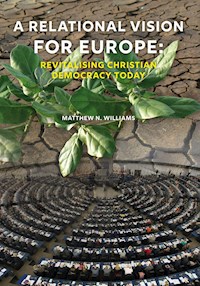
A Relational Vision for Europe:
Revitalising Christian Democracy Today
Matthew N. Williams
COLOPHON
A Relational Vision for Europe: Revitalising Christian Democracy Today
By Matthew N. Williams
© 2022 Sallux Publishing. All rights reserved. No part of this publication may be reproduced, stored in a retrieval system, or transmitted, in any form or by any means, electronic, mechanical, photocopying, recording or otherwise, without the prior permission of the publisher.
Cover design and lay-out: Reproserve
Cover images: Abaca Press / Alamy Stock Photo and Pisauikan / Pixabay.com
Unless otherwise stated, scripture taken from The Holy Bible, New International Version® (Anglicised), NIV®. Copyright © 1979, 1984, 2011 Biblica, Inc. Used by permission of Hodder & Stoughton Limited, a division of Hachette UK. All rights reserved worldwide. “New International Version” and “NIV” are registered trademarks of Biblica, Inc. Used by permission.
Contact data:
Sallux Publishing
EPub format: ISBN 978-94-92697-xx-x
Disclaimer
Since 2011, the activities of Sallux have been financially supported by the European Parliament. The liability for any communication or publication by Sallux, in any form and any medium, rests with Sallux. The European Parliament is not responsible for any use that may be made of the information contained therein.
About Jubilee Centre & Sallux
The Jubilee Centre
The Jubilee Centre offers a biblical perspective on social, economic and political issues, and equips Christians to be salt and light in the public square.
We believe the Bible describes a coherent vision for society that has enduring relevance for the UK and the world in the twenty-first century. At the heart of this social vision is a concern for right relationships. We seek to study, disseminate and apply this vision in order to provide a positive response to the challenges faced by individuals, communities and policy makers.
Sallux | ECPM Foundation
Sallux is the political foundation for the European Christian Political Movement (ECPM). Sallux means “Salt and Light” and we want to spark a salted debate where needed and shed light on the issues we face. We present solutions by organising events and distributing relevant publications and will not stay on the safe side of the status quo.
www.sallux.eu
About the author
Dr Matt Williams is a theologian who has worked in Malawi, Northern Ireland and England. His main interest has been to establish a biblical approach to the issue of poverty in both theory and practice. He is currently the Head of Biblical Insight at the Jubilee Centre in Cambridge. Outside of professional work, he is involved in several social and environmental projects as well as his local church. Most of all, he has the pleasure of building home with his wife and raising their son as a disciple of Jesus.
Foreword
As this foreword is being written the war in Ukraine is grinding on without any clear end in sight. The atrocities being committed by the Russian army are a stark reminder of other dark chapters of European history. The shock we feel is justified and at the same time revealing.
The shock reveals our ‘silent assumption’ that underpins the whole European project. This assumption is worded in Article 1 of the Charter of Fundamental Rights of the European Union: “Human dignity is inviolable. It must be respected and protected”. Our shock reveals how deep this principle is engrained in our culture and shaping our almost instinctive responses.
Implicitly we are now reminded why the European project came about and what it tries to preserve. Moreover, we face the enormous challenge to make human dignity again the cornerstone of all European Union policies. The current combination of crises forces us to go back to the equal dignity of human life. This includes the notion of the intrinsic value of all life as we cannot exist outside the life that surrounds us.
We face climate change as a consequence of an unbridled consumerism that is powered by the short-termism of a shareholder focused economy. An economy in which ever fewer people have ever more money and power and in which a growing number of families face a cost-of-living crisis. We face a resurgence of authoritarianism and increased craving of absolute power over ever more people and land by totalitarian regimes. There is growing pressure on fundamental freedoms and ever more persecution of Christians and other religious and ethnic groups in many places in the world. Moreover, we face confusion in the western world over what our fundamental freedoms are and an increasing battle over freedom of speech and expression. The atomization of society as a consequence of unbalanced individualism has increased this confusion. Polarization is more rule than exception in the western world.
This is the environment in which Christian Democracy in Europe finds itself in. It is a very challenging environment that is complicated by the secularization in large parts of Europe. Society has changed almost beyond recognition compared with postwar Europe. As a consequence Christian Democrat parties find it increasingly difficult to express who they are and where they stand for. Some Christian Democrat parties try to maintain the status-quo but suffer from an aging electorate. Others decided to include more secular and left-liberal notions and tone of voice but subsequently struggle to define their distinctive place in the political landscape. A number of parties decided to compete with the right-wing populists and adopted elements from their language and platforms but find it difficult to maintain the difference between themselves and rightwing populist parties. Those parties who decided to maintain a distinctive Christian voice are able to maintain their core electorates but also face a more secular world and the question how to build bridges without giving up on their Christian identity.
This publication is written with the conviction that Christian Democracy can only maintain its relevance if it is firmly rooted in Christian faith. Without these roots Christian Democrat parties will find it very difficult to remain a recognizable and clear place in the European political spectrum. At the same time this publication recognizes the challenge that secularization poses. That is why it based on an explicit relational understanding of the human being and human dignity. This enables Christian Democracy to communicate with all of society and address the challenges described above from a coherent perspective. Therefore this publication proposes Relational Thinking as foundation for Christian Democracy.
Moreover this publication deliberately internalizes the ecumenical reality of Europe as it ties Catholic Social Teaching, Orthodox thinking, Reformational philosophy and evangelical engagement to Relational Thinking as a common ecumenical basis for Christian Democracy in Europe.
This ecumenical approach is even more needed as the Christianity in Europe becomes more globalized as many Christians in Europe now have roots beyond our continent1. We are in need for a truly ecumenical understanding and application of Christian Democracy as Christianity is a global reality. Many Christians beyond Europe are in need for a renewed and ecumenical understanding of Christian Democracy that is firmly rooted in Christian faith and communicable in a secular society. This is what this publication has to offer.
This publication also shares the motivation of the European Christian Political Movement which is that Christian politics and Christian Democracy must remain rooted in Christian faith and continue to explicitly express that conviction in current political life.
In many ways this publication is a culmination of the work of Sallux over the past years. It brings together what has been expressed over many events and various publications. In that regard it is a milestone for our organization. We thank Matt Williams and all of Jubilee Centre for their great efforts to write this publication. We thank the Sallux members and partners who invested their time to give input in this process which allowed this result.
In light of the challenges we face, we need a revival of human dignity in government and in the public square. This has to be rooted in a firm understanding that human dignity is universal and relational. Only Christian Democracy is able to express this fully as it is rooted in the Christian source that gave rise to this understanding of the human being. All other political streams are ultimately standing for a partial interest that is only one aspect of human dignity. Only Christian Democracy has the inner strength and conviction that can transcend these partial interests and transform our societies.
We hope that all politicians and parties and movements in the European Christian Political Movement (ECPM) and the wider Christian-democrat tradition will find inspiration in this publication to contribute to that transformation.
Johannes de Jong
Director Sallux
Introduction: the case for Relational Thinking
1) Christian Democracy at the Crossroads
Where is Christian Democracy today? At first glance, its position in Europe looks promising. Both the European Union (EU) and the largest European party, the European People’s Party (EPP), have Christian Democratic roots. Within the largest European nation, Germany, the Christian Democrat CDU/CSU was only a single percentage point from achieving a higher number of votes than any other party in the 2021 elections2. But there is another story. The liberalism uniting the coalition that formed the German government seems increasingly powerful in comparison to the ‘Christian’ elements in the nation. Furthermore, the EPP has diluted its identity as a Christian Democratic party and the international body to which it belongs has erased ‘Christian Democracy’ from its name3. Does this mean an end to the influential role of Christian Democracy (CD) in Europe? Not quite – what political scientist Carlo Invernizzi Accetti claims rings true:
‘‘Whatever ideologies will mark the political landscape of Europe in the coming decades, they will most likely have to inhabit an institutional shell created primarily by Christian Democrats, in their image and likeness’’4.
This kind of development has given not only the EU but many Western democratic regimes the character of a hermit crab, living in a shell shaped largely by CD5. Just as a hermit crab does not shape its own external structure, so are European political movements bound to work, for the meantime, within structures they did not create.
In light of this situation, what is the task for CD? One temptation would be to say that CD can keep riding its success. Those who fought for institutional reform should be happy with the structural impact that they’ve had. Christian democratic politicians and parties should carry on as they are, content in the knowledge that the major work has been done and no fundamental change is necessary. They can focus on formulating policies, increasing their power bases and competing in elections. However, this approach is badly mistaken. The argument of this book is that CD urgently needs to be revitalised by going back to its source. There are two key reasons for this.
Firstly, there needs to be a real connection between the origin of ideas and their development for them to retain their original character. Without any vital connection to Christianity, there is nothing to stop ideas birthed from CD from being transformed out of all recognition. In time, the frameworks that we take for granted will be torn down and replaced with structures that are potentially hostile to Christian values built on love of God and neighbour6. This is, in fact, what is already happening in Europe. Parties established on a CD platform are losing their distinctive quality and being assimilated into the prevailing ideological currents. Some have joined the liberal stream, embracing its social ethics and the economic status-quo in the name of a sub-Christian idea of ‘freedom’. Others have joined the nationalist stream, evoking Christianity along with populist sentiments in support of ‘national interest’ or traditional cultural values. In both of these cases, the political current is directed by a sense of identity that is inherently conflictual: either the autonomous individual or the sovereign nation. And this leads us onto our second point.
Not only will CD become disconnected from its roots if it carries on as it is. Even worse, it will become allied to forces that are mutually destructive. Therefore, CD needs to return to its source in order to be a unifying force. Current circumstances show that liberalist and nationalist impulses end in polarisation and perpetual conflict. Within Europe, this conflict is most clearly manifest in the UK’s exit from the EU and the deepening split in French society7. The globalist liberalism to which most of the social and political elite belong cannot eliminate more conservative and nationalistic impulses. Various manifestations of these two forces also underlie much of the conflict beyond Europe today, especially within the USA and between the West and Russia8. We cannot witness the suffering of the Ukrainian people and remain blind to the price of this conflict.
But we can go deeper and identify a common factor that unites the warring sides. Part of liberal individualism is the impulse to deny any ‘given’ or ‘irrational’ association (other than ‘universal humanity’) to determine its social vision. Yet in reality, liberalism has in common with nationalism the desire to belong to groups into which people are born. The identity politics so prevalent within liberalism gives many examples of collective identities that are no more ‘rational’ than the nation. What CD does in this context is to offer a genuine way of peace. It affirms the human desire for collective identity but does not make one social identity dominant over the others. Within the fundamentally unified view of CD, there is an order that allows one to belong to various levels of relational identities (from family to transnational organisations) without these being set in conflict with one another.
So the question for CD as it stands at the crossroads is this: how can it be a force for good in Europe today? How can it fulfil its huge potential to make a constructive and peaceful impact in a situation that is increasingly characterised by conflict? What can revitalise CD and prevent it from being further assimilated—so that it eventually disappears?
The answer offered in this book is Relational Thinking. Relational Thinking (RT) is ideally placed to play a crucial role in revitalising CD for four key reasons: firstly, it flows from the source of CD because it is profoundly biblical; secondly, therefore, it appeals to the whole Church and is ecumenical; thirdly,however, it can be expressed in language and concepts that are universally valued; fourthly, it is practicable in a variety of contexts and at a number of different levels. We will now turn to an introductory account of RT and address each of these three strengths consecutively.
2) Introducing ‘Relational Thinking’
‘Relational Thinking’ or ‘Relationism’ has arisen from the work of the Cambridge-based Jubilee Centre in its work of applying biblical thinking to public life9. As the name suggests, the central premise is about relationships and can be simply stated as follows10:
‘‘Healthy relationships are at the heart of a healthy society and should be the focus of social, economic and political activity”.
It is important to note that relationships are not simply what happens in the personal and domestic sphere. It may not always feel like it, but social, economic and political life are fundamentally relational in nature. Everything – even purely ‘business’ transactions – ultimately depends on interactions between people or groups of people. Therefore, a focus on relationships bridges the gap between the private and public spheres. What ‘healthy’ relationships look like on these various levels will be spelled out as we go along. For now, it is enough to say that RT gives a framework within which to deal with the tensions between individual and corporate identity (and between various types of the corporate identity) through the lens of relationships.
The first reason why RT is ideally placed to revitalise CD is that it is biblical. A large portion of this book will be taken up with explaining how this is so, but in a nutshell, the Bible’s revelation of God and God’s plan for humanity puts relationships at the very heart of reality in a way that can be articulated as a socio-political vision. Before getting into detail on that, we need to see why the close connection that RT makes between CD and the Bible is important. It comes down to the fact, which all Christians believe, that engagement with biblical material is an indispensable way for people to engage with God. Without maintaining this connection, ‘Christian’ ideas such as ‘liberty’ become empty shells inhabited by forces increasingly alien to Christianity11. To change the metaphor, failure to engage directly with the text of the Bible can give Christian ideas the character of copies made from copies on a photocopying machine. Inevitably, the original gets progressively fainter until it becomes impossible to see. Taking CD back to the source of God’s word will bring up life-giving water from its source. It will be truly Christian, flowing from the revelation of God through Christ in the Word spoken by the Spirit.
The second key strength of RT flows from the first. Because it is firmly rooted in the Bible itself, it can appeal across the whole breadth of Christianity. Despite divisions between Church traditions, they all share one Scripture. Whilst there may be debates on matters of canonical inclusion, translation and interpretation, these tend to be at a less fundamental level than the basic biblical truths that RT builds upon. This common ground does not erase difference, of course. But RT provides a strong common political vision within which questions of detail can be helpfully discussed without everyone moving in totally divergent directions. When discussions centre around the text of the Bible itself, rather than contesting traditional vantage points, then unity is already being established around the Word. Such unity can bear much fruit even before consensus on every issue is reached.
Thirdly, despite its source in the Bible and its direct appeal to the Church, RT communicates universally held values. Christianity is, unfortunately, discredited within much European public discourse. However, RT takes it starting point not from an exclusively Christian dogma but from the premise of human dignity that claims universal assent12. Whilst this principle has always been fundamental to CD more broadly, RT emphasises that we must define humanity and personhood as inherently relational. When one asks: ‘‘What does it mean for me to be a human?’’, the first answer is ‘Relationships’. We each have a unique relational identity as children, neighbours, citizens, employees and so-on. This does not discount inherent personal characteristics, but these characteristics are only manifest in interaction at the various domestic, local community, political and economic levels.
It is increasingly recognised that people are not best understood as rational autonomous individuals. The late Desmond Tutu explained that ‘‘my humanity is caught up and is inextricably bound up in yours for we can only be human together’’13. This is not a realisation restricted to theological circles. Even economists are beginning to move in this direction, throwing doubt on the ‘rational consumer’ model that dominated for so long14. In fact, Susan Eastman shows how science and religion are in harmony on this particular issue:
‘‘Across a spectrum of views among both philosophers of science and experimental psychology, there is a broadly shared notion of the person as irreducibly embodied and socially and environmentally embedded. This model of self-in-relationship does not begin with the individual at all, in terms of either mental states or neural circuitry. It is intersubjective all the way down. The Cartesian idea of an individual, freestanding, independent is long gone. There are no lone rangers on this playing field; for good or for ill, there are always other players involved’’15.
Respecting relational identity is the only way to maintain the healthy tension between inviolable individuality and belonging to a wider collective that is core to our existence. It is the Bible that gives us this perspective and thus provides the best lens through which to understand the universally held value of human dignity.
The fourth and final reason why RT is key to the revitalisation of CD is its practicability




