


30,99 €
Mehr erfahren.
- Herausgeber: John Wiley & Sons
- Kategorie: Geisteswissenschaft
- Sprache: Englisch
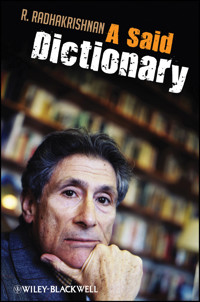
This interpretive dictionary introduces the critical and theoretical world of distinguished literary and cultural critic Edward W. Said through the crucial terms and concepts central to his work.
- Compares and contrasts Said's perspective with other key theorists, such as Derrida, Spivak, Foucault, and Jameson
- Describes the crucial terms and concepts central to Said's work
- Places the development of Said's work within its historical context
Sie lesen das E-Book in den Legimi-Apps auf:
Seitenzahl: 364
Veröffentlichungsjahr: 2012
Ähnliche




















Contents
Cover
Title Page
Copyright
Dedication
Terms
Preface
A
B
C
D
E
H
I
L
N
O
P
R
S
T
V
W
Z
Bibliography
Index
This edition first published 2012 © 2012 R. Radhakrishnan
Blackwell Publishing was acquired by John Wiley & Sons in February 2007. Blackwell's publishing program has been merged with Wiley's global Scientific, Technical, and Medical business to form Wiley-Blackwell.
Registered Office John Wiley & Sons Ltd, The Atrium, Southern Gate, Chichester, West Sussex, PO19 8SQ, UK
Editorial Offices 350 Main Street, Malden, MA 02148-5020, USA 9600 Garsington Road, Oxford, OX4 2DQ, UK The Atrium, Southern Gate, Chichester, West Sussex, PO19 8SQ, UK
For details of our global editorial offices, for customer services, and for information about how to apply for permission to reuse the copyright material in this book please see our website at www.wiley.com/wiley-blackwell.
The right of R. Radhakrishnan to be identified as the author of this work has been asserted in accordance with the UK Copyright, Designs and Patents Act 1988.
All rights reserved. No part of this publication may be reproduced, stored in a retrieval system, or transmitted, in any form or by any means, electronic, mechanical, photocopying, recording or otherwise, except as permitted by the UK Copyright, Designs and Patents Act 1988, without the prior permission of the publisher.
Wiley also publishes its books in a variety of electronic formats. Some content that appears in print may not be available in electronic books.
Designations used by companies to distinguish their products are often claimed as trademarks. All brand names and product names used in this book are trade names, service marks, trademarks or registered trademarks of their respective owners. The publisher is not associated with any product or vendor mentioned in this book. This publication is designed to provide accurate and authoritative information in regard to the subject matter covered. It is sold on the understanding that the publisher is not engaged in rendering professional services. If professional advice or other expert assistance is required, the services of a competent professional should be sought.
Library of Congress Cataloging-in-Publication Data
Radhakrishnan, R. (Rajagopalan) A Said dictionary / R. Radhakrishnan. p. cm. ISBN 978-1-4051-8378-9 (cloth) – ISBN 978-1-4051-8377-2 (pbk.) 1. Said, Edward W.–Criticism and interpretation. 2. Said, Edward W.–Language–Glossaries, etc. I. Title. PN75.S25R33 2012 801′.95092–dc23 2011047215
A catalogue record for this book is available from the British Library.
1 2012
The book is dedicated, with affection and abiding gratitude, to Edward Said and his impeccable and imaginative legacy of critical, humane, and inclusive worldliness.
Terms
affiliation
Auerbach, Eric
beginnings
between/between-ness
centrism
Conrad, Joseph
contrapuntal criticism
Culture and Imperialism
democratic criticism
exile
humanism
intellectual, the
linguicity
narrative
nationalism
oppositional criticism/consciousness
Orient/Oriental/Orientalism
philology
postcoloniality
professionalism
representation
secular criticism
speaking truth to power
specular/border intellectual
style
text/textuality
theory
“Traveling Theory”
Vico, Giambattista
virtuosity
voyage in
worldliness
Zionism
Preface
Edward Said has been in the general international eye for a number of years now as a public intellectual steeped in a very specific sort of academic scholarship; and the purpose of this book is to explicate and explain the public salience of Said's work for our times without in any way dumbing down the conceptual or the polemical complexity of Said's perspectives and positions on a variety of worldly issues: positions that could not have been reached without the help of erudition achieved rigorously within the walls of academia. It is intended to be of use to specialists, non-specialists, Edward Said aficionados as well as those who have a general awareness of Said and his prominence, and particularly students, both graduate and undergraduate, as well as professors in the humanities who will seek this book out as a text for their courses.
Since the publication of his Orientalism in 1978, Said had built up a tremendous reputation as a visible and audible public intellectual who was unafraid to contaminate and politicize the hoary chambers of scholarship with the clamor and urgency of worldly, political issues. At the risk of dire misrecognition, even death threats, Said continued to espouse causes that were anathema in the West and did so on the basis of his formidable expertise as a humanities scholar steeped in the tradition of the West. It is precisely because he cared for the West that it was important for him to be the ambassadorial voice of the so-called non-West to the West; and of course, his real objective was to break down the falsity of the Occident–Orient, or for that matter, any putative civilizational divide that disavowed the reality of shared and coeval histories. Precisely because of the richly ambivalent nature of his subject position as well as politics of location, Said was vulnerable to hostile criticism from both sides. He was of the West, academically and disciplinarily speaking; and yet, how could he, how dare he bite the very hand that had fed him? He was a spokesperson of the Palestinian and the Arab cause, but he was neither a Middle Eastern Studies scholar nor a gung-ho Arab (nor any other kind of) nationalist; moreover, he was more interested in finding an ear in the West rather than in being the authentic representative of Arab or Palestinian identity. He was no defender of nationalism per se, and yet he was a member of the Palestinian National Council in exile and was vilified as the “professor of terror” because of his support of the Palestine Liberation Organization and the intifada. But as an eternal oppositional critic, he was as much a critic of Arafat and his cronies as he was of the state of Israel and Zionism. Political activists of a certain color found his commitment to Western humanism irrelevant, even offensive; whereas the pure scholars of literary humanism found his politics obstreperous and reprehensibly partisan. He was always talking about the significance of representation; and yet he meant by representation something other than identity politics, insiderism, and the politics of authenticity.
Was he academically political or politically academic? It would all depend on who your interlocutor was. As a distinguished humanities professor at an Ivy League institution in the United States, his position was clearly secure and privileged; and yet within academia, his reputation was hotly contested. In many circles he was so much persona non grata that he would even say that in those unpopular contexts a letter of reference from him would be tantamount to the kiss of death. Whereas he was after all an academic and a professor, he had indeed rendered the academic department a different kind of place by openly acknowledging and embracing an interested rather than a disinterested mode of scholarly enquiry. While on the one hand there is a chorus of voices maintaining that postcoloniality was nothing but an aseptic metropolitan, academic, diasporic formation fraught with no peril whatsoever, there is ample proof on the other hand that area studies that have been influenced by Orientalism in particular, and Edward Said's work in general, have been targeted for patriotic nationalist-American surveillance, even more so after 9/11 and the American Homeland Security Act. Whatever he wrote about, and his range was indeed impressive; and wherever he wrote, and indeed he published in a wide spectrum of sites, he brought to his writings a sense of worldly urgency. In other words, whether the reader agreed with Said or not, she could sense that there was always something at stake behind the essay or the article, and that whatever was at stake was open to multilateral argumentation. In other words, whatever Said wrote was intellectual and public at the same time, in the same breath. It was in this spirit that he would exhort those who came under his influence to write, whatever their immediate area of specialized focus, firstly, for a large audience that would transcend their specialist argot, and secondly, for a range of constituencies, from the narrowly academic to the broadly populist. What he preached, he clearly practiced all his life as he strove tirelessly to make sense of the world he lived in through passionate, lively, partisan but contrapuntal dialog with other voices and perspectives.
Like the work of all public intellectuals, Said's work too was richly and deeply symptomatic of the times he lived in. His was an intensely situated life, in Jean-Paul Sartre's sense of “situatedness,” and Said endeavored, till the very end when he collaborated with Daniel Barenboim (Parallels and Paradoxes: Explorations in Music and Society), in the field of music, to bring about some real conversation between the state of Israel and an emerging Palestinian state, to produce critical-oppositional meaning from the symptoms of historical existence. There are three particular aspects of Said's life and career that make him particularly readable and attractive to the lay reader. Firstly, Said tried the best he could to bridge the so-called professional gap between life and career. His goal was to render the one intelligible in terms of the other and vice versa. What were his considered opinions on identity politics, representation, authenticity, the two-state solution to Israel–Palestine, Bach's or Wagner's music, anthropology, colonization, self and other, truth and power, democracy, intellectualism, professionalism, the West and the Rest, civilizational clash, cosmopolitanism, and nationalism? His responses were simultaneously those of Edward the Palestinian-American citizen with a cause and those of the dazzlingly brilliant critic and distinguished Columbia University professor Edward Said. What his ongoing work tried to dramatize was the truth that these issues and the passions that they engender are to be lived through critically and self-reflexively; and that criticism and self-reflexivity are to be practiced and performed both qualitatively and democratically, that is, both in the name of a restless individual critical consciousness that dances to the tune of scholarship and erudition, and in the name of the inclusive All. In other words, for Said, to understand the world and to understand the more selective world of music and literature and literary scholarship were flip sides of the same coin.
Secondly, in the pursuit of his objective, Said was unafraid to declare that the object of his critical analysis was not just Culture (this would be the choice of apolitical theorists) or just Imperialism (this would be the preference of reductive agitprop polemicists), but Culture and Imperialism. He was not daunted by contradiction, complicity, the abject asymmetries of guilt and blame, the realities of what he so eloquently termed “discrepant but overlapping experiences,” histories that had not lived up to their theoretical promise, and theories that in their utopian haste had chosen to become post-historical. Instead, he lived in the tensions, in the glaring gaps and contradictions of our times, and actively chose, intentionally and agentively, to make sense of these symptoms. It was by exercising a mercurially oppositional critical consciousness, between Culture and System, that he tried both to understand and to go beyond the given, the status quo.
Thirdly, he did not seek, philosophically or systemically, to produce a grand theory of reading or of the text that would result in some massively monolithic universal understanding of the world and its significance. Much more humble than the grandstanding theorists or the pure ethicists who were his contemporaries, he was more than satisfied to be syncretic, eclectic, non-systemic, partial and non-totalizing, and pragmatically contingent in his thinking. What was important to him was to make conscious choices rather than be spoken for, in a formulaic manner, by culture or by professional system. It was equally crucial for him to announce his agenda; he was no immaculate theoretical rebel without a cause or a rebel looking for the birth of the perfect cause or the Cause of all causes. He was also quite happy to declare “where he came from” and where he was headed. He might stumble in the process, perhaps make strange and inconsistent choices, or, as I found myself saying wistfully a number of times during the course of this book, not be a philosophic enough thinker as he addresses the crises and problems of humanism and essentialism; but what he did consistently, and with rigorous integrity, was to compile, in the Gramscian sense of the term, an inventory of the historical traces that lead him to the present. It is quite easy to hoist Edward Said with his own petard for the very simple reason that his criteria are transparent, and easy to read by all. What makes Said interesting are the choices that he made: choices that win him a number of fellow passengers as well as opponents who are on different trips altogether.
Said was a pragmatic literary and cultural critic who used and borrowed from existing vocabularies to create his own non-standard usages. His phrases and locutions are for the most part directly available to anyone with a degree, say in English literature. Even when he avails extensively of terms for literary and cultural criticism, his discourse is never dense with its own ponderous materiality. His language is much more explanatory and explicatory than self-referentially theoretical. As he maintains time and again, particularly in the context of Vico, the world and reality are already complex and theory-laden; and the task of the critic is to do justice to the heterogeneous and multi-layered richness of what he called “worldliness,” rather than pretend that theory manufactures its own autonomous meaning. He is interested in explaining to the reader why he finds a text rich and significant, what he finds in the text, how he finds it, how the text is put together and towards what objective. His prose takes on a clear responsibility of representation, demonstration, and critical paraphrase. In light of this, we may wonder: why would such a critic who explains so lucidly need further explanation? Clearly, Edward Said is not a Samuel Taylor Coleridge “explaining metaphysics to the nation,” of whom Byron famously quipped, “I wish I could explain his explanation.” Nor is he “difficult” in the manner of a Jacques Derrida: an out and out theoretical thinker deeply invested in the priority of philosophical reading. The answer to the question is: to explain to the reader Said's critical position on issues, the reason he takes these positions, and the ways in which he justifies the taking of these positions; and in particular, how he uses his expertise as a reader of texts to clarify issues and problems in the real world. Said was always committed to knowledge both as a way of knowing and a way of being, a way of being and a way of doing. In other words, this book aims to account for Said's way of being worldly: for example, not so much defining concepts or ideas that he might have formulated (he was not an original thinker in that way), but rather to explain how and why he related to certain ideas and formulations and not to others, and how in the making of these choices within his professional world he had also invited the world out there into the narrow rooms of scholarly erudition. It was his way of occupying a certain terrain that needed explanation. His most impressive achievement was his ability to bridge the gap between worldly reality and the excitement of books, of scholarship, of cultural enrichment. The meanings, valences, and inflections that he chose on behalf of scholarship, that is, on behalf of the text and the critic, were the same, representatively speaking, as the ones that he valorized on behalf of the world. If there are special words in a Said dictionary, they are special by democratic usage, and not because they are esoteric mantras that warrant exclusive initiation.
In writing this book, it was important to find the balance between making Said available in a reader-friendly way to the general reader, and at the same time making the reader aware of the delicate and nuanced complexity of Said's democratically oriented erudition. Said lived democratically, but all the while pushing it towards greater inclusiveness and higher levels of qualitative appreciation without turning such a project into one of paternalistic aristocratization. There were two important challenges here: first, to deal with each of the entries on a double register with the objective of telling the reader that these terms have a take and a bite both in the world of scholarship and the world out there. Terms like “identity,” “theory,” “representation,” “secular criticism,” and “nationalism,” resonate both for the common lay reader and the humanities scholar. In fact, the lay reader and the scholar are often one and the same person. Said's contention was that these terms are in fact lived realities which are then subjected to professional and scholarly analysis, but only to be brought back to the terrain of lived life on a heightened level of critical awareness. In other words, there always is a representative connection of meaning and meaning-making between life and literature, life and scholarship. After encountering the travails and vicissitudes of “representation” in a novel, the reader returns to her life with a meaningful exclamation of “Wow, so that is what representation is all about,” and on the basis of that insight understands more critically what it is to be an American, a Palestinian, a literary scholar.
The second challenge was how to find some credible equilibrium between presenting Said's thought objectively and providing the reader with an appreciative critique of what Said was all about. The method that has been used for each entry is to begin with the concept, locate it in Said's context, and offer an explanation or definition from Said's perspective without quoting too much directly from Said. Then a few questions are raised around the entry by way of suggesting to the reader the significance of the concept or the term. I thus introduce to the reader a brief history of the term in the field, including the debates and polemical confrontations occasioned by the concept. I then focus in particular on Said's own specific participation in these argumentative conversations, and differentiate his take from those of others in the conversation. I have also been keen on accounting for the reasons why Said sometimes abandoned a certain path to go in a different direction. Said made a number of choices as a critic, and I have attempted to show what these choices were and how Said went about shaping and styling his own trajectory as a critic as a cumulative function of these choices. My hope is that in doing so I have been able to elucidate Said's freewheeling relationships and affinities with a number of theories, theorists, and schools of thought. Wherever possible, without being too intrusive, I have also outlined criticisms of Said or briefly indicated the limitations of his mode of enquiry.
In addition to having been a general and long-distance student of Said for a long time, I had also had the privilege of having been his actual student during the summer of 1982 at the School of Criticism and Theory at Northwestern University. (This was the summer of catastrophe in the Middle East and I distinctly recall how Said would travel under great pressure to London, Cairo, and Lebanon, during that period and dash back and forth and still be available to us, his eager and demanding students.) He was kind and attentive to my presence and my contributions, even though I was a mere senior doctoral student on the verge of completing my dissertation under the direction of that magnificent teacher William V. Spanos. Despite the uneven and asymmetrical nature of this relationship, he empowered me, made me feel like a potential equal, and most important of all, he pushed and pressured my thinking with tough suggestions and critical comments.
I would like to thank my editors Emma Bennett and Ben Thatcher for their patience and support all along. A special “thank you” goes out to Kathleen McCully, my copy-editor, for her critical rigor, care, and her unerring eye/ear for any kind of infelicitous phrasing. I am also grateful to Shalini Sharma for her patient technical help during the final stages of proof reading. I also wish to acknowledge, in profound friendship and solidarity, a whole family of critics and theorists who have all endeavored to keep the Said legacy alive critically and meaningfully in their own projects: William V. Spanos, Paul Bove, Donald Pease, Aamir Mufti, Neal Lazarus, Jonathan Arac, Bruce Robbins, Gauri Viswanathan, Timothy Brennan, Anne McClintock, Rob Nixon, Asha Varadharajan, Ibish Hussein, Satish Kolluri, Ling-Yan Yang, Marian Aguiar, Giovanna Covi, Mina Karavanta, and Robert Marzec, Steven Mailloux, and many more. I thank Edward Said for his brilliant and humane critical intelligence and for having opened up a path for us to follow, each in his or her own way, as we keep the conversation going with the world, contrapuntally, in the hope that the world to come will be meaningfully and critically “out of place,” forever dedicated to the project of admitting the all in the name of the All.
And as always, I thank my wife Asha for her unconditional support and inspired and inspiring partnership, and my son Surya for his deeply caring and rigorous friendship. My warm and affectionate greetings also drift out to my parents in distant Chennai.
A
affiliation This is a classic example of a simple and non-technical word that Said inflects imaginatively to produce a critical semantic range. First of all, rather than define the word or fix its denotation in isolation, Said makes it a point to differentiate “affiliation” from “filiation.” Whereas filiation, as in “filial duty or piety,” represents a genetic, dynastic, familial, natal, nativist, or natural-biological order, affiliation is a mode of belonging based on secular and historical choices that an individual makes: choices that may or may not re-validate or re-recognize the pattern of filiation. Thus, in a Bildungsroman, the protagonist may be born Irish or Sephardic-Jewish, but may reject, problematize, deconstruct, or redirect or re-channelize her “given” identity in response to other pressures, calls, passions, and imperatives that emanate from elsewhere and from other histories that are not part of her “given” birth-identity. Questions like “What is my history?,” “Which ‘we’ am I part of?,” and “Which community is more binding: family, class, gender, nationality?” could be answered from a filiative or an affiliative point of view. A vibrant example of a character in fiction who downplays filiation and valorizes affiliation is the nameless narrator in Amitav Ghosh's eloquent novel, , who asserts on the very first page of the text that he “did not to think of her as a relative: to have done that would have diminished her and her family – I could not bring myself to believe that their worth in my eyes could be reduced to something so arbitrary and unimportant as a blood relationship.” Affiliation plays a major role in Said's theatre of thought for the simple reason that it mediates effectively in the interplay between identity politics and the politics of , between and belonging, between so-called authenticity and the inauthentic, between racialized, essentialist, and stereotypical modes of communal belonging and secular and open-ended ways of constituting community, between “blood and guts” rhetoric and secularist discourse, and finally between solidarity and critique. It is significant that Said reads filiation diagnostically as a “failed idea” and understands affiliation as “a kind of compensatory order that, whether it is a party, an institution, a culture, a set of beliefs, or even a world-vision,” that is capable of providing “men and women with a new form of relationship” (“Secular Criticism,” in , 19). Affiliative moves can be kept trace of and accounted for immanently, that is, from within themselves, unlike filiative reiterations that resist diagnostic or symptomatic accounts in the name of natural self-evidence. Also, affiliations are like chapters in an ongoing of “becoming” whereas filiations promote a notion of “completed being” from the very beginning and thus come in the way of subsequent relationships and solidarities. Born a Hindu always a Hindu, born American always American, and so on, are examples of dogged and non-porous filiation.
Lesen Sie weiter in der vollständigen Ausgabe!
Lesen Sie weiter in der vollständigen Ausgabe!
Lesen Sie weiter in der vollständigen Ausgabe!
Lesen Sie weiter in der vollständigen Ausgabe!
Lesen Sie weiter in der vollständigen Ausgabe!
Lesen Sie weiter in der vollständigen Ausgabe!
Lesen Sie weiter in der vollständigen Ausgabe!
Lesen Sie weiter in der vollständigen Ausgabe!
Lesen Sie weiter in der vollständigen Ausgabe!
Lesen Sie weiter in der vollständigen Ausgabe!
Lesen Sie weiter in der vollständigen Ausgabe!
Lesen Sie weiter in der vollständigen Ausgabe!
Lesen Sie weiter in der vollständigen Ausgabe!
Lesen Sie weiter in der vollständigen Ausgabe!
Lesen Sie weiter in der vollständigen Ausgabe!
Lesen Sie weiter in der vollständigen Ausgabe!
Lesen Sie weiter in der vollständigen Ausgabe!
Lesen Sie weiter in der vollständigen Ausgabe!




