


Erhalten Sie Zugang zu diesem und mehr als 300000 Büchern ab EUR 5,99 monatlich.
- Herausgeber: Mercier Press
- Kategorie: Geisteswissenschaft
- Sprache: Englisch
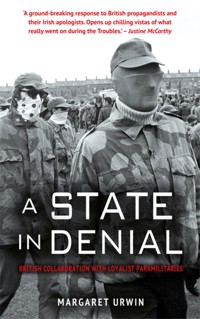
This meticulously researched book uses previously secret official documents to explore the tangled web of relationships between the top echelons of the British establishment, incl Cabinet ministers, senior civil servants, police/military officers and intelligence services with loyalist paramilitaries of the UDA & UVF throughout the 1970s and early 1980s. Covert British Army units, mass sectarian screening, propaganda 'dirty tricks,' arming sectarian killers and a point-blank refusal over the worst two decades of the conflict, to outlaw the largest loyalist killer gang in Northern Ireland. It shows how tactics such as curfew and internment were imposed on the nationalist population in Northern Ireland and how London misled the European Commission over internment's one-sided nature. It focuses particularly on the British Government's refusal to proscribe the UDA for two decades – probably the most serious abdication of the rule of law in the entire conflict. Previously classified documents show a clear pattern of official denial, at the highest levels of government, of the extent and impact of the loyalist assassination campaign.
Sie lesen das E-Book in den Legimi-Apps auf:
Seitenzahl: 425
Veröffentlichungsjahr: 2016
Das E-Book (TTS) können Sie hören im Abo „Legimi Premium” in Legimi-Apps auf:
Ähnliche




















MERCIER PRESS
3B Oak House, Bessboro Rd
Blackrock, Cork, Ireland.
www.mercierpress.ie
http://twitter.com/IrishPublisher
http://www.facebook.com/mercier.press
© Margaret Urwin and the Pat Finucane Centre, 2016
ISBN: 978 1 78117 462 3
Epub ISBN: 978 1 78117 463 0
Mobi ISBN: 978 1 78117 464 7
This eBook is copyright material and must not be copied, reproduced, transferred, distributed, leased, licensed or publicly performed or used in any way except as specifically permitted in writing by the publishers, as allowed under the terms and conditions under which it was purchased or as strictly permitted by applicable copyright law. Any unauthorised distribution or use of this text may be a direct infringement of the author’s and publisher’s rights and those responsible may be liable in law accordingly.
Contents
Abbreviations
Acknowledgements
Foreword
1 From conflict origins to internment and direct rule
2 The first ira ceasefire and the repercussions of its breakdown
3 Arming the loyalists
4 Ireland v United Kingdom (european commission of human rights)
5 Loyalists Torpedo the Northern Ireland power-sharing executive
6 The new IRA ceasefire and the loyalist backlash
7 Discrimination in ‘Screening’ and the power of propaganda
8 Civil War? the ‘official’ arrival of the SAS and ‘ulsterisation’
9 UDA murders of high-profile republicans
Conclusion
Endnotes
Bibliography
About the Author
About the Publisher
Abbreviations
ACC Assistant Chief Constable
AP Arrest policy
AUS Army Under-Secretary
BGS Brigade General Staff
CESA Catholic Ex-Servicemen’s Association (also CEA)
CID Criminal Investigation Department, RUC
CGS Chief of the General Staff
CLF Commander of Land Forces, Northern Ireland
DOW Down Orange Welfare
DPP Director of Public Prosecutions
DS10 Defence Secretariat 10 of the MoD
DUP Democratic Unionist Party
DUS Deputy Under-Secretary
ECHR European Commission of Human Rights
ECtHR European Court of Human Rights
FCO Foreign and Commonwealth Office
FRU Force Research Unit
GOC General Officer Commanding
HET Historical Enquiries Team
HMG Her Majesty’s Government
HQNI British Army Headquarters Northern Ireland
ICO Interim Custody Order
INC Irish National Caucus
INLA Irish National Liberation Army
IPU Information Policy Unit, British Army Headquarters
IRA Irish Republican Army
IRSP Irish Republican Socialist Party
JFF Justice for the Forgotten
LCC Loyalist Coordinating Committee
MoD Ministry of Defence
MRF Military Reaction Force
NAI National Archives of Ireland
NAUK National Archives UK
NIAC Northern Ireland Advisory Commission
NIO Northern Ireland Office
NUPRG New Ulster Political Research Group
OIRA Official Irish Republican Army
OV Orange Volunteers
PAB Public Affairs Branch, NIO
PAD Public Affairs Division, NIO
PAF Protestant Action Force
PD People’s Democracy
Acknowledgements
This publication is the result of years of collaborative research by the Pat Finucane Centre (PFC) and Justice for the Forgotten (JFF) (now part of the PFC) at the National Archives in both London and Dublin, the National Library of Ireland, the University College Dublin Archives, the Linen Hall Library in Belfast and the London School of Economics.
I would like to thank my colleagues, Anne Cadwallader, Sara Duddy and Alan Brecknell, for their assistance in plundering the archives and for their helpful suggestions. Thanks also to PFC board members Paddy Hillyard, Stuart Ross and Robin Percival for their crucial editorial input. I particularly wish to acknowledge the enormous contribution of PFC Director Paul O’Connor. His guidance, advice and suggestions throughout the project were invaluable. I am also grateful to London-based journalist Tom Griffin for helping with the London end of the research and Raymond Walker for his assistance. The final product is the collective responsibility of the editorial board of the PFC/JFF.
I wish also to thank those families who kindly agreed to allow details from their case files to be included. A special thank you to Ian Knox for creating a cartoon for the picture section.
Finally, I hope that even those who disagree profoundly with me will take the time to examine the evidence and reflect on the conclusions.
Foreword
In 1989 the deputy head of the Royal Ulster Constabulary (RUC) Special Branch, Brian Fitzsimons, submitted two documents to the Stevens investigation, which had been set up to examine allegations of collusion between the British Army, the RUC and loyalist paramilitaries.1 These documents, reproduced in the de Silva Report, summarised intelligence reports on collusion between the security forces and loyalist paramilitaries in the mid-1980s.2 In a cover note an unnamed official commented: ‘the overall picture seems to be one of RUC collusion and links with the loyalists which is similar in scale (if not greater in some respects) to that of the UDR [Ulster Defence Regiment].’ Since the UDR was a British Army infantry regiment, the primary purpose of which was to aid the RUC, this shows just how deep the relationship between the RUC and loyalist organisations was thought to be.
The declassified official documents discussed in this book show more than a decade of official toleration, and at times encouragement, of loyalist paramilitaries throughout the 1970s, which would have horrifying results. According to Lost Lives: The Stories of the Men, Women and Children Who Died as a Result of the Northern Ireland Troubles, between 1969 and the signing of the Good Friday Agreement in 1998, in all but two years, more Catholic civilians than Protestant civilians died each year.3 There were only two years – 1978 and 1987 – when this deadly trend was reversed. Loyalist paramilitaries were responsible for the majority of Catholic civilian deaths.4
This is not to trump one community’s suffering over another – the entire conflict was a desperate waste of human life and clearly the high level of casualties, including those of serving and retired members of the RUC and UDR, had a profound and devastating effect on the Protestant and unionist community.
But it is important to remember that the main focus of the Ulster Defence Association (UDA) and the Ulster Volunteer Force (UVF) assassination campaign was the Catholic civilian population. As this was happening, the British government, the RUC, the British Army and the criminal justice system were living in a state of denial about the true extent of the assassination campaign and who was carrying out these assassinations – the fictional Ulster Freedom Fighters (UFF) or the still-legal UDA, as well as the illegal UVF.5 Perhaps the greatest state of denial – a phrase coined by sociologist Stan Cohen6 – was the fiction that collusion, if it existed at all, was limited to a few bad apples. The evidence shows that successive British governments turned a blind eye and sometimes encouraged the actions of the UDA and UVF. Church leaders were too often silent. Senior unionist political figures from 1969 onwards flirted with the ‘men of violence’ as it suited them, and abandoned them just as quickly.
This is not to overlook the fact that there were many decent officers in the RUC who were not engaged in collusion, and who sought to uphold the rule of law and put loyalist paramilitaries behind bars. But all too often Special Branch, army intelligence and the Security Service, MI5, withheld vital intelligence from the RUC’s Criminal Investigation Department (CID) officers on the ground. As a result, many investigations were doomed from the outset.
It is possible that many within the RUC wished to see the UDA proscribed, but it was a chief constable, John Hermon, who opposed this in the early 1980s, as did secretaries of state and the mandarins in the Northern Ireland Office (NIO). It is sometimes argued that the emerging evidence of state collusion with republicans through British agents working undercover, as in the case of the man codenamed ‘Stakeknife’, somehow balances the equation.7 This is to miss the point. Collusion with loyalists was intended to help defeat the IRA by increasing the effectiveness of loyalist groups. The infiltration of agents into the IRA, and ignoring their involvement in murder, had the same goal – weakening and ultimately defeating the IRA.
It is clear that the evidence presented in this book is only one part of the tragic story that led to the loss of so many lives. As our colleague Anne Cadwallader wrote in Lethal Allies (a previous PFC publication), ‘not for one moment should anyone suggest that the agony was restricted to one community’.8 During the period covered in this book, the IRA and other republican organisations killed and maimed hundreds of members of the security forces, both on and off duty. Some were killed in front of their families. IRA and Irish National Liberation Army (INLA) attacks also led to a shocking loss of civilian lives. Many survivors are still struggling to come to terms with horrific injuries. To negate this would be a form of denial as repugnant as the denial that still exists in the face of overwhelming evidence of a collusive relationship between loyalist paramilitaries and the state. But the state is still with us and the state is still in denial, as evidenced by the refusal to grant an independent public inquiry into the murder of Pat Finucane and to release documents relating to the Dublin and Monaghan bombings.9
The declassified documents discussed within these pages paint an extraordinary picture. Where Lethal Allies explored the extent of collusion during a specific time in a specific area, A State in Denial peeps behind the doors of Whitehall and Stormont in the 1970s and early 1980s. The picture that emerges is one of toleration and even de facto encouragement of loyalist paramilitaries.
During the worst year of the conflict, 1972, many within civil society carried out the onerous task of documenting what was happening nightly on the streets. In this context the Association for Legal Justice and Fathers Raymond Murray and Denis Faul stand out as a light in the darkness. Another individual, a member of the Central Citizens’ Defence Committee, Jim O’Callaghan, was literally mapping all sectarian murders in the city of Belfast. Mr O’Callaghan used his influence to get a meeting in late 1972 with Secretary of State William Whitelaw, to voice his concerns at the level of assassinations. He brought along the map on which he had painstakingly plotted all the sectarian murders that had occurred that year. His daughter, Eimear, writing about the incident years later, described her father’s account of the meeting – ‘the Secretary of State closed his deep-set bloodhound eyes and drifted off into a doze, as the group – including my father – delivered their presentation’.10 Was this a metaphor for British attitudes to loyalist violence?
The ambiguous and contradictory British attitude towards loyalist violence and threat of violence, as argued below, was not a new phenomenon. According to Max Caulfield, General John Maxwell, who was responsible for the execution of the leaders of the Easter Rising in 1916, ‘blamed all the trouble on the Government’s pusillanimity in allowing Carson to form the Ulster Volunteers, naming this as the primary cause of the Rebellion and the growing unrest which succeeded it’. Clearly no lessons were learned.
Paul O’Connor
Director
Pat Finucane Centre
1 From conflict origins to internment and direct rule
‘A series of positive actions by employees of the State actively furthered and facilitated Patrick Finucane’s murder and … in the aftermath of the murder, there was a relentless attempt to defeat the ends of justice.’ The Government accept[s] these findings unequivocally.
Former British Prime Minister David Cameron speaking in the House of Commons on 16 January 2015, accepting the conclusions of Sir Desmond de Silva’sReport of the Patrick Finucane Review1
The purpose of this book is to explore the tangled web of relationships between British government ministers, senior civil servants and senior police and military officers with loyalist paramilitaries in both the UDA and the UVF. By using the lens of official British and Irish declassified documents from the 1970s and early 1980s, it will also put into context the loyalist intimidation and sectarian assassination campaigns that occurred in Northern Ireland throughout this period.
That the British government would engage in a collusive relationship with loyalist paramilitaries in Northern Ireland is consistent with British counter-insurgency operations in other theatres of conflict since the Second World War.2 Having introduced counter-insurgency methods in a number of colonial campaigns – Malaya, Muscat, Oman, Cyprus and Kenya – British Army brigadier Sir Frank Kitson was posted to Northern Ireland in 1970 as commander of 39 Brigade, Belfast.3 He soon set about introducing these methods in his new posting by establishing plain-clothes soldiers in covert units, which evolved into the Military Reaction Force (MRF), and encouraging the use of ‘proxy’ or supporting forces – local friendly forces employed throughout the colonies by the British Army.4
Just as the use of ‘Q Patrols’ of Turkish Cypriots was an important feature in the British victory in Cyprus, and tribes hostile to the Kikuyu in Kenya played a major role in the defeat of the Mau-Mau, so the loyalists of Northern Ireland were the natural allies of the British in their war against republicans, especially the Provisional Irish Republican Army (PIRA).5 In fact, the loyalists of Northern Ireland had a stronger incentive to become involved than any colonial group. They were British citizens and wanted Northern Ireland to remain part of the United Kingdom, sharing a common identity and mutual self-interest.
While it would be simplistic to make direct comparisons between the colonies and Northern Ireland, the British Army did discuss among themselves precedents established in Cyprus, Aden and Hong Kong.6 All army officers who held the top job (general officer commanding) in Northern Ireland during the 1970s had colonial experience. Many of the tactics used in the colonies were employed in Northern Ireland (but on a much smaller scale) as is exemplified in the Falls Curfew of 1970,7 internment, in-depth interrogation, Bloody Sunday,8 screening of the population,9 undercover units and the use of ‘friendly forces’.
The main ‘friendly forces’ were the UVF and the UDA. While a number of less important loyalist organisations were also established in the early 1970s – Vanguard, Red Hand Commando (RHC), Tara, Orange Volunteers (OV) and Down Orange Welfare (DOW) – the focus here will be on the two main organisations. Numerous official documents establish that British government policy was to portray these loyalists as reactive and defensive, but also largely undisciplined and unstructured – only loosely bound by constraints or leadership control (although these documents also reveal that, in reality, the government knew very well that they were both structured and disciplined).10 The benefit of portraying them in this way was that there would not be organisational accountability for their actions (unlike the disciplined and structured IRA). Once adopted, this policy position continued through the decades, giving cover to the UDA and, to a lesser extent, the UVF, in their murderous sectarian campaigns.
***
An examination of the origins of the modern UVF leads directly to the opening shots of the conflict in Northern Ireland. From at least 1965 unionist unease was growing. Several factors, both political and economic, contributed to mounting unionist disquiet: the reforms of Prime Minister Terence O’Neill and his meetings with Irish Taoiseach Seán Lemass; the economic downturn, resulting in job losses in the shipyard and aircraft industry (both had mainly Protestant/unionist workforces) and the terminal decline of the linen industry; a decision to dedicate the new bridge over the River Lagan to Queen Elizabeth II rather than Edward Carson;11 and constant rumours of a new IRA campaign.12
Several factors were stoking unionist fears about IRA intentions. In November 1965, during the election campaign, members of the Stormont Parliament announced that the IRA was planning to disrupt the election. Rumours were also circulating that the anniversary of the IRA’s previous campaign – 12 December 1965 – would provide the impetus for the resumption of an armed campaign. The IRA’s previous ‘Border Campaign’, which ended in 1962, began on 12 December 1956. When these predictions failed to materialise, speculation then began about the potential for IRA violence during the upcoming fiftieth anniversary of the Easter Rising in April 1966.
Rev. Ian Paisley was in the vanguard of those fuelling the flames. Although Easter Rising commemorations were to be confined to nationalist areas, Paisley led public objections to the government’s decision to permit the events.13 An RUC report on ‘the Paisleyite Movement’ was sent by RUC Inspector General A. H. Kennedy to the Ministry of Home Affairs on 20 June 1966. The inspector general wrote:
While there is always the IRA in the background ready to seize any opportunity to disturb the peace, the fact is that an equal or even greater threat is posed at present by extremist Protestant groups, many of whom are members of loyalist organisations. These are the people whom it may be possible to reach at meetings of the Loyal Orange Order and other similar bodies and it may be that leaders of Protestant churches could also play their part before it is too late.14
The report advised that Paisley and his followers had decided to form ‘a new extreme Protestant organisation’ which would operate under a number of different names:
1. The Ulster Constitution Defence Committee
2. The Ulster Protestant Volunteer Force
3. The Ulster Volunteer Force
4. The Ulster Defence Corps
5. Ulster Protestant Action15
The report contained the following information on the UVF:
The Ulster Volunteer Force is regarded as the militant wing of the organisation and operates under great secrecy. Small divisions are known to have been formed in Belfast, Counties Antrim, Armagh and Tyrone. There is little doubt that a good number of personnel in the Ulster Special Constabulary are active members; indeed it is feared that some have been recruited from other branches of the Crown Forces and government departments.16
Inspector General Kennedy observed that in the event of force being used, the UVF would be entirely dependent on sympathisers in the Ulster Special Constabulary and crown forces.17
When Prime Minister O’Neill banned the UVF on 28 June 1966, after the killing of three people in sectarian attacks in May and June of that year, he insinuated that there was a connection between the UVF and Rev. Paisley. He referred to a statement made in the Ulster Hall on 16 June, when Paisley purportedly read out resolutions from the UVF that they were ‘solidly behind Paisley’. The prime minister also referred to a statement of thanks that Paisley had extended to the UVF at a march on 17 April.18
UVF leader Gusty Spence, a former soldier in the Royal Ulster Rifles who was convicted of one of the killings, later claimed that the RUC and Stormont government in 1966 deliberately tried to connect Paisley to the UVF to discredit him. However, he also claimed that some members of the Ulster Unionist Party (UUP) were ‘key to the UVF’.19 Although Paisley flatly denied that his Ulster Constitution Defence Committee or his Ulster Protestant Action had any links to the UVF, according to Margaret O’Callaghan and Catherine O’Donnell, loyalist activist Noel Doherty was listed as secretary of both the Ulster Constitution Defence Committee and the Belfast UVF, while William (Billy) Mitchell was said to be a member of both Ulster Protestant Action and the Belfast UVF.20
David Boulton notes that the modern UVF was formed in March 1966 and began a petrol-bombing campaign on Catholic premises in March and April, which accelerated in May.21 After Spence and two others were convicted in October 1966 of the three killings, the UVF went quiet until March 1969 when it was responsible for causing explosions at power stations, reservoirs and water pipelines. These explosions were initially blamed on the IRA. Paisley’s newspaper, the Protestant Telegraph, described the four bomb explosions at the electricity substation in Castlereagh, Belfast, as ‘the first act of sabotage by the IRA since 1956 … the sheer professionalism of the act indicates the work of the well-equipped IRA’.22 A number of former B Specials were later charged with but acquitted of these bomb attacks, while one former member, Samuel Stephenson, was convicted.23
Questions remain as to who planned and financed these attacks. They had the desired effect, as far as Paisley and his supporters were concerned, as in the unionist uproar after the explosions Terence O’Neill was forced to resign.
In November 1970 enquiries from an Irish Press journalist as to whether the UVF was recruiting in a number of areas of Belfast, and whether arms were being manufactured in certain unionist-owned factories, were met with a flat denial from the British Army that the UVF even existed.24 These denials were made despite the fact that the organisation had caused explosions at the homes of MPs Sheelagh Murnaghan, Ulster Liberal Party; Austin Currie, Social Democratic and Labour Party (SDLP) – for which the UVF had claimed responsibility; and Richard Ferguson and Ann Dickson, both Unionist Party, earlier in the year. Bombs had also been set off at Crumlin Road gaol in Belfast and the adjacent courthouse in February 1970, and at a Belfast Catholic students’ hostel in March.25
In the same year, the British government showed its sensitivity to potential criticism regarding its selectivity in arms searches. An official in the Western European Section of the Foreign and Commonwealth Office (FCO) wrote to the Ministry of Defence (MoD) in November expressing concern about arms searches in nationalist areas. Statistics he had received showed that the number of searches in these areas was double the number in loyalist areas, relative to the size of the population.26 Although he expressed the view that it would be wrong to try to ‘cook the books’, he wondered if there was some way of ‘putting the Army’s activities in a more favourable light’. The period chosen, he said, covered a time when ‘Catholics were for obvious reasons’ the target of a particularly large number of searches, suggesting the period be extended ‘which might remove the imbalance’, again stressing that he was not deliberately trying to give a false impression. There would be many people, he believed, who would like to prove that the army was discriminating against Catholics, so it had a ‘perfect right’ to present its statistics in such a way as not to do its detractors’ work for them.27
These remarks show that, from a very early stage in the conflict, there was evidence that some officials were willing to massage the statistics to preserve the myth that the rule of law was being applied fairly and to maintain Britain’s reputation.
***
In September 1971 the UDA evolved from a number of loyalist vigilante groups or local ‘defence associations’, and it soon became the largest paramilitary group in Northern Ireland. It attracted many thousands of members – at its peak in 1972 it was said to have had a membership of 40,000–50,000 men. They openly engaged in military-style marches; the sight of thousands of UDA men – usually wearing sunglasses and masks, bush hats and combat jackets – marching through the centre of Belfast became common, particularly in 1972.
According to Paul Bew and Gordon Gillespie, the UDA provided certain benefits for working-class loyalists in boosting morale, but there was also a very sinister side to many of its activities. They claim that it used kangaroo courts to discipline its members, that racketeering emerged early in the organisation’s history, and that, for some members, the organisation was merely a front for attacking Catholics.28
Martin Dillon claims that, before the formation of the UDA, William Craig held discussions with William McGrath (of Kincora infamy),29 John McKeague,30 Charles Harding Smith and Tommy Herron.31 Craig, the former minister for home affairs in the Stormont government, had founded the Vanguard Unionist Progressive Party on 9 February 1972, as a result of a split in the UUP. During these talks the men were impressed by Craig’s advice about combining street-defence groups.32The Sunday Times later described the UDA as the military wing of the Vanguard Party.33
The British government, which publicly denied the UDA’s murderous campaign for two decades, was aware from an early stage of the nature of the organisation. In April 1972 the UDA’s chairman, Charles Harding Smith, along with another member, John White, went to London to procure weapons for the organisation.34 They were caught red-handed in a sting operation by MI5; however, the case collapsed when it came to trial in December 1972.35 In May 1972 The Sunday Times reported that ‘Woodvale District Commander is ex-British Army: the UDA has many former servicemen and B-Specials as well as active members of the UDR.’36 Woodvale was one of the defence associations from which the UDA had evolved. Despite its involvement in extensive violence and intimidation, the UDA was permitted to remain a legal organisation for two decades and was not proscribed until 1992.
***
In contrast to its tolerant attitude towards the two developing loyalist paramilitary organisations, from August 1970 the government was considering the possible internment of IRA members. The then UK Representative,37 Tony Hewins, advised a Home Office official that he had been approached by Christopher Herbert, the director of intelligence, Northern Ireland Command, about contingency planning for the power of detention.38 Hewins expressed concern about the adequacy of RUC Special Branch dossiers on potential internees. He suggested:
[The British authorities] should be ready to take prompt action if and when a decision to use the power of detention is made and in making any approach to the police would be careful not to give the impression that the question was under active consideration by Ministers.39
Hewins also referred to the internment of persons the previous year. It is not generally known that two men, Malachy McGurran and Proinsias MacAirt, were arrested and detained under the Special Powers Act on 15 August 1969 at MacAirt’s home in the Lower Falls area of Belfast.40 They were still being held in December 1969.41 In his memo, the UK representative complained that the RUC had had great difficulty in producing adequate dossiers on those interned in 1969.42
A draft reply to Hewins’ memo suggested that the British government would be very reluctant to countenance such a development as it would be ‘counter to the spirit behind the reform programme’. Since taking power in 1963, Terence O’Neill had begun a policy of rapprochement with the Irish Taoiseach, Seán Lemass, as well as introducing a five-point reform programme in response to the demands of the Northern Ireland Civil Rights Association – in housing allocation, voting rights and review of security. If the IRA or ‘any other dissident organisation’, however, ‘began a powerful offensive designed to imperil order in Northern Ireland’, the government might have to agree to the internment powers being invoked.43
At the beginning of September 1970, Ronnie A. Burroughs replaced Tony Hewins as UK Representative. On 9 September he reminded Robin North in the Home Office of a previous discussion when they had both agreed that they found the idea of internment ‘distasteful’ – but, however distasteful, it could not be stated that it would never be used.44
On 4 November an internal Home Office memo reported that all the intelligence assessments emanating from the ‘Ireland Current Intelligence Group’ for many weeks had made it clear that the IRA threat should be taken seriously, as a considerable amount of training had been taking place. It was believed that the trainees ‘would be unlikely … to let the skills they have acquired go to waste’. The Home Office was of the opinion that ‘the RUC were still violently opposed to detention on the practical grounds that it would make the security situation worse rather than better’.45
On the same date, Philip Leyshon, Home Office, wrote to C. Johnson, MoD, seeking his department’s views on internment. He referred to increased IRA activity and suggested that, while detention should be a last resort, they should be prepared in case that scenario developed at short notice, perhaps in connection with ‘murderous attacks on British troops’.46
On 4 December an announcement by the Taoiseach, Jack Lynch, added to the debate. He stated that the Irish government would be prepared to introduce internment ‘in the face of a conspiracy of kidnapping, bank raids and murder’. A Home Office official speculated that this was a warning to Saor Éire – a militant republican group based in the Republic of Ireland.47
In a letter to Philip Woodfield, Home Office, on 8 December, Ronnie Burroughs was very optimistic about the security situation.48 Burroughs was just back from leave and reported a great improvement in the ‘law and order’ situation since early October. This progress was marred only by explosions, the vast majority of which were IRA bombs, although two ‘small recent bangs’ had been attributed by the police to ‘Protestant extremists’. All the bombs were ‘pretty trifling affairs’. He repeated the Home Office view that the RUC believed internment would be counterproductive.49
On 9 December Home Office official D. R. E. Hopkins wrote to Burroughs reporting that, although Chief Constable Sir Graham Shillington was against internment, in view of Lynch’s statement he had decided that contingency plans should be made. The lists of suspects had to be kept updated and, since the prisons were full, a holding centre for the internees would have to be found. Both Shillington and Burroughs favoured the Maidstone, a former submarine depot ship that was being used in 1970 to provide accommodation for British troops in Belfast harbour. According to Hopkins, Burroughs believed, however, that Shillington wanted to avoid interning anyone.50
The home and defence secretaries were opposed to the use of the Maidstone. In an undated paper by the Northern Ireland Department of the Home Office, Rathlin Island was suggested as a possible location for internment camps, but was quickly dismissed as preparations on the island would be obvious and their purpose clear.51
In a memo of March 1971 to Woodfield, Burroughs noted that at some time between December 1970 and March 1971, the head of RUC Special Branch, David Johnston, had changed his mind about the use of internment. This may have been because a senior member of Special Branch, Cecil Patterson, had been killed by the IRA on 26 February.52 While Burroughs noted that Johnston had regular meetings with Northern Ireland Prime Minister James Chichester-Clark, and would likely have conveyed his views to him, he had not detected any signs that the prime minister was considering internment, nor did he believe that the chief constable was in agreement with his head of Special Branch. He advised Woodfield that the general officer commanding (GOC) and his staff ‘remained firmly of the view that internment is undesirable and would be ineffective’. He observed that the army virtually exercised a veto, since internment would require a massive military effort.53
On 16 March a proposal for consideration was sent by MI5 to Home Office official Robin North, which suggested that internment, if deemed necessary, might be confined ‘within the boundaries of Greater Belfast’.54 It was noted that the possible inclusion of the illegal UVF ‘would be a sop for the minority community’.55 Before it was put into effect in August 1971, however, a decision was taken not to include loyalists in the swoop.
In a briefing note, in preparation for a House of Commons debate on 6 April, the head of DS6, a section of the MoD, wrote that contingency planning for internment was ‘in hand’. He noted that Chichester-Clark had discussed the subject with the British prime minister some weeks previously and that, subsequently, discussions had taken place between RUC Special Branch and British Army Headquarters Northern Ireland (HQNI) about potential detainees. A decision had been taken that the best long-term solution regarding a suitable site would be to construct a special camp at Long Kesh, which would be ready in about five months’ time. He also noted that HQNI were ‘continuing their studies into the way in which the rounding up of internees might be effected’. Arrangements were also in hand to train RUC Special Branch in ‘interrogation techniques’. He advised that it would be for Stormont to authorise internment ‘even if this were only done after consultation with Westminster’.56
In a paper on ‘Detention and Internment’ (undated, probably written in late July 1971) it was remarked that in the House of Commons debate on 6 April the home secretary had said internment was a ‘hideous step’ to have to take, ‘but it was no more hideous than a campaign of murder’. The author advised that assessments at that time had been that the use of internment was counterproductive, but since then ‘the campaign of violence and murder has escalated and four more soldiers have been killed’. It also reported that work had commenced on MoD land at Long Kesh on 1 June and that accommodation for 150 internees would probably be available by mid-September.57 As 1971 saw the first deaths of soldiers – ten were killed in the period between 1 January and 9 August – it would appear that soldiers’ deaths at the hands of the IRA were the real impetus for the introduction of internment.
In an internal FCO memo of 3 August, Kelvin White informed Sir Stewart Crawford, the deputy under-secretary, that the Defence Secretary Lord Carrington ‘is determined that any decision to intern should be properly under-written by the politicians in Northern Ireland, who should not be allowed to shuffle off the responsibility for so unpopular a move onto the Army’.58
While Home Secretary Reginald Maudling favoured the inclusion of some loyalists, the UK representative at that time, Howard Smith, in a telegram on 8 August to Jack Howard-Drake, assistant secretary at the Home Office, informed him that the RUC Special Branch had drawn up a list containing only IRA members and a few members of People’s Democracy (PD) – a legal, radical, left-wing organisation that opposed the Special Powers Act. The UVF, the only loyalist organisation in existence at that time, had been responsible for very few deaths (from 1966 up to 9 August 1971 it had killed nine people) but had caused non-fatal explosions both north and south of the border in 1969, 1970 and 1971. Yet the RUC Special Branch still argued that the threat from loyalists was potential rather than actual and could not be equated with that from the IRA.59 There was also the practicality that the army was going to be ‘stretched to the limit’ pulling in republicans and ‘what is desirable for public opinion in Britain and abroad is therefore in conflict with what is desirable in Northern Ireland’.60 In the circumstances, Howard Smith recommended to the Home Office that ‘the initial grab’ should go ahead ‘on the basis of the list that has been worked out’.61
Smith’s telegram informed Howard-Drake that the list of those to be picked up comprised ‘IRA Brady [PIRA] 283; IRA Goulding [Official IRA] 143; IRA General 29; PD 7; Anarchist: 1; Saor Éire: 1’.62 He explained that there was nobody of particular prominence – one local councillor, O’Kane; twelve teachers or lecturers including Michael Farrell and J. C. Gray (both PD), and D. O’Hagan of ‘IRA Goulding’ – an instructor at a teacher-training college in Belfast.63
In the first wave of raids, 342 people were arrested in the early hours of 9 August, all but two of them Catholics. The only two Protestants included – Ronnie Bunting and John McGuffin – held openly republican sympathies. The total number arrested in the raid fell well short of the British wish list – not everyone was at home when the army came calling.
Over the next four days twenty-four people were killed – twenty civilians, two IRA members and two British soldiers. Three other civilians shot at this time died before the end of the month. The British Army was responsible for twenty-four of these twenty-seven deaths, which included the eleven civilians killed by the Parachute Regiment in what has become known as the Ballymurphy Massacre.64
A military appreciation document, with which General Anthony Farrer-Hockley, the first commander of Land Forces Northern Ireland (CLF) agreed, was overly optimistic about the effect internment would have:65
The residue of IRA men left with arms would throw their bombs and shoot wildly. There would then ensue a lull while the IRA organised with [sic] the Republic; finally, IRA activity would begin again, but probably in the form of flying columns operating in the Border areas. There was a fair chance here of pitched battles, in which the Army would come off the best. Then activity would tail off.66
Two SDLP members, Gerry Fitt and Paddy Devlin, were quick to react to the introduction of internment, almost immediately lodging a complaint about its one-sided nature. At a press conference they stated that internment was a political decision (presumably rather than a military one) and claimed that there was evidence of active involvement by armed UVF men in eleven areas of Belfast, which had resulted in hundreds of nationalists leaving their homes.67
Two weeks after internment began, in an internal MoD memo, Brigadier J. M. H. Lewis, the senior army intelligence officer in Northern Ireland, stated:
There is a difference between the Protestant extremist and the IRA. The Protestant is usually more vulnerable to the normal processes of law; he is often a true criminal; he is even more inefficient than the IRA; but above all witnesses against him will come forward. Therefore he often ends up in the criminal courts and is to that extent not good ‘detainee material’.68
This memo suggests that a marker was being set to enable the continued future exclusion of loyalists from internment. This view is borne out by the figures and by the ‘Arrest Policy for Protestants’ explained below. It would be another eighteen months before any loyalist was interned. By December 1975 – when internment ended – 1,981 persons had been held in custody. Of this total, approximately thirty to thirty-eight were women. Only 107 (or 5.4 per cent) of the 1,981 were loyalists.69
It is clear from declassified documents that, around the time internment was implemented, a decision was taken to adopt as official policy the exclusion of loyalist paramilitaries from detention. This ‘Arrest Policy for Protestants’ was introduced, and in ‘Directives’ issued, the army based its instructions ‘closely on guidance which we have received from the Northern Ireland Office’.70 The various categories of persons who might or might not be detained were listed as follows:
(a) Anyone against whom there is known to be evidence to justify the preferring of criminal charges;
(b) Anyone against whom there is thought to be evidence which might, after questioning, justify the preferring of criminal charges;
(c) Anyone known to be holding officer rank in the PIRA even though there is no evidence to justify criminal charges;71
(d) PIRA volunteers who, on the strength of reliable intelligence, are known to be an exceptionally serious threat to security;
(e) Anyone in the company of a person arrested ‘red-handed’ if the arresting soldier suspects him of having committed or being about to commit an act prejudicial to peace.72
In other words, a member of the IRA would be automatically detained, while loyalists were to be arrested only if there was a prospect of bringing criminal charges against them. Consequently, all citizens were not equal before the law.
In October 1971, soon after the introduction of internment, a decision was taken to allow ‘vigilantes’ to assist the security forces. MI6 officer Frank Steele, deputy to Howard Smith, the UK representative, and his eventual successor, informed the FCO of a decision to liaise with paramilitaries and to coordinate their activities.73 He enclosed a list of instructions from the CLF to troops in 3, 8 and 39 Brigades, as well as to the UDR.74 In relation to vigilantes willing to help the security forces, army units were instructed to:
… effect informal contact with unofficial forces in order that their activities and areas of operation can be co-ordinated and taken into account in the security plans for the area concerned. The aim will be to effect liaison normally at company or platoon level between the security forces and all unofficial bodies who are seen to be working in the public interest.75
Although the directive did not specifically refer to loyalist vigilantes, it is quite clear from other declassified documents that this is what was intended.76
In a follow-up telex message from the GOC at HQNI to the army under-secretary (AUS) at the MoD, there was a further discussion on the role of vigilantes. The GOC noted that Frank Steele was of the opinion that the problem must be left entirely ‘to local military initiative’ and expressed the view that those who wished to serve the community should preferably volunteer for either the UDR or the RUC Reserve (RUCR). However, ‘in the present troubled conditions’ the government recognised that unofficial unarmed bodies ‘with a purely defensive purpose’ had been formed in many areas. He went on to say:
While it should be understood that these cannot be encouraged or given any official standing, nevertheless, the security forces are ready to accept help from any quarter provided the bodies concerned operate within the framework of the defensive arrangements controlled by the police and the Army. Accordingly, these unofficial forces are required to make contact with the nearest police station or Army post in order that their activities can be co-ordinated and taken into account in the security plans for the area concerned.77
In December 1971 it was confirmed in a routine Situation Report (SitRep) that vigilante groups in loyalist housing areas such as the Shankill Road had already received a measure of ad hoc recognition from the security forces: they had been given police and army telephone numbers which they should ring if they had any information.78 The author of the report cautioned against formalising their existence any further, contrary to the view of Brian Faulkner, Northern Ireland prime minister, who was anxious that this should happen.79
The idea of recruiting loyalists as an auxiliary force in Ireland had a historical precedent. In The Tree of Liberty, historian Kevin Whelan notes that Major General John Knox, who commanded the Dungannon District in 1797–8, wrote in 1797 regarding the threat posed by the United Irishmen: ‘I proposed some time ago that the Orangemen might be armed and added to some of the loyal corps as supplementary yeomen.’80
In more recent times, at a Joint Security Committee meeting of the old Stormont Parliament on 28 June 1970, where attendees included the prime minister and other ministers, the GOC, the chief of staff, the chief constable and deputy chief constable of the RUC, the director of intelligence and the UK representative, such a proposal was mooted.81 Then Prime Minister James Chichester-Clark raised the question of ‘granting official status to vigilante activities’. It was agreed that any such organisation would have to be brought under some authority – possibly the RUCR, while the ‘membership ceiling’ of the reserve should be raised in order to accommodate it.82 The available vigilantes at that time, before the formation of the UDA, would likely have been its predecessor, the defence associations, as well as the UVF. The proposal, however, appears not to have been put into effect.83
All the evidence from these official documents suggests that by the end of 1971 loyalist paramilitaries were in a favoured position, contrary to the rule of law. They were shielded from internment, with a brigadier arguing that they were more amenable to prosecution; a special arrest policy was formulated to ensure their continued exclusion from detention; and a decision was taken by the army and the British and Northern Ireland governments to adopt loyalists as an auxiliary force.
***
After Bloody Sunday, when Parachute Regiment soldiers shot thirteen men and boys dead during an anti-internment march on the streets of Derry on 30 January 1972 (a fourteenth died later from his injuries), the security situation deteriorated rapidly. On 30 March, as a direct result, the Stormont government was prorogued and direct rule was introduced. The likely necessity for the introduction of direct rule had been under discussion for many months before Bloody Sunday, but it had been judged that the time was not then right.84
Vanguard leader William Craig called a widely supported two-day strike in protest. Street demonstrations and UDA marches began soon afterwards. Large numbers of UDA members in paramilitary uniform – some of them masked, wearing dark glasses and carrying sticks or cudgels – took part. While it was illegal to wear a paramilitary uniform or carry an offensive weapon, the security forces made no attempt to arrest those taking part, because they claimed to fear that major riots would result.85 In contrast, republicans who had worn uniforms at the funeral of IRA member James Saunders in February 1971 were arrested and charged.86 The Irish government, in its European case against the United Kingdom, claimed that the UDA demonstrations were provocative.87
At a meeting of the chiefs of staff in June 1972, the very formal structure of the UDA was laid out as follows by Brigadier M. S. Bayley:88
Inner Council (15 members, Chairman Harding Smith, Deputy Chairman Ernest Willis)
Security Council – (10 members)
District Branch (i.e. Woodvale, Shankill, etc.)
Area Level (a number of streets)
Street Level (Street Commander of one street – approximately 40 men)
Section Level (Section Commander – approximately 10 men)89
Brigadier Bayley informed the meeting that there was reliable evidence of the recent rapid development of the UDA, which had originated from loosely knit vigilante street groups. The army and Special Branch in Belfast, he said, had gathered intelligence on the UDA’s structure. It was well developed in the Shankill, Woodvale, east Belfast and Rathcoole areas, but information on other areas was ‘blurred with the growing Vanguard organisation’ and was much sketchier. Bayley indicated that both Captain Austin Ardill (Vanguard) and Billy Hull (Loyalist Association of Workers) were associated ‘with the top echelon [sic] of the UDA’.90
BBC reporter and author Peter Taylor also observes that ‘the UDA grew enormously in 1972 and was structured more formally along military lines’.91 After the fall of the Stormont government, the UDA began organising actively and, in the following months, grew exponentially in numbers and confidence. Brigadier Bayley expressed no concern at the ‘rapid development’ of the UDA or of its formal structure when he discussed the organisation with the chiefs of staff at the June 1972 meeting. While official documents up to then gave the impression that the British believed the UDA to be undisciplined and unstructured, the evidence from Brigadier Bayley proves that they knew from the organisation’s early days that this was a fiction. Although they publicly continued to claim that the UDA had no structures and no identifiable leadership, by mid-1972 British government officials and, indeed, the secretary of state were meeting with UDA leaders.
The British state, in viewing republicans as offensive and loyalists as defensive, showed complete disdain for the rule of law. The one-sided nature of internment and, particularly, the adoption of an official ‘Arrest Policy for Protestants’, based on religious affiliation alone, was a policy that was, most likely, unique in Europe.
2 The first IRA ceasefire and the repercussions of its breakdown
It was arguable that Protestant areas could be almost entirely secured by a combination of UDA, Orange Volunteers and RUC.
Sir Harry Tuzo, general officer commanding Northern Ireland1
By the summer of 1972, the worst year of the conflict, state and non-state participants, both republican and loyalist, were developing a complex set of relationships. In particular, the British military were actively pursuing tacit understandings with loyalists.
Between January and May 1972, the PIRA had killed more than ninety people, many of them British soldiers and members of the UDR. The Official IRA (OIRA) had killed fourteen more. According to Stephen Dorril, MI6 representative Frank Steele regarded internment as a disaster and believed that – since it was not proving possible to defeat the IRA militarily – they would, at some point, have to talk.2 Realising that internment was a failure, the British authorities now found it necessary to try to persuade the IRA to end its campaign.
The British authorities held two meetings (on 20 June and 7 July 1972) with the PIRA. At the first, held at Ballyarnett on the outskirts of Derry city, Steele and Philip Woodfield met two IRA representatives. This meeting was merely a testing of the waters, where possible conditions for a truce were discussed. The British side agreed that if the IRA maintained a ceasefire for ten days, they would meet a larger IRA delegation.3 The previous day, William Whitelaw had conceded Special Category Status to eight republican and forty loyalist prisoners.4
The IRA called a ceasefire from 26 June and, ten days later, on 7 July, a larger delegation met Secretary of State Whitelaw in Cheyne Walk, London – the home of Guinness millionaire Paul Channon, MP. At this second meeting, where the IRA delegation was led by Seán MacStiofáin, it was clear the positions of both sides were too far apart, and two days later the IRA truce broke down.5 Even before the truce came into effect, the UDA had erected barricades in Woodvale, Belfast, ostensibly to protect loyalist areas against IRA attacks, but in reality as a bargaining chip with the British authorities, to force them to remove barricades in Republican ‘no-go’ areas. They also facilitated the escalation of its sectarian murder campaign against Catholics, as will be shown later in this chapter.




