


1,99 €
Mehr erfahren.
- Herausgeber: Quickie Classics
- Kategorie: Fachliteratur
- Sprache: Englisch
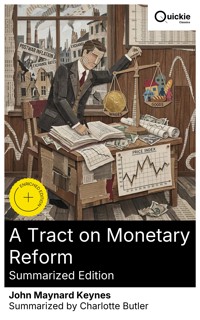
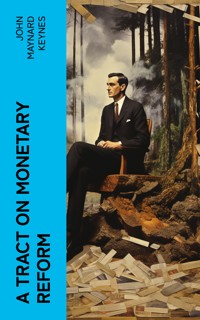
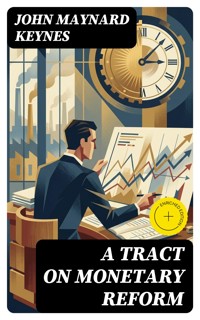
Published in 1923, A Tract on Monetary Reform is a lucid diagnosis of post–World War I monetary disorder and a manifesto for stabilizing the domestic price level. Combining crisp polemic with empirical care, Keynes dissects inflation and deflation as "arbitrary and inequitable" redistributions, reframes the quantity theory as a practical guide to policy, and urges a managed currency over mechanical fidelity to gold. He advances index-number stabilization and assigns central banks the duty of safeguarding the internal value of money, warning against restoring prewar parities; the lapidary reminder, "in the long run we are all dead," punctuates his impatience with purely long-run cures. Keynes wrote as a Cambridge economist and seasoned Treasury official, shaped by wartime finance and the Versailles aftermath. His close observation of European hyperinflations and British deflation, together with looming plans to return to gold, compelled a brisk, unsentimental treatise in which statistical reasoning, institutional detail, and policy design are inseparable. This book merits close reading by economists, historians, and policymakers concerned with inflation targeting, central bank mandates, and the perennial trade-offs of monetary regimes. Clear, compact, and prescient, it illuminates the foundations of modern monetary policy while remaining acutely relevant to today's dilemmas of price stability and financial credibility. Quickie Classics summarizes timeless works with precision, preserving the author's voice and keeping the prose clear, fast, and readable—distilled, never diluted. Enriched Edition extras: Introduction · Synopsis · Historical Context · Author Biography · Brief Analysis · 4 Reflection Q&As · Editorial Footnotes.
Das E-Book können Sie in Legimi-Apps oder einer beliebigen App lesen, die das folgende Format unterstützen:
Veröffentlichungsjahr: 2026
Ähnliche





A Tract on Monetary Reform (Summarized Edition)
Table of Contents
Introduction
At the heart of A Tract on Monetary Reform lies a choice between the rigid comfort of rules and the living demand for stability in everyday prices. John Maynard Keynes frames money not as a neutral veil but as an institution whose mismanagement distorts contracts, savings, and production. He presses readers to confront how shifts in purchasing power rearrange society’s burdens, while resisting dogma that treats mechanisms as ends in themselves. The book’s driving question is practical: what policies best preserve orderly exchange and confidence? By centering consequences rather than creed, Keynes invites an empirically grounded, humane approach to monetary design.
First issued in 1923, this non-fiction economic treatise emerges from the unsettled monetary landscape of the early postwar years. Prices had swung violently, exchange rates were unstable, and policymakers debated whether and how to restore the prewar gold standard. The work addresses chiefly the British and European context while speaking to broader international concerns, melding policy analysis with timely diagnosis. Keynes writes as a scholar steeped in public affairs, bringing a clear, argumentative voice to problems that had moved from seminar rooms to parliaments and central banks. The era’s tensions—fiscal strains, reparations, and shifting trade patterns—form the backdrop to his intervention.
As premise, the book scrutinizes the consequences of unstable price levels for the web of contracts that binds savers, borrowers, workers, and firms, and it evaluates alternative policy instruments for achieving steadier purchasing power. Readers encounter a blend of narrative reasoning and compact numerical illustration, designed for the informed generalist as well as the practitioner. The tone is pragmatic, persistent, and occasionally sharp, yet the prose remains remarkably lucid. Rather than constructing an abstract system, Keynes tests policies against their observable effects, arguing for an approach that equips the monetary authority to focus on domestic stability in a turbulent world.
Core themes assemble around the social distribution of gains and losses from monetary change, the fragility of long-term commitments when the price level wobbles, and the institutional responsibilities of central banks and treasuries. Keynes stresses that both rising and falling prices can misalign incentives and unsettle production, though in distinct ways, and he probes their political ramifications. He examines how external currency commitments can constrain national goals, and how credibility must be earned rather than proclaimed. Throughout, the analysis links technical mechanisms to human outcomes, insisting that sound policy be judged by its capacity to sustain confidence, investment, and employment.
For contemporary readers, the book resonates with debates over inflation targeting, exchange-rate regimes, and the scope of discretion central banks should possess. Its counsel that policy be oriented toward the stability of everyday transactions rather than the prestige of fixed arrangements continues to inform how institutions balance domestic objectives with external commitments. In a world of fiat currencies and mobile capital, the practical questions it poses—how to anchor expectations, how to coordinate fiscal and monetary aims, how to distribute adjustment burdens fairly—remain pressing. The Tract offers a vocabulary and framework for assessing trade-offs that still organize policy choices.
The reading experience rewards patience and curiosity. Keynes combines historical reflection with policy craft, builds definitions carefully, and uses concrete examples to make abstract dynamics graspable without heavy formalism. The voice is authoritative yet exploratory, inviting the reader to test generalizations against evidence and to prefer instruments that work to policies that merely signal resolve. Because the argument develops step by step, attention to transitions repays the effort, and period-specific references enrich rather than obscure the analysis. The result is a tract in the original sense: a compact, persuasive case aimed at shaping practice as much as understanding.
Approached today, A Tract on Monetary Reform functions as both diagnosis and guide, encouraging readers to think in terms of consequences, distribution, and institutional capacity. It does not demand assent to a single blueprint; instead it equips one to interrogate rules, targets, and trade-offs under changing conditions. By foregrounding the lived effects of price instability and the limits of mechanical discipline, Keynes reframes monetary policy as a civic responsibility, not a technocratic ritual. The book endures because it clarifies what is at stake when societies choose how money should behave: the fairness of exchange, the trust in contracts, and the tempo of recovery.
Synopsis
John Maynard Keynes’s A Tract on Monetary Reform, published in 1923, addresses the instability of money in the aftermath of the First World War. Written for policymakers and the educated public, it seeks to clarify how changes in the value of money disturb economic life and to outline practical remedies. Keynes situates his analysis in a period marked by rapid inflation in parts of Europe and intense British debate over restoring prewar monetary arrangements. He frames the book as a guide to thinking coherently about monetary objectives and instruments, urging a clear hierarchy of aims and a candid appraisal of the trade-offs policymakers face.
The Tract begins by clarifying the concept of the value of money and its determinants. Keynes emphasizes the centrality of the price level as the summary measure of money’s purchasing power and examines how money, credit conditions, output, and the velocity of circulation interact. He accepts the usefulness of quantity-theory reasoning as a framework but cautions against treating its relationships as fixed or mechanical. He underscores the complexity of lags, expectations, and institutional settings. From the outset, his analytical focus is practical: before prescribing reforms, one must grasp how monetary changes work through the economy and why measurement matters.
Keynes then assesses the social and economic consequences of inflation and deflation. He highlights how unanticipated movements in prices redistribute wealth between creditors and debtors, unsettle long-term contracts, and complicate savings and investment decisions. Inflation can erode trust and favor speculation over productive enterprise, while deflation can depress profits and employment, making adjustment painful and prolonged. The core concern is not simply that prices move, but that instability undermines confidence and blurs relative price signals. The chapter builds a case for prioritizing stability in the purchasing power of money as a precondition for orderly economic behavior and credible financial commitments.
Turning to public finance, Keynes discusses the means by which governments, especially in wartime and its aftermath, may inadvertently drive monetary instability. He examines the links between budget deficits, the financing mix of taxation, borrowing, and money creation, and the resulting pressures on prices and exchange rates. While recognizing the urgency that often underlies such choices, he warns that persistent reliance on monetary finance invites cumulative depreciation of the currency. The analysis underscores the importance of transparent fiscal policy and sustainable debt management as complements to monetary stewardship, since the credibility of the monetary regime is inseparable from the state’s broader financial position.
A central theme is the tension between external and internal objectives—specifically, between stabilizing the exchange rate and stabilizing the domestic price level. Keynes reviews the prewar gold standard’s attractions and its breakdown during the war, noting the difficulties of restoring old parities in altered economic circumstances. He argues that slavish adherence to a fixed external value can force disruptive internal adjustments, particularly if it requires deflation to meet an outdated benchmark. The Tract urges that domestic price stability take precedence, with external policy adapted accordingly, rather than sacrificing internal balance to a rigid exchange-rate target.
Because stability cannot be pursued without measurement, Keynes devotes sustained attention to index numbers and their construction. He surveys practical problems—choice of commodities, weighting schemes, and statistical reliability—yet concludes that well-constructed indices are sufficiently robust to guide policy. The objective, he argues, should be to keep the general price level reasonably stable over time, recognizing that perfect precision is unattainable. By making the target explicit and measurable, index numbers provide both a criterion for success and a discipline for authorities, reducing the scope for ad hoc responses driven by short-term pressures or incomplete information.
The Tract then outlines the instruments by which a central bank can influence monetary conditions. Keynes emphasizes the policy rate and open-market operations as the primary levers for regulating credit and the money supply. He stresses the role of expectations and the need for steady, intelligible signals from the authorities. Institutional capacity and clarity of mandate matter: authorities must be equipped to act promptly and be judged by a transparent objective—stabilizing the price level. He cautions against purely automatic rules, given uncertain lags and shifting conditions, advocating instead informed discretion guided by the chosen stabilization criterion.
Keynes also considers the international dimension, in which one country’s policy stance can transmit pressures to others through trade, capital flows, and reserve movements. He evaluates how alternative exchange arrangements interact with domestic stabilization goals, arguing that international monetary order is best served when major countries pursue coherent internal objectives and cooperate where necessary. He allows that intervention to smooth abrupt disturbances can be warranted, provided it does not compromise the primary aim of internal stability. The discussion situates national reform within a wider system, highlighting both the constraints and the opportunities for coordination.




