


9,99 €
Mehr erfahren.
- Herausgeber: The History Press
- Kategorie: Geisteswissenschaft
- Sprache: Englisch
In 1938 Brian Kingcome joined the RAF with a permanent commission and was posted to No 65 Fighter Squadron at Hornchurch, soon to be equipped with the Spitfire, and so it came about that Brian flew the Spitfire throughout the war. He became acting CO for No 92 Squadron at Biggin Hill and led over sixty operations, achieving the highest success rate of any squadron in the Battle of Britain. In May 1943 Brian joined Desert Air Force in Malta and took command of 244 Wing. At this time he was confirmed Flight Lieutenant, acting Squadron Leader, acting Wing Commander and at twenty-five was one of the youngest Group Captains in the Royal Air Force. Brian Kingcome may have been the last Battle of Britain pilot of repute to put his extraordinary story into print; looked upon by other members of his squadron as possibly their finest pilot, his nonetheless unassuming memoirs are related with a subtle and compassionate regard for a generation who were, as he felt, born to a specific task. Brian's memoirs have been edited and introduced by Peter Ford, ex-National Serviceman in Malaya.
Das E-Book können Sie in Legimi-Apps oder einer beliebigen App lesen, die das folgende Format unterstützen:
Veröffentlichungsjahr: 2016
Ähnliche




















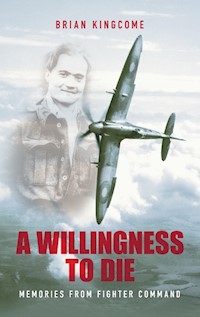
A WILLINGNESS TO DIE
MEMORIES FROM FIGHTER COMMAND
A WILLINGNESS TO DIE
MEMORIES FROM FIGHTER COMMAND
BRIAN KINGCOME
Frontispiece: Brian Kingcome, by Cuthbert Orde
First published in 1999 by Tempus Publishing
This edition published in 2006
Reprinted in 2008 by
The History Press
The Mill, Brimscombe Port,
Stroud, Gloucestershire, GL5 2QG
www.thehistorypress.co.uk
This ebook edition first published in 2016
All rights reserved
© Lesley Kingcome 2006, 2008
The right of Brian Kingcome to be identified as the Author of this work has been asserted in accordance with the Copyrights, Designs and Patents Act 1988.
This ebook is copyright material and must not be copied, reproduced, transferred, distributed, leased, licensed or publicly performed or used in any way except as specifically permitted in writing by the publishers, as allowed under the terms and conditions under which it was purchased or as strictly permitted by applicable copyright law. Any unauthorised distribution or use of this text may be a direct infringement of the author’s and publisher’s rights, and those responsible may be liable in law accordingly.
EPUB ISBN 978 0 7524 7350 5
Typesetting and origination by Tempus Publishing Limited.
eBook converted by Geethik Technologies
CONTENTS
AUTHOR’S NOTE
FOREWORD BY GEOFFREY WELLUM
INTRODUCTION BY PETER FORD
PROLOGUE: RAF HORNCHURCH, 1939
ONE
A MINGLED EDUCATION
TWO
THE CALL OF THE AIR
THREE
LOSING FACE AND GAINING WINGS
FOUR
THE TRAINING GROUND
FIVE
THE PHONEY WAR AND THE REAL THING
SIX
92 SQUADRON: EARLY DAYS
SEVEN
COMING DOWN TO EARTH
EIGHT
THE CHANNEL DASH
NINE
THE ENIGMA OF THE MORLAIX RAID
TEN
PROSPECTS OF ITALY
ELEVEN
WINDING DOWN
TWELVE
HEADLINES
EPILOGUE
BIGGIN HILL, 1940–42
APPENDIX ONE
A BRIEF SUMMARY OF BRIAN KINGCOME’S SERVICE RECORD
APPENDIX TWO
SUMMARY OF AERIAL VICTORIES
APPENDIX THREE
LETTER FROM TONY BRUCE
APPENDIX FOUR
EULOGY FOR BRIAN KINGCOME
TO MY MINDER
AUTHOR’S NOTE
Anyone looking for a chronological sequence of events won’t find it here. I’m no diarist, have no notes and a fading memory which at its best was never strong. I wanted to call this book ‘The Ramblings of a Geriatric Ex-Fighter Pilot’. I was restrained, mainly by my wife whose benevolent terrorism, thank God, controls my life. Nonetheless the title would have been apt, for that’s what it’s really all about. There’s a vague chronological thread where time seemed the most logical link, but in many instances it isn’t and indeed is often an irrelevance.
In my mind events are linked by many factors often transcending the barriers of time, sometimes by a similarity of the events themselves, sometimes by the atmosphere they evoked, often by the sounds, the smells, the emotions, the fears, the passions they triggered. These are the paths down which my memory led me and which I’ve cheerfully followed when they seemed more natural than those dictated by a slavish subservience to calendar and clock.
This book is no more and no less than a brief glimpse into ‘long ago’ times and places by an eyewitness who considers himself lucky to have been born into that era. Interest in them may now have waned. If so, or if my chronological untidiness proves too confusing, I shall of course be disappointed but ritual suicide will remain low on my list of priorities.
I’ve enjoyed reviving memories I’d thought long dead.
And worse things happen at sea.
Brian Kingcome, DSO, DFC, Erstwhile Group Captain RAF, Devon.
FOREWORD BY GEOFFREY WELLUM
In early June 1940 and as a newly trained, very young and junior pilot officer, I was posted to and joined 92 Squadron. I immediately became aware of a tall rather nonchalant Flt Lt with a captivating personality. He was introduced to me as my Flight Commander, Flt Lt Brian Kingcome. Immediately, on first acquaintance, he commanded my greatest respect and during my time with 92 Squadron, from June 1940 until August/September 1941, I bent the knee to only one person, one Brian Kingcome.
During the Battle of Britain we lost four Commanding Officers but the squadron was led and indeed held together, during Fighter Command’s most testing time in September 1940 and during its greatest days, by Brian.
He led from the front. He was a ‘come-oner’ and not a ‘go-oner’ and as a result earned the deepest respect and affection from all those who were fortunate enough to follow him into battle. Brian Kingcome was 92 Squadron.
This book makes for compelling reading and portrays a man, fighter pilot and leader of the highest quality, a man who could look any other man straight in the eye.
Sqn Ldr Geoffrey H.A. Wellum, DFC
First Light by Geoffrey Wellum is published by Penguin.
INTRODUCTION
I corresponded with Brian Kingcome only once. He was then about two thirds of the way through drafting the story of his early life and his wartime service as a fighter pilot, and he wanted an opinion on how he was getting on with it. To enable himself to write it he had bought an already venerable second word processor and was knocking out his memoirs on a basis of association as thoughts occurred to him – one recollection leading to the next.
The result was a text with problems for which solutions would need to be found. On the other hand, it was a manuscript with personality and charm that had points to make, and it was saying them in a way that made their tone quite distinct from that of much other wartime reminiscence. There was a powerful aversion in its viewpoint to the clichés of writing about war in general and of the experiences of Second World War battle pilots in particular.
A Willingness to Die was clearly a book with the potential to be published, especially since it came from someone whose name was a legend among the airmen of his generation. Kingcome was writing it, as he said, in the only way he could think of, off the top of his head. This being so, it seemed important not to stem the flow by putting forward ideas about editorial discipline. At that stage the priority was to urge him to continue and to make sure he was getting down everything he had it in mind to say. Tactful advice with editorial technicalities could follow when there was a completed manuscript draft. Some months later, on 14 February 1994, Brian Kingcome died suddenly.
He was still working on his text, and no one can say how much more he might have written. Nor can anyone say how the book might have turned out if he had been able to work on his draft armed with editorial comment and his own second thoughts. At a guess he might have added another thirty or forty pages to give more details of his time in Italy during the last stages of the war (particularly of his atypical experiences with 205 Bomber Group) and the early months of peace in the Middle East and Austria. The text has had to be shaped from the material he did produce. The last, post-war part of his RAF career was covered by little more than synopsis notes.
The editing has involved breaking down the text and rebuilding it to allow the emergence of a narrative thread (which happens to be broadly chronological, whether or not this would have appealed to Kingcome). Inevitably there has been rewriting as well as some writing in to provide links. In this case I have, in the role of editor, had to be more of a locum tenens for the author than usual. At every stage there has been the need to preserve, sometimes to enhance, Kingcome’s ‘voice’, and to avoid putting words in his mouth that might ring false. This has been the basic challenge of the manuscript as he left it.
⋆ ⋆ ⋆
Brian Kingcome belonged to a generation for which the romance of the air was still pristine, before the growth of air travel had made flying a commonplace. It was still possible in the 1930s for the aspiring pilot to feel he was joining the ranks of the frontiers men, pushing back the barriers of the element of air and exploring where men had never been before while gaining an entirely new perspective on the world stretched out below. The novelist David Garnett, author of Lady into Fox and The Sailor’s Return, described this freshness and exhilaration vividly in A Rabbit in the Air (1931), the diary he published about his civilian adventure in learning to fly in a Bluebird Mark III and a Tiger Moth between 1929 and 1931 as a ‘mature student’ in his late twenties.
I took her in and landed. I was drunk with air. I was wild, and driving home sang and shouted, full of realisation that we have found a new freedom – a new Ocean. For thousands of years we have crawled or run on the earth, or paddled across the seas, and all the while there has been this great ocean just above us in which at last we sail with joy. The longing for the sea: the call of the sea, one has heard of that, and that was the natural adventure in the past. But now it is a longing for the air, to go up.
Brian Kingcome came under this same spell while he was still at school, and all his early years may be seen as providing a background to the story of an airman in the making. It seems a natural outcome when, after leaving school in 1936, he goes to Cranwell RAF College as a flight cadet. Combined with this was another romantic conviction: pilots were going to be needed, since Europe was inevitably moving towards a Second World War despite the illusions of the appeasers; and when war came the fighter pilot would be uniquely placed to conduct his part in it. The skies were destined to be the last bastion of individual chivalry.
Within only a few short years the realities of war would provide sharp correctives to such a naïve notion, as we shall see. Kingcome’s friend and colleague, Sir Hugh ‘Cocky’ Dundas, gave a graphic description in his own memoirs, Flying Start (1988), of what it felt like to be alone in the cockpit of an aeroplane, engaging the enemy for the first time. Above the seas at Dunkirk during Operation Dynamo Cocky had discovered in himself little but panic, confusion, an instinct to live and the draining away from his mind of everything he had been taught. As he came back to land at Rochford airfield, behind Southend, however, he found that ‘a sense of jubilation replaced the cravenness of a few minutes earlier’.
I was transformed, Walter Mitty-like: now a debonair young fighter pilot, rising twenty, proud and delighted that he had fired his guns in a real dog-fight, even though he had not hit anything, sat in the cockpit which had so recently been occupied by a frightened child…
As an operator in combat Kingcome soon gave proof of his natural aptitude. By Dunkirk he was serving with 92 Squadron, which then went for a time to South Wales before moving to Biggin Hill at the height of the Battle of Britain. The official score for the ‘kills’ he made was always thought to be an underestimate by his fellow airmen as well as by later historians. The final figure at the end of his active service stood at eighteen enemy aircraft and included a number of German bombers. In part the uncertainty surrounding this figure may be attributed to the scorn he felt for the idea of keeping a precise tally. ‘Of course I used up a lot of ammunition on 109s in the Battle of Britain – who didn’t – but I don’t remember claiming many kills’, he wrote. ‘In my experience there was usually too much going on upstairs to spend time following victims down to the ground for confirmation of a kill.’ The need to follow a stricken plane down to be sure of a ‘kill’ in turn made a pilot vulnerable and left other possible targets free to attack again or escape. As Kingcome’s obituarist in The Times suggested, ‘He was without that sometimes fatal curiosity, and perhaps his relaxed attitude to combat statistics was, in the long run, his salvation’.
In Brian Kingcome’s view, any attempts to draw comparisons between pilots was invidious. Those who stood outside the circle may have seen personal scores as a reliable yardstick, but the pilots themselves knew it was a grey area. Such claims were never likely to be able to bear too close a scrutiny. There was no such thing as a typical pilot personality. The warriors of the air were made up from a cross-section of people whose aspirations and reactions varied as widely as they would in a cross-section from any other walk in life. Some pilots saw big personal scores as an ultimate aim, but others were indifferent to trophies. Some loathed the limelight and avoided publicity while others were hungry for the spotlight and applause. There were also those who were natural hunters, stalking their prey and closing in for the kill, and among the leaders were those who ruthlessly put their own interests first and those who selflessly thought first of the men they were leading. In an aside trimmed from the present text Kingcome wrote:
The controversial claims in the Battle of Britain were the sum total of many factors, but I suspect were mainly the results of duplication. No one without personal experience of being centre stage in a sky literally a maelstrom of aircraft in all attitudes, diving, climbing, spinning, some on fire, some smoking, some breaking up, dodging, ducking, weaving, searching frantically for targets, can understand how simple it would be in the heat of battle, with adrenaline racing, for two or more pilots to believe quite genuinely they had each destroyed the same aircraft. But to me, and to the majority of the pilots involved, these are all irrelevancies. The Battle of Britain and the battles that followed weren’t numbers games, except for an insignificant majority. Who cared whether Smith claimed five and Jones fifty-five? We had a job. It wasn’t about personalities or personal achievement. In 1940 it was about fighting-off invading hordes, about freedom and subjugation, and between them the Smiths and Jones’s, their colleagues and friends, defeated their own fears and, in so doing, the enemy. That’s all that history needs to know.
He was repelled by derring-do accounts of aerial battle, and the idea that the situation had produced men who could be singled out as heroes or that the job they did was in any way heroic was an anathema to him for similar reasons. At a ball given at the Savoy Hotel in 1990 to mark the fiftieth anniversary of the Battle of Britain he reacted brusquely to a conversational remark made by the columnist Barbara Amiel to the effect that, ‘To us you were all heroes.’ Later, fearing he may have overdone it, he wrote her a letter of ‘apologia’ to clarify his feelings:
I think it quite wrong that, because the B of B turned out to be quite an important event in retrospect, the participants should be automatically classed as ‘heroes’. Why can’t they just talk about B of B pilots? Why does it always have to be heroes? I think it devalues the word and denigrates all those others who were called on to face just as great odds and whose contribution and sacrifices are just as great, but whose exploits hadn’t been pushed into the public eye by Churchill’s splendid oratory. Dying is what’s important, not the time and place you did it. If we’re not very careful we’ll start believing our own publicity, and I see a time when we’ll start wearing our medals on our pyjamas.
Brian Kingcome’s diffidence in these matters went back to the very beginning of the war. He was notorious for never having maintained or kept his flight logbooks, and when it came to souvenirs of any kind was determinedly unsentimental. No material of this sort therefore survives and the loss is ours. On the other hand, he wrote his draft for A Willingness to Die with no prompts at his elbow except his memory. What he put into the manuscript is what he wished to put in and what he wished to survive of his story. This gives us his human quality. To try to reconstruct the frantic minutes or seconds of long-ago air battles in mock-up recollections would have been to his mind a false and purposeless exercise.
We can see that he had his point about ‘heroes’ when we consider how wartime pilots like Richard Hillary and Guy Gibson have, in recent studies, been put through the mill of deconstruction and brought down to earth as flawed personalities. Heroes come into being only because society has a need for them. These figures do not, on the whole, pin the label on themselves and it may be unfair to their memory to pass them the blame, whatever their other failings. Hillary certainly stands reproached for contributing to the mythologizing of the fighter-pilot experience, even though it was his stated intention in The Last Enemy (1942) to strip away much that was ‘untrue and misleading… written on the pilot in this war’. The author and critic John Lehmann, writing in the second volume of his autobiography, I Am My Brother (1960), felt that; ‘the mystique that surrounded Hillary, and the doom that seemed to pursue that brave and tortured young man like a lover, cast a glamour over the prose expression that was not, I believe, inherent in it’. Even so, The Last Enemy was ‘a classic description of the discovery by an apparently disaffected young English cynic that when it came to the point, he was neither disaffected nor cynical but braver and with a deeper feeling for what his country stood for than most of the patriotic tub thumpers. I shall never forget the sight of his smiling, mask-like, re-made face at a party of Sybil Colefax’s not long before his death’.
Hillary died crashing an aged Blenheim bomber on a night-training flight. His first biographer, Lovat Dickson, cited the last will and testament found in his locker as his ‘authentic voice’ in Richard Hillary (1950):
I want no one to go into mourning for me. As to whether I am buried or cremated, it is immaterial to me, but as the flames have had one try, I suggest they might get their man in the end.
There is in this a rhetorical hint of measuring up to spar with destiny, but as Brian Kingcome might have responded, wartime is full of these sorts of individual tragedy and for the most part they are never chronicled or noted. We also have to recognise the uniqueness of these experiences for those who went through them and survived. It is a notable feeling among survivors that only those who shared an existence on the edge can truly understand how it was for them and that ultimately this can never be fully communicated to another soul. The phenomenon applies to many groups as much as to the fighter pilot: to the men who fought in the Western Desert, for instance; to the shamefully unsung merchant seamen of the North Atlantic convoys; to the prisoners of war in Germany and the Far East; to the relative handful of persecuted humanity that emerged from the Nazis’ labour and ex-termination camps.
Another aspect of the specific experience of the airmen that set them apart, especially during the battle on the Home Front, was the extreme contrast between being one moment high in the air in a life-or-death situation and the next, back on the ground, in the total ‘normality’ of the village pub among people who did not fly. At a time when life was uncertain, when the example of sudden, violent death was something that in some way or other touched everyone you knew, it became necessary to cultivate a distance and an apparent invulnerability to emotion. There was no time for the luxury of the ‘stages of grief’ in response to the loss of comrades, and relationships with the opposite sex held no guarantee of having a future. The prevailing self-protective style, which aimed to take these things lightly, concealed complexities that were rarely explored in British films of the war period. The ‘stiff upper lip’ syndrome was thus by the early 1960s a ripe target for parody in the Beyond the Fringe revue. Yet the mask had been necessary and it did not detract from a determination to enjoy life, since that aspect too was intensified and the old habits of mind remained in place once the war was over.
The only WAAF officer in the British Zone in Austria in 1946 recollected how it was when Brian Kingcome arrived to take over as the CO of 324 Wing at Zeltweg. Initially she was apprehensive that she might no longer be asked for weekends to ‘Snobs’ Corner’ as the house in which the CO lived with his support officers was known. Before long an invitation arrived.
At first I didn’t really take to Brian Kingcome, although I could see that here was the prototype – the person that all the young pilots wished to emulate. A cat that walked by his lone, one of the ‘over-promoted, over-decorated young men’ as someone has described them, who were the heroes in the RAF. The glamour was real, so also the charm and the strong personality, the quick decisions. ‘Daggers’ Rees, his Squadron Leader Admin. [Lord Rees, who as Merlyn Rees the Labour MP for Morley and Leeds South and Secretary of State for Northern Ireland], once told me that Kingcome was a very efficient Commanding Officer, who knew everything that was going on in his wing, despite his rather aloof manner and apparent lack of interest in anything other than having a good party as often as possible. I grew to enjoy Brian’s quickness of mind and instant understanding of anything one said and luckily he found me amusing and invited me to continue my weekend visits. Often there would be a party – sometimes we’d sit around at Snobs’ Corner, then go over to the officers’ mess on the airfield for a while and spend a quiet evening. A ‘snapshot’ of memory comes to mind of Brian stalking into the mess one evening, his two large dogs at his heels – Melly, an Alsatian bitch, and Wilma, a young Great Dane and me a couple of paces behind. He was tall and walked faster than I did, but it was also that he couldn’t bear to feel that he was encumbered by any girl. He liked women, and being very attractive had always had decorative female companions, but they must not become in any way possessive or dependent. This amused and suited me then as I was equally determined not to belong to only one person whilst I was one of the very few girls in an almost all-male world. To be labelled as so-and-so’s girlfriend was not my line. Luckily the pilots liked having me around as a person. The lovely Austrian spring and early summer of 1946 remain forever in my mind as a time of pure happiness. An island in one’s life, a summer’s lease of all too short a date. When Barney Beresford [Brian Kingcome’s predecessor at 324 Wing] flew in for a week’s leave my happiness was complete. Brian and Barney and a couple of the squadron commanders drove down to Venice, taking me with them and we were allotted rooms in the Daniele by the Town Major at 25c. a night. During one lunch party at Harry’s Bar Brian became convinced that the steaks were made of horse meat and got me to ask in Italian if they ever had beef. This caused quite an angry exchange – but we ate the meat anyway. Brian loved Venice and had an idea that some of his American ancestors had come from there.
In the opinion of many of Kingcome’s colleagues, including P. B. ‘Laddie’ Lucas, the only factor that stopped Brian Kingcome going all the way to the top in the RAF after the war was the breakdown in health that led to his resignation from the service when he was still only in his early thirties. Lucas added one other qualification: that Kingcome would have needed to modify some of his attitudes to seniority and hierarchy. In the funeral address he gave for Kingcome, Cocky Dundas told a story from the brief period when he was in partnership in a luxury car-hire business with his former RAF colleague and friend, Wing Commander Paddy Barthropp. Barthropp happened to overhear a conversation that Kingcome was having with one of their regular clients, the Duke of Beaufort, who needed a car to meet him in London at Paddington Station and gave warning that he would be carrying a particularly long fishing rod. ‘What a lucky duke you are,’ Kingcome responded. ‘We have a particularly long car for you.’
An aspect of his post-war career that Kingcome would certainly have told us more about if he had lived was the time he spent flirting with the film industry. The references he makes to it are frustratingly brief and incomplete, though we do also know that he worked on a script for a film version of Bruce Marshall’s The White Rabbit, a book that was a best-seller in its day, despite being a broken-backed telling of the story of Wing Commander ‘Tommy’ Yeo-Thomas, the SOE agent who was captured in France and withstood the most horrific tortures of the Gestapo before being sent to Buchenwald, which he survived. Among others who worked on the script was the novelist Jack Trevor Story, and at one stage Twentieth Century-Fox were seeking to produce it. Kenneth More was front runner to play Yeo-Thomas, and the actor delayed other lucrative commitments for a year in the hope of the film being made. Unfortunately complexities over copyright proved insurmountable and the project was abandoned, though More did not let his personal ambition disappear from view. Later in the 1960s, on the crest of the acclaim he received for his playing of Young Jolyon in The Forsyte Saga television series, he took the book to David Attenborough, who was then head of Features at the BBC. By the terms of its charter the BBC could get round the rights difficulties, but only on condition that the production would never be repeated or sold. The result was a four-part series that had one transmission. Afterwards the tapes were destroyed.
There seems to be no doubt that Kingcome extracted enormous enjoyment from his fringe involvements with the film industry, though he also realised that its brittleness and tendency to self-admiration went against his personal grain. Integrity was something fundamental to him at every level, and this in itself created difficulties for him as he sought to find his way within a civilian existence. He found himself going through a very hard period of adjustment, made even harder by the lack of an emotional centre and the apparent blindness of the business world to what his personal qualities had to offer. ‘A job for life’ was still regarded as an ideal to be aimed for; people in management stayed put, and often stagnated where they happened to be. Indeed, a poor quality of management was one of the root causes of Britain’s post-war industrial troubles. Ideas about flexibility of employment and the transferability of technical and management skills between various areas of activity would have to wait many years before they came to be seen as something that was socially desirable besides offering potential scope for the creativity and fulfilment of the individual.
In time the years of struggle led towards a personal resolution. He married Lesley Shute, a granddaughter of Sir Hector Macneal and the daughter of a squadron leader who had died in the war, and he became a family man. Together he and his wife eventually founded and built up a successful company called Kingcome Sofas, a design manufacture business widely recognised for the hand-crafted qualities of its furniture. To this he was able to apply the same principles and standards that had marked out his service career. At his funeral Cocky Dundas singled out the ‘four key attributes that made him the man he was and enabled him to do the things he did. They were courage, determination, a total lack of pomposity or self-importance and an everlasting lightness of heart and touch.’ These values governed his dealings with others on a personal and business level in the same way that they had gone to create the extraordinary leadership qualities which made him such an outstanding squadron leader during the crisis of the Battle of Britain. More than fifty years later one of the survivors who had served with him in 92 Squadron commented after he died, ‘He really was 92 Squadron and all its spirit’.
⋆ ⋆ ⋆
The Epilogue was originally published in Air Fair Biggin Hill and the Independent on Sunday, and both I and Kingcome’s family are grateful to the respective editors for permission to reprint it here.
⋆ ⋆ ⋆
For advice with preparing the text of A Willingness to Die for publication, I would like to record a debt to the late Wing Commander P.B. ‘Laddie’ Lucas, who kindly read through all the chapters concerning the war years and made several valuable points and corrections. I am also grateful to Sebastian Cox, Head of Air Historical Branch (RAF) at the Ministry of Defence, for giving Chapter 9, on the Morlaix raid, a detailed check to help with clarifying the squadrons that took part and also to correct several errors which might otherwise have slipped by. (It should perhaps be noted that Kingcome’s memories of this abortive venture and his theories about the reasons for its failure do not necessarily coincide at every point with the conclusions of the original official investigation; but since he was a major protagonist in the operation it seems right that his eyewitness account should stand as a valid contribution to the record.) Above all I am indebted to Lesley Kingcome, the ‘minder’ of Brian’s dedication, whose ‘benevolent terrorism’, he said, ‘thank the Lord, controls my life’. She has given her support patiently throughout and has reassured me on numerous occasions that the editorial treatment was managing to catch and hold Brian Kingcome’s authentic style and tone of voice.
Peter Ford OrkneyJanuary 1999
PROLOGUE
RAF HORNCHURCH, 1939
There are occasions so momentous, like the assassination of President Kennedy, that they become proverbial for all those who heard the news, who remember for ever after where they were at the time. An earlier such moment came at fifteen minutes past eleven o’clock on the Sunday morning of 3 September 1939. The indelible scene in my memory is of a dozen or so of us, young men in our late teens and early twenties, sitting, sprawling or leaning against the walls in the flight office of 65 Fighter Squadron, based at Royal Air Force Hornchurch on the eastern edge of London and therefore strategically placed at the forefront of our country’s air defences. The volume of the wireless has been turned up as the doom-filled voice of Neville Chamberlain, the British Prime Minister, falteringly informs us that ‘a state of war now exists between Great Britain and Germany’.
As I glance around at my fellow-pilots I wonder how they feel as the Prime Minister’s voice, broken with sorrow and despair, crushed by an ultimate failure to avoid tragedy, announces the onset of this new era of death and destruction to a listening public not yet free from memories of the horrors and bereavements of the slaughter in the trenches of the Western Front only twenty years before. The same public is no doubt expecting and hoping for a rousing call to arms, something to help it forget its recent tragedies and to gird its loins anew for the future struggle, yet this is not it, most certainly. My own strongest feeling is one of unreality. We ought to be spellbound, gripped by an overpowering sense of history in the making, of epic upheaval, change and challenge. Instead the words ring hollow. It is as if we are all actors in a poorly scripted play. Surely this grey, defeated voice coming over the airwaves cannot be that of the leader of the greatest empire the world has known? Where are the ringing phrases to kindle a fire in the belly, the inspired leadership, the confidence, the unswerving belief in an ultimate victory, however hard and long the road?
Only with difficulty do I shrug off the sense of unreality. Yet, if this is the real world, what does the future hold for us, a group of youthful airmen at the sharp edge of our country’s defences? The Royal Air Force is a new, young service, hardly more than twenty years old, and it has no historical yardstick to assess the future other than the aerial battles of the First World War. If those were anything to go by, then the life expectancy of a fighter pilot in wartime might be measured in hours, perhaps in days, maybe even in weeks, but rarely in months. Under the onslaught of these darting thoughts, the sense of unreality returns and deepens as I try to absorb the unavoidable implications. All of these around me, my good friends, and I myself, will be dead by Christmas. What common denominator can it be that has brought us together at this time, young men from every corner of empire and all walks of life, to face extinction on the threshold of our destinies?
There were, of course, the obvious reasons, the very arguments we had used to convince ourselves and our families when we decided to become fighter pilots, the hack stuff repeated endlessly and parrot-like: the challenge of elements to be conquered, new worlds to be explored, new frontiers to be crossed; a recognition of the dangers ahead and the penalties there would be for failing to confront them; a fatalistic belief instilled in our pre-nuclear generation of the recurring certainty of war in history; an instinctive chivalrous reaction to the bully and the jackboot. These rationalisations were all very plausible and, properly dressed up, they gave a satisfying impression of self-sacrifice and selflessness. Yet, when it came to it, did they reflect a reality – a truth?
There were those in the era of appeasement who believed, or so they argued, that talk and reason were the ultimate defences and that the wave of arrogant nationalism sweeping across Europe could be contained by words. Among those of us who had taken the ‘king’s shilling’, on the other hand, all patience with such cerebral elasticity had long ago been lost. Our plain pragmatism cut through the soothing smokescreen of words to what we saw as the stark reality beyond. In this imperfect world tyrants laughed at words seeing their use merely as a delaying tactic to be used for ruthless advantage. While diplomats debated, despots acted. In the meantime, a lust for power and physical domination had reached bursting point in the hearts and minds of new national leaders who had lived too long in the shadow of defeat. This was something never to be dissolved or deflected by persuasion or reasoning. There was one thing, and one thing only, that would stop them: Force.
At this point a doubt enters into my line of thought. Am I trying too hard to make crusaders out of us, ascribing a high-mindedness that simply did not exist? Perhaps we were motivated by nothing nobler than a mixture of boredom and bloody-mindedness. The latter is a wearisome weakness as a rule, though it can also be sublime in the right context, as I learnt years later when, after the war, I came across it at its most inspirational in the person of ‘Tommy’ Yeo-Thomas. He was arguably among the bravest of the brave in the Second World War, an Anglo Welshman born and brought up in France who became a manager to the Paris fashion house of the couturier Edward Molyneux. As soon as war broke out he volunteered for the RAF, but was too old for flying duties and instead was recruited, with his bilingual background to the Special Operations Executive (SOE), which co-ordinated undercover operations in Europe. Soon frustrated at being stuck in a desk job, he volunteered to train as an active agent and was dropped into occupied France on three occasions, and under the code-name ‘White Rabbit’ became a key element in the French Resistance.
Eventually the inevitable happened and he was captured by the Gestapo, who subjected him to almost three months of unrelenting, unspeakable torture and beatings. Entombed in solitary confinement, where the temptation to surrender is strongest, with no one to bear witness to acts of courage and day-by-day survival, no one to comfort or applaud, no contacts except for his inhuman tormentors, no break from the routine of hearing the rattle of keys in the lock before being dragged from a bare and freezing cell to endure more beatings and worse, he somehow summoned up extraordinary reserves of strength and never divulged a word. If he had been less valuable, the Germans would have killed him at an earlier stage, but the Gestapo badly wanted to keep him alive while they still hoped to wring a morsel of his priceless knowledge out of him. In the end, even, those master torturers had to admit defeat with grudging admiration. They packed him off to Buchenwald for extermination, and yet again underrated his indomitable will. Physically shattered he may have been, but in that desolate community of lost souls, among the doomed and dying for whom ‘hope’ and ‘future’ were forgotten words, his spirit triumphed over his broken body. Driving himself beyond conceivable limits, he once more contrived the impossible and escaped, making his way to the Allied lines as the Third Reich collapsed around him.
When I knew him after the war I asked him how on earth he had managed to resist the most crippling, agonising torture for hour after hour, day after day, week after week, when so few had been able to hold out for even the forty-eight hours needed to allow their contacts to disperse. What was this amazing force that he had been able to summon up, to give him a strength inconceivable to an ordinary mortal? ‘Well,’ he replied, ‘I was often on the point of giving them everything they wanted. But no one said please.’
I would never presume to compare our watered-down version with the unique, heroic brand of a ‘White Rabbit’, but was that what it boiled down to in our case too: bloody-mindedness? Is all this philosophising nothing more than an attempt by me to create a highfalutin image of us as an elite band of Arthurian knights of the air, hanging on to our haloes as we took off in defence of the realm? – pretentious poppycock and a flight of fancy? It would seem so, and perhaps it is just as well. Sainthood would have been a heavy burden to us. At our time of life it was a comfort to be down to earth, accepting that we were nothing more than a bunch of normal healthy young men, motivated by the normal healthy qualities of the young in every generation – an un-dramatic mix of patriotism, bloody-mindedness and the spirit of ad venture.
Since war was inevitable, then let any would-be foreign invader attempt to set foot in our country at his peril! We had seen the pattern forming in Europe and felt our hackles rise. We knew, even if the politicians and prattlers appeared not to, that the time for words was coming to an end, that only fighting back would break the emerging pattern, and that the consequence of not breaking it would be for our world as we knew it to be lost for ever. As a nation, we would lose our freedom and our dignity. We should be humbled, our pride extinguished, a conquered subject people.
And no one would ever again say, ‘Please’.
There was one other small but important ingredient, the link that completed the chain which bound us – too embarrassing ever to talk about, even to formulate into words, and most likely quite forgotten in a conscious sense. Yet at some stage it must have been recognised by each one of us, and become a chosen option, accepted before being dismissed and buried deep in the recesses of the mind. Without it none of us could have been in that room on that day, listening to the sombre, thin, defeated voice of Neville Chamberlain. It was the ingredient that gave reality to our unreal world, the positive bond – a very simple thing. It was a willingness to die.
ONE
A MINGLED EDUCATION
‘What are you going to do when you grow up my boy?’
The question was predictable enough, the standard opening conversational gambit of my parents’ friends whenever, as a schoolboy, I was introduced to them.
Among friends such a question was acceptable but asking about occupation was not the sort of approach you would take with a stranger. Nowadays it is a usual and convenient tactic for starting a conversational ball rolling when meeting someone for the first time, but in those more socially sensitive pre-war days it was a question to be avoided. A substantial portion of the public still had independent means from inherited wealth, and they would have been affronted by any suggestion that they needed to work for a living. My only problem with replying was that I had not the slightest clue what I should like to do, nor had 1 given the subject much thought. My fairly spasmodic upbringing had not steered me in any particular direction.
My father, Charles Kingcome, a Devonian whose family came from the then remote, unspoilt villages of Newton Ferrers and Noss Mayo, which sat astride the tidal waters of the River Yealm off Plymouth Sound and were linked by a foss that only surfaced at low water, had gone to India as a young man to work for a firm concerned with growing and exporting hemp. My mother, a most remarkable woman with a glorious independence of spirit, had been born as Ruby Fabris to peripatetic missionary parents, American citizens of English and Welsh origins, with a dash of ancient Italian blood to add piquancy to the mixture. They had taken off for China in the 1880s, and there Mother was born and continued to live until her early twenties. In that era when young ladies were expected to learn nothing more serious than household crafts and social graces, she felt bored by the prospect of such inactivity and limited horizons and studied shorthand and typing. She then landed a job working for a remote cousin, Colonel Sam Browne, best known for having designed the ‘Sam Brown’ belt, worn to this day by army officers.
The Boxer Rebellion having left her unscathed, she decided China had nothing more to offer within the limitations of the expatriate community and took off back to the United States on her own. She stayed in Boston for a time, supporting herself by her secretarial skills, then moved to Jersey in the Channel Islands for two or three further years, and afterwards went to Paris. There she met a young Frenchwoman, also of independent spirit, who became a life-long friend and whom I would meet years later and know as ‘Tante Jeanne’. They joined forces to set up an English-style tea shop, which, despite its ultra-respectability, represented an outrage to convention. Unperturbed, they ran it with great success for several years, until Mother’s feet began to itch again. She decided to give India a try, and it was on the boat sailing east that she met my father. He was returning from one of the six-month spells of home leave he was granted every two years.




