


32,99 €
Mehr erfahren.
- Herausgeber: John Wiley & Sons
- Kategorie: Fachliteratur
- Serie: ABC Series
- Sprache: Englisch
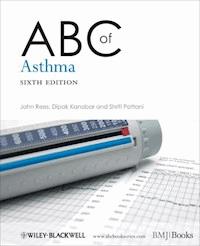
Asthma is a common condition with increasing prevalence. This new edition of the highly regarded ABC of Asthma has been thoroughly revised with reference to the latest British Thoracic Society guidelines on the management of asthma in children and adults. It covers the advances in practice and methods, with a new emphasis on delivery systems, self-dose assessment and delivery of care with different pharmacological approaches.
The ABC of Asthma is a concise, up-to-date overview of all aspects of asthma and includes two new chapters focussing on GP practice issues including clinical management and organisation of asthma care. It is ideal for GPs, junior doctors and medical students, nurses, and anyone dealing with the treatment of asthma in children and adults.
Sie lesen das E-Book in den Legimi-Apps auf:
Seitenzahl: 236
Veröffentlichungsjahr: 2013
Ähnliche



















Contents
Preface
CHAPTER 1 Definition and Pathology
Labelling
Pathology
Types of asthma
CHAPTER 2 Prevalence
Genetics
Genetic studies
Future investigations
Early environment
Genetic factors and clinical course
Family history
Smoking in pregnancy
Weight control
Analgesics
Diagnostic criteria in epidemiological studies
Prevalence figures
Changes in prevalence
CHAPTER 3 Diagnostic Testing and Monitoring
Recording airflow obstruction
Use of diary cards
Written asthma action plans
Responsiveness to bronchodilators
Measuring reversibility
Further review
Peak flow variation
Diurnal variation
Nocturnal attacks
Exercise testing
Other types of challenge
Airway hyper-responsiveness
Degree of responsiveness
Specific airway challenge
Skin tests
Differential diagnosis in adults
Asthma and COPD
Non-asthmatic wheezing
Vocal cord dysfunction
Hyperventilation syndrome
Monitoring asthma control Peak expiratory flow
CHAPTER 4 Clinical Course
‘Growing out’ of asthma
Likelihood of remission
Adult height
Prognosis in adults
Deaths from asthma
Need for rapid response
Diurnal variation
Inpatient management
Morbidity
Patient education
CHAPTER 5 Precipitating Factors
Bronchial hyper-responsiveness
Exercise
Allergens at home
Cockroaches
Pollens and spores
Allergic bronchopulmonary aspergillosis
Occupational asthma
Drug-induced asthma
Emotional factors
Pollution
Asthma and pregnancy
CHAPTER 6 General Management of Chronic Asthma
Guidelines
General features
Asthma clinics
Aims of management
CHAPTER 7
β-agonists
Long-acting β-agonists
Anticholinergic bronchodilators
Methylxanthines
Mast cell stabilisers
Inhaled corticosteroids
Oral corticosteroids
Combined preparations
Leukotriene antagonists
Anti-IgE monoclonal antibody
Steroid-sparing agents
Future treatments
Immunotherapy
Alternative treatments
Chapter 8 General Management of Acute Asthma
Assessment of severity
Peak flow monitoring
Breathlessness
Seeking help
Examination
Chest sounds
Peak flow readings
Blood gases
Hypoxia and hypercapnia
Where to treat acute asthma
Initial treatment
Dangers of under-treatment
CHAPTER 9 Treatment of Acute Asthma
Introduction
Oxygen
β-agonists
Use and availability of nebulisers
Parenteral delivery
Anticholinergic agents
Methylxanthines
Corticosteroids
Oral delivery
Intravenous delivery
Length of steroid course
Magnesium
Fluid and electrolytes
Potassium supplements
Antibiotics
Controlled ventilation
Other factors
Discharge from hospital
Subsequent management
Hospital follow-up
CHAPTER 10 Methods of Delivering Drugs
Metered dose inhalers
Breath-actuated aerosol inhalers
Metered dose inhaler propellants
Spacer devices
Dry powder inhalers
Soft mist inhalers
Nebulisers
Tablets and syrups
Injections and infusions
CHAPTER 11 Definition, Prevalence and Prevention
Defining asthma in children
Public health issues
Reasons for the increasing global prevalence
The relevance of atopy
Lymphocytes
Early exposure to infections
Trigger factors in asthma
The domestic environment
Smoking
Air pollution
Intervention
Airway inflammation and hyper-responsiveness
CHAPTER 12 Patterns of Illness and Diagnosis
Wheezing in infancy
Respiratory tract infections
Progression of asthma from childhood to adolescence
Predictability
Results of studies
Teenagers with asthma
Sympathetic consultation
Diagnosis of asthma
Presentation
Hypersecretory asthma
Lung function and other tests
Labelling
Assessment of severity
Mild asthma
Moderate asthma
Severe asthma
CHAPTER 13 Treatment
Pharmacological management
Partnership in management
Changing the environment
House dust mite
CHAPTER 14 Pharmacological Therapies for Asthma
Inhaled short-acting β2-agomsts (bronchodilators)
Prophylactic agents
Inhaled corticosteroids
Dose
Methods of delivery
Adverse effects
Long-acting β2-agonists
Leukotriene receptor antagonists
Omalizumab
Magnesium
Theophyllines
Inhaler devices
Aerosols and powders
Spacers
Nebulisers
Choice of device
The future
CHAPTER 15 Acute Severe Asthma
Oxygen and dehydration
Steroids
Antibiotics
Stabilisation
Clinical signs to monitor severity and response to treatment
CHAPTER 16 Clinical Aspects of Managing Asthma in Primary Care
Background
Initial diagnosis
History
Examination
Diagnosis
Differential diagnosis
Management
Triggers
Referral to secondary care
Occupational asthma
Asthma, pregnancy and breastfeeding
Acute asthma
Life threatening
Severe attack
Moderate attack
Treatment of severe/moderate asthma
CHAPTER 17 Organisation of Asthma Care in Primary Care
The aim of asthma care
Asthma
Asthma register
Practice protocol
Initial assessment in asthma clinic
Personalised asthma plan
Review appointments
Compliance
Auditing asthma clinic
Criteria for referral to secondary care
Training and support
Index
This edition first published 2010, © 2010 byJohn Rees, Dipak Kanabar and Shriti PattaniPrevious editions: 1984, 1989, 1995, 2000, 2006
BMJ Books is an imprint of BMJ Publishing Group Limited, used under licence by Blackwell Publishing which was acquired byJohn Wiley & Sons in February 2007. Blackwell’s publishing programme has been merged with Wiley’s global Scientific, Technical and Medical business to form Wiley-Blackwell.
Registered office: John Wiley & Sons Ltd, The Atrium, Southern Gate, Chichester, West Sussex, PO19 8SQ, UK
Editorial offices: 9600 Garsington Road, Oxford, OX4 2DQ, UKThe Atrium, Southern Gate, Chichester, West Sussex, PO19 8SQ, UK111 RiverStreet, Hoboken, NJ 07030-5774, USA
For details of our global editorial offices, for customer services and for information about how to apply for permission to reuse the copyright material in this book please see our website at www.wiley.com/wiley-blackwell
The right of the author to be identified as the author of this work has been asserted in accordance with the Copyright, Designs and Patents Act 1988.
All rights reserved. No part of this publication may be reproduced, stored in a retrieval system, or transmitted, in any form or by any means, electronic, mechanical, photocopying, recording or otherwise, except as permitted by the UK Copyright, Designs and Patents Act 1988, without the prior permission of the publisher.
Wiley also publishes its books in a variety of electronic formats. Some content that appears in print may not be available in electronic books.
Designations used by companies to distinguish their products are often claimed as trademarks. All brand names and product names used in this book are trade names, service marks, trademarks or registered trademarks of their respective owners. The publisher is not associated with any product or vendor mentioned in this book. This publication is designed to provide accurate and authoritative information in regard to the subject matter covered. It is sold on the understanding that the publisher is not engaged in rendering professional services. If professional advice or other expert assistance is required, the services of a competent professional should be sought.
The contents of this work are intended to further general scientific research, understanding, and discussion only and are not intended and should not be relied upon as recommending or promoting a specific method, diagnosis, or treatment by physicians for any particular patient. The publisher and the author make no representations or warranties with respect to the accuracy or completeness of the contents of this work and specifically disclaim all warranties, including without limitation any implied warranties of fitness for a particular purpose. In view of ongoing research, equipment modifications, changes in governmental regulations, and the constant flow of information relating to the use of medicines, equipment, and devices, the reader is urged to review and evaluate the information provided in the package insert or instructions for each medicine, equipment, or device for, among other things, any changes in the instructions or indication ofusage and for added warnings and precautions. Readers should consult with a specialist where appropriate. The fact that an organization or Website is referred to in this work as a citation and/or a potential source of further information does not mean that the author or the publisher endorses the information the organization or Website may provide or recommendations it may make. Further, readers should be aware that Internet Websites listed in this work may have changed or disappeared between when this work was written and when it is read. No warranty may be created or extended by any promotional statements for this work. Neither the publisher nor the author shall be liable for any damages arising herefrom.
Library of Congress Cataloging-in-Publication Data
Rees, John, 1949-
ABC of asthma/John Rees, Dipak Kanabar, Shriti Pattani. – 6th ed.
p.; cm.
Includes bibliographical references and index.ISBN 978-1-4051-8596-7
1. Asthma. I. Kanabar, Dipak. II. Pattani, Shriti. III. Title.[DNLM: 1. Asthma. WF 553R328a 2010]
RC591.R43 2006616.2'38 – dc22
2009029888
ISBN: 978-1-4051-8596-7
A catalogue record for this book is available from the British Library.
1 2010
Preface
The prevalence of asthma has increased over the past 20 years and it continues to be a common problem throughout the world. Considerable advances have been made in understanding the genetics, epidemiology and pathophysiology of asthma, new treatments have been devised and older treatments refined.
A small minority of patients have a form of asthma that is very difficult to control but the majority of patients can obtain very good control with standard medications. A number of studies have shown that many patients do not achieve this degree of control. Management of chronic conditions such as asthma is a partnership between patients, families and their doctors and nurses in primary care. This sixth edition of the ABC of Asthma deals with recent advances and also contains new chapters that deal with the management of asthma in general practice. We hope that it will help health professionals dealing with asthma and lead to real improvements in the lives of people with asthma.
John ReesDipak KanabarShriti Pattani
CHAPTER 1
Definition and Pathology
John Rees
Sherman Education Centre, Guy’s Hospital, London, UK
Lesen Sie weiter in der vollständigen Ausgabe!
Lesen Sie weiter in der vollständigen Ausgabe!
Lesen Sie weiter in der vollständigen Ausgabe!
Lesen Sie weiter in der vollständigen Ausgabe!
Lesen Sie weiter in der vollständigen Ausgabe!
Lesen Sie weiter in der vollständigen Ausgabe!
Lesen Sie weiter in der vollständigen Ausgabe!
Lesen Sie weiter in der vollständigen Ausgabe!
Lesen Sie weiter in der vollständigen Ausgabe!
Lesen Sie weiter in der vollständigen Ausgabe!
Lesen Sie weiter in der vollständigen Ausgabe!
Lesen Sie weiter in der vollständigen Ausgabe!
Lesen Sie weiter in der vollständigen Ausgabe!
Lesen Sie weiter in der vollständigen Ausgabe!
Lesen Sie weiter in der vollständigen Ausgabe!
Lesen Sie weiter in der vollständigen Ausgabe!
Lesen Sie weiter in der vollständigen Ausgabe!




