


Erhalten Sie Zugang zu diesem und mehr als 300000 Büchern ab EUR 5,99 monatlich.
- Herausgeber: Batsford
- Kategorie: Geisteswissenschaft
- Sprache: Englisch
An exploration of abstract textile work with practical tips on how to progress from the realistic to the abstract within your own practice. From Amish quilts through to contemporary makers, abstract textile work is a captivating art form that can capture a mood or feeling. In this fascinating book, renowned textile artist and tutor Anne Kelly shows you how to incorporate abstraction into your own work through experimentation and process. From shapes, colours and surface patterns to line art and textile influences, you will be armed with everything you need to make and experience your own personal responses to the theme. Beautiful artworks by the author illustrate the themes and techniques in the book. There are also contributions from other exciting contemporary artists and makers, such as Sarah Z. Short, Lorna Crane, Iain Perry and Helen Banzhaf. Chapters include: • From Nature to Abstract: Getting Started. • Shapes and Colour: Midcentury Influences. • Surface Pattern and Mixing Media. • Capturing Emotion. • Playing and Process: Materials and Experimentation. This fascinating and evocative book is suitable for all ages and abilities, from students to experienced practitioners, or anybody seeking to inject new inspiration into their textile practice.
Sie lesen das E-Book in den Legimi-Apps auf:
Seitenzahl: 168
Veröffentlichungsjahr: 2025
Das E-Book (TTS) können Sie hören im Abo „Legimi Premium” in Legimi-Apps auf:
Ähnliche
















Description
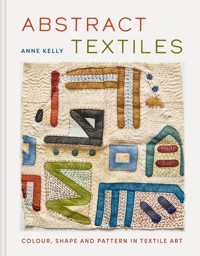
The title is displayed at the top in bold, uppercase letters, with Abstract in red and Textiles in green. Below the title, the author's name, Anne Kelly, is written in smaller blue uppercase letters. The central focus of the cover is a piece of abstract textile art, featuring a variety of colorful embroidered shapes and patterns on a textured, off-white fabric background. The embroidery includes geometric shapes such as rectangles, triangles, and zigzags in vibrant colors like red, blue, green, and yellow, with visible stitching details. At the bottom of the cover, the subtitle reads, Color, Shape and Pattern in Textile Art, in red uppercase letters.
Abstract Textiles
Description
The piece is densely layered with interwoven threads in a variety of earthy tones, including yellow, brown, green, and hints of white. The threads create a textured, almost chaotic surface with overlapping patterns. Black thread is prominently used to form intricate, web-like shapes and patterns that stand out against the lighter background.
Description
The fabrics include shades of blue, red, beige, and purple, with some featuring intricate designs such as geometric shapes, floral motifs, and abstract patterns. The pieces are stitched together with visible zigzag and straight stitches in contrasting thread colors, creating a textured and layered appearance. The stitching adds a dynamic element, with some threads overlapping and crisscrossing the fabric pieces.
Abstract Textiles
Colour, Shape and Pattern in Textile Art
Anne Kelly
Contents
Introduction
Chapter 1 From Nature to Abstraction
Chapter 2 Shapes and Colour – Mid-century Influences
Chapter 3 Surface Pattern and Mixed Media
Chapter 4 Following the Line
Chapter 5 Capturing Meaning
Chapter 6 Playing and Process
Conclusion
Featured artists and contributors
Further research
Further reading
Suppliers and art textile courses
Index
Acknowledgements
Introduction
‘With the most primitive means the artist creates something which the most ingenious and efficient technology will never be able to create.’
Kazimir Malevich (1879–1935)
Anne Kelly, Window, 1982. Black and white photograph
Description
The surface appears scratched or etched, with visible horizontal and vertical lines creating a rough, uneven texture. In the center of the composition is a small white rectangular fabric, which contrasts sharply with the dark surroundings. The white fabric has an irregular, distressed appearance, with black marks and patches that give it a weathered or aged look.
Abstract textile work is a popular and enduring theme in textile art and can be viewed in many ways. From Amish quilts through to contemporary makers, this genre is captivating because of colour and shape, and its ability to capture mood and feeling. In this book, we will show you how to progress from the realistic to the abstract through experimentation and process. From shapes, colours, surface pattern, line and art/textile influences, you will be able to experience and convey your own personal responses to the theme.
As in my previous publications, I combine examples of my own work and projects with examples from exciting contemporary artists and makers. This book is suitable for practitioners of all ages and abilities.
In Chapter One: From Nature to Abstraction we start from a representational viewpoint and use familiar shapes found in the natural world to create mixed media textile collages, looking at the work of artists and makers who use nature as their starting point.
Chapter Two: Shapes and Colour – Mid-century Influences starts with the building blocks of shape and colour to create original designs that can be applied to a variety of surfaces. The influence of pivotal women artists from the twentieth century informs and endures in current design work.
Chapter Three: Surface Pattern and Mixed Media features an exciting collection of mixed media works, inspired by shapes and materials. This chapter also looks at surface pattern and printing, and the combination of random elements to create original and creative designs.
In Chapter Four: Following the Line we take a considered approach to linear compositions, both in design and stitch terms. Line is another building block that enables structure and composition to develop organically in abstract work.
Chapter Five: Capturing Meaning discusses the challenging issue of how to inject emotion into abstract work. Through exploration and repetitive, intentional mark-making, we are able to create personal and individual responses and work through themes.
Chapter Six: Playing and Process shows examples of artists who use their practice to explore media through creative play. This is a ‘workbook’ chapter and should provide helpful reference for practitioners starting out on their abstract journey.
Anne Kelly, Mid-century Meadow Jacket (detail). Stitched and appliquéd jacket
Description
The fabric is adorned with various geometric and abstract patterns, including squares, circles, and spoon-like shapes, all outlined with colorful stitching. The designs are created using a mix of bright colors such as yellow, red, green, and white, with intricate details and textures. The edges of the textile are bordered with yellow stitching, and the center opening reveals a striped orange and black fabric underneath.
Chapter 1 From Nature to Abstraction
‘For me nature is not landscape, but the dynamism of visual forces… (which) can only be tackled by treating colour and form as ultimate identities, freeing them from all descriptive or functional roles.’
Bridget Riley (b.1931)
Anne Kelly, Inspiration Box, Natural Forms. Mixed media in wooden box
Description
The contents include a large, tangled root system with multiple branches, a spiky seed head resembling a teasel, and several dried stems of varying lengths and thicknesses. The paper beneath the plants features intricate floral and circular designs.
Inspiration From Nature
Probably the most challenging element of approaching abstraction is to know where to start. With representational art, there are natural starting points and a readymade vocabulary embedded in the history of art and making. With abstraction, there are signposts and references that can help us to find inspiration, but it requires organisation and focus.
The natural world is always a rich resource. There are many aspects of nature that are great for sampling and developing new work: colour, texture, line, form and pattern. I like to start with drawings, whether from photographs or from life. I begin with small sketches and studies, fragments of postcards and images. I like to experiment with paint and paper before progressing onto cloth.
In this chapter we look at artists who are inspired by the natural world and landscape, showing their transition from representational to abstract. This is a good place to start and work through before attempting more complex work. Sketchbooks and notebooks are useful to make studies and develop ideas, and enable you to make a range of versions and decisions.
Anne Kelly, Sketchbook Pages. Mixed media
Description
The collage features seven distinct sections, each highlighting leaves, flowers, or natural textures. The top row includes a vibrant red and green leaf print, a soft blue and green palm drip painting, and a yellow and green flower press design. The middle row displays a muted blue and green monotone leaf print and a bright green and pink hydrangea-inspired print. The bottom row features a painted leaves composition with swirling green and yellow tones and a dark blue leaf print on a beige background. Handwritten labels accompany each section, identifying the techniques used, such as “leaf print,” “palm drip,” and “painted leaves.”
Anne Kelly, Flower. Mixed media embroidery
Description
The background is a mix of beige and green tones, with a rough, woven texture. The embroidery depicts a stylized flower with a pink petal outlined in blue and green thread. The flower has two smaller leaves on the left, also outlined in blue and green, with pink accents. The stitching is dense, creating a layered and textured appearance. The edges of the fabric are slightly frayed.
Sampling Sketchbook Pages
Here are some examples of experiments and starting points from my sketchbooks. To make similar studies, you will need:
Simple natural forms, interesting shapes, plants, flowers
Sketchbook or cartridge paper
Pencil
Ink pens (I used a waterproof fine-line pen)
Watercolour or gouache paint, brushes
Waste paper and tissue
Glue stick
Small shape prints and ink pad (optional)
Starting points in nature
1
Isolating shapes
– choose interesting shapes, whether flowers, leaves or plants. Simplify the shape and repeat, using a fine-line pen when happy with the pencil version. Colour with pencil and paint, with watercolour washes over the top.
2
Mini collage
– this is useful for starting to create compositions. Choose a colourway that goes with your natural form. Cover your background with pieces of torn paper. Draw your simplified forms over the top, then add colour.
3
Simple blocks
– use the paint to create a wash over your background. When dry, use the simplified shapes of your plants to draw over the top, using a pencil then fine-line pen. Finally, use the shaped blocks to print over the top.
Anne Kelly, Sketchbook Pages. Mixed media
Description
The collage consists of four panels arranged in two rows against a light blue watercolor background. The top-left panel displays a symmetrical geometric floral design in orange, blue, and white, with overlapping star-like shapes. The top-right panel contains a hand-drawn flower pattern outlined in black on a yellow and green watercolor background, giving it a whimsical look. The bottom-left panel features vertical, detailed seed pods in black ink on a textured beige background. The bottom-right panel shows a flowing leaf pattern on a green and blue watercolor background, with stylized leaves arranged vertically. Handwritten labels beneath each panel read: Geometric, Flower pattern, Seed pods, and Leaf pattern. The artwork is a mixed-media composition divided into four sections, each showcasing a unique artistic style. The top-left section features a pattern of small, overlapping flowers in pink, orange, and purple hues, set against a white background. The top-right section displays a dark, textured collage with layered elements, including faint text and abstract shapes in deep blue and brown tones. The bottom-left section continues the collage theme, incorporating swirling floral motifs and textured layers in earthy colors like brown, black, and hints of blue. The bottom-right section presents a linear botanical design, with tall, thin plants or leaves drawn in black ink on a pale pink background. The entire piece is framed by a soft blue watercolor border. The collage is divided into labeled sections highlighting various patterns. In the top left, a section labeled Library book cover shows a grid of earthy-toned squares with central circular details. To its right, the Leaf pattern section displays vertical rows of elongated green leaves outlined in black. Below that, the Hydrangea pattern section presents circular green forms connected by curved lines. In the center-left, Stem branching pattern contains a textured green rectangle with fine branching lines. At the bottom, Leaf prints includes stylized green leaves with distinct patterns, and to its right, Leaf design prints displays abstract leaf shapes in green and yellow arranged vertically.
From Nature to Abstraction – An Italian Landscape
My large textile collage Italian Landscape is a piece based on sketchbook pages, made on a residency in Abruzzo, Italy. I decided to take elements from the sketches and develop them into shapes rather than transposing them as straight interpretations of the landscape. I used some previously worked pieces of textile to give the piece additional texture and colour. I also used pieces of fabric sourced in Italy.
Before I started making the piece, I sketched out the general outline shapes that I wanted to use. This helped to develop the scale of the piece and enabled me to cut out the pieces to the right size for collaging. I used a strong piece of canvas about 1m (40in) square. I then used the drawing to sketch out the various shapes and areas of the composition.
I pinned and tacked (basted) the elements of the collage onto the background. I was then able to stitch them on with a sewing machine using my signature overstitching technique, as well as some hand stitching to finish the piece. My overstitching technique uses a repetitive machine stitch (like an edging or finishing stitch) to cover and blend pieces together, usually with white thread. This has the effect of creating a ‘filter’ or blurring the layers so that they appear more homogenous. I use old sewing machines for this that can cope with joining several layers of fabric. If you want to try this technique, you can use a sample to see which patterns of stitch repeated together work for you.
Italian Landscape was then mounted onto a painter’s canvas and framed. It has been exhibited in the UK and France.
Anne Kelly, Italian Landscape. Mixed media textile
Description
The piece features a variety of colors, such as red, green, yellow, and black, with textures created through stitching and fabric layering. The houses are depicted with triangular roofs and rectangular walls, interspersed with floral motifs like sunflowers and tulips. Abstract shapes and patterns fill the spaces between the houses.
There are recognisable elements in the piece, which act as guideposts to the subject matter. I would describe this as a transitional piece, a hybrid between representation and abstraction. I have included it in this chapter to share that journey.
Landscape
Featured ArtistSarah Symes
Sarah Symes’s work is inspired by the elemental beauty of the Sea to Sky region of British Columbia, Canada. This series explores the interplay and connection between land, sea and sky. She tells us more here:
Sarah Symes, Sea to Sky Landscape No. 2. Mixed media textile
Description
The upper portion of the composition features a series of overlapping triangular shapes in varying sizes and colors, including shades of blue, purple, green, and white. These triangles are arranged in a fragmented, mosaic-like pattern. The lower portion transitions into a textured, flowing background dominated by teal and white hues. The background has a fluid, watercolor-like appearance, with soft gradients and streaks that contrast with the sharp edges of the triangles above.
‘Here are some of my sketchbook notes, recording my observations of the landscape: A dramatic cloudburst above Mount Garibaldi pulls the stormy sky into focus… The jagged rock faces of The Chief catch the evening sunlight, fracturing the line between rock and sky… A dense fog hovers above Howe Sound, obscuring the islands, leaving nothing between sea and sky… Heavy rains turn Shannon Falls into a thunderous waterfall, cascading in bubbly plumes blurring the shoreline… The alpine meadows of Sky Pilot are ablaze with wildflowers, leading to cool turquoise lakes high in the skyline… Snowmelt swells the Squamish River into an unstoppable torrent, flooding the white sandy beaches… Blue skies turn Lost Lake into a glittering mirror, reflecting snow-capped peaks against the sky…
‘To create a texture representing the sky, I dyed fabric by soaking it in paint and leaving it outside in the rain. To create patterns representing water, I poured cups of water and dye over stretched fabric and let it drip dry. Each work of art started out with two pieces of background fabric, placed intentionally to section the picture plane with a horizontal line. I allowed the random dye markings to inspire the landscape and become part of the composition. I then cut a selection of smaller triangular pieces of fabric and appliquéd them to the background, working intuitively with silhouettes in mind to suggest recognisable landforms. This resulted in a geometric abstract formation, depicting the interplay and connection between landscape elements.
‘I have titled the work numerically in order to track my progression through the idea. Across the body of work, I play with point of view by changing the canvas size and moving the horizon line. A low horizon gives the feeling of expansion and freedom and a high horizon gives the feeling of being surrounded by mountains. Rather than working from photos or sketches, I composed the pieces from memory, opening myself up to the inextricable link between the subject and my inner emotional landscape.’
Sarah Symes, Sea to Sky Landscape No. 4. Mixed media textile
Description
The foreground consists of a network of interconnected triangles in varying sizes and colors, including shades of blue, purple, gray, and mustard yellow. These triangles are outlined with thin lines, creating a fragmented, mosaic-like effect. The background features a cloudy sky with soft, muted tones of white, gray, and light blue, blending seamlessly with the geometric design.
Photos As An Inspiration and Resource
My piece Suburban Gardens 2 was made when I was inspired by a photo of my garden at dusk in which the shades of the plants seemed to glow against an equally striking sunset, with beautiful colours. I simplified the shapes and colours with a sketch on a remnant of a woven cotton tea towel. I then painted the rough outlines onto the cotton with fabric paints. When it was dry, I drew over the patches of colour to create lines for stitching. I used free-motion embroidery with a dark grey thread to map out the main structure of the image. Then I used more colours in the background, matching my thread choices with the paints.
Anne Kelly, Suburban Gardens 2. Mixed media textile
Description
The scene features tall, leafy plants in the foreground, their dark green and blue tones contrasting with the vibrant background. To the left, a small, rustic house with a slanted roof is stitched in shades of brown and red, nestled among the greenery. The background is dominated by a dramatic sunset sky, rendered in bold hues of orange, pink, and yellow, with streaks of light radiating outward. The embroidery style is expressive and layered.
Anne Kelly, Suburban Gardens 2 (detail). Mixed media textile
Description
The scene features tall, slender trees with green foliage in the foreground, surrounded by vibrant, multicolored leaves in shades of red, orange, and yellow. The background includes a bright sky with soft yellow and white tones. The embroidery is intricate, with visible thread textures and overlapping stitches.
Description
1. The top-left panel, labeled “Magnolia,” shows a photograph of magnolia tree branches with pink and white blossoms against a blue sky. 2. The top-right panel, labeled “Blossom pattern,” features a stylized, abstract pattern of green stems and leaves with small pink blossoms on a light background. 3. The center panel, labeled “Liberty postcard,” displays an abstract composition of overlapping circular and floral shapes in shades of blue, orange, and red, resembling a decorative postcard. 4. The bottom-left panel, labeled “Ivy pattern,” shows a graphic design of green ivy leaves and stems arranged in a geometric pattern on a light background. 5. The bottom-right panel, labeled “Ivy,” is a close-up photograph of ivy leaves with dark green and yellow variegation.
Anne Kelly, Sketchbook Pages. Mixed media
Description
In the top left, a photo labeled Blossom ground shows dark soil scattered with pink and white petals. The top right section, labeled Petal pattern, presents a repeating design of green leaves, ferns, and small blue flowers on a light background. At the center, a section labeled V&A card displays a geometric pattern with abstract sail-like shapes in gray, yellow, and blue. The bottom left features a hand-drawn illustration labeled Mahonia pattern, with green Mahonia leaves and stems on a warm yellow background. In the bottom right, a photo labeled Mahonia shows a close-up of the plant’s glossy, spiky leaves.
Anne Kelly, Sketchbook Pages (detail). Mixed media
Tips for using photos
•
Use your zoom function to get a close-up view of your subject.
•
Print out your photos so you can work on them and from them.
•
You can make collages and studies from your photos before you stitch.
•
Work in stages, from the photo, to a drawing or collage, then a stitch sample.
•
You can change the colours, shapes and orientation of your source image.
Working From the Landscape
Jan Beaney and Jean Littlejohn have a venerable and well-established partnership, working, exhibiting and writing books about their practice, often inspired by the natural landscape. They are generous with suggestions and techniques, as we see here.
Featured ArtistJan Beaney
‘Our mantra is: the more you look, the more you see.
‘Even if you do not want to draw, written descriptions and the odd diagram can also work well. So often a few words and some squiggles will remind you of the particular element you wish to remember. At times it is helpful to isolate your looking. For instance, look for stripes – perhaps rows of crops in a field, views through railings, patterns on a butterfly wing or creviced bark on a tree. Edges, spots or a colour could all be focused looking exercises. The list is endless.
Jan Beaney, Pale Waters. Mixed media textile
Description




