


30,99 €
Mehr erfahren.
- Herausgeber: John Wiley & Sons
- Kategorie: Geisteswissenschaft
- Serie: Blackwell History of Russia
- Sprache: Englisch
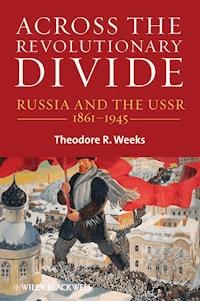
Across the Revolutionary Divide: Russia and the USSR 1861-1945 offers a broad interpretive account of Russian history from the emancipation of the serfs to the end of World War II.
- Provides a coherent overview of Russia's development from 1861 through to 1945
- Reflects the latest scholarship by taking a thematic approach to Russian history and bridging the ‘revolutionary divide’ of 1917
- Covers political, economic, cultural, and everyday life issues during a period of major changes in Russian history
- Addresses throughout the diversity of national groups, cultures, and religions in the Russian Empire and USSR
- Shows how the radical policies adopted after 1917 both changed Russia and perpetuated an economic and political rigidity that continues to influence modern society
Sie lesen das E-Book in den Legimi-Apps auf:
Seitenzahl: 612
Veröffentlichungsjahr: 2011
Ähnliche




















Contents
Illustrations
Series Editor’s Preface
Acknowledgments
Introduction
Why a New Russian History?
Main Events and Arguments
Why a Thematic Approach?
Two Snapshots: 1861 and 1945
1 Politics
The Great Reforms: 1861–1876
Government under Siege: 1876–1904
The Beginning of the End: 1904–1914
War and Revolution: 1914–1917
The Revolution’s First Decade: 1917–1927
Building Socialism: 1928–1939
World War II: 1939–1945
2 Society
The End of Soslovie
Peasants into Kolkhozniks
“Civil Society” and Intelligentsia
The “Woman Question”
Bureaucrats and Society, Tsarist and Soviet
Edges of Society: Criminality, Social and Sexual “Deviance”
Amusements, Free Time, Leisure
Conclusion
3 Nations
Nationalities in the Russian Empire
Imperial Expansion and Policy: 1863–1917
The Great Liberation: 1917 to ca. 1930
Contradictions of Soviet Nationality Policy to 1945
Russia’s “Jewish Question”: 1861–1945
Conclusion
4 Modernization
The What and Why of Modernization
Tsarist Modernization to 1900
Stresses of Modernization: 1900–1917
Bolsheviks as Modernizers
The Modernizing Decade: 1930s
Triumphs and Weaknesses of Modernization: The Acid Test of World War II
Conclusion
5 Belief
Russian Orthodoxy, Dissenters, and Sects
Society between Science and Faith
The Triumph of Socialism and the Persistence of “Outdated Beliefs”
Antireligious Campaigns
The Survival of Religion under Soviet Rule
Compromising with Religion: World War II
Conclusion
6 World
Russia in Europe
Russia as Empire
Anxiety about Remaining “on Top”: 1900–1917
USSR Confronts the World to 1935
Russia Abroad: Émigrés
The Threat Turns Real: 1935–1945
Conclusions
7 Culture
Tsarist Education: Strengths and Weaknesses
A Society in Upheaval? Russian Culture in the Late Nineteenth Century
Science and Technology
Peasant Culture Becoming Mass Culture: Liubok, Chapbooks, Press
Visual Arts Reflecting Social Change
Bolshevik Revolution in Culture
Socialist Realism
Conclusion
Conclusion
The Search for Modernity
Changing Identities
Culture and Ideologies
Technology and Everyday Life
Roads Not Taken, and Why
Timeline
Notes
Select Bibliography
Index
The Blackwell History of Russia
General Editor: Simon M. Dixon
This series provides a provocative reinterpretation of fundamental questions in Russian history. Integrating the wave of new scholarship that followed the collapse of the Soviet Union, it focuses on Russia’s development from the mid - seventeenth century to the present day, exploring the interplay of continuity and change. Volumes in the series demonstrate how new sources of information have reshaped traditional debates and present clear, stimulating overviews for students, scholars and general readers.
Published
Russia’s Age of Serfdom, 1649–1861
Elise Kimerling Wirtschafter
Across the Revolutionary Divide: Russia and the USSR, 1861–1945
Theodore R. Weeks
Forthcoming
The Shadow of War: Russia and the USSR, 1941 to the present
Stephen Lovell
This edition first published 2011 © Theodore R. Weeks 2011
Blackwell Publishing was acquired by John Wiley & Sons in February 2007. Blackwell’s
publishing program has been merged with Wiley’s global Scientific, Technical, and Medical business to form Wiley-Blackwell.
Registered Office
John Wiley & Sons Ltd, The Atrium, Southern Gate, Chichester, West Sussex, PO19 8SQ, United Kingdom
Editorial Offices
350 Main Street, Malden, MA 02148–5020, USA 9600 Garsington Road, Oxford, OX4 2DQ, UK
The Atrium, Southern Gate, Chichester, West Sussex, PO19 8SQ, UK
For details of our global editorial offices, for customer services, and for information about how to apply for permission to reuse the copyright material in this book please see our website at www.wiley.com/wiley-blackwell.
The right of Theodore R. Weeks to be identified as the author of this work has been asserted in accordance with the UK Copyright, Designs and Patents Act 1988.
All rights reserved. No part of this publication may be reproduced, stored in a retrieval
system, or transmitted, in any form or by any means, electronic, mechanical, photocopying, recording or otherwise, except as permitted by the UK Copyright, Designs and Patents Act 1988, without the prior permission of the publisher.
Wiley also publishes its books in a variety of electronic formats. Some content that appears in print may not be available in electronic books.
Designations used by companies to distinguish their products are often claimed as trade- marks. All brand names and product names used in this book are trade names, service marks, trademarks or registered trademarks of their respective owners. The publisher is not associated with any product or vendor mentioned in this book. This publication is designed to provide accurate and authoritative information in regard to the subject matter covered. It is sold on the understanding that the publisher is not engaged in rendering professional services. If professional advice or other expert assistance is required, the services of a competent professional should be sought.
Library of Congress Cataloging-in-Publication Data
Weeks, Theodore R.
Across the revolutionary divide: Russia and the USSR, 1861–1945/Theodore R. Weeks.
p. cm. - (Blackwell history of Russia)
Includes bibliographical references and index.
ISBN 978-1-4051-6961-5 (hardcover: alk. paper)-ISBN 978-1-4051-6960-8 (pbk.: alk.
paper) 1. Russia-History-Alexander II, 1855–1881. 2. Russia-History-Alexander III,
1881–1894. 3. Russia-History-Nicholas II, 1894–1917. 4. Soviet Union-History-
1917–1936. 5. Soviet Union-History-1925-1953. 6. Soviet Union-History-1939-1945.
7. Social change-Russia-History. 8. Social change-Soviet Union-History. I. Title.
DK189.W44 2011 947.08-dc22
2010003197
To my students: Past, present, and future
Illustrations
Figure 1.1 Mikhail Cheremnykh and Victor Deni, “Comrade Lenin Cleanses the Earth of Scum.” Figure 1.2 Viktor Govorkov, “Stalin in the Kremlin Cares about Each One of Us.” Figure 2.1 Russian Peasantry before the Revolution: A Village Council ca.1902 – 10. Figure 2.2 Nikolai Mikhailov, “There Is No Room in Our Collective Farm for Priests and Kulaks.” Figure 2.3B ezprizornye (street orphans). Figure 3.1 V. Elkin, “Long Live the Fraternal Union and Great Friendship of the Nations of the USSR!” Figure 4.1 Konstantin Zotov, “Every Collective Farm Peasant or Individual Farmer Now Has the Opportunity to Live Like a Human Being.” Figure 4.2 The Moscow Metro, one of the grand construction projects of the Stalin period. Figure 5.1 Cathedral of Christ the Savior. Figure 5.2 “Drunkenness on Holidays: A Survival of Religious Prejudices.” Figure 6.1 Iraklii Toidze, “The Motherland Calls!” 1941. Figure 7.1 Ilya Repin, Reply of the Zaporozhian Cossacks toSultan Mehmed IV of the Ottoman Empire. Figure 7.2 Vasily Vereshchagin, An Allegory of the 1871 War. Figure 7.3 Aleksei Radkov, “The Illiterate Is Just as Blind. Disaster Awaits Him Everywhere.” Figure 7.4 Film poster for Sergei Eisenstein’s BattleshipPotemkin, 1925. Map 0.1 Russian Empire. Map 0.2 USSR in 1945. Map 1.1 USSR in 1923 (or post- Civil War but pre- 1945). Map 3.1 Expansion of Russian Empire, 1860s to 1914. Map 3.2 Russian Poland and the Jewish Pale of Settlement.Series Editor’s Preface
The Blackwell History of Russia aims to present a wide readership with a fresh synthesis in which new approaches to Russian history stimulated by research in recently opened archives are integrated with fundamental information familiar to earlier generations. Whatever the period under review, new discoveries have thrown into question some persistent assumptions about the nature of Russian government and society. Censorship and surveillance remain important subjects for investigation. However, now that social activity in Russia is no longer instinctively conceived in terms of resistance to a repressive, centralized state, there is room not only to investigate the more normal contours of everyday life, but also to consider its kaleidoscopic variety in the thousands of provincial villages and towns that make up the multinational polity. Religion, gender, and culture (in its widest sense) are all more prominent in the writings of contemporary scholars than they were in the work of previous generations. Historians once preoccupied with pig-iron production are now more inclined to focus on pilgrimages, icon veneration, and incest. No longer so overwhelmingly materialist in their approach, they are more likely to take “the linguistic turn”; the changing meanings of imagery, ritual, and ceremonial are all being reinterpreted.
The challenge is to take account of “extra” dimensions of the subject such as these (the list could easily be extended), and, where appropriate, to allow them to reshape our understanding, without risking a descent into modishness and without neglecting fundamental questions of political economy. One way of squaring the circle is to adopt an unconventional chronological framework in which familiar subjects can be explored in less familiar contexts. Each of the three volumes in the series therefore crosses a significant caesura in Russian history. The first, examined by Elise Kimerling Wirtschafter in Russia’s Age of Serfdom, 1649-1861, is the physical and cultural move from Moscow to St Petersburg at the beginning of the eighteenth century; the last, explored by Stephen Lovell in The Shadow of War: Russia and the USSR, 1941 to the present, is the collapse of the USSR in 1991. In this middle volume, Ted Weeks ranges “across the revolutionary divide” of the year 1917.
For much of the twentieth century, 1917 seemed to mark the most significant of historical ruptures and there are naturally good reasons for continuing to regard the revolutionary cataclysm as a fracture between radically different worlds. Autocracy and Marxism - Leninism were ideological poles apart; so were the aims of their respective proponents. Indeed, it is hard to exaggerate the ambition of the Bolsheviks who came to power in October to transform the world in which they lived. They attempted not only to supplant the monarchy and to extend the dictatorship of the proletariat far beyond Russia’s borders, but also to forge a new civilization, ultimately to be peopled by a different sort of human being: New Soviet Man and New Soviet Woman.
For all these reasons, it is no surprise that the Soviet and tsarist periods should have tended until recently to attract historians of different backgrounds, different temperaments, and different preoccupations. While some were fascinated by the decline of an increasingly inflexible tsarist regime, whose attempts to strengthen the Romanov dynasty paradoxically served only to make its own government more brittle, others were drawn to explain why a Bolshevik vision apparently so suffused with optimism should have corrupted within less than a generation into the horrors of the Stalinist Terror. Even basic logistics militated against scholarly efforts to “cross the revolutionary divide,” for while the Soviet government stored its principal papers in Moscow, the richest archival collections relating to the late -imperial period remained in Leningrad.
Nearly 20 years after the collapse of the USSR, however, 1917 no longer seems quite such a total rupture. After all, as governors of a sprawling multiethnic state, the Bolsheviks faced many of the same geopolitical challenges as their tsarist predecessors. How were they to balance the security of multinational Rossiia against ethnic and cultural Rus’? Some of the most fertile research of the last generation has been devoted to precisely this question and to related dilemmas of imperial expansion. Himself an acclaimed authority on the history of the Polish- Lithuanian borderlands both before and after 1917, Weeks draws on this literature to offer a brilliant analysis of the nationalities question in one of the most striking chapters of his new book. Continuities are no less striking when one turns to the economy. The last three tsars and the early Soviet leaders were all struggling to manage the politics of industrialization in an overwhelmingly agrarian empire. All of them ran up against the risk - averse peasantry’s stubborn attachment to the small-scale communal organization that had helped them to survive for centuries. Peasant obstinacy was to prove just as exasperating to Stalin at the end of the 1920s as it had to Stolypin between 1906 and 1911. Their solutions, of course, were radically different. Whereas Stolypin hoped to foster a new generation of prosperous (and politically loyal) farmers by encouraging the wealthiest peasants (“kulaks”), Stalin set out to annihilate them. Nevertheless, it would be misleading to suppose that the Bolsheviks had a monopoly on state violence. In many ways, the key turning point was not 1917, but, rather, World War I, described with characteristic prescience by Norman Stone in 1975 as “a first experiment in Stalinist tactics for modernization.” More recently, Peter Holquist has traced the development of a wartime consensus in favor of planning that stretched across the political spectrum, including among liberals in government who regarded themselves as a supra - class elite with the best interests of the state at heart. And just as liberal planners’commitment to forcible state intervention in the food supply chain during World War I marked the first stage in a continuum of state violence that stretched beyond 1917, so Daniel Beer has demonstrated the ways in which psychiatrists and other liberal intellectuals anticipated some of the controlling instincts of the Soviet regime by seeking to combat a perceived threat of moral degeneration well before 1917.
Not that violence and surveillance were the only tools at the state’s disposal. Russia has always derived much of its stability and flexibility from time - honored ways of doing things. The sorts of informal patronage network that had overlain the tsarist bureaucracy for centuries at both central and local levels soon wove their way into a powerful Soviet nomenklatura. Nor should we confine our interest in continuity to matters of geopolitics and the state. Most aspects of the distinctive form of Soviet consumer society that emerged in the aftermath of the Russian Civil War - tourism, the cinema and so on - had their origins in the commercial explosion of late-imperial Russia. Many of the reformist impulses in Russian Orthodoxy that emerged in the first decade of the twentieth century found expression only after the October Revolution, when the nascent Soviet regime tried to exploit them as a way of splitting the church. There is no need to stress the virtues of writing cultural history “across the revolutionary divide”: it is the only way to write about Russian modernism, itself part of a European cultural movement with deep roots before World War I.
In other words, while no one would sensibly seek to minimize the impact of the October Revolution, the lived experience of Stalin’s generation only partly confirms the impression of 1917 as a fundamental caesura. Drawing on recent writings which have enriched our understanding of the 1920s and 1930s as never before, Ted Weeks explores a vital period in Russian history, culminating in the “Great Patriotic War” that served as the ultimate test of the nascent Soviet regime.
Simon M. Dixon
School of Slavonic and East European Studies
University College London
Acknowledgments
Writing a textbook is truly a case, as medieval writers liked to say, of a “dwarf standing on the shoulders of giants.” Among the giants among Russian historians that I have known and learned from over the years are my Doktorväter, Nicholas Riasanovsky and the too-soon departed and sorely missed Reggie Zelnik. My wonderful colleagues in graduate school at the University of California, Berkeley, here at Southern Illinois University, and throughout the world, have also been important teachers. Probably most vital of all for a textbook writer is the interaction with students who are constantly reminding me to be clear, precise, and concise.
Many people helped improve this book. My sincere thanks to colleagues who took time from their busy schedules to read and critique chapters: Peter Blitsein, Chris Chulos, Adrienne Edgar, Brian Horowitz, Stephen Lovell, Kevin O’Connor, David Schimmelpenninck van der Oye, and Christine Worobec. Brad Woodworth, Pierre Holquist, and Clayton Black helped with specific queries. Chapter 5 is much improved after the thorough critique provided by the Midwest Russian Historians Workshop. My sincere gratitude to all of these people and all others whom I have neglected to mention specifically. All remaining weaknesses, errors, and infelicities are entirely mea culpa.
A Note on Calendars
Unlike most European countries, which had adopted the Gregorian calendar (“new style”: “n.s.”) by the eighteenth century, imperial Russia continued to use the Julian calendar (“old style”: “o.s.”) well into the twentieth century. This meant that the calendar used in Russia was 12 days behind in the nineteenth century, 13 days behind in the twentieth. Thus October 1, 1901, in Russia was October 14 in, say, London. This fact is important in understanding why this book speaks of the “October” (old style) Revolution whereas a general European history would speak of the “November” (new style). This confusion was cleared up when the Bolsheviks adopted the Gregorian calendar in February 1918.
Introduction
Why a New Russian History?
The Russia of today is an entirely different place than the one I read about in college textbooks and experienced as a college student in the 1980s. In the past generation Russia has gone from being, in the guise of the USSR, one of two superstates whose policies affected millions around the globe to a still powerful but insecure state no longer certain of its preeminence on the global scene. This enormous change took place almost literally overnight in the early 1990s and left millions of Russians baffled, frustrated, and angry. One cannot understand the politics and culture of the Russian Federation in the twenty-first century without a good grasp of the past–in particular of the crucial period between serf emancipation (1861) and victory in the second World War (1945). In that quite short period–essentially one long lifetime–Russia became a world power as it had never been before in history. Now, once again, Russia has returned more or less to its pre-World War I power status: important but not one of the two superpowers engaged in power projection around the globe. At the same time many Russians continue to feel that their country is not receiving proper respect in the world. The broad discrepancy between Russia’s actual military and economic power and the role that Russians think their country should play in world politics stems mainly from the memory of a powerful USSR–the country built in the years we will consider here.
Despite the transformations of the 1990s and the resulting reduction in Russian military might, Russia continues to aspire to a global role–to the great consternation of many of its European neighbors. With its large energy reserves, nuclear capabilities, and geographical sweep covering nearly half of the globe, Russia remains vitally important in world politics. One should also never forget that the Russian nuclear arsenal is still capable of ending all life on earth. So Russia continues to “matter,” just as Germany and Britain after 1945 remain significant in world politics, economy, and culture. Up to now, all histories of Russia written have consciously or unconsciously been histories of a world power. The challenge of a survey of Russian history in the twenty-first century is to present the history of a country whose importance can no longer be taken for granted.
Map 0.1 Russian Empire.
Source: based on map in Dominic Lieven, Empire, Yale University Press, 2000, “The Russian Empire at its Greatest Extent, 1914.”
The present-day importance of Russia derives from geographical, military, cultural, and historical factors. The largest country in the world from the seventeenth century to the present day, its borders stretch from the European Union to China, from the Middle East (Iran) to Korea, from the Black and Baltic Seas to the Pacific. The huge oil and natural gas reserves located on its territory allow Russia to exert serious–and often much resented–influence in Europe where many countries are overwhelmingly dependent on energy delivered from the east. With its nuclear arms and new-found assertiveness under President Vladimir Putin and his successors, Russia cannot be dismissed as “yesterday’s news.” Of course, for a historian, the news of yesterday is vitally significant, even more so, perhaps, for Russia more than any other present–day country. While Germans or Japanese no longer regard their countries as world powers (and, crucially, have no great desire to take on that role) and the British Empire has been transformed into the Commonwealth that has relinquished any pretensions of a geopolitical role, the Russian Federation and Russian citizens in the early twenty-first century often regard their country in terms of world political power. Thus Russia expects to be respected as a power of the first rank; neither government nor populace is yet content to accept a reduced role on the international scene in the way that former world powers like Great Britain, France, or Japan have. This view, which clashes with many aspects of post-1992 political reality, can only be understood through a sympathetic examination of Russia’s past experience.
Lesen Sie weiter in der vollständigen Ausgabe!
Lesen Sie weiter in der vollständigen Ausgabe!
Lesen Sie weiter in der vollständigen Ausgabe!
Lesen Sie weiter in der vollständigen Ausgabe!
Lesen Sie weiter in der vollständigen Ausgabe!
Lesen Sie weiter in der vollständigen Ausgabe!
Lesen Sie weiter in der vollständigen Ausgabe!
Lesen Sie weiter in der vollständigen Ausgabe!
Lesen Sie weiter in der vollständigen Ausgabe!
Lesen Sie weiter in der vollständigen Ausgabe!
Lesen Sie weiter in der vollständigen Ausgabe!
Lesen Sie weiter in der vollständigen Ausgabe!




