


36,99 €
Mehr erfahren.
- Herausgeber: John Wiley & Sons
- Kategorie: Fachliteratur
- Serie: Wiley Finance Editions
- Sprache: Englisch
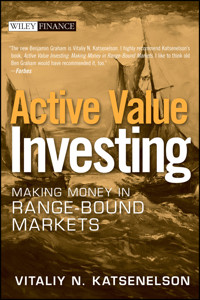
A strategy to profit when markets are range bound-which is half of the time One of the most significant challenges facing today's active investor is how to make money during the times when markets are going nowhere. Bookshelves are groaning under the weight of titles written on investment strategy in bull markets, but there is little guidance on how to invest in range bound markets. In this book, author and respected investment portfolio manager Vitaliy Katsenelson makes a convincing case for range-bound market conditions and offers readers a practical strategy for proactive investing that improves profits. This guide provides investors with the know-how to modify the traditional, fundamentally driven strategies that they have become so accustomed to using in bull markets, so that they can work in range bound markets. It offers new approaches to margin of safety and presents terrific insights into buy and sell disciplines, international investing, "Quality, Valuation, and Growth" framework, and much more. Vitaliy Katsenelson, CFA (Denver, CO) has been involved with the investment industry since 1994. He is a portfolio manager with Investment Management Associates where he co-manages institutional and personal assets utilizing fundamental analysis. Katsenelson is a member of the CFA Institute, has served on the board of CFA Society of Colorado, and is also on the board of Retirement Investment Institute. Vitaliy is an adjunct faculty member at the University of Colorado at Denver - Graduate School of Business. He is also a regular contributor to the Financial Times, The Motley Fool, and Minyanville.com.
Sie lesen das E-Book in den Legimi-Apps auf:
Seitenzahl: 436
Veröffentlichungsjahr: 2007
Ähnliche


















Contents
Preface
Part One: What the Future Holds
Chapter 1: Introduction: Range-Bound Markets Happen
Fasten Your Seat Belts and Lower Your Expectations
Let’s Identify the Animal
Secular versus Cyclical
Distinction between Secular Bull, Bear, and Range-Bound Markets
Is 100 Years Long Enough?
Stocks Carried the Torch in the Long-Run Marathon
International Stocks Were Bright Lights, Too
Will Gold Shine Again?
Gold’s Recently Emerged Competition
The Deception of the Long Run (Marathon)
Range-Bound Markets Erode Bull Market Returns
The Long Run for Us May Be Shorter Than We Think
Chapter 2: Emotions of Secular Bull, Bear, and Range-Bound Markets
Bull Market Euphoria
Bear Market Doldrums
What Does a Secular Range-Bound Market Feel Like?
Volatility of Bull and Range-Bound Markets
Chapter 3: Stock Market Math
Sources of Capital Appreciation: Earnings Growth
Sources of Capital Appreciation: Price to Earnings
Sources of Dividend Yield
Why Range-Bound Markets Follow Bull Markets
It Is Not Over Until It Is Over
Chapter 4: Bonds: A Viable Alternative?
Why Not Bonds?
Asset Allocation Role Is Diminished in Range-Bound Markets
Part Two: Active Value Investing
Analytics: Introduction to Analytics: The Quality, Valuation, and Growth Framework
Chapter 5: The “Q”—Quality
Competitive Advantage
Management
Predictable Earnings
Strong Balance Sheet
Significance of Free Cash Flows
High Return on Capital
Conclusion
Chapter 6: The “G”—Growth
Sources of Growth: Earnings Growth and Dividends
Past Has Passed
Future Engines of Growth
Dividends
Growth Matters—A Lot!
Chapter 7: The “V”—Valuation
Tevye the Milkman’s Approach to Valuation
Review of Relative Valuation Tools
Absolute Valuation Tools—Discounted Cash Flow Analysis
Relative versus Absolute Tools
Absolute Models Overview
The False Precision of Math
Absolute P/E Model
Discount Rate Model
Margin of Safety Model
The Marriage of Absolute P/E and Margin of Safety
Bring Out the Toolbox
The P/E Compression and How to Deal with It
Chapter 8: Let’s Put It All Together
The Added Clarity
One Out of Three Is Not Enough
Two Out of Three Is Better, But Is It Enough?
Conclusion
Strategy: Introduction to Strategy: The Value of Process and Discipline
Chapter 9: Buy Process—Fine-Tuning
The Value of the Process and Discipline
Think Long-Term, Act Short-Term
Meet Your New Best Friend—Volatility
Time Stocks, Not the Market
Cash Is King
Be Ready to Strike When the Time Comes
Chapter 10: Buy Process—Contrarian Investing
Contrarian Is the Name of the Game
You Don’t Have to Own It
Be a Myth Buster
Quantify Everything and Be a Contrarian Headline Investor
Time Arbitrage
Finding New Ideas
Do In-Depth Primary (Your Own) Research and Document It
Chapter 11: Buy Process—International Investing
The World Has Flattened: Hola, Bonjour, Guten Tag, Buon Giorno to the Rest of the World
Same Difference
Location of Corporate Headquarters Abroad May Not Constitute a Foreign Company
You Are Exposed to More Foreign Political Risk Than You Realize
What About the United States?
Pick Your Comfort Zone and Go from There
Don’t Confuse a Fast-Growing Economy and a Good Investment
Currency Risk
How Much Is Too Much?
Conclusion
Chapter 12: Sell Process—Make Darwin Proud
Selling When Stock Price Has Gone Up
Selling When Fundamentals Have Deteriorated
Conclusion
Risk and Diversification: Introduction to Risk and Diversification
Chapter 13: A Different View of Risk
What Is Risk?
Properties of Randomness
The Crocodile Hunter, Randomness, and Investing
Understand the Linkage Between and Inside QVG Dimensions
Identify Impact of Randomness on Value Creators
The Cost of Being Wrong
Conclusion
Chapter 14: A Different View of Diversification
Don’t Bet the Farm!
Too Many Eggs or Too Many Baskets
Mental Accounting and Diversification
Mental Accounting and Randomness in a Stock Portfolio
Randomness Could Be Your Friend
Chapter 15: Conclusion and Implication
I Could Be Wrong, But I Doubt It
Bull Markets
Bear and Range-Bound Markets
Bonds?
No, I Am Not Wrong
Appendix—Years to Bull Market
Acknowledgments
Index
More Praise for Active Value Investing
“Whether a self-styled seat-of-the-pants day trader or the kind of investor who intends to buy and hold forever, you’re operating at a distinct disadvantage if you lack the skills to break a company down into its financial nuts and bolts. Vitaliy “Red” Katsenelson is one of the best on the Street at analyzing a business and putting that knowledge to work to make money. In Active Value Investing, Red shares the skills and strategies that allow him to cut through the noise and build a long-term portfolio of winners. Bull and bear markets come and go, but the ‘secrets’ shared in this book are forever. This book is a must-have guide for any market!”
—Jeff Macke
Contributor to Minyanville.com and CNBC’s Fast Money
“Vitaliy has done the world a significant favor; he shows, in erudite fashion, that value investing (the one tried and tested investment approach) holds in range-bound markets. This should matter for all investors as in a world of low returns, ensuring the avoidance of permanent loss of capital is paramount. But he doesn’t stop there, Vitaliy manages to go even further and provides you with a working process for evaluating investment in such a world.”
—James Montier
Global Equity Strategist, Dresdner Kleinwort
“In a world of uncertainty, Vitaliy’s investing techniques help calm the storm.”
—James Altucher
Author of Trade Like a Hedge Fund Founder of Stockpickr.com
“Vitaliy Katsenelson wears two professional hats: As a successful money manager, he has the responsibility to clear out the noise and center upon what makes a market-beating investment. As an educator, he’s honed his ability to distill complex concepts into the explainable. With Active Value Investing, he’s managed both the clarity of thought and the clarity of investment to bring to you an outstanding investment resource.”
—Bill Mann
Advisor, Hidden Gems newsletter The Motley Fool
“Active Value Investing provides a laconic vision of how the individual or institutional investor can successfully navigate a market that is neither a bull nor a bear. Unlike most stock market authors who automatically posit the stock market’s prospects as knowing only one way (up), Katsenelson provides a refreshingly honest and, sometimes, humorous approach to a less defined future.”
—Douglas A. Kass
President, Seabreeze Partners Management Inc.
“Vitaliy’s passion for value investing and teaching others makes Active Value Investing enjoyable as well as insightful. It is required reading for the investment team at Second Curve Capital.“
—Thomas K. Brown
CEO, Second Curve Capital
Founded in 1807, John Wiley & Sons is the oldest independent publishing company in the United States. With offices in North America, Europe, Australia, and Asia, Wiley is globally committed to developing and marketing print and electronic products and services for our customers’ professional and personal knowledge and understanding.
The Wiley Finance series contains books written specifically for finance and investment professionals as well as sophisticated individual investors and their financial advisors. Book topics range from portfolio management to e-commerce, risk management, financial engineering, valuation, and financial instrument analysis, as well as much more.
For a list of available titles, visit our Web site at www.WileyFinance.com.
Copyright © 2007 by Vitaliy N. Katsenelson. All rights reserved.
Published by John Wiley & Sons, Inc., Hoboken, New Jersey.
Published simultaneously in Canada.
Wiley Bicentennial logo: Richard J. Pacifico.
No part of this publication may be reproduced, stored in a retrieval system, or transmitted in any form or by any means, electronic, mechanical, photocopying, recording, scanning, or otherwise, except as permitted under Section 107 or 108 of the 1976 United States Copyright Act, without either the prior written permission of the Publisher, or authorization through payment of the appropriate per-copy fee to the Copyright Clearance Center, Inc., 222 Rosewood Drive, Danvers, MA 01923, (978) 750-8400, fax (978) 750-4470, or on the Web at www.copyright.com. Requests to the Publisher for permission should be addressed to the Permissions Department, John Wiley & Sons, Inc., 111 River Street, Hoboken, NJ 07030, (201) 748-6011, fax (201) 748-6008, or online at http://www.wiley.com/go/permissions.
Limit of Liability/Disclaimer of Warranty: While the publisher and author have used their best efforts in preparing this book, they make no representations or warranties with respect to the accuracy or completeness of the contents of this book and specifically disclaim any implied warranties of merchantability or fitness for a particular purpose. No warranty may be created or extended by sales representatives or written sales materials. The advice and strategies contained herein may not be suitable for your situation. You should consult with a professional where appropriate. Neither the publisher nor author shall be liable for any loss of profit or any other commercial damages, including but not limited to special, incidental, consequential, or other damages.
For general information on our other products and services or for technical support, please contact our Customer Care Department within the United States at (800) 762-2974, outside the United States at (317) 572-3993, or fax (317) 572-4002.
Wiley also publishes its books in a variety of electronic formats. Some content that appears in print may not be available in electronic books. For more information about Wiley products, visit our Web site at http://www.wiley.com.
Exhibits sourced Ibbotson Associates are from: Stocks, Bonds, Bills and Inflation® 2007 Classic Edition Yearbook. © 2007 Morningstar. All rights reserved. Used with permission.
Copies of the Yearbook may be acquired directly from Morningstar. For more information, please visit global.morningstar.com/SBBIYrBks.
Library of Congress Cataloging-in-Publication Data:
Katsenelson, Vitaliy N.
Active value investing : making money in range-bound markets/by Vitaliy N. Katsenelson.
p. cm.-V (Wiley finance series)
Includes bibliographical references.
ISBN 978-0-470-05315-7 (cloth)
1. Speculation. 2. Investments. I. Title.
HG6041.K36 2007
332.6-Vdc22
2007013701
For my parents:
My father Naum and in memory of my mom Irene
Thank you for always believing in me
Preface
Readers of investment books are right to be skeptical. Hundreds of new titles hit the shelves of bookstores every year. It is hard to navigate them and determine which are worthy reads and which undeservingly consume bookshelf space.
I wrote this book for skeptics who look for opportunity but have a healthy dose of “the glass is half empty” mentality and a great passion for investing. Whether you are an “I’d rather do it myself, damn it!” investing weekend warrior or an “I do it 12 hours a day and eat lunch at my desk—I love this job!” professional investor (the latter category is where I fit in), you should find this book worthwhile. It takes common and traditional investing concepts and modifies and applies them in some surprising and profitable ways to the enigma of the range-bound market.
If you properly take the role of a skeptical reader, I’ll answer questions you’d want to ask me before you buy this book.
Skeptical Reader: How is active value investing different from just value investing?
Vitaliy Katsenelson:Active value investing is the necessary modification for traditional value investing strategies to make them effective in range-bound markets. Although principles of fundamental analysis are agnostic to the long-term direction of the market, stock analysis and investment strategy should be actively recalibrated to adapt to changing market environments.
SR: What are these “range-bound markets” you’re talking about?
VK: The most vivid analogy is to a roller coaster. After all the excitement of dramatic up, down, sideways, and pin-your-back-to-your-seat thrill-ride gyrations, no matter how long the ride lasts, you (and your portfolio) end up back where you started. This is the fate of the inactive value investor, the buy-and-hold and passive index investor, during range-bound markets—close to zero stock returns plus meager dividends, with time having passed but little progress toward retirement nest-egg goals.
SR: This is a bear market, then?
VK: On the surface that certainly seems how it appears, but this is a common misconception. We are used to thinking about markets in binary terms: bull and bear. But if you look at the U.S. stock market during the entire twentieth century, most of the prolonged (greater than five years) markets were actually bull or range–bound markets. Prolonged bear (declining) markets happened in the past only when high market valuation was coupled with significant economic deterioration, similar to what was going on in Japan from the late 1980s through 2003 or so.
SR: And you think we are in one of those range-bound markets?
VK: Yes. If two centuries of stock market history are a guide, every protracted bull market (and we just had one of those from 1982 to 2000) was followed by a long-lasting range-bound market. Range-bound markets are the payback times—investors are paying with their returns and with lost time for the valuation excesses of prior bull markets.
SR: I see the first part of the book is entitled “What the Future Holds.” That doesn’t sound like value investing to me. What’s that about?
VK: This book is a practical guide to value investing in range-bound markets. But to buy into and incorporate these strategies into your own investing process will require some convincing. I know I would need to be convinced. Therefore, in the first part of the book we examine historical performance of the U.S. market over the past two centuries and discuss what caused prolonged bull, bear, and range-bound markets. We look at the emotions that have dominated each of these markets, and why there is a high probability that a range-bound market has descended upon us and is here to stay for another good dozen years.
I’ll then provide a framework that will help you forecast how long this market will last, and explain why I believe that corporate earnings growth over the next several years will lag gross domestic product (GDP) growth.
SR: If the market is not going anywhere, just up and down and sideways, you’ll probably just tell me that I need to become a market timer.
VK: I won’t. I promise. And what I do instead is offer a major new alternative mind-set. It is hard, if not impossible, to create a successful market-timing process. A market timer’s buy and sell decisions are made based on predicting the short-term direction of stock prices, interest rates, or the condition of the economy. Aside from the fact that this demands that you be correct twice—when you buy and when you sell—emotions are in the driver’s seat of the market, especially at the tops and bottoms. You don’t need to time the market; you need to time the valuations of individual stocks.
SR: You are saying don’t time the market, time stocks. How is that different from timing the market?
VK: Timing stocks is not much different from what you are accustomed to doing, except it has to be more proactive. If you don’t like the word timing, call it pricing—you need to price individual stocks. Then you actively engage in a strategy that helps you buy when they are undervalued and sell when they approach becoming fully valued. As a market timer your cash balance is a function of what you think the market is about to do. However, the stock timer’s (pricer’s) cash balance is a by-product of investment opportunities you see in the market.
SR: I hope you are not saying that I need to be day trader!
VK: Not at all. But you need to be a more active investor during range-bound markets than in a pleasant bull run. The traditional buy-and-hold strategy of the last bull market is not dead, but close—it is in a coma.
Buy-and-hold is really just a code name for the “buy and forget to sell” strategy. A stock is usually bought with a discipline, but hold is really just a disguise for absence of a concrete sell discipline—unless you call “I’ll own it until death do us part” a discipline. “Buy and forget to sell” works great in a prolonged bull market, when P/Es keep expanding from much below to much above average; stocks of so-so companies rise, and stocks of great companies shoot to the stars. Passive investing—buying and never selling—is rewarded.
The opposite takes place during a range-bound market, as P/Es go from much above to much below average (it happened every single time during the twentieth century). We need a new thinking paradigm to replace what we subconsciously learned in 1982–2000!
SR: And you’ll tell me what to do, right?
VK: Definitely. In Part II, the practical application section of the book, we discuss stock analysis and active investing strategy for range-bound markets.
In the Analytics section, we discuss a Quality, Valuation, and Growth (QVG) framework that lies at the core of the approach, and which should add clarity to stock analysis. We look at a stock from this systematic, three-dimensional view and assess each dimension separately; we then explore interactions among them. We identify what constitutes a good company, and how to determine at what price these good companies turn into good stocks worth owning.
The Quality and Growth dimensions of the analysis require some tweaking in range-bound markets, but it’s not that much different from any market analysis. The Valuation dimension, however, requires the most recalibration for the range-bound markets.
SR: Why Valuation?
VK: Constant P/E compression, a staple of range-bound markets, requires good understanding of stock valuation and a reassessment of valuation tools. Relative valuation tools generate false buy signals in times like this and should be used only in conjunction with absolute valuation tools. Absolute valuation becomes increasingly important in range-bound markets, however; this is discussed here in depth, and I introduce some new tools.
SR: What if I am a growth investor—do I care about all this?
VK: You very much should! Throughout prolonged range-bound markets, investors are willing to pay progressively less for earnings growth. P/Es of higher-growth companies contract at a much faster rate for higher-valuation stocks than for low-P/E stocks. I performed a study of what happened to low- and high-P/E stocks throughout the 1966–1982 range-bound market. In the beginning, investors were willing to pay a 200 percent P/E premium for high-growth companies versus low-growth companies. However, that premium consistently shrank, ending up at only 40 percent by the end in 1982. Growth investors must understand this dynamic to navigate these markets.
SR: But the higher earnings growth rate of growth stocks overcompensated for P/E compression, right?
VK: Not at all! Low-P/E stocks outperformed high-P/E stocks on a consistent basis throughout the 1966–1982 range-bound market.
SR: What if I’m a growth investor—what do I do about this?
VK: Be absolutely sure that the earnings growth and dividends of the higher-P/E stocks will overcompensate for their likely P/E compression. In the Valuation chapter I provide several adjustments that will help you deal with that.
SR: Does your strategy change as the market evolves?
VK: You need to become an active buy-and-sell investor. I cannot overemphasize the importance of the selling process. You need to sell when your stocks hit their predetermined sell valuations, which will be emotionally difficult, since often it will happen when everybody else is buying and excited about the market again. I’ll share some strategies that will help you become a better seller.
This brings us to the importance of being an independent thinker, a contrarian. In fact, it is so important that I dedicated a chapter to contrarian strategies: taking advantage of media myth amplification, time arbitrage, how to use myth busting to find undervalued stocks, how to find new stock ideas, and more.
It is more difficult to invest during the trendless range-bound market than in the bull market; no question about it. So a look overseas at other markets should help you to increase the incremental opportunity cost of each decision. This is the subject of Chapter 11.
SR: Amen! But what if I don’t buy your range-bound market argument?
VK: Although I’ve written this book specifically to address investing in such markets, a lot of the concepts discussed have solid application at other times as well. In fact, I use the concepts from these sections (minus modifications for the range-bound markets) to teach Practical Equity Analysis class at the graduate school of the University of Colorado at Denver. I also added two chapters, “A Different View of Diversification” and “A Different View of Risk,” in the Risk and Diversification section that apply to analysis in any market.
SR: What if the range-bound market you describe is not in the cards and we’ll have a prolonged bull or bear market instead?
VK: Every strategy should be evaluated not just on a “benefit of being right” basis, but at least as importantly on a “cost of being wrong” basis, and I intend to do just that. The Active Value Investing strategy has the lowest cost of being wrong! It is superior to buy-and-hold or high-growth strategies in the range-bound and bear markets. In a very unlikely case of a full-fledged prolonged bull market, Active Value Investing should provide strong returns but may underperform buy-and-hold and high-beta strategies. The small level of underperformance is a small insurance premium to pay to avoid failure in a range-bound or bear market.
SR: If what you are describing is true, why shouldn’t I just buy bonds?
VK: Again, approaching strategies on a “cost of being wrong” basis, the Active Value Investing strategy should outperform bonds in a bull market, in a range-bound market, and in a bear market caused by or coinciding with inflation. The only time bonds will do better than stocks is if the U.S. economy goes into a severe deflation-caused recession. And even in this case government default-free bonds should do comparatively well, whereas corporate bonds’ performance would be questionable as their default rates are likely to skyrocket.
SR: Is this an academic book?
VK: No. I have little patience for academic investment books that are riddled with Greek symbols, heavy footnotes, and long formulas. This is not one of those books. Though we look at some formulas, I promise no Greek symbols, and the formulas will be simple enough for a seven-year-old to understand.
I’ll also be sensitive to the fact that finance talk can rival the dryness of the Sahara. I’ve learned in my years of teaching investments that when students start bringing six-packs of double-shot espresso to my lectures I am doing something wrong. I’ll attempt to make the journey as concise and as interesting as possible, keeping humor to the maximum and interjecting as many real-life, practical examples as my editor allows me to keep.
SR: Looking at your bio, I cannot figure out who you are: teacher, writer, or investor. Pick one.
VK: If I had to pick just one, I’d say investor. I love investing. I love everything about it: The uncertainty of every decision. The intellectual exercise of putting different pieces of the puzzle together while never having enough information at your disposal. The constant battle with one’s emotions—the hardest and the most important battle of all. The never-ending pursuit of perfection despite its unattainability, how just when you think you have figured it out, the market has a new lesson in store for you. The humbling aspect of the market—arguably the most humbling mechanism ever invented by humans. The people, the debate, the search for the truth. The fact that for every trade there are two opposing sides (buyer and seller), and time is the variable that separates them from discovering who was right and who was wrong. And finally, the hidden, rarely recognized, but fascinating impact that randomness plays in many outcomes.
I discovered that I wanted to invest for a living when I was a sophomore in college, so both my undergraduate and graduate degrees were in finance. I topped them off with a Chartered Financial Analyst (CFA) designation. I invest for living. It is my job, but actually more like a paid hobby. I’ve got the best job in the world! If I did not miss my family and friends, I’d do it 24/7.
SR: But how does it tie in with teaching and writing?
VK: The university allowed me to create the curriculum for my class from scratch, so it is designed to be a practical and fun extension of my day job. Plus I have a captive audience.
SR: And writing?
VK: Several years after I started teaching, I discovered another passion—writing. I write only when I have an insight and interest in the topic, as a by-product of my investment process. I am a regular contributor to the Financial Times and have written articles for Rocky Mountain News, The Motley Fool, Minyanville.com, The Street.com, and RealMoney. This book, for example, is the result of my personal trifecta of investing, teaching, and writing—all focused around the same thing, really.
SR: How come there are few books that talk about the range-bound market idea? Actually, I don’t see a single other one that talks about how to invest in range-bound markets!
VK: Investment books are usually written about investment strategies for bull markets. From a business perspective this makes sense. Books are published to sell, and interest in investing, and thus interest in buying books about investing, is highest when investors are making money—during a bull market. But this shortchanges you, my serious Skeptical Reader/Investor, as over long periods of time the stock market has spent as much time going nowhere as it has rising. Range-bound markets may not be as exciting or profitable to the average investor, but why be average? My hope is that you will find the fortitude to stay invested during this difficult market rather than running away to bonds or cash, and use the book as a resource to help you squeeze decent mileage out of a difficult market full of exhilarating highs and surprising lows.
Part One
What the Future holds
CHAPTER 1
Introduction: Range-Bound Markets Happen
It is hard to make predictions, especially about the future.
—Attributed to Yogi Berra
FASTEN YOUR SEAT BELTS AND LOWER YOUR EXPECTATIONS
For the next dozen years or so the U.S. broad stock markets will be a wild roller-coaster ride. The Dow Jones Industrial Average and the S&P 500 index will go up and down (and in the process will set all-time highs and multiyear lows), stagnate, and trade in a tight range. They’ll do all that, and at the end of this wild ride, when the excitement subsides and the dust settles, index investors and buy-and-hold stock collectors will find themselves not far from where they started in the first decade of this new century. And these at best minuscule returns are unacceptable!
Lesen Sie weiter in der vollständigen Ausgabe!
Lesen Sie weiter in der vollständigen Ausgabe!
Lesen Sie weiter in der vollständigen Ausgabe!
Lesen Sie weiter in der vollständigen Ausgabe!
Lesen Sie weiter in der vollständigen Ausgabe!
Lesen Sie weiter in der vollständigen Ausgabe!
Lesen Sie weiter in der vollständigen Ausgabe!
Lesen Sie weiter in der vollständigen Ausgabe!
Lesen Sie weiter in der vollständigen Ausgabe!
Lesen Sie weiter in der vollständigen Ausgabe!
Lesen Sie weiter in der vollständigen Ausgabe!
Lesen Sie weiter in der vollständigen Ausgabe!
Lesen Sie weiter in der vollständigen Ausgabe!
Lesen Sie weiter in der vollständigen Ausgabe!
Lesen Sie weiter in der vollständigen Ausgabe!
Lesen Sie weiter in der vollständigen Ausgabe!
Lesen Sie weiter in der vollständigen Ausgabe!
Lesen Sie weiter in der vollständigen Ausgabe!
Lesen Sie weiter in der vollständigen Ausgabe!
Lesen Sie weiter in der vollständigen Ausgabe!
Lesen Sie weiter in der vollständigen Ausgabe!




