


94,99 €
Mehr erfahren.
- Herausgeber: John Wiley & Sons
- Kategorie: Fachliteratur
- Serie: Wiley Finance Editions
- Sprache: Englisch
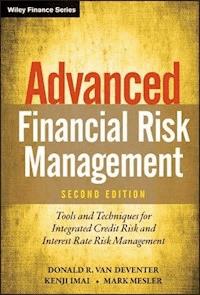
Practical tools and advice for managing financial risk, updated for a post-crisis world Advanced Financial Risk Management bridges the gap between the idealized assumptions used for risk valuation and the realities that must be reflected in management actions. It explains, in detailed yet easy-to-understand terms, the analytics of these issues from A to Z, and lays out a comprehensive strategy for risk management measurement, objectives, and hedging techniques that apply to all types of institutions. Written by experienced risk managers, the book covers everything from the basics of present value, forward rates, and interest rate compounding to the wide variety of alternative term structure models. Revised and updated with lessons from the 2007-2010 financial crisis, Advanced Financial Risk Management outlines a framework for fully integrated risk management. Credit risk, market risk, asset and liability management, and performance measurement have historically been thought of as separate disciplines, but recent developments in financial theory and computer science now allow these views of risk to be analyzed on a more integrated basis. The book presents a performance measurement approach that goes far beyond traditional capital allocation techniques to measure risk-adjusted shareholder value creation, and supplements this strategic view of integrated risk with step-by-step tools and techniques for constructing a risk management system that achieves these objectives. * Practical tools for managing risk in the financial world * Updated to include the most recent events that have influenced risk management * Topics covered include the basics of present value, forward rates, and interest rate compounding; American vs. European fixed income options; default probability models; prepayment models; mortality models; and alternatives to the Vasicek model Comprehensive and in-depth, Advanced Financial Risk Management is an essential resource for anyone working in the financial field.
Sie lesen das E-Book in den Legimi-Apps auf:
Seitenzahl: 1239
Veröffentlichungsjahr: 2013
Ähnliche



















Contents
Introduction: Wall Street Lessons from Bubbles
Part One: Risk Management: Definitions and Objectives
Chapter 1: A Risk Management Synthesis
Risk Management: Definitions and Objectives
Advances in Integrated Risk Management and Institutional Barriers to Progress
Measuring the Trade-Offs between Risk and Return
When Bad Things Happen to Good People
U.S. Savings and Loan Crisis
Long-Term Capital Management
The 2006–2011 Credit Crisis
A Thousand Cuts
Notes
Chapter 2: Risk, Return, Performance Measurement, and Capital Regulation
Practical Quantification of Risk
Perils and Pitfalls in the Measurement of Risk: The Impact of Selection Bias
Biases in Return vs. a Relative Benchmark
Historical Value at Risk: Selection Bias Again
Monte Carlo–Based Value at Risk
Expected Losses on Tranches of Collateralized Debt Obligations
Measuring Return: Market vs. Accounting Returns
Introduction to Transfer Pricing: Extracting Interest Rate Risk in a Financial Accounting Context
Performance Measurement and Capital Regulation
Perspectives on Measuring Risk: One Source of Risk or Many Sources of Risk?
Interest Rate Risk Management Evolution
Equity Risk Management Evolution
Option Risk Management Evolution
Credit Risk Management Evolution
Managing Risk and Strategy, Business by Business
Risk and Strategy Management in a Complex Financial Institution
What Causes Financial Institutions to Fail?
The Role of Capital in Risk Management and Business Strategy
Capital-Based Risk Management in Banking Today: Pros and Cons
History of Capital-Based Regulations in Commercial Banking
Notes
Part Two: Risk Management Techniques for Interest Rate Analytics
Chapter 3: Interest Rate Risk Introduction and Overview
Background Information on Movements in the U.S. Treasury Yield Curve
A Step-by-Step Approach to Analyzing Interest Rate Risk
The Interest Rate Risk Safety Zone
Notes
Chapter 4: Fixed Income Mathematics
Modern Implications of Present Value
Price, Accrued Interest, and Value
Calculation of Accrued Interest
Present Value
The Basic Present Value Calculation
Calculating the Value of a Fixed Coupon Bond with Principal Paid at Maturity
Calculating the Coupon of a Fixed Coupon Bond with Principal Paid at Maturity When the Value Is Known
The Value of an Amortizing Loan
Calculating the Payment Amount of an Amortizing Bond When the Value Is Known
Calculating the Value of a Floating-Rate Bond or Loan with Principal Paid at Maturity
Compound Interest Conventions and Formulas
Compounding Formulas and Present Value Factors P(t)
Yields and Yield-to-Maturity Calculations
The Formula for Yield to Maturity
Yield to Maturity for Long or Short First Coupon Payment Periods
Calculating Forward Interest Rates and Bond Prices
Implied Forward Interest Rates on Zero-Coupon Bonds
Implied Forward Zero-Coupon Bond Prices
Present Value of Forward Fixed Coupon Bond
Implied Forward Price on a Fixed Coupon Bond
Implied Forward Coupon on a Fixed Coupon Bond
Other Forward Calculations
Summary
Notes
Chapter 5: Yield Curve Smoothing
Example A: Stepwise Constant Yields and Forwards vs. Nelson-Siegel
Deriving the Form of the Yield Curve Implied by Example A
Fitting the Nelson-Siegel Approach to Sample Data
Example D: Quadratic Yield Splines and Related Forward Rates
Deriving the Form of the Yield Curve Implied by Example D
Example F: Cubic Yield Splines and Related Forwards
Deriving the Form of the Yield Curve Implied by Example F Assumptions
Example H: Maximum Smoothness Forward Rates and Related Yields
Deriving the Parameters of the Quartic Forward Rate Curves Implied by Example H Assumptions
Comparing Yield Curve and Forward Rate Smoothing Techniques
Trading Off Smoothness vs. the Length of the Forward Rate Curve
The Shimko Test for Measuring Accuracy of Smoothing Techniques
Smoothing Yield Curves Using Coupon-Bearing Bond Prices as Inputs
Appendix: Proof of the Maximum Smoothness Forward Rate Theorem
Notes
Chapter 6: Introduction to Heath, Jarrow, and Morton Interest Rate Modeling
Objectives of the Example and Key Input Data
Key Implications and Notation of the HJM Approach
Pseudo-Probabilities
The Formula for Zero-Coupon Bond Price Shifts
Building the Bushy Tree for Zero-Coupon Bonds Maturing at Time T = 2
Building the Bushy Tree for Zero-Coupon Bonds Maturing at Time T = 4
Valuation in the HJM Framework
Valuation of a Zero-Coupon Bond Maturing at Time T = 4
Valuation of a Coupon-Bearing Bond Paying Annual Interest
Valuation of a Digital Option on the One-Year U.S. Treasury Rate
Conclusion
Chapter 7: HJM Interest Rate Modeling with Rate and Maturity-Dependent Volatility
Objectives of the Example and Key Input Data
Key Implications and Notation of the HJM Approach
Pseudo-Probabilities
The Formula for Zero-Coupon Bond Price Shifts
Building the Bushy Tree for Zero-Coupon Bonds Maturing at Time T = 2
Building the Bushy Tree for Zero-Coupon Bonds Maturing at Time T = 4
Valuation in the HJM Framework
Valuation of a Zero-Coupon Bond Maturing at Time T = 4
Valuation of a Coupon-Bearing Bond Paying Annual Interest
Valuation of a Digital Option on the One-Year U.S. Treasury Rate
Conclusion
Chapter 8: HJM Interest Rate Modeling with Two Risk Factors
Probability of Yield Curve Twists in the U.S. Treasury Market
Objectives of the Example and Key Input Data
Introducing a Second Risk Factor Driving Interest Rates
Key Implications and Notation of the HJM Approach
Pseudo-Probabilities
Valuation in the HJM Framework
Valuation of a Zero-Coupon Bond Maturing at Time T = 4
Valuation of a Coupon-Bearing Bond Paying Annual Interest
Valuation of a Digital Option on the One-Year U.S. Treasury Rate
Replication of HJM Example 3 in Common Spreadsheet Software
Conclusion
Chapter 9: HJM Interest Rate Modeling with Three Risk Factors
Probability of Yield Curve Twists in the U.S. Treasury Market
Objectives of the Example and Key Input Data
Risk Factor 1: Annual Changes in the One-Year U.S. Treasury Spot Rate
Alternative Specifications of the Interest Rate Volatility Surface
Key Implications and Notation of the HJM Approach
Pseudo-Probabilities
Valuation in the HJM Framework
Valuation of a Zero-Coupon Bond Maturing at Time T = 4
Valuation of a Coupon-Bearing Bond Paying Annual Interest
Valuation of a Digital Option on the One-Year U.S. Treasury Rate
Conclusion
Note
Chapter 10: Valuation, Liquidity, and Net Income
How Many Risk Factors are Necessary to Accurately Model Movements in the Risk-Free Yield Curve?
Revisiting the Phrase “No Arbitrage”
Valuation, Liquidity Risk, and Net Income
Risk-Neutral and Empirical Probabilities of Interest Rate Movements
Monte Carlo Simulation Using HJM Modeling
Common Pitfalls in Interest Rate Risk Management
Summarizing the Problems with Interpolated Monte Carlo Simulation for Risk Analysis
Notes
Chapter 11: Interest Rate Mismatching and Hedging
Political Factions in Interest Rate Risk Management
Making a Decision on Interest Rate Risk and Return: The Safety Zone
Obvious Interest Rate Risk Decisions
Assessing the Risk and Return Trade-Offs from a Change in Interest Rate Risk
Chapter 12: Legacy Approaches to Interest Rate Risk Management
Gap Analysis and Simulation Models
Measuring Interest Rate Risk: A Review
Legacy Rate Risk Tools: Interest Rate Sensitivity Gap Analysis
The Safety Zone
What’s Wrong with Gap Analysis?
Legacy Rate Risk Tools: Multiperiod Simulation
Modeling the Maturity Structure of a Class of Assets
Macaulay’s Duration: The Original Formula
Using Duration for Hedging
Comparing a Duration Hedge with Hedging in the HJM Framework
Duration: The Traditional Market Convention
The Perfect Duration Hedge: The Difference between the Original Macaulay and Conventional Durations
Convexity and Its Uses
Conclusion
Note
Chapter 13: Special Cases of Heath, Jarrow, and Morton Interest Rate Modeling
What is an Academic Term Structure Model and Why Was It Developed?
The Vocabulary of Term Structure Models
Ito’s Lemma
Ito’s Lemma for More Than One Random Variable
Using Ito’s Lemma to Build a Term Structure Model
Duration as a Term Structure Model
Conclusions about the Use of Duration’s Parallel Shift Assumptions
The Vasicek and Extended Vasicek Models
The Merton Term Structure Model: Parallel Yield Curve Shifts
The Extended Merton Model
The Vasicek Model
The Extended Vasicek–Hull and White Model
Alternative Term Structure Models
Reprising the HJM Approach
Appendix A: Deriving Zero-Coupon Bond Prices in the Extended Merton/Ho and Lee Model
Appendix B: Deriving Zero-Coupon Bond Prices in the Vasicek Model
Appendix C: Valuing Zero-Coupon Bonds in the Extended Vasicek Model
Notes
Chapter 14: Estimating the Parameters of Interest Rate Models
Revisiting the Meaning of No Arbitrage
A Framework for Fitting Term Structure Models
Fitting Zero-Coupon Bond Prices and Volatility Parameters Jointly
Steps in Fitting the Interest Rate Volatility Assumptions
Interest Rate Parameter Fitting in Practical Application
Note
Part Three: Risk Management Techniques for Credit Risk Analytics
Chapter 15: An Introduction to Credit Risk
Market Prices for Credit Risk
Critical Sources of Market Data on Credit Risk
Increased Accuracy in Pricing
Increased Clarity in Corporate Strategy
Increased Sophistication in Risk Management
Increased Precision in Measuring the Safety and Soundness of Financial Institutions
Credit Default Swaps: The Dangers of Market Manipulation
Daily Nondealer Trading Volume for 1,090 Reference Names
Credit Default Swap Trading Volume in Municipals and Sub-Sovereigns
Credit Default Swap Trading Volume in Sovereign Credits
Implications of CDS Trading Volume Data
Notes
Chapter 16: Reduced Form Credit Models and Credit Model Testing
The Jarrow-Turnbull Model
The Jarrow Model
Zero-Coupon Bond Prices in the Jarrow Model
Fitting the Jarrow Model to Bond Prices, Credit Derivatives Prices, and Historical Default Databases
Correlations in Default Probabilities
The Jarrow and Jarrow-Turnbull Models: A Summary
Tests of Credit Models Using Historical Data
An Introduction to Credit Model Testing
Misunderstandings about Credit Model Testing
The Two Components of Credit Model Performance
The Predictive Capability of the Jarrow-Chava Reduced Form Model Default Probabilities
Reduced Form Model vs. Merton Model Performance
Consistency of Estimated and Actual Defaults
Recent Results from North America
The Falkenstein and Boral Test
Performance of Credit Models vs. Naïve Models of Risk
Testing Credit Models: The Analogy with Interest Rates
Appendix: Converting Default Intensities to Discrete Default Probabilities
Notes
Chapter 17: Credit Spread Fitting and Modeling
Introduction to Credit Spread Smoothing
The Market Convention for Credit Spreads
A Better Convention for Credit Model–Independent Credit Spreads
Credit Spread Smoothing Using Yield Curve–Smoothing Techniques
Fitting Credit Spreads with Cubic Splines
Maximum Smoothness Forward Credit Spreads
Comparing Results
Data Problems with Risky Issuers
Determinants of Credit Spread Levels
The Credit Risk Premium: The Supply and Demand for Credit
Conclusion
Notes
Chapter 18: Legacy Approaches to Credit Risk
The Rise and Fall of Legacy Ratings
Ratings: What They Do and Don’t Do
Through the Cycle vs. Point in Time, a Distinction without a Difference
Stress Testing, Legacy Ratings, and Transition Matrices
Transition Matrices: Analyzing the Random Changes in Ratings from One Level to Another
Moral Hazard in “Self-Assessment” of Ratings Accuracy by Legacy Rating Agencies
Comparing the Accuracy of Ratings and Reduced Form Default Probabilities
Problems with Legacy Ratings in the 2006 to 2011 Credit Crisis
The Jarrow-Merton Put Option and Legacy Ratings
The Merton Model of Risky Debt
The Intuition of the Merton Model
The Basic Merton Model
Valuing Multipayment Bonds with the Merton Model of Risky Debt
Estimating the Probability of Default in the Merton Model
Implying the Value of Company Assets and Their Return Volatility σ
Mapping the Theoretical Merton Default Probabilities to Actual Defaults
The Merton Model When Interest Rates are Random
The Merton Model with Early Default
Loss Given Default in the Merton Model
Copulas and Correlation between the Events of Default of Two Companies
Problems with the Merton Model: Summing Up
Appendix
Notes
Chapter 19: Valuing Credit Risky Bonds
The Present Value Formula
Valuing Bonds with No Credit Risk
Simulating the Future Values of Bonds with No Credit Risk
Current and Future Values of Fixed Income Instruments: HJM Background and a Straight Bond Example
Valuation of a Straight Bond with a Bullet Principal Payment at Maturity
Valuing an Amortizing Loan
Valuing Risk-Free, Floating-Rate Loans
Valuing Bonds with Credit Risk
Simulating the Future Values of Bonds with Credit Risk
Valuing the Jarrow-Merton Put Option
Chapter 20: Credit Derivatives and Collateralized Debt Obligations
Credit Default Swaps: Theory
Credit Default Swaps: Practice
Collateralized Debt Obligations: Theory
Collateralized Debt Obligations: A Worked Example of Reduced Form Simulation
Collateralized Debt Obligations: Practice
The Copula Method of CDO Valuation: A Postmortem
Valuing the Jarrow–Merton Put Option
Notes
Part Four: Risk Management Applications: Instrument by Instrument
Chapter 21: European Options on Bonds
Example: European Call Option on Coupon-Bearing Bond
Example: Coupon-Bearing Bond with Embedded European Call Option
European Options on Defaultable Bonds
HJM Special Case: European Options in the One-Factor Vasicek Model
Options on Coupon-Bearing Bonds
The Jarrow-Merton Put Option
Chapter 22: Forward and Futures Contracts
Forward Contracts on Zero-Coupon Bonds
Eurodollar Futures-Type Forward Contracts
Futures on Zero-Coupon Bonds: The Sydney Futures Exchange Bank Bill Contract
Futures on Coupon-Bearing Bonds: Dealing with the Cheapest to Deliver Option
Eurodollar and Euroyen Futures Contracts
Defaultable Forward and Futures Contracts
Note
Chapter 23: European Options on Forward and Futures Contracts
Valuing Options on Forwards and Futures: Notations and Useful Formulas
European Options on Forward Contracts on Zero-Coupon Bonds
European Options on Forward Rate Agreements
European Options on a Eurodollar Futures-Type Forward Contract
Defaultable Options on Forward and Futures Contracts
Note
Chapter 24: Caps and Floors
Caps as European Options on Forward Rate Agreements
Forming Other Cap-Related Securities
Value of a Loan with a Cap and a Floor
Measuring the Credit Risk of Counterparties on Caps and Floors
Note
Chapter 25: Interest Rate Swaps and Swaptions
Interest Rate Swap Basics
Valuing the Interest Rate Swaps
The Observable Fixed Rate in the Swap Market
An Introduction to Swaptions
Notes
Chapter 26: Exotic Swap and Options Structures
Arrears Swaps
Digital Option
Digital Range Notes
Range Floater
Other Derivative Securities
Credit Risk and Exotic Derivatives Structures
Chapter 27: American Fixed Income Options
An Overview of Numerical Techniques for Fixed Income Option Valuation
An Example of Valuation of a Callable Bond with a Three-Factor HJM Bushy Tree
What is the Par Coupon on a Callable Bond?
An Example of Valuation of a Rationally Prepaid Amortizing Loan
Finite Difference Methods
Binomial Lattices
Trinomial Lattices
HJM Valuation of American Fixed Income Options When Default Risk is Present
Notes
Chapter 28: Irrational Exercise of Fixed Income Options
Analysis of Irrationality: Criteria for a Powerful Explanation
The Transactions Cost Approach
Irrational Exercise of European Options
The Irrational Exercise of American Options
Implied Irrationality and Hedging
Credit Risk and Irrational Prepayment Behavior
Chapter 29: Mortgage-Backed Securities and Asset-Backed Securities
Transactions Costs, Prepayments, Default, and Multinomial Logit
Legacy Prepayment Analysis of Mortgage-Backed Securities
Legacy Approaches: Option-Adjusted Spread
Implications for OAV Spread, CMOs, and ARMs
Logistic Regression, Credit Risk, and Prepayment
Mortgage-Servicing Rights: The Ultimate Structured Product
An Introduction to the Valuation of Mortgage-Servicing Rights
Comparing Best Practice and Common Practice in Valuing and Hedging Mortgage-Servicing Rights
Conclusion
Notes
Chapter 30: Nonmaturity Deposits
The Value of the Deposit Franchise
Total Cash Flow of Nonmaturity Deposits
Specifying the Rate and Balance Movement Formulas
The Impact of Bank Credit Risk on Deposit Rates and Balances
Case Study: German Three-Month Notice Savings Deposits
The Regulators’ View
Conclusion
Notes
Chapter 31: Foreign Exchange Markets
Setting the Stage: Assumptions for the Domestic and Foreign Economies
Foreign Exchange Forwards
Numerical Methods for Valuation of Foreign Currency Derivatives
Legacy Approaches to Foreign Exchange Options Valuation
Implications of a Term Structure Model-Based FX Options Formula
The Impact of Credit Risk on Foreign Exchange Risk Formulas
Notes
Chapter 32: Impact of Collateral on Valuation Models
The Impact of Changing Home Prices on Collateral Values in the Credit Crisis
Modeling Variations in Collateral Values
The Impact of Collateral Values on a Rationally Prepaid Mortgage
Conclusions about the Impact of Collateral Values
Chapter 33: Pricing and Valuing Revolving Credit and Other Facilities
Analyzing Revolving Credit and Other Facilities
Fluctuating Credit Risk and Revolving Credit Drawdowns
Incorporating Links between Credit Quality and Line Usage
Is a Line of Credit a Put Option on the Debt of the Issuer?
Chapter 34: Modeling Common Stock and Convertible Bonds on a Default-Adjusted Basis
Modeling Equities: The Traditional Fund Management Approach
Modeling Equities: The Derivatives Approach
Modeling Equities: A Credit Risk–Adjusted Approach
Options on the Common Stock of a Company That Can Go Bankrupt
Convertible Bonds of a Company That Can Go Bankrupt
Note
Chapter 35: Valuing Insurance Policies and Pension Obligations
Life Insurance: Mortality Rates vs. Default Probabilities
Pension Obligations
Property and Casualty Insurance
The Jarrow-Merton Put Option
Notes
Part Five: Portfolio Strategy and Risk Management
Chapter 36: Value-at-Risk and Risk Management Objectives Revisited at the Portfolio and Company Level
The Jarrow-Merton Put Option as a Measure of Total Risk: An Example
A Four-Question Pass–Fail Test for Financial Institutions’ CEOs and Boards of Directors
Is Your Value-at-Risk from Value-at-Risk?
VaR vs. the Put Option for Capital Allocation
Why Are the VaR and Put Approaches So Different: Self-Insurance vs. Third-Party Insurance
Calculating the Jarrow-Merton Put Option Value and Answering the Key 4 + 26 Questions
Valuing and Simulating the Jarrow-Merton Put Option
What’s the Hedge?
Liquidity, Performance, Capital Allocation, and Own Default Risk
Note
Chapter 37: Liquidity Analysis and Management
Liquidity Risk Case Studies from the Credit Crisis
Case Studies in Liquidity Risk
Implications of the Credit Crisis History for Liquidity Risk Management and Analysis
Determining the Optimal Liquidity Strategy
Summing Up
Notes
Chapter 38: Performance Measurement
Transaction-Level Performance Measurement vs. Portfolio-Level Performance Measurement
Plus Alpha Benchmark Performance vs. Transfer Pricing
Why Default Risk Is Critical in Performance Measurement of Equity Portfolios
“Plus Alpha” Performance Measurement in Insurance and Banking
Decomposing the Reasons for Plus or Minus Alpha in a Fixed Income Portfolio
A Worked Example of Modern Fixed Income Performance Attribution
The Jarrow-Merton Put Option and Capital
Using the Jarrow-Merton Put Option for Capital Allocation
Summing Up
Notes
Chapter 39: Managing Institutional Default Risk and Safety and Soundness
Step 1: Admitting the Possibility of Failure
Managing the Probability of Failure
Controlling the Probability of Failure through the Credit Cycle
Hedging Total Risk to Maximize Shareholder Value
Implications for Basel II, Basel III, and Solvency II
Simulating Your Own Probability of Default
Note
Chapter 40: Information Technology Considerations
Common Practice in Risk Management Systems: Dealing with Legacy Systems
Upgrading the Risk Infrastructure: The Request for Proposal Process
Paid Pilots as Final Proof of Concept
Keys to Success in Software Installation
Vendor Size: Larger Vendor or Small Vendor?
Being a Best Practice User
Chapter 41: Shareholder Value Creation and Destruction
Do No Harm
Measure the Need to Change
Rating Your Primary Risk System
Master the Politics and Exposition of Risk Management: Shareholder Value Creation
Daily Management Reporting of Total Risk
Moving from Common Practice to Best Practice
The Senior Management Perspective
The Middle Management Perspective
The Working-Level Perspective
Getting Help to Create Shareholder Value
Postscript
Notes
Bibliography
Index
Founded in 1807, John Wiley & Sons is the oldest independent publishing company in the United States. With offices in North America, Europe, Australia, and Asia, Wiley is globally committed to developing and marketing print and electronic products and services for our customers’ professional and personal knowledge and understanding.
The Wiley Finance series contains books written specifically for finance and investment professionals as well as sophisticated individual investors and their financial advisors. Book topics range from portfolio management to e-commerce, risk management, financial engineering, valuation, and financial instrument analysis, as well as much more.
For a list of available titles, visit our Web site at www.WileyFinance.com.
Cover Design: Leiva-Sposato.
Cover Image: © hudiemm/iStockphoto.
Copyright © 2013 by John Wiley & Sons Singapore Pte. Ltd.
Published by John Wiley & Sons Singapore Pte. Ltd.
1 Fusionopolis Walk, #07-01, Solaris South Tower, Singapore 138628
All rights reserved.
No part of this publication may be reproduced, stored in a retrieval system, or transmitted in any form or by any means, electronic, mechanical, photocopying, recording, scanning, or otherwise, except as expressly permitted by law, without either the prior written permission of the Publisher, or authorization through payment of the appropriate photocopy fee to the Copyright Clearance Center. Requests for permission should be addressed to the Publisher, John Wiley & Sons Singapore Pte. Ltd., 1 Fusionopolis Walk, #07-01, Solaris South Tower, Singapore 138628, tel: 65–6643–8000, fax: 65–6643–8008, e-mail: [email protected].
Limit of Liability/Disclaimer of Warranty: While the publisher and author have used their best efforts in preparing this book, they make no representations or warranties with respect to the accuracy or completeness of the contents of this book and specifically disclaim any implied warranties of merchantability or fitness for a particular purpose. No warranty may be created or extended by sales representatives or written sales materials. The advice and strategies contained herein may not be suitable for your situation. You should consult with a professional where appropriate. Neither the publisher nor the author shall be liable for any damages arising herefrom.
Other Wiley Editorial Offices
John Wiley & Sons, 111 River Street, Hoboken, NJ 07030, USA
John Wiley & Sons, The Atrium, Southern Gate, Chichester, West Sussex, P019 8SQ, United Kingdom
John Wiley & Sons (Canada) Ltd., 5353 Dundas Street West, Suite 400, Toronto, Ontario, M9B 6HB, Canada
John Wiley & Sons Australia Ltd., 42 McDougall Street, Milton, Queensland 4064, Australia
Wiley-VCH, Boschstrasse 12, D-69469 Weinheim, Germany
Library of Congress Cataloging-in-Publication Data
ISBN 978-1-118-27854-3 (Hardcover)
ISBN 978-1-118-27857-4 (ePDF)
ISBN 978-1-118-27856-7 (Mobi)
ISBN 978-1-118-27855-0 (ePub)
For Yasuko, Tomoki, and Anna.
K. I.
To all of our colleagues at Kamakura.
M. M.
For Ayako, Ella, Ai, and Yuu.
D. v. D.
Introduction: Wall Street Lessons from Bubbles
The credit crisis that began to unfold in the United States and Europe in 2006 contains a treasure trove of lessons for risk managers that we have tried to incorporate into this book. Since we have each worked in Japan, we felt strongly that the collapse of the Japanese bubble, which peaked in late 1989, contained equally useful lessons for risk managers. As you’ll note in the “key fallacies in risk management” discussed below, many ignored the lessons of the Japanese bubble because of the common fallacy that “if it hasn’t happened to me yet, it won’t happen to me, even if it’s happened to someone else.”
Now that the United States and much of Europe are experiencing the collapse of a bubble much like that which burst in Japan, the lessons from each of these bubbles seem much more relevant to risk managers around the world.
We have worked hard in the second edition of this book to severely de-emphasize the discussion of financial models that are obviously inaccurate, misleading, or clearly inferior to another modeling approach. We make this judgment on the basis of cold hard facts (via model testing) or because of assumptions that are known to be false. The list of models that failed under the duress of the credit crisis is a long one, and we make no apologies for reflecting those failures in this book. We’ve also worked hard to explain which models performed well during the credit crisis. Again, we base that judgment on model testing and the logical consistency and accuracy of the assumptions behind those models.
We believe in a “multiple models approach” to risk management. That doesn’t mean, however, that all models used are equally accurate. Nothing could be further from the truth. The use of a multiple models approach, however, makes it clear when a better model has been brought to the risk management discipline and when it’s time for an older model to be removed from the toolkit. One of our British friends provided the elegant observation that “I don’t think it’s gentlemanly to compare the accuracy of two models.” The authors, by contrast, believe that such comparisons are a mandatory part of corporate governance and best practice risk management.
With that brief introduction, we turn to a short summary of common fallacies in risk management that have been exposed as fallacies very starkly in the wake of the recent credit crisis.
KEY FALLACIES IN RISK MANAGEMENT
Summarizing the dangerous elements of conventional wisdom in risk management isn’t easy. We’ve restricted ourselves to the seven most dangerous ways of thinking about risk. Each of them has much in common with this famous quote of John Maynard Keynes from “The Consequences to the Banks of the Collapse of Money Values” in 1931: “A sound banker, alas, is not one who foresees danger and avoids it, but one who, when he is ruined, is ruined in a conventional way along with his fellows, so that no one can really blame him.” We summarize them here and discuss each briefly in turn:
Lesen Sie weiter in der vollständigen Ausgabe!
Lesen Sie weiter in der vollständigen Ausgabe!
Lesen Sie weiter in der vollständigen Ausgabe!
Lesen Sie weiter in der vollständigen Ausgabe!
Lesen Sie weiter in der vollständigen Ausgabe!
Lesen Sie weiter in der vollständigen Ausgabe!
Lesen Sie weiter in der vollständigen Ausgabe!
Lesen Sie weiter in der vollständigen Ausgabe!
Lesen Sie weiter in der vollständigen Ausgabe!
Lesen Sie weiter in der vollständigen Ausgabe!
Lesen Sie weiter in der vollständigen Ausgabe!
Lesen Sie weiter in der vollständigen Ausgabe!
Lesen Sie weiter in der vollständigen Ausgabe!
Lesen Sie weiter in der vollständigen Ausgabe!
Lesen Sie weiter in der vollständigen Ausgabe!
Lesen Sie weiter in der vollständigen Ausgabe!
Lesen Sie weiter in der vollständigen Ausgabe!
Lesen Sie weiter in der vollständigen Ausgabe!
Lesen Sie weiter in der vollständigen Ausgabe!
Lesen Sie weiter in der vollständigen Ausgabe!
Lesen Sie weiter in der vollständigen Ausgabe!
Lesen Sie weiter in der vollständigen Ausgabe!
Lesen Sie weiter in der vollständigen Ausgabe!
Lesen Sie weiter in der vollständigen Ausgabe!
Lesen Sie weiter in der vollständigen Ausgabe!
Lesen Sie weiter in der vollständigen Ausgabe!
Lesen Sie weiter in der vollständigen Ausgabe!
Lesen Sie weiter in der vollständigen Ausgabe!
Lesen Sie weiter in der vollständigen Ausgabe!
Lesen Sie weiter in der vollständigen Ausgabe!
Lesen Sie weiter in der vollständigen Ausgabe!
Lesen Sie weiter in der vollständigen Ausgabe!
Lesen Sie weiter in der vollständigen Ausgabe!
Lesen Sie weiter in der vollständigen Ausgabe!
Lesen Sie weiter in der vollständigen Ausgabe!
Lesen Sie weiter in der vollständigen Ausgabe!
Lesen Sie weiter in der vollständigen Ausgabe!
Lesen Sie weiter in der vollständigen Ausgabe!
Lesen Sie weiter in der vollständigen Ausgabe!
Lesen Sie weiter in der vollständigen Ausgabe!
Lesen Sie weiter in der vollständigen Ausgabe!
Lesen Sie weiter in der vollständigen Ausgabe!
Lesen Sie weiter in der vollständigen Ausgabe!
Lesen Sie weiter in der vollständigen Ausgabe!
Lesen Sie weiter in der vollständigen Ausgabe!
Lesen Sie weiter in der vollständigen Ausgabe!
Lesen Sie weiter in der vollständigen Ausgabe!
Lesen Sie weiter in der vollständigen Ausgabe!




