


144,99 €
Mehr erfahren.
- Herausgeber: John Wiley & Sons
- Kategorie: Fachliteratur
- Serie: Wiley Series on Plastics Engineering and Technology
- Sprache: Englisch
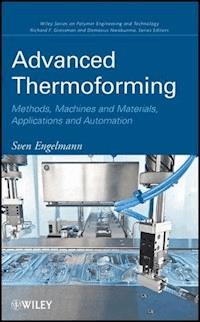
Introduces the latest innovations in thermoforming materials, processes, and applications Advanced Thermoforming brings readers fully up to date with the latest standards, processes, materials, and applications in the field. From forming to filling to sealing processes, the author explains everything that can now be accomplished using the most advanced thermoforming technologies available. Moreover, readers learn how to fully leverage these technologies in order to design and manufacture products that meet all specifications at minimum cost and maximum efficiency. Emphasizing the application of advanced thermoforming for the production of technical parts and packaging, the book: * Guides readers through all facets of development, design, and machine and mold technology * Recommends new technologies that offer higher productivity, better quality, and lower costs * Describes common raw materials used in thermoforming, including how specific materials affect the production process * Explains the proper handling of semi-finished products and formed parts * Sets forth the basic principles of extrusion, an essential process underlying thermoforming * Introduces the latest software techniques to simulate the thermoforming of new products Throughout the book, readers learn about the latest innovations in thermoforming, from thermoformed automobile body parts to fully automated packaging assembly lines. The author offers valuable content from his interviews with leading industrial thermoformers, sharing insights and tips from their years of hands-on experience with readers. With Advanced Thermoforming as their guide, polymer and plastics engineering professionals and students can now explore and exploit the full range of possibilities that thermoforming technology offers.
Sie lesen das E-Book in den Legimi-Apps auf:
Seitenzahl: 470
Veröffentlichungsjahr: 2012
Ähnliche



















Table of Contents
Cover
Wiley Series on Polymer Engineering and Technology
Title page
Copyright page
Dedication
Preface
Chapter 1 Introduction
Chapter 2 Basics of Thermoforming and Thermoplastics
2.1 THERMOFORMING METHODS
2.2 POSITIVE FORMING
2.3 NEGATIVE FORMING
2.4 ADVANTAGES AND DISADVANTAGES OF THERMOFORMING
2.5 THERMOFORMING MACHINES
2.6 SEMIFINISHED THERMOPLASTIC PRODUCTS
Chapter 3 Production of Semifinished Products, Extrusion, and Coextrusion
3.1 EXTRUSION
3.2 COEXTRUSION
Chapter 4 Introduction to Technical Parts
Chapter 5 Antenna Radome Manufacturing
5.1 WEATHER-RESISTANT HIGH-IMPACT POLYSTYRENE
5.2 THE EFFECT OF UV LIGHT
5.3 WETTING RESISTANCE
5.4 ANTENNA GAIN
5.5 WATER AND ANTENNA GAIN
Chapter 6 Fuel Tank Production on Sheet Machines
Chapter 7 Automotive Body and Commercial Vehicle Applications
7.1 APPLICATIONS FOR CAR BODIES—ABS/PMMA
7.2 CAR BODIES FOR UTILITY VEHICLES
7.3 COVER FOR HEAD LAMP
Chapter 8 Production of Refrigerator Liners
8.1 HIGH-IMPACT POLYSTYRENE (PS-HI)
8.2 SYNTHESIS
8.3 MORPHOLOGY
8.4 MECHANISM OF RUBBER REINFORCEMENT
8.5 PROPERTIES OF PS-HI
8.6 RUBBER-MODIFIED SAN COPOLYMERS (ABS)
8.7 GENERAL GRADES OF ABS
8.8 THE THERMOFORMING PRODUCTION PROCESS
8.9 ENVIRONMENTAL STRESS CRACKING
8.10 REFRIGERATOR OUTSIDE COVERS
Chapter 9 Paint Replacement in Automotive Applications
9.1 PAINT REPLACEMENT
9.2 REASONS FOR REPLACEMENT OF PAINT IN AUTOMOTIVE APPLICATIONS
9.3 LAYER CONSTRUCTION OF COEXTRUDED INLINE COLORED PLASTIC SHEETS
9.4 COLOR MANAGEMENT DURING PRODUCT DEVELOPMENT AND PRODUCTION
9.5 REQUIREMENTS FROM THE AUTOMOTIVE INDUSTRY ON SURFACE QUALITY
9.6 REQUIREMENTS FROM THE AUTOMOTIVE INDUSTRY ON COLOR MATCH
9.7 AUTOMOTIVE INDUSTRY AND “ORANGE PEEL”
9.8 EXAMPLES OF PAINT REPLACEMENT IN AUTOMOTIVE APPLICATIONS
9.9 PAINT-FILM TECHNOLOGY: PAINTING PRIOR TO THERMOFORMING
Chapter 10 Motor Air Intake Made from PA 6 GF 15
Chapter 11 Sanitary Equipment (Sheet Machine)
11.1 FROM THE RIG TO THE THERMOFORMING MACHINE
11.2 FINISHING
11.3 REINFORCEMENT METHODS FOR BATHTUBS
Chapter 12 Thermoforming and Milling of Large-Scale Formed Parts (Sheet Machine)
12.1 SURFACE PROBLEMS
12.2 MOLD SHRINKING AND FREE SHRINKAGE
12.3 EXPANSION
12.4 THE DECISION BETWEEN POSITIVE OR NEGATIVE FORMING
12.5 TWIN-SHEET FORMING
12.6 AUTOMATION
Chapter 13 Changeover of Sheet Machines
13.1 THE INCREASING IMPORTANCE OF THE CHANGEOVER PROCEDURE
13.2 SHORTENING OF CHANGEOVER WITH HIGH-QUALITY EQUIPMENT
Chapter 14 Chromed Parts
Chapter 15 Applications in Aircraft and Mass Transportation
15.1 CURRENT GOVERNMENT AND OEM SPECIFICATIONS FOR FLAMMABILITY
15.2 USE OF ACRYL/PVC
15.3 POLYCARBONATE
15.4 POLYETHERIMIDE (PEI)
15.5 POLYPHENYLSULFONE (PPSU)
Chapter 16 High-Quality and Fully Transparent Products (Sheet Machines)
16.1 THICK AND SELF-SUPPORTING CLASS-A FORMED PARTS
16.2 CLASS-A MOLDED PARTS FOR IN-MOLD DECORATION
16.3 DEVELOPMENT OF FULLY TRANSPARENT PRODUCTS
Chapter 17 Deco Molding and Multi-deco Molding
17.1 THERMOFORMING
17.2 INJECTION MOLDING
17.3 TACTILE EFFECTS
17.4 OTHER SECTOR PARTS
17.5 MULTI-DECO MOLDING
17.6 THE AUTOMATED SEQUENCE PROCESS
Chapter 18 Automotive Body Parts Made of PA + ABS
Chapter 19 Softfeel Made from ABS/ TPU Material
Chapter 20 Introduction to Packaging
Chapter 21 Optimizing a Thermoforming Process for Packaging
21.1 METHOD FOR OPTIMIZING A PROCESS TO PRODUCE A THERMOFORMED ARTICLE FROM POLYMERIC MATERIAL
21.2 CHARACTERIZATION OF RESINS BY PERFORMANCE PARAMETERS
21.3 VARIABLES THAT CAN BE ALTERED TO INFLUENCE THE PLUG FORCE AND CAVITY PRESSURE
21.4 APPLICATION EXAMPLES
Chapter 22 Analysis of Thermoforming Films
22.1 GENERAL ANALYSIS OF THERMOFORMING FILMS
22.2 TESTS MEASURING FREE SHRINKAGE
22.3 TESTS MEASURING THICKNESS
22.4 TENSILE STRENGTH TEST
22.5 SURFACE TEXTURE TEST FOR THE GLOSS FACTOR
22.6 FLAME COLORATION
Chapter 23 Advanced Analysis of Thermoforming Films
23.1 PRODUCT QUALITY DEMANDS
23.2 DIFFERENTIAL SCANNING CALORIMETRY
23.3 DMA (DYNAMIC MECHANICAL ANALYSIS)
23.4 TORSION PENDULUM TEST
23.5 SUMMARY
Chapter 24 Analysis of Thermoformed Products
24.1 WALL THICKNESS DISTRIBUTION
24.2 TOP LOAD
24.3 VISUAL APPEARANCE
24.4 WATER VAPOR PERMEABILITY
24.5 OXYGEN PERMEABILITY
24.6 TRANSPARENCY
24.7 TESTING DEVICE FOR THE PRACTICAL ASSESSMENT OF THERMOFORMABILITY
Chapter 25 Analysis of Completely Formed, Filled, and Sealed Containers
25.1 BURST PRESSURE AND IMPERMEABILITY
25.2 RHODAMINE TEST
25.3 GENERAL REMARK ON IMPERMEABILITY TESTS
25.4 OPENING FORCE
Chapter 26 Automated Packaging
26.1 CUTTING SUBSEQUENT TO FORMING
26.2 CHARACTERISTICS OF THERMOFORMING PACKAGING LINES
26.3 CHARACTERISTICS OF PACKAGING MACHINE CONTROL
26.4 FORMING, FILLING, AND SEALING (FFS)
26.5 FORMING, PUNCHING, FILLING, AND SEALING (FPF)
26.6 FORMING, CROSS-CUTTING, FILLING, SEALING/PUNCHING (FCFS)
26.7 CONCLUSION
Chapter 27 Production of Flowerpots
27.1 THE THERMOFORMING MACHINE
27.2 HEATING SYSTEM
27.3 THE FORMING STATION
27.4 FORMING AIR
27.5 CHALK AS A FILLER
Chapter 28 Steel Rule Die Punching
28.1 BASICS
28.2 SHAPES OF CUTTING EDGES
28.3 CREATION OF ANGEL HAIR DURING STEEL RULE DIE CUTTING
Chapter 29 Production of Meat Trays
29.1 VACUUM PACKAGING
29.2 ACTIVE PACKAGING
29.3 MAP
29.4 PRODUCTION PROCESS FOR THE PP TRAY
29.5 NEW DEVELOPMENTS
Chapter 30 Multilayer Films for Thermoforming Applications
Chapter 31 PET in Thermoforming Applications
31.1 EXTRUSION AND THERMOFORMING OF A-PET RESINS
31.2 PET FOR ELECTRONIC PACKAGING
31.3 PET-G (GLYCOL-MODIFIED POLYETHYLENE TEREPHTHALATE)
31.4 SLIP AND ANTIBLOCK MASTERBATCHES
31.5 RECLAIMING SCRAP
Chapter 32 Thermoformed Packaging Made of PLA
32.1 PHYSICAL PROPERTIES
32.2 COMPOSTABILITY
32.3 PROCESSING OF PLA FILM
32.4 THERMOFORMING OF PLA
32.5 FILM TRANSPORT
Chapter 33 Peel and Reseal
33.1 FILM MATERIALS
33.2 PRODUCTION OF FILMS FOR PACKAGING
33.3 PRODUCTION OF RESEALABLE FOOD PACKAGING
33.4 PEEL AND RESEAL1
Chapter 34 Foam Packaging with PP and PS
34.1 POLYPROPYLENE
34.2 POLYSTYRENE
Chapter 35 Blister Packaging of Syringes
35.1 A-PET/PE
35.2 MATERIAL DESCRIPTION
35.3 THE MANUFACTURING PROCESS
35.4 SUMMARY OF THE PRODUCTION METHODS FOR A-PET/PE FILMS
35.5 PRODUCTION OF BLISTERS IN THE PACKAGING LINE
Chapter 36 The Production of Drinking Cups
36.1 FROM MONOMER TO POLYMER
36.2 MECHANICAL AND THERMAL BEHAVIOR OF PP
36.3 DIFFERENCE BETWEEN MOLD SHRINKAGE AND FREE SHRINKAGE
36.4 POLYPROPYLENE MODIFICATIONS
36.5 THERMOFORMING CONDITIONS AND FINISHED PART ATTRIBUTES5
36.6 DISTRIBUTION OF MOLECULAR WEIGHT
36.7 INFLUENCE OF NUCLEATION OF PP ON PROCESSING AND CHARACTERISTICS OF THE FINISHED PART
36.9 INFLUENCE OF FILM PRODUCTION TECHNOLOGY
36.10 OPTICAL PROPERTIES
36.11 FILM MORPHOLOGY
36.12 THE THERMOFORMING MACHINE
36.13 THE MOLD
36.14 STACKING
36.15 DOWNSTREAM DEVICES
Chapter 37 Ultrasonic Sealing and Cutting in Thermoforming
37.1 BACKGROUND
37.2 DEVELOPMENT OF ULTRASONIC SEALING AND CUTTING TECHNOLOGY
37.3 CONCLUSIONS
Chapter 38 Understanding the Brittle Behavior of Polystyrene Cups
38.1 EXPERIMENTAL METHODS
38.2 RESULTS AND DISCUSSION
38.3 CUP ORIENTATION RESULTS
38.4 CONCLUSION
38.5 APPENDIX: ORIENTATION IN VENDING CUPS
Chapter 39 Preprinted Film for Lid Thermoforming
Chapter 40 Flexible Films
40.1 FLEXIBLE PACKAGING MATERIAL
40.2 MAIN FLEXIBLE FILM TYPES
40.3 SEALING LAYERS
Chapter 41 Simulation
41.1 T-SIM COMPUTER SIMULATION OF THERMOFORMING
41.2 FEATURES OF SIMULATION SOFTWARE SUCH AS T-SIM
41.3 PRE-DISTORTION OF IMAGES
41.4 CAD FEASIBILITY STUDY
Chapter 42 Recycling
42.1 R-PET
42.2 R-PS
Glossary
Index
Wiley Series on Polymer Engineering and Technology
Richard F. Grossman and Domasius Nwabunma, Series Editors
Copyright © 2012 by John Wiley & Sons, Inc. All rights reserved
Published by John Wiley & Sons, Inc., Hoboken, New Jersey
Published simultaneously in Canada
No part of this publication may be reproduced, stored in a retrieval system, or transmitted in any form or by any means, electronic, mechanical, photocopying, recording, scanning, or otherwise, except as permitted under Section 107 or 108 of the 1976 United States Copyright Act, without either the prior written permission of the Publisher, or authorization through payment of the appropriate per-copy fee to the Copyright Clearance Center, Inc., 222 Rosewood Drive, Danvers, MA 01923, (978) 750-8400, fax (978) 750-4470, or on the web at www.copyright.com. Requests to the Publisher for permission should be addressed to the Permissions Department, John Wiley & Sons, Inc., 111 River Street, Hoboken, NJ 07030, (201) 748-6011, fax (201) 748-6008, or online at http://www.wiley.com/go/permissions.
Limit of Liability/Disclaimer of Warranty: While the publisher and author have used their best efforts in preparing this book, they make no representations or warranties with respect to the accuracy or completeness of the contents of this book and specifically disclaim any implied warranties of merchantability or fitness for a particular purpose. No warranty may be created or extended by sales representatives or written sales materials. The advice and strategies contained herein may not be suitable for your situation. You should consult with a professional where appropriate. Neither the publisher nor author shall be liable for any loss of profit or any other commercial damages, including but not limited to special, incidental, consequential, or other damages.
For general information on our other products and services or for technical support, please contact our Customer Care Department within the United States at (800) 762-2974, outside the United States at (317) 572-3993 or fax (317) 572-4002.
Wiley also publishes its books in a variety of electronic formats. Some content that appears in print may not be available in electronic formats. For more information about Wiley products, visit our web site at www.wiley.com.
Library of Congress Cataloging-in-Publication Data
Engelmann, Sven.
Advanced thermoforming : methods, machines and materials, applications and automation by / Sven Engelmann.
p. cm.
Includes index.
ISBN 978-0-470-49920-7 (cloth)
1. Thermoforming. I. Title.
TP1151.T48E64 2012
668.4'23–dc23
2011037218
For my lovely wife Ulrike and my wonderful children Leo, Peter, and Luzy.
Preface
This book focuses on practical applications. It deals with technical parts, but also with packaging (the topics range from bathtubs to syringe blisters). Beside the applications, the respective machine and tooling technologies, automation, and, of course, semifinished products and materials are described. Also a large part of the book is dedicated describing innovations in materials, so that the book can serve as a useful reference work on raw materials and semifinished products. Also discussed are multilayer structures, which are finding increasing use for fuel tanks as well as cheese packaging. Reliable applications of machine, tooling, and materials are demonstrated. The basic principles of extrusion, which are important for thermoforming are named for clarity’s sake without going into depth.
The basic principles of thermoforming and thermoplastics are covered briefly, as there are already several standard works dealing with these subjects. The present book is intended to complement, not replace the existing literature on thermoforming, and to open up new perspectives on the applications considered within. The author is grateful to all those writers who have advanced, described, and explained thermoforming and made it popular.
The aim of the book is to communicate points worth knowing about thermoforming and to arouse interest. The author hopes this book will show the reader the diversity and sophistication of the thermoforming industry and ways of implementing cost-effective production.
SVEN ENGELMANN
Chapter 1
Introduction
Reference books can be difficult to read and understand. Often technical connections and contexts are described by using a lot of mathematics—and often right from the beginning—so that a large part of the target group is overcharged or quickly loses interest. However, reading books on technology and engineering can be fun. Books dealing with technology should impart knowledge at an adequate pace. We live in a world that is dependent on a multitude of technologies. Yet it can be observed that fewer and fewer young people are interested in technical professions. What are the reasons for this development? It is true that the rush of today’s technology can initially have a discouraging effect. A lot of technology has become so complex and abstract that it is no longer possible to understand the connections through mere reflection or observation. As the modifications to technologies and processes come even faster, is it possible to keep up with these developments? The answer is yes!
There will always be technological development because economic issues and ecology are driving forces. Technological advancements, however, depend on the degree to which enthusiasm for technology can be aroused in persons with a certain talent and a disposition toward engineering. To some extent this book is based on a series of lectures called the “Basics of Thermoforming.” Among these lectures the discussions range over many topics, even to the “mere” production of a yogurt cup.
There are many people who are not directly involved in the development of technologies but who exert nonetheless an influence on technological developments. These decision makers, however, do depend on basic knowledge of the technological linkages and contexts.
This book is intended as a reference book for the relatively small industrial sector of thermoforming applications. This book focuses on thermoformed products and applications. All of us once had the experience of asking ourselves, when contemplating a formed part, how was this part produced? This book is subdivided into the description of technical formed parts and of packaging.
Some parts may not even look like thermoformed parts to the casual observer. This book will discuss the enormous possibilities of thermoforming at a level that presents an overview of the diversity of this plastics-processing method for nonprofessionals. At the same time the book includes useful detailed knowledge for the professional practitioner.
This book takes the thermoformed part and traces it back to the process chain. Machine and tooling technologies and the possible automation steps are explained in full detail, as are the materials used. For the description of the materials, the effects of the extrusion process are also considered and the characteristics of the raw materials are explained. Where the process chains are similar for some of the described applications, only the distinctive features are identified. The book also describes methods for the optimization of the thermoforming process.
If you look closely at your surroundings, you will find countless objects in your daily use that were produced using the thermoforming process. Bath and shower tubs are thermoformed parts and among the first thermoforming products you will see on entering your bathroom in the morning. If you decide to use a new toothbrush, you have to tear open its packaging made of thermoformed material. Opening your fridge, you will see thermoformed yogurt cups, and even your fridge itself has a thermoformed interior housing (liner). Even though thermoforming is being more and more used for automobile interiors and exteriors, the automotive industry has not yet played a big role in plastics engineering. But the pressure for more efficiency, cost cutting, and longer durability of some products has managers changing their outlook on thermoforming.
Thermoforming has a vast area of applications. From bathtub to toothbrush blister, from a cookie tray to a car roof, it does not matter which product you look at; most often it is a high tech application.
This book should help give an overview and insight in this advanced technology. There are different processes you can use depending on the application you need. The machine technology is getting more refined, enabling users to get with higher productivity, better quality, less material cost, and so forth. With the use of new machine drive concepts and digital machine control systems, modern machines need less energy.
The mold technology has dramatically developed in the past few years. Flexible molds require less change over times. This book shows the possibilities available with the new standard technology.
The literature so far has covered little regarding the handling of the semifinished products and formed parts, as well as further handling in inline processes. Automation is well on its way and will not stop for technical parts or in the packaging industry. This book will show the possibilities of automated processes. The forming, filling, and sealing processes will be reviewed in particular, as these processes are not exhaustively treated in other works of literature.
Many innovations, such as thermoformed automobile body parts or fully automated packaging assembly lines, include end packaging. These innovations need to be discussed in a written work and so are addressed in this book.
A discussion of thermoforming should also include the various developments from the resin producers and semifinished product producers. A large part of the book will cover such materials, so that the book will serve as a useful reference. The discussions of multilayer laminates have applications ranging from fuel tanks to the packaging of cheese.
The simulation of formed parts will be covered in another chapter in this book. The thermoforming simulation is even less discussed than, for example, simulation for injection molding. This and many other procedures of the entire field of thermoforming are described in this book.
The book therefore takes a comprehensive view of thermoforming and shares the expert knowledge of experienced thermoformers. With regard to the available literature, the application of thermoforming differs significantly from that of injection molding, and it is all the more important to assemble the available knowledge on thermoforming, as it is in this book. While much information contained in this book can be researched, the thermoforming applications assembled here will help the user to better understand the end results.
Of course, companies that specialize in thermoforming processes are dependent on their workers’ know-how. In many circumstances knowledge of the tricks of thermoforming can lead to significant competitive disadvantages. Indeed I have benefited from people who supported the ideal of this book by divulging their knowledge. Experienced thermoformers, for example, Dr. Manfred Reichert, Horst R. Dänzer, and above all Rudi Salmang, have greatly contributed to the writing of this book. For several decades they have collected experiences in the field of thermoforming and the related processing steps. They were all willing to share their knowledge. For these persons it is certainly true that tradition does not mean the keeping of the ashes, but the passing on of the fire.
The compilation of the book was also supported by a number of companies that, despite the hard times during the economic crisis in 2009 to 2010, made a point of describing interesting applications and providing information. First of all Kiefel GmbH, Freilassing, Germany, must be mentioned. Here the support was chiefly provided by Erwin Wabnig and Reinhold Plot, who in the European Thermoforming Division are deeply involved with the Society of Plastic Engineers. Both men significantly contributed to the development of this book by drawing attention to interesting research at their company and providing relevant information. Likewise Geiss AG, Seßlach, Germany, contributed to the making of this book by providing information. Manfred Geiss, in particular, must be mentioned, who, as is well known, always presents up-to-date technologies in his speeches. Thanks must additionally be extended to the tooling manufacturer Bosch Sprang BV, Netherlands, especially to Berry Smeulders, who gave information about interesting examples arising from engineering practices.
A large part of the book deals with the description of raw materials. It is very gratifying that so many companies and persons who were interviewed were so willing to share their knowledge; they significantly raised my understanding of thermoforming materials. My particular interest in writing this book is to sensitize the user to the connection between knowledge of the materials and successful thermoforming production. So far this is an area where not all phenomena have been recognized. The more knowledge we have about materials and their processing characteristics, the more economic efficiency we can impart to production.
Special thanks goes to Paul de Mink of Borealis, Austria, who shared his knowledge about extrusion and thermoforming of PP. Rudi Salmang also contributed his profound knowledge on extrusion and thermoforming of PS. Furthermore, he shared his vast experience in helping to proofread the final typescript of this book. Additional thanks go to Willy Onclin, PhD, of Eastman Chemical BV, the Netherlands, and Frank Kleinert of Klöchner Pentaplast GmbH & Co. KG, Germany, for their counsel regarding the development of the articles dealing with PET material.
I want to thank Senoplast Klepsch & Co. GmbH, Piesendorf, Austria, especially Claudia Pichler, Erich Bernsteiner, Lukas Schwaighöfer, Thomas Höfels, and Walter Körmer, for their help on the chapters dealing with the processing of semifinished sheet products. For their help regarding the topic of semifinished film products in the packaging sector, I want to express my thanks to Claudia Müller and Peter Brass of Südpack Verpackungen GmbH & Co. KG, Ochsenhausen, Germany. Thanks also go to Daniel Ganz of Sukano Products Ltd., Switzerland, and Holger Müller of Omya International AG, Switzerland, for their contribution regarding filling material and additives. For his help with the chapter dealing with simulation, I would like to thank Karel Kouba, whose work has led to advancements in simulation processes.
The stimulus for the development of this book also came from Hannes Jacob, Klaus Wlasak, and Marcus Schuck of Jacob Plastics GmbH. Special thanks go to Thorsten Eymael and Nina Schick of SE Kunststoffverarbeitung GmbH & Co. KG for their help as well. To Gerlind zum Hingst, Sabine Jettke, Bärbel Beyhl, and Karin Scherer, I want to express my gratitude for their support with the organization of this book and help with the translation. Also many thanks to Hartmut Thimig and Tobias Vogt.
All other persons who contributed to the development of this book are referred to in the relevant chapters. Last, but not least, I would particularly like to thank Gerhard Schubert, one of the most innovative machine designers, for his support.
In this book a semifinished product that can be wound is referred to as “film.” Any semifinished product that, due to its material thickness, cannot be wound, is referred to as “sheet.” While this book is an attempt to explain the world of thermoforming, it lays no claim to completeness or universal validity and assumes no liability.
Several persons and companies which deal with thermoforming are deliberately cited. The experiences of the author show that this provides support for someone who is seeking advice.
Naturally, the number of applications described in the book is not all-encompassing, because this book can only provide an overview about the various possibilities. Also, in this regards, only one reference per topic is mentioned in order not to create a competing impression.
Chapter 2
Basics of Thermoforming and Thermoplastics
Several very good books on the basics of thermoforming and thermoplastics have already been published. Some institutes and machine manufacturers are offering training courses for the acquisition of basic knowledge about thermoforming as well as of basic knowledge about thermoplastics. For this reason the present book does not describe in detail the basics of thermoforming. The plastics discussed in this book are illustrated by means of an example of use.
Thermoforming normally consists of heating a thermoplastic semifinished product until the forming temperature is reached, and subsequently the desired form is obtained by means of pressure difference and mechanic stretching. Mostly, this is carried out with only one mold half. Thus it can already be discerned that, compared with other plastic processing methods, thermoforming presents economic advantages relating to the forming tool.
Thermoforming is a forming method that, by means of several process steps, facilitates the production of an inherently stable plastic part. Basically the raw material is transformed by heating into a viscous-flexible phase and a relatively low load. The formed part cools in the tooling and is subsequently demolded. Due to the cooling down the orientations of the molecule chains keep their stretched positions. Re-heating results in a recovery to the original sheet state.
Lesen Sie weiter in der vollständigen Ausgabe!
Lesen Sie weiter in der vollständigen Ausgabe!
Lesen Sie weiter in der vollständigen Ausgabe!
Lesen Sie weiter in der vollständigen Ausgabe!
Lesen Sie weiter in der vollständigen Ausgabe!
Lesen Sie weiter in der vollständigen Ausgabe!
Lesen Sie weiter in der vollständigen Ausgabe!
Lesen Sie weiter in der vollständigen Ausgabe!
Lesen Sie weiter in der vollständigen Ausgabe!
Lesen Sie weiter in der vollständigen Ausgabe!
Lesen Sie weiter in der vollständigen Ausgabe!
Lesen Sie weiter in der vollständigen Ausgabe!
Lesen Sie weiter in der vollständigen Ausgabe!
Lesen Sie weiter in der vollständigen Ausgabe!
Lesen Sie weiter in der vollständigen Ausgabe!
Lesen Sie weiter in der vollständigen Ausgabe!
Lesen Sie weiter in der vollständigen Ausgabe!
Lesen Sie weiter in der vollständigen Ausgabe!
Lesen Sie weiter in der vollständigen Ausgabe!
Lesen Sie weiter in der vollständigen Ausgabe!
Lesen Sie weiter in der vollständigen Ausgabe!
Lesen Sie weiter in der vollständigen Ausgabe!
Lesen Sie weiter in der vollständigen Ausgabe!
Lesen Sie weiter in der vollständigen Ausgabe!
Lesen Sie weiter in der vollständigen Ausgabe!
Lesen Sie weiter in der vollständigen Ausgabe!
Lesen Sie weiter in der vollständigen Ausgabe!
Lesen Sie weiter in der vollständigen Ausgabe!
Lesen Sie weiter in der vollständigen Ausgabe!
Lesen Sie weiter in der vollständigen Ausgabe!
Lesen Sie weiter in der vollständigen Ausgabe!
Lesen Sie weiter in der vollständigen Ausgabe!
Lesen Sie weiter in der vollständigen Ausgabe!
Lesen Sie weiter in der vollständigen Ausgabe!
Lesen Sie weiter in der vollständigen Ausgabe!
Lesen Sie weiter in der vollständigen Ausgabe!
Lesen Sie weiter in der vollständigen Ausgabe!
Lesen Sie weiter in der vollständigen Ausgabe!
Lesen Sie weiter in der vollständigen Ausgabe!
Lesen Sie weiter in der vollständigen Ausgabe!
Lesen Sie weiter in der vollständigen Ausgabe!
Lesen Sie weiter in der vollständigen Ausgabe!




