


6,99 €
Mehr erfahren.
- Herausgeber: Soleil Editions
- Kategorie: Ratgeber
- Sprache: Englisch
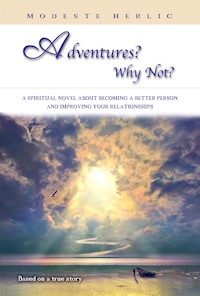
This book is based on a true story. As Karina felt a huge void in her chest, she started a journey of self-knowledge, which made her discover many interesting places and people. But eventually, she realized that the answer had always been in her heart - an inner voice that guided her in everything she did. And to realize this, she just needed to listen to her innermost part as Soul.
In 2015, she met a man called Paulo, an unemployed economist. They had several conversations in which she shared a different way of seeing life. As time went by, Paulo found inner peace and decided to realize his childhood dream. Thanks to Karina, he understood that the practice of the spiritual laws makes life lighter, regardless of the surrounding circumstances.
Das E-Book können Sie in Legimi-Apps oder einer beliebigen App lesen, die das folgende Format unterstützen:
Veröffentlichungsjahr: 2023
Ähnliche


















Adventures? Why not?
Modeste Herlic
Published by IW, 2022.
While every precaution has been taken in the preparation of this book, the publisher assumes no responsibility for errors or omissions, or for damages resulting from the use of the information contained herein.
ADVENTURES? WHY NOT?
First edition. October 4, 2022.
Copyright © 2022 Modeste Herlic.
Written by Modeste Herlic.
10 9 8 7 6 5 4 3 2 1
To my sister Theodora for her unconditional love.
This book is about spiritual freedom, which can be found within.
Contents
Cafe Sorriso
The mysterious artist
The beginning of a new being
Amaro and Clymene
The ideal job
Carpe Diem
Detachment
Flying high
A job like any other
The woman in the café
The red rose
The woman in the poem
Grandma Maria’s stories
Serving
Don Juan of Lisbon
Contemplation
The way
Connecting diamonds
A treasure
Queen of the home
A ship without passengers
Mother’s Day
The poem of the universe
Dreaming
Love
How Lucky!
A school
In every corner
Manifestation of a goal
The Inner Master
A great African king
Beyond the horizon
A journey
Return for a good action
The universe
Facing fear
A blessing
True service to God is always an adventure in learning spiritual things.
Harold Klemp
Cafe Sorriso
––––––––
Paulo's current apartment was ten times smaller than his former luxury apartment. He had lived in a sumptuous penthouse overlooking the sea on Vieira Souto Avenue, in Ipanema. Now his life was different. In his new dwelling, the space was small. In the living room, separated from the bedroom by just one door, there was a small table, a chair and an old couch that had been left by the former resident. On the desk, he kept a computer, a piggy bank to store coins, a music box, several pieces of paper with annotations, scattered money notes and crumpled purchase receipts. On the other side of the room, you could see the American kitchen, where there was a fridge and a stove that had never been used. There was also a two-door kitchen cabinet above the sink with two plates, two forks, two spoons and two glasses in it. Everything was basic in his new home. Paulo had no television or decorative objects. When he moved in, he thought of having one guest at a time.
Under the desk, in the right corner of the room, lay four dusty books: Rich Father, Poor Father by Robert Kiyosaki and Lechter Sharon L, The Richest Man in Babylon by George Samuel Clason, The Secrets of the Millionaire Mind by T. Harv Eker, and How to Make Friends and Influence People by Dale Carnegie. Paulo was no friend of literature. However, he was devoted to reading with the greatest interest when it came to economics. That’s how he spent his time when he was not working.
These four books abandoned on the floor of his new apartment were nothing compared to the number of works he had read about the secret of financial freedom. In his old office, there was a huge library with stacking shelves. There were hundreds of books, all well-ordered. They were works about the key to success. Having been traumatized when he was fired, Paulo did not want to return to his old office to pick up his belongings.
In his bedroom, opposite the bed, there was a table where he kept some medicine. Near that table, there was a simple wardrobe with its doors ajar, since the clothes in it were thrown carelessly. At the bedside, decorated with a lampshade that provided little light, were two books carefully arranged one on top of the other — Plato's The Symposium and Eckhart Tolle's The Power of Now.
It had been eight years since Paulo had read The Power of Now. This book was a gift from his son on his fortieth birthday. He was so amazed by his son's gesture that he ended up reading the book quickly. He read it, but he did not really read it, for at no time did he hold his breath to realize the depth of the words. In just three days, he had finished reading it. He never wondered why his son had given him that gift. He found the book fascinating and practical for business. Sometimes he was inspired by that book to make his emblematic speeches, motivating his coworkers in the art of trading. The truth is that he never stopped to think about the concept of the “now” outside the matter of money. Paulo was simply a born economist. Everything he did, he did with a view to profits.
On the other hand, Plato's The Symposium did not take up much of his time. In fact, what Paulo lacked most was time. The more money he made, the less time he had left. In the schedule of the good professional that Paulo was, there were no moments set aside for exercising, being with his family or having fun.
One day, he started reading The Symposium. However, he found the language too refined. This book was a gift from a woman who used to serve him coffee when he was still working at his last job. Her name was Vanessa, and she worked at Café Sorriso, located near his old office. Besides serving coffee to her customers, Vanessa also owned the business. She was a sweetheart, and her coffee had a special flavor. With or without sugar, with or without milk, her coffee was like a treat for the executives who frequented the place. Besides coffee, she also offered her customers hot chocolate, cappuccino and much more. All this was a delight for those habitués to Café Sorriso.
Vanessa was beautiful and charming. She had a heart of gold. She was so considerate that it was always difficult to determine if her beauty was greater than her kindness. Gracious and generous, Vanessa used her words with elegance, humility, and sympathy, enchanting her customers. Gradually and without any effort, she won the hearts of those who met her. All the customers loved her, and everyone delighted in her stories. She had a simple way of seeing the world, and people enjoyed listening to her. Whenever she had to comment on life, she tried to see the good side of things. Everything about her was perfect, and most of her male customers fell in love with her in silence. Those who were married didn't want to lose her friendship. The bachelors desired her in the silence of their burning hearts.
Paulo was also fond of Vanessa. He always went there for his morning coffee. When Vanessa saw him, she didn't miss the opportunity to say: “There is nothing better in this city than to start the day with a smile.” Paulo was not good with words, but he was delighted to return her smile. Then he would leave without saying anything. In fact, Paulo never knew how to deal with women, much less with someone like Vanessa.
From look to look, Paulo and Vanessa became friends. They had great conversations as time went by. On rare occasions, they would stick to a simple “Good morning! How is it going?”. Despite being shy, Paulo made it clear how pleasant her conversation was. One day, Paulo told her, “Talking to you is an endless delight.” Vanessa was perplexed at the time, knowing that Paulo was not a big fan of poetry. Amazed, she smiled as she always did and said in a soft voice, “Ah, my friend Paulo! How beautiful. You’ve made my day.” Vanessa was surprised because she didn't know that love could make poetry sprout in the heart of any human being, whether king or slave.
Little by little, Paulo began to share some of his concerns with Vanessa. On the other hand, she never mentioned anything about her personal life or about her problems. She was content to listen to Paulo's stories. He knew very little about her, like all the other customers at Café Sorriso. All they knew was that she enjoyed life and loved traveling.
Paulo was given Plato's The Symposium four years before everything fell apart in his life. It all happened in a routine conversation at the Café Sorriso. It was Paulo's birthday. Sergio, his boss, had given him a day off, to celebrate and spend it with his family. Even so, Paulo wanted to work. He looked at Sergio and said with irony, “I think about the money I won’t be making if I stay home.” After a short laugh, Sergio replied with satisfaction, “Great!” Then he added with a certain sarcasm, “You’re the boss!” They both laughed.
It should be noted that at that time, the need for Paulo to remain at work all the time was not motivated by the search for money, as he was already a rich man. The reason he would rather not be at home was because he did not feel happy with his wife. Moreover, the children had already taken their bearings in life. The truth is that Paulo had never felt happy with his family. Over the years, he came to realize that material wealth was not always a guarantee of happiness. At least he knew the importance of love and care for his relatives as much as possible.
On his forty-second birthday, Paulo, in front of Cafe Sorriso, did not want to pay attention to the day he was born. At the entrance of the Café, was written:
A smile to start the day,
With an open heart,
With nothing to wish for,
Without expecting anything in return.
A day, happy or sad,
A smile that costs nothing
To change the world
And cheer up
The heart of the unknown.
For years, Paulo had come across this message, but he had never been able to read it completely. He didn't have much time to waste on things besides work. He behaved the same way even on his birthday.
Before entering the Cafe, he looked at his watch. It was seven thirty. He always arrived thirty minutes before his office opened. That way, he could spend some time with Vanessa.
— Good morning, Vanessa! How's everything here today?
— Too early to tell. So far, so good! What about you?
— I'm fine too! I need a coffee from Cafe Sorriso to start the day.
— Oh! How nice. The taste of coffee is magical when the customer's heart is joyful.
— But you know, I haven't been cheerful lately. Anyway, I’m sure I’ll enjoy your delightful coffee that never disappoints.
— What happened?
— It was no big deal. Stuff happens.
— I saw on Facebook that it’s your birthday today.
— Oh! It's true!
— Happy Birthday! I wish you peace, love, and much success in this new cycle. You should have stayed home to enjoy your day and celebrate with your loved ones.
— My colleagues and I agree that time is valuable. We shouldn’t waste it on unnecessary things.
— I think you and your colleagues communicate in Chinese. But I only speak Portuguese — Vanessa said with a soft laugh.
Paulo went on.
— It's just that everything goes so fast in this life. If I go one day without working, the company will lose a lot.
— Paulo, my friend, you are free to do whatever you wish. Just don't forget that everything in life is a celebration. So there's nothing bad about celebrating the day we came into this world.
Paulo bowed his head and said timidly, “Men like me don’t lead this sort of life.” Vanessa responded immediately, “If the world of success is like this, I don't want to live in it.”
— You’re right. It's just that success is not always for the romantics — said Paulo.
— Anyway, I have a gift for you.
Vanessa bent down and got something from the other side of the counter. Then she gave him the gift wrapped in golden paper, tied with a red bow. Paulo thought about love. He took the little present and opened it immediately. It was Plato's The Symposium, a beautiful text on the meaning of love and friendship.
— Wow! — exclaimed Paulo.
— What's surprising about that? — asked Vanessa.
— Are you giving a book written by a dreamer to a pragmatic man like me?
— Yes, I believe in change.
— That was a good one — Paulo agreed, smiling. — Anyway, thanks, Vanessa!
— I’m the one who should thank you.
His watch beeped. It was eight o'clock. Paulo said goodbye and left in a hurry. A lot of work was waiting for him.
The mysterious artist
––––––––
In the bedroom of Paulo's new apartment, there was a small, simple dresser placed near the entrance to the bathroom. In it, there was an unfinished illustration of a shack in the middle of the forest. Paulo had kept this drawing since he was six years old.
In addition, there was a work of art. It was an acrylic painting called The Return. It represented a bright star in the middle of a bluish sky. At the star’s edges, the work was darker and marked by a gradual change in tone. From the left corner at the bottom of the canvas, there was a golden path that went toward the star. The cool color of the painting promoted a feeling of peace and serenity in the heart of those looking at it. However, Paulo never stopped to contemplate this painting. This small picture was the only work of art he had in his apartment.
In the summer of 2001, Paulo and his family went for a walk at General Osorio Square in Ipanema. That day, in that same place, the Hippie Fair was happening. Rafael, Paulo's youngest son, who was the Soul of a poet, was only nine years old. While his family was walking in the square, the boy saw an artist, who not only created and recited poems, but also sold paintings.
“Dad, I want to hear that poem”, cried the boy. Paulo, his wife and the two children went to the poet. When they got there, they realized the artist's miserable condition. However, he seemed to think himself rich. Maybe it was because you must have the wealth of your heart to write or recite a poem. Paulo put a coin in the glass bowl. The artist, sitting down, looked at them and said eloquently, “Under the sun, I speak to myself, singing the melody of life. I see what the eyes do not see. I say what the ears do not hear. I am what the world does not want to be. Am I a wise man among the mad? A fool among men? Or a wretch among the rich? Oh! Holy Creator, I do not know who I really am.”
Paulo was embarrassed. The two kids seemed to enjoy that weird poet. Their mother, astonished, smiled and put three coins in the transparent bowl. Soon after, the artist laughed wholeheartedly. His laugh was bizarre and funny at the same time. The family looked at him, and he looked back at them. Together, they had a cheerful laugh.
Paulo watched him suspiciously, trying to understand his appearance. The poet was a slender man. His countenance, though pale, was illuminated. His smile evoked a feeling of contentment. He was a poor citizen with a very well-cared for goatee and mustache. He was very attractive, even though he was wearing a torn T-shirt. It wasn't hard to tell that his belly was empty. Yet, he seemed satisfied as if he had just eaten. At times, he smiled like an angel, and at some other times, he frowned seriously as if he had many worries.
After looking at that artist in detail, Paulo thought, “If he's wearing a torn shirt, it mustn’t be because he's sloppy. It must be because it's the only clothing he owns.” After thinking about it, he put a few more one-real coins in the bowl.
The artist did not ask the family what theme they would like him to develop in his poem. He simply stood up with pride and humility at the same time. He stroked his mustache and goatee gently, walking from side to side. With a dramatic attitude, he moved with grace and gestured like a prince in a palace. He looked up at the sky and began to recite a poem. As he spoke, his words rhymed with his gestures. He was in a state of pure harmony.
“I know very little about truth. However, I believe that life is a gift. To live is to be grateful for every moment, every smile, every adversity, every hug, and everything else. To live is to enjoy the journey and not yearn for the destination. To live is to find joy in every step as you go towards the unknown. To live is simply to love, even if life seems to mock us. So live as if everything you do is a consecration. Walk as if you were dancing with the melody of love.
“I say that because the heartbeat is a verse in the poem of life. In the daylight, dance as if the movement is a celebration of Soul. In the dark night, lie down with joy and sleep in peace, free from remorse. Behold love as if you were playing the divine flute. Live every moment of your existence with no fear. Live joyfully and do not fear death. Fear for what? It's nothing else than the night of the day. Breathe in the light air of life and think, 'I love and will always love, for in love I find myself.”
The children looked in wonder at this spectacle. Little Rafael was so absorbed in the words of the man that he did not even notice when the poem ended. Another artist Paulo knew had already said, “Poetry is the same as life, infinite as the sea. When it touches a man’s heart, it is never forgotten.”
“Come on, children! The poem is over”, Paulo said. The artist went silent and sat down. “No, Dad. I want this painting”, replied Rafael, pointing at a work of art. That’s how they bought that blue painting from the mysterious artist at the General Osorio Square. A few years passed, Rafael lost interest in the canvas, which ended up with his father.
Deep down, Rafael was a lot like his father. As a child, Paulo only dreamed of two things — to become a great painter and to get to know all the countries in the world. When he was only five years old, he already scribbled in his notebook some natural objects such as plants, trees, mountains, valleys, stars, animals, and human beings. His father was always happy when he came across his son's illustrations. Paulo also sketched things that his parents did not know about, things taken from a child's fertile imagination.
When he wasn't equipped with a pencil, he had a brush, a pen, or a piece of chalk. The truth is that Paulo did not spend a day without drawing. During his vacation, when he didn't have a notebook anymore, he would paint things on everything you could see in the family home, such as chairs, tables, doors, walls, the refrigerator, the stove and much more. He left his artist's mark on everything that had a surface in that house, including the floor. When he turned six, he was beaten by his mother for messing up the house with his flood of illustrations. As a punishment, he had to repeat the following statement fifty times, “When I grow up, I will be a doctor.” That day was the last time Paulo ever made a complete drawing. In fact, since then, he never painted or drew again. Being a health professional was always his mother's dream, but unfortunately, she could not join college. She hadn't realized her dream, but she promised herself that her beloved son would achieve it.
Paulo did not do what his mother wanted. In an act of rebellion, he studied economics. As a pastor's son, he also acted against his father's will when he skipped the evangelical seminars as well as the classes in theology. Against his mother's wishes, he did not enroll in medical school. His mother questioned him about this, and he answered that he had just forgotten. At the end, he followed neither his father's nor his mother's wishes. They took a long time to accept their son's choice.
Paulo's second big dream was never manifested. Soon after graduating, he got a position in a renowned stock market investment company. Over the years, he became the firm's greatest economist. He worked there for over twenty years until he was fired. During all this time, he was so in demand for his work that he never had a moment to himself — a moment to travel and get to know the world, a moment to enjoy life with his children and his wife. Now, he found himself alone, facing his failure. He had failed not only as an economist, but also as a family man. After all these years serving the science of money, he ended up finding himself alone in that tiny apartment, far from everything he had conquered and lost.
In the neglected bathroom of the apartment, there was space for only one person. On the sink, just one soap, and above the sink, a round mirror. Whenever Paulo looked at himself, he would ask, “Why me? Why did all this happen to me?” He was reflective for a moment and soon continued his daily routine, which was to come and go without thinking too much. Sometimes the circular shape of that mirror reminded him of the illustration of the cycle of rebirths. He had discovered that expression in a book he had read a few years before. Now he tried in vain to remember the author and the title.
Whenever Paulo took a shower, he would stay several minutes under the water and think about the penthouse where he had lived in Ipanema. He missed his vast bathroom, highly adorned with glittering artifacts. He mainly remembered the crystal tub that sparkled like a star in the dark sky. He also remembered the winter nights when he was immersed for hours in the ofuro tub, reflecting on how to make more success in life. All this was part of the past. Now, Paulo had to face the reality of the present moment.
The beginning of a new being
––––––––
One day in January 2015, Paulo awoke during a dream. It was not one of those nightmares that frighten sinners, nor one of those worries that torment the spirits of the anxious. It had been seven days since he had dreamed of the visit of a graceful Soul. She had shown herself with a delightful voice and soothing words. She uttered only one sentence, which was enough to reassure Paulo's heart. He was freed from the anguish that plagued him on those nights, and since then, he had not stopped reflecting on the meaning of that dream. In his imagination, he tried to recall the visitor’s face, but he could not.
Lying in bed and feeling serene, Paulo remembered that some months before, on a night when he could no longer bear the burden of remorse, he had begun to cry in front of the mirror, saying, “I need help from above. Light my path and guide my steps.” Now he wondered if that unusual dream was a sign from the universe. Soon after this reflection, he was mysteriously overcome with a feeling of peace and contentment. Then, he convinced himself that he was not alone on the road of life. Somehow, he began to imagine the hand of God behind everything that was happening, whether in his life or in that of others.




