


69,99 €
Mehr erfahren.
- Herausgeber: via tolino media
- Kategorie: Geisteswissenschaft
- Sprache: Englisch
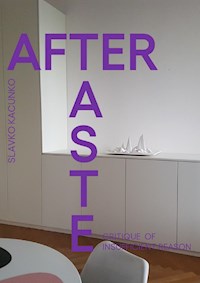
After Taste is an inquiry into a field of study dedicated to the reconsideration, reconstruction and rehabilitation of the concept of Taste. Taste is the category, whose systematic, historical and actual dimensions have traditionally been located in a variety of disciplines. The actuality and potential of the study is based on a variety of collected facts from readings and experiences, which materialize in the following features: One concept (figurative Taste), two thinking traditions (analytic and synthetic/continental) and three interrelated dimensions (systematic, historic and actual) are presented in three parts or volumes. As such, the study presents a salient comprehensive companion for wider readership of humanities approaching conceptions of Taste for the first time. Moreover, After Taste is intended for anyone who hopes to make a further contribution to the subject. Since its appearance and apparently short triumph some 250 years ago, the concept of non-literary Taste remained the linchpin of aesthetic theory and practice, but also a category outreaching aesthetics. Taste as the personal unity of the production, theory and criticism of art and literature, which was still largely taken as a given in the eighteenth century, has meanwhile given way to a highly-differentiated art world, in which aesthetic discourse is placed in such a way that it can seemingly no longer have a conceptual or linguistic effect on general opinion making. After Taste fills the gaps of systematic research by a comprehensive tracing of the emergence of the doctrines, discourses and disciplinary dimensions of Taste up to the peak of its systematic and historical trajectory in the eighteenth century and onwards into the present day. The guiding goal is a post-disciplinary rehabilitation of the contested category as a preparation for its productive usage in emerging academic and popular contexts. It shows how the category of Taste became the foundation, legitimation and the catalyst for the emerging division of labour, faculties and disciplines, confirming the hypothesis of the immense impact and actuality of Taste in the contemporary world.
Das E-Book können Sie in Legimi-Apps oder einer beliebigen App lesen, die das folgende Format unterstützen:
Veröffentlichungsjahr: 2021
Ähnliche



















IMPRESSUM
© Copyright Slavko Kacunko 2021
All rights reserved.
This book was published by the author himself. The publication was made possible through support provided by Micro Human UG, Winkler Str. 4a, 14193 Berlin.
www.microhuman.org
www.slavkokacunko.com
ISBN 978-3-00-069213-0
Table of contents
Preface
Notes to Preface
Introduction
Actuality and popularity – Systematic and historicity – Methodological considerations – Structure of the study – Notes to Introduction – Introduction - Bibliography
Part one. Logic of TasteSaggital dimension: Systematics and differentiations
1. Taste concept
1.1 Giving reasons
§1. Insufficient reason –§2. Concept and difference –§3. Preference and reference
1.2 Thinking, perceiving and judging
§4. Judgment and categories –§5. Faculties and ressources –§6. Analysis and synthesis –§7. Aesthetic concepts –§8. Aesthetic difference –§9. Aesthetic categories
Notes to chapter 1
Chapter 1 – Bibliography
2. Taste and cognition
2.1 Cognitivism and conceptualism
§10. The art of invention – §11. Taste as a critical instance of logical knowledge
2.2 Universalism and realism
§12. Aspects of realism – §13. Truth makers – §14. Conceptual truth
2.3 Particularism and anti-realism
§15. Aspects of anti-realism – §16. Correlationism and coherentism
2.4 Aesthetic objectivism and -subjectivism
§17. Relativism and non-relativism – §18. Relativism and contextualism – §19. Faultless disagreement – §20. Simplicity – §21. Taste-judgment and aesthetical judgment – §22. Assesment sensitivity – §23. Concept engineering – §24. Aesthetic realism and -relativism
2.5 Aesthetic conceptualism and -empiricism
§25. Aspects of aesthetic conceptualism – §26. Reflective concepts – §27. Aspects of aesthetic empiricism – §28. Conditions of cognition
Notes to chapter 2
Chapter 2 – Bibliography
3. Taste and faculties
3.1 Making sense of the faculties
§29. Herder´s sagacity – §30 Deleuze´s indeterminate accord of the faculties
3.2 Witty judgment
§31. Inventio and iudicium – §32.Gracián´s ingenio and genio – §33. Ingenio and genio in further contexts – §34. Kant´s disguised reconstruction of inventio-iudicium complex – §35. Taste of comparison – §36. Taste of genius
Notes to chapter 3
Chapter 3 – Bibliography
4. Taste and value theories
4.1 Taste, criticism and criteria of value
§37. Taste as agency of value theory – §38. Epistemic models of aesthetic valuation – §39. Analytic theories of aesthetic value – §40. Default theory of aesthetic value – §41. Digression 1. Synthetic theories of aesthetic value: intuition and expression – §42. Digression 2. Synthetic practices of aesthetic value: modernist art criticism
4.2 Aesthetic truth
§43. Facts and values – §44. Aesthetic preferentialism
4.3 Immanentism and invitationalism
§45. Picturing Taste – §46. Imagining Taste – §47. Rhetoric of invitationalism
4.4 Aesthetic experience
§48. Truth and synthetic experience – §49. Value and analytic experience – §50. Aesthetic value and aesthetic innovation
Notes to chapter 4
Chapter 4 – Bibliography
Part two. Pathology of TasteVertical dimension: Historicity
5. Taste judgment
5.1 Tacit Taste. Philosophy and rhetoric
§51. Optitudes and the historicity of Taste – §52. Fragments of forerunners – §53. From Gorgias to Plato – §54. From Plato to Aristoteles – §55. Cicero – §56. From Plotinus to Boetius – §57. Isidore of Seville – §58. Alcuin
5.2 Tacit Taste. Rhetoric, theology and psychology
§59. Medieval reinventing inventio – §60. Avicenna´s estimative sense – §61. Latin middle ages. Sensus, honestus, decorum
5.3 Tacit Taste. Art theory and poetics
§62. Nizolius – §63. Humanists and anti-humanists – §64. Digression 3. Reinventing inventio and ingenium
Notes to chapter 5
Chapter 5 – Bibliography
6. Touching, telling and true Taste
6.1 Touching Taste
§65 Beginnings of the Taste discussion in Italy and France– §66. Academization of Taste – §67 De Piles and Boileau – §68. From Querelle to Du Bos – §69. From Crousaz to Du Bos – §70. Batteaux – §71. Philosophes in the Temple of Taste – §72. Gracián and France. Bouhours – §73. From de Méré to La Rochefoucauld – §74. Digression 4. In the mirror of Taste
6.2 Telling Taste
§75. Aspects of Taste and common sense in Britain – §76. Shaftesbury, Hutcheson, Reid – §77. Addison, Hume, Burke – §78. Home, Gerard, Alison – §79. Digression 5. Capitalizing on Taste
6.3 True Taste
§80. Apects of true Taste. Leibniz – §81. From Leibniz to Thomasius – §82. From Thomasius to Wolff – §83. Wolff – §84. König – §85. Quarrel of poets in the German-spoken countries – §86. From Gottsched to Bodmer – §87. From Bodmer to Breitinger – §88. From Nicolai to Gellert – §89. From Klopstock to Schlegels
Notes to chapter 6
Chapter 6 – Bibliography
7. The science of Taste
7.1 Aesthetics
§90 Vico – §91. From Vico to Baumgarten – §92. Baumgarten – §93. From Baumgarten to Meier – §94. Sulzer
7.2 Beautiful sciences
§95. Aspects of beautiful sciences – §96. Winckelmann – §97. Mendelssohn – §98. Lessing
Notes to chapter 7
Chapter 7 – Bibliography
8. Taming Taste
8.1 Kant´s Taste
§99 Aspects of Kant´s Taste – §100. Refractive judgment
8.2 Taste and idealism
§101. Fichte and Schelling – §102. From Schelling to Hegel
8.3 Terminating Taste: classicism and early romanticism
§103. Herder on Taste – §104. From Goethe to Schiller – §105. From Wieland to Hamann – §106. Möser, Hertz, Moritz, Garve
8.4 Taste and emotions
§107. Functionalist and humanist approaches – §108. Systematic and historicity of emotions
8.5 Tyranny of Taste
§109. Distaste for Taste – §110. Digression 6. Culture as capital and the traps of Taste
Notes to chapter 8
Chapter 8 – Bibliography
Part three. Ethology of TasteHorizontal dimension: Actuality and popularity
9. Taste conclusion
9.1 Antirhetoric, aetiology, politics
§111. Rehabilitating Taste – §112. Telling Taste: Towards a rehabilitation of the concept – §113. From Gracián to Velázquez
9.2 Ideological valences of Taste
§114. Aspects of ideological valences of Taste – §115. Epistemological (im-) mediacy of Taste – §116. Taste, aesthetics and ideology
9.3 Retrieving rhetoric
§117. Aspects of retrieving rhetoric – §118. Birth of Taste from the spirit of rhetoric – §119. Taste and credibility – §120. Taste and its rhetoric “gentrification”
9.4 Taste, culture and society
§121. Gadamer on Taste – §122. Taste and “critical aesthetics” – §123. Bourdieu on Taste
Notes to chapter 9
Chapter 9 – Bibliography
10. Enlightening Taste
10.1 Taste and prejudice
§124. Aspects of Taste and prejudice – §125. Digression7. From Vico to Kittler – §126. Sapere aude
10.2 Enlightenments
§127. Aspects of religious Enlightenment – §128. Enlightenment´s emotionalism – §129. Aspects of “radical” and “moderate” Enlightenment – §130. Aspects of “counter”-Enlightenment – §131. Theology of Taste
10.3 Play of the faculties: pro and counter Kant
§132. Baeumler and the logic of individuality – §133. Baeumler and the logic of Taste – §134. From Baeumler to Gadamer: Coopting irrationalism – §135. From Beiser to Gadamer: Coopting rationalism – §136. Dickie, Eagleton, Žižek: Coopting critique of ideology – §137. Bourdieu: Distinction and division of play and labor
10.4 Labor of the disciplines: disciplining Taste
§138. Provenances and perspectives of discourses and disciplines – §139. From “moral journalism” and “science of Man” to ethics and social sciences – §140. From poetics and rhetoric to psychology and art philosophy – §141. From amateurs and connoisseurs to criticism – §142. Digression 8. From amateurs and connoisseurs to archaeology and art history
10.5 Contest of the faculties
§143. Kant´s contest of the faculties and his anthropology – §144. Secularization and settlement
10.6 Archives of Taste
§145. Archiving appraisals – §146. Foucault´s archives – §147. Foucault: genealogy, structure, subject
Notes to chapter 10
Chapter 10 – Bibliography
11. Cosmopolitan Taste
11.1 Charting cosmopolitanism
§148. Cosmopolitanism and Enlightenment – §149. Cosmopolitanism and anthropology after Kant – §150. Cosmopolitanism and teleology after Kant – §151. Cosmopolitanism and universal history after Kant – §152. Cosmopolitanism and universal geography after Kant – §153. Varieties of cosmopolitanism
11.2 Disciplining cosmopolitanism
§154. Herder and cosmopolitanism – §155. Nietzsche and Taste – §156. Sociological cosmopolitanism – §157. Ethical and political cosmopolitanism – §158. The contested taxonomies of cosmopolitanism
11.3 Aesthetic of cosmopolitanism
§159. Systematization – §160. The aesthetic of cosmopolitanism and cosmopolitan aesthetic – §161. Cosmopolitan imagination and cosmopolitan imaginary
11.4 Aesthetic of capitalism
§162. Stoic sensibility – §163. Idealism of faculties and materialism of resources – §164. Taste and industry – §165. Taste´s rewind to the future – §166. Contemporary artist as subject of Taste – §167. Political economy of Taste
Notes to chapter 11
Chapter 11 – Bibliography
12. Actuality of Taste
12.1 Taste and valuating practices
§168. The high, the low and the (neo-) avant-garde – §169. Apocryphal Adorno – §170. Culturalism and philistinism
12.2 Practices of choosing and theories of practice
§171. Cultivating, taming, domestication – §172. Digression 9. Choose Life – §173 Popular Taste
12.3 Likeminded
§174. Popularization of Taste – §175 Retrieving sensus communis – §176 Taste taboo and cultural canon – §177 Populist Taste
12.4 After Taste
§178. Time for Taste – §179. Digression 10. Taste and immediation – §180. “It is good”
Notes to chapter 12
Chapter 12 – Bibliography
Preface
Let us imagine Sabine as the heroine of a novel, who, like many of her peers, likes and likes to be liked: She likes to share her valuations, appraisals, assessments and estimations while she is subjected to the judgments of others. Sabine ventures out to feel out who she is and what it actually means to be both the subject and object of Taste: The plot follows her in a time capsule throughout the centuries from ancient Greece to the chatrooms of the Internet. Spontaneous and inventive but also calculated and judgmental, Sabine faces conflicts and disagreements on her enlightening and cosmopolitan journey, meeting the villains of prejudice, ignorance and, above all, of indifference. In a series of provocative incidents throughout the eighteenth century, Sabine faces attempts to be marginalized, disciplined and reduced to the cliché of her increasingly suppressed past. Will she and can she ultimately triumph over adversity? Sabine then, as Taste personified, reappears in a fast-forward take on all kinds of academic and popular contexts of the present: Once seemingly obsolete, Taste lives on because the moment to realize the mission of its own feeling-out was missed. But what about its status and its prospects? The tension between the (un-) wanted outcomes of the journey remains, while the tasks of thought and action seem to be gradually crossing over to the reader as the future agent of Taste. – Such a synopsis would roughly fit the present work, had it been a fictional novel.
Since it is, however not a novel written in a groovy selling style of the first passage, another, still accessible, approximation seems better appropriate. The fact, that nearly fifty percent of philosophers believe that aesthetic judgments are subjective makes it plausible that at least fifty percent believe in some kind of aesthetic objectivity, or that it is possible or even advisable to argue about and dispute Taste. But philosophers are a rather vanishingly small group of people and this statistic would not be representative by any means, had public opinion not shared the interests and dissents of philosophers; to discuss and theorize Taste and opinions in public has namely always been and still is a matter that heats the temper, as the these three examples demonstrate:
(1) On September 19th 2020, the 44-year-old Kremlin critic Alexej Navalny thanked the doctors at the Berlin Charité hospital for saving him from a poisoning and treating him for almost a month. Quite tellingly, he expressed his joy about the recovery as well as the feeling of being “technically a living person” in the following fashion: He would quickly again become someone who could use Instagram and who “understands without thinking where a ‘Like’ belongs”.1 To “Like” becomes hence a sign of Life, as it were, in a strict, technical/cognitive sense, but also in a purely affective non-cognitive one.
(2) The Danish Prime Minister (and later NATO General Secretary) Anders Fogh Rasmussen made the major point of his, generally assessed as historical, New Year’s Speech of 2002 with an only twofold mentioning of the expressions “Taste judges” and “Taste-judging” (smagsdommere2, smagsdommeri3). Taste in this context pointed to the very core of both positive and pejorative connotations of populism – the critical distance to the “elites”. The famous speech prepared the next steps of the public debate in the small Scandinavian state, which was introduced as a canon of art, culture or democracy (kunstkanon, kulturkanon or demokratikanon). The critical connotations and viral dispersion of “Taste judges” ultimately contributed, due to popular and social media, to a new form of rhetoric, which has embossed even global politics ever since. Some global responses like the Danish TV ranking and rating classics Taste-judges (Smagsdommerne, 2005-2015)4 and the parallel pandemic of the Idols / Super-Star TV franchise (since 2001) became the first movers in a revival, a new kind of sensus communis in popular and social media, visualized in the thumbs up and thumbs down gestures of the experts in the TV contests or the thumbs up emoji on social media. Taken together, these terms reproduce the continuous combat for our faculties and resources with an immediate impact on social and cultural life. As (unquantifiable) values, they circumscribe the horizons of Taste. However, the issues of Taste judges, -judging, -institutionalizations and expert cultures still haven’t become the subject of an overarching systematic, historiographic and geographic inquiry.
(3) In her study entitled Republic of Taste (2016), Catherine E. Kelly presented several nonfictional cases, showing how “putatively free from the Old World’s decadence, taste promised to be a vehicle for discovering and exercising a distinctly American genius. And putatively free from sectional prejudice and partisan strife, taste provided a platform that would encourage men and women to rise above their differences.”5 The questions of class, race and gender were, from a historical perspective, involved equally in the matters of Taste in securing both personal pleasure and cultural capital as both innate and cultivated aspects of sensitivity.
This study attempts to fill some gaps of research opened up through the cases such as the three mentioned ones. This shall be achieved by a comprehensive tracing of the emergence of the doctrines, discourses and disciplinary dimensions of Taste up to the peak of its systematic and historical trajectory in the eighteenth century and onwards into the present day. The guiding goal is a post-disciplinary rehabilitation of the pre-disciplinary, contested category of Taste as a preparation for its productive usage in emerging academic and popular contexts. Three intertwined research hypotheses form the guiding goal of an overall study of the agencies of Taste, its institutionalizations and expert cultures:
The (1) first part provides a missing systematic perspective on the concept of Taste as a key factor for understanding the human faculties, value theories and practices of valuating.
The (2) second part traces the events at the peak of Taste’s systematic and historical trajectories up until the late eighteenth century and verifies the historiographical hypothesis about the instrumentality of Taste for the production, reception and distribution of culture.
The (3) third part reconstructs the major moments in which the contested concept of Taste experiences its post-disciplinary rehabilitation, in preparation for its future productive usage in the academic and popular discourses and practices. It shows how the category of Taste became the foundation, legitimation and the catalyst for the emerging division of labour, faculties and disciplines, confirming the hypothesis of the immense impact and actuality of Taste in the contemporary world.
In addition, this study introduces the possibility of overcoming the implied identifications of culture as capital and nature as resource. By addressing the “aesthetics of capitalism”, with its ten digressions, it also provides exemplary material that can be evaluated by applying the proposed aesthetical (1) “play paradigm”, related to the principles of consumption and dispersion as well as their features of abundance, squandering, dissipation and distraction, as provisionally opposed to the (2) “labour paradigm” related to the principles of production and cohesion as well as their features related to accumulation, effort, austerity and contraction.
Notes to Preface
1 “Они превратили меня из «технически живого человека» в того, кто имеет все шансы снова стать Высшеи Формои Существа Современного Общества, - человеком, которыи умеет быстро листать инстаграм и без размышлении понимает, где ставить лаики.” URL: https://www.instagram.com/p/CFUAPu8llSO/?utm_source=ig_embed.
2 Anders Fogh Rasmussen’s New Year’s Speech 2002.
3Deadline, DR2 / 13. Juli 2018.
4 Danish TV DR2 / DRK.
5 Catherine E. Kelly, Republic of Taste (Philadelphia, PE: University of Pennsylvania Press Philadelphia, 2016), 5.
Introduction
Abstract
The introduction presents the significance of the non-literal or figurative Taste for academic and popular discourse. It describes the complexity of the subject matter, which requires a simultaneous focus on Taste’s actuality and popularity as well as on its historicity and classification. Out of this, the double-edged conclusion of the study is derived: The historical Taste discourse was the root cause for the emergence of the diversified and dynamic research context from which today’s Taste has emerged as an integrated study subject in its own right. The structure of the study is addressed, showing that it covers the prescriptive, ascriptive and descriptive aspects of Taste that appear as both a result of and a resource for interpreting of its various notions, functions and actualities. In addition to postdisciplinary methodological considerations, six auxiliary concepts used throughout the study are briefly introduced: Insufficient reason, the invention-judgment complex, optitude, refractive judgment, cosmopolitanism and immediation.
Keywords
Taste, aesthetic judgment, liking, rating, ranking, comparing, invention, influencer, co-optation.
Actuality and popularity
This study is an exploration of the foundations and limits, structures and histories as well as the actuality and popularity of Taste. The study focusses on three intertwined mechanisms through which Taste mobilizes historical and actual subjects as well as systemic instances and disciplines that maintain its continuity and transmit its doctrines. These mechanisms will be treated, acknowledging their simultaneousness, successively, by quasi-deducing the logos of Taste systematically, inducing the pathos of Taste historiographically and analogizing the ethos of Taste geographically. These three dimensions together exhibit the prescriptive, ascriptive and descriptive aspects of Taste that still function as catalysts of local and global truths, feelings and loyalties.
The study is intended as a comprehensive companion for readers of humanities approaching the concept of Taste for the first time. Moreover, it is intended for anyone who hopes to make a further contribution to the subject. Many parts of this study can be thought of as revolving, mostly implicitly, around the two exemplary statements: “Sabine is beautiful” and “Sabine likes that”. By addressing Sabine (being the name of a person, an animal, object or a weather phenomenon) as subject matter as well as a subject of judgment, both assertions also address Sabine as the possible object of someone’s assessment and in particular her judgment as either “purely” attributive, “purely” evaluative or something in between. It has been recently remarked that the tendency of authors to either consider aesthetic predicates as a subclass of predicates of personal Taste or to just leave them aside demonstrates a reluctance to address adjectives like “beautiful” in modern and contemporary analytic philosophy.1 In addition to our task to check the relations of the adjective “aesthetic” against the substantive “Taste”, we will have to check the role of adjectives that imply an “experiencer” of the verb from which they are derived.2
“Experiencer”, “truth bearer”, “truth maker” and “truth assessor”, or also “holder of value”3 are common terms linked to Taste discussions in the context of contemporary “analytic” philosophy of the English tongue, and they will have to be put in the context of “synthetic” or “continental” philosophy and the historiography of Taste as well as that of the actual and popular “exercising Taste”4 by contemporary agents and usage of languages. The conflux of meanings and references becomes virulent, when we add the omnipresence of “influencer”, also a genuine occupational title, to the list of agencies responsible for bearing the burdens of Taste. Also “artists” belong to the candidates who push the boundaries of what is tasteful and desirable to the extent that the productive and receptive sides of Taste need no longer be discerned, just like “experiencer”, “influencer”, “artist” and “taster”. As Boris Groys expressed, “That is why contemporary art is less production of individual artworks than it is manifestation of an individual decision to include or to exclude things and images that circulate anonymously in our world – to give them a new context or to deny it to them: a private selection that is at the same time publicly accessible and thereby made manifest, present, explicit.”5 If the exercising of Taste has become a major seller on the amplified scale of globalized media streams, then so too must, and will, the inferences of production and persuasion – the rhetorical roots of Taste – be taken into consideration. They have always involved both inventive and judgmental aspects, just as any “upcycling” of Taste must include the questions and dynamics of values: added value, surplus value, use value, exchange value as instances of evaluation streams.
Nikola Tesla began his autobiography entitled My Inventions (1919) with the following remarks: “The progressive development of man is vitally dependent on invention. It is the most important product of his creative brain.” Tesla wrote about the “difficult task of the inventor who is often misunderstood and unrewarded”, but also about the inventor’s “pleasing exercises of his powers”, while rescuing humanity “in the bitter struggle against pitiless elements.”6 This study will follow the trails of the highlighted invention as a necessary constituent of Taste throughout systematic, historical and actual contexts. It attempts to show how and why thinkers and practitioners fought and still fight with its integration into the respective systems of thought and practice.
In what follows, we shall adopt the capitalization of the word “Taste” to indicate a use of the concept in its comprehensive, open, and adaptive meaning. It is important also as a matter of its distinction and denotation as a yet insufficiently “filling” signifier, bearing meaning or being a reference to a yet unspecified preference. The term “Taste” expresses not least an unintentionally collective singular inscribed most prominently in a Kantian aesthetical sensus communis, while, paradoxically or not, still implying the poststructuralist Kantian reversal, which led to a tacit understanding of Taste as “singular collective” or “singularity” of an acculturation of Taste’s various potentials. Our concept expresses therefore both the rise and fall of the (un-) social instance or subject of Taste, depending on whether we assume an upward or downward development line.7 Frederic Beiser summarized a related issue seemingly sticking to our defeasible concept by asking, “Why must we give reasons for matters of taste?”8 The commonsensical, Kantian answer seems to be paradoxically inscribed in the quoted question of a Kant-critical scholar. On the other hand, if an anti-commonsensical answer were to be offered, a kind of Freudian repetition compulsion solution, the paradox would seem to remain. “If repetition is possible”, Deleuze wrote, “it is as much opposed to moral law as it is to natural law [...] it is by nature transgression or exception, always revealing a singularity opposed to the particulars subsumed under laws, a universal opposed to the generalities which give rise to laws.”9
To assume a principle of Taste in the latter sense – opposed to both a judgmental and a conceptual setup – seems to lead straight to a paradox. It seems to be structurally built out of exceptions or allegedly singular opinions. However, a sequence of exceptions or singularities hardly builds a new rule or principle alone; exceptions may or may not confirm an existing rule. This is at least what the referred, apparent incompatibility of Kantian and Deleuzean ontologies and epistemologies suggests. If then such a quest for one principle of Taste (“top-down”) does not apply, one may tend to assume a reverse (“bottom-up”) approach more promising. However, a quest for many sub-principles or components of Taste would imply an assumption of its compound character which would indicate the (pre-) existence of the rules or principles of thought, perceiving and judging according to which (or around which) the components of Taste are somehow organized.10 These rules of Taste, however, again dissolve the former assumption that exceptions build its capital.11
Systematic and historicity
With our capitalized Taste, it would seem as if we were dealing with a mystical entity, which should be neither composed nor undivided. This paradox and apparent inapplicability of either “communal” or “non-communal” access to Taste are but the most obvious reasons for the apparent opacity or at least high complexity of the subject itself. This complexity is reflected through disciplinary development and the corresponding research literature. It is also manifested in the alleged tensions between the systematization and historicizing of our topic. Two aspects should be pointed out:
Firstly, there is no consensus on the necessary interdependence between historical insights in philosophy and their systematic fruitfulness, and vice versa.12 However, our work must assume the usefulness of that interdependence, of the simultaneous systematization and historiography of Taste at the points where boundaries between philosophy and aesthetics, criticism and art history, literary and music criticism and other disciplines have been drawn. This is why the structure of this study will work with parallel foci on systematic, historiographic and sociocultural and political-economic aspects of Taste. In recent decades, the increasing devaluation of aesthetics and “fine arts” and the appreciation of “cultural-” and “natural sciences” has intensified social pressure on the humanities to conform to changing norms due to political and economic circumstances. An example: To be accepted and further recognized, academic art history has adapted itself to this pressure by widely denying precisely the aspect without which an objective justifying of the discipline would not be possible: the judgment of the artwork as a centerpiece of the concept of art. It is undisputed that judgments make up a considerable part of historical documents and that they belong to “historical fact” with the same right as the works of art themselves. However, it is equally undisputed that the processes in which both works and judgments are involved make up an actual field of both theoretical and practical inquiry.
Secondly, our apparent “Taste paradox” is thus also manifested in the apparent contradiction between the “immediacy” or the present tense of the Taste judgment and the cumulatively mediated character or “historicity” of both the judged object or event and its judges. This study aims to trace the developments of doctrines, discourses and disciplinary dimensions of Taste at the peak of its systematic and historical trajectories, not least throughout the eighteenth century. Its root locus is Europe, a place that at that point in time does not designate a legitimately recognized context today: We are no longer in Leibniz’s Franchophone Europe, nor are we yet in a Europe which is dynamically stabilized and balanced through a cultural, economic and political power of its fully functioning national constituent parts, as we know them today. A central presupposition is that such a challenging subject and locus of investigation must owe essential parts of its complex character to the evenly demanding systematic, geographic and historiographical coordinates in which it is both “rooted” and “routed” (or “tracked”) in the sense of cross-cultural, cross-lingual and other contexts, not forgetting the systemic role of exploitation of the other continents. With respect to this, our focus will be also a Euro-eccentric one, as we shall see. We will take the basic meanings of Taste and distinctions within concepts of Taste as points of departure and project them onto systematic, historiographical and geographical foils.
Both academic and popular Taste discourse imply several tacit, often interrelated distinctions between the qualities, quantities, relations, and modalities of Taste.13 We could summarize the connotations of Taste inquiry and popular usage with the following list:
(1) productive Taste – receptive Taste
(2) individual Taste – collective Taste (fashion, period style, national style)
(3) changeless (“good”, “timeless”) Taste (known from [neo-]classical and idealistic theories) – variable Taste (may decline or degenerate, depending on a) era / epoch, b) nation, c) personal circumstances [aesthetical perception of the artist, for example])
(4) lacking Taste (lack of style, complete indifference [“philistinism”])
(5) Taste as manner, method, or habit
(6) Taste as (aesthetic) sense for something, an instance of perception, or (a pro-active) ability to perceive beautiful items (or the idea of the beautiful, sublime, agreeable etc.)
(7) Taste as an aesthetic choice (the choosing instance itself)
(8) Taste as aesthetic judgment (judgment itself)
(9) Taste as opinion, character, way of thinking
(10) Taste as field of art and culture (of the aesthetic)
(11) Taste understood as morality, or appropriateness in different areas (a sense for the appropriate).
14
We believe that each of these connotations actually requires a proper place in the present study. In order to avoid, insofar as it is possible, the confusion of connotations and to provide some added intelligibility to our subject matter, we will have to be particularly sensitive to the presenting order and the interconnectedness of the themes.
Methodological considerations
The concept of Taste belongs to the category of not only philosophically interesting concepts, that are, as Donald Davidson pointed out, “not definable in simpler terms, but they can still be illuminated by articulating their theoretical connections to other concepts.”15 Michael Dummett had already claimed the same irreducibility to the more primitive concepts for the concept of “truth”.16
In recent years, “an explosion of literature concerning matters of “personal taste” has led to belief that exploration of this “evaluative domain” more generally would make considerable sense throughout the disciplines.17 One reason that it hasn’t yet happened in a systematic manner might lie in the contemporary structures of humanistic disciplines. Philosophers of language responsible for this explosion of literature confined a fair deal of their efforts to their own disciplinary interests in explaining the possibilities of “faultless disagreement” (cf. §19).18 Some of them have suggested that scholars working in aesthetics and ethics remain particularly skeptical regarding systematization in this field by explaining it away.19 Moreover, there is a comparable explosion of literature in cultural studies concerned with the actual and popular phenomena faced by “generation Like”, in which a reluctance towards a systematic treatment of the subject could be explained away with other methodological reasons. What remains is a desideratum growing alongside the growing corpus of literature and the public discourse.
When we take the contemporary practices of rating and ranking20 in wider contexts of Taste-evaluation and comparison, the main stream of postcolonial critique would probably recognize that a maintaining the straight rejection of such practices as elitist by default actually throws the baby out with the bathwater. On the other hand, our Taste research also needs to reevaluate and take the ambivalent status of exercising Taste fully into account. Matters of Taste appear necessary not as a new agenda, but rather as an agenda suppressed and hidden by the disciplinary diversification and its rooting in the historical Taste agenda itself; matters of Taste don´t seem necessary to fit to the feasibility requirement of the research programs, because the research is, as we regard it, rather basic and quit expansive, showing its outcomes in a deferred manner. Still, a parallel to recent research on comparing gives a sense of “new beginnings in the air” in the sense of complementing postcolonial criticism´s difference-oriented comparisons with more reliance on similarities and commonalities.21
It has been aptly remarked, that “comparing the self and the other in a colonial or postcolonial context [...] can lead to stereotypes fixing judgments and established norms within a wide array of public and philosophical thinking. Comparing [...] can also – almost at the same time open up horizons that restructure the whole field of comparative knowledge.”22 Similar applies to “exercising Taste” (as Frank Sibley named the wider context of criticism, and we take it in an even broader sense). The criticisms directed to the alleged “regimes of value”, the “tyranny of Taste” and also the “regimes of comparatism”23 seem not any more thought-provoking than the matters of their criticisms.24 What Angelika Epple and Walter Erhart (2020) claimed for the practices of comparison, we can claim to the theory and practice of Taste, if it is principally conceived as rooted in the inventio-iudicium complex, which is itself based on acts of comparison:
“In European academia, comparisons became the basis for methodology in many different disciplines such as anatomy, ethnology, literature, and the like [...] through comparison, they ordered the world. The decisive point, however, goes beyond this: By ordering the world, the doing of comparison also helped to change the world. Not only is the request for equal rights based on comparisons, but the stress on inequality or unevenness cannot do without comparing. Both ask for change.”25
One of the methodological goals of this study is to challenge the “Taste taboo” in the current theory and “practice theory” that sometimes suggests that you can check-out any time from what you like, although you can never leave. The matter of being “like-minded” in the exclusivity of implied and institutionalized public and private, academic and popular chatrooms can subtly support what is often alleged matter of criticism – tacit essentialism, ethno-centrism and the like.
This study covers hence both more and less than what has been labeled “meta-aesthetic”26, since in our view, the “aesthetic” in its wider sense has always included its own “meta” – its “behind” of logic, ontological, epistemic, ethical and political foundations and cross-references. “Meta-aesthetic” would be in this sense a synthesis of general analytic and synthetic-philosophical backgrounds in which Taste served as a movable parergonal structure entangled both with its moving history and with actuality.27
Disciplinary disputes, or the lack thereof, regarding disputes about Taste make their social aspects tangible, revealing some social aspects of our subject as well. It has been recently recognized by the analytical philosophy of language that a theory perhaps requires both semantic and non-semantic elements. While there used to be isolated aesthetic cultures with essentialized aesthetic practices, such sociologically and economically persisting isolations seem to have vanished over the course of globalization. It would be, however, quite optimistic to assume that “our” aesthetic culture is a “highly reflective” one, “whose members are aware that its practices might have been otherwise”.28 This is at least not yet reflected with regard to the mentioned disciplinary divergences, when it comes to the Taste disputes in which debaters remain silent, as if the added cognitive burden would not at all fit to the frameworks of austerity to which the humanities are presently exposed.
In such a strained silence, the voices of radical skeptics and dogmatists become particularly audible. The reasons for explaining away matters of Taste on the part of dogmatism-inclined deniers were that “we are all chauvinistic when it comes to taste because we are all very bad at recognizing when something is tasteful. Our lack of ability makes us overconfident in our own judgments, even in the face of disagreement with our peers.”29 John MacFarlane criticized such alleged unreliability in Taste judgments and called for skeptical action, as it were. Robert Fogelin criticized both extremes by pointing out the “problems that make reasoning itself a precarious activity.”30 This is, roughly, what the justification of Kant’s epistemology consists of – avoiding the insufficiency of reason to moderate between its own drive towards metaphysics or dialectics, respectively. When pursued without constraint, reason fails to avoid metaphysical or dialectical illusions that irresistibly lead either to radical dogmatism or to radical skepticism. Fogelin retrieved Kant´s warnings in order to project them onto contemporary thinking:
“A life of reason is a life based on reasons, and this involves the evaluation of reasons, sorting out the good ones from the bad, the adequate from the inadequate, and so on. Without this critical attitude, innovation (for example, in the sciences) would not be possible. It is, or at least should be, one of the primary goals of education to instill healthy skeptical attitudes in students.”31
Regarding the (re-) integration of Taste throughout the disciplinary divisions today, the following fundamental methodological question was identified: “What constraints prevent a particular discipline from becoming merely dialectical?” If the answer to this question is nothing, this by itself shows that the discipline has lost systematic connection with its subject matter and, as a discipline, is no more than an illusion.”32 But although neither Kant nor Wittgenstein nor Fogelin probably haven’t been able to answer this central question, the latter’s suggestion to make an effort at amelioration seems to be more promising than the alternatives of explaining away.33
Interestingly, Herman Cappelen described in his much discussed meta-philosophical proposals for “conceptual engineering” precisely the permanent process of conceptual amelioration as a most promising and practicable route for both “analytic” and “synthetic” philosophies as well as a whole range of other disciplines. Cappelen regarded conceptual engineering as a central topic in contemporary philosophy, which is not only interesting for science historians but also for others engaged with the dynamics of academic disciplines.34 Conceived as “assessing and then ameliorating our concepts”35, Cappelen’s conceptual engineering is regarded as a normative-“revisionist” project that stands in contrast or at least in tension to “descriptive” approaches. While the latter merely describe our metaphysical, epistemic, semantical, ethical or aesthetic concepts, the former show rather a rebellious or revisionist stance towards our inherited concepts. (Cappelen took Nietzsche as one such “absolute” skeptic revisionist as an example.) Although some classifications of historical figures are admittedly arguable36, the main points of Cappelen’s skeptical call for action are directed towards future procedures. For example, “amelioration sometimes involves improving the meaning while keeping the lexical item fixed, and sometimes it involves the introduction of a new lexical item with an improved meaning.”37
If we now try to apply, generally and on the same meta-philosophical level, the proposed procedure onto the concept of Taste, we can confirm that this kind of open and trans- or postdisciplinary approach to our subject matter is probably the only one which might capture its dimensions both before and after the disciplinary diversification emerged from the Taste discourse itself. The approach seems promising regarding research procedures as well, because it reflects the truism that disciplinary differences in priorities would decidedly shape the goals and directions of the research projects; the “ameliorator” should be restrained by neither descriptive nor revisionist nor any disciplinary insights.38
What then should our Taste concept(s) be like? As the significance of the term in different realms of inquiry and praxis suggests, a “descriptive” part of our generative work will have to refer to the major strains of discourses, both historically, systematically, and with respect to actuality. The “revisionist” – or better, potentially controversial – part will include a couple of new, defeasible and also haunted concepts and topics.39 The list includes (1) insufficient reason, (2) refractive judgment, (3) opting aptitude (“optitude”), (4) immediation (5) cosmopolitanism and (6) invention-judgment complex.
(1) “Insufficient reason” will be introduced at the very beginning, as a foundation of what we refer to as laying in the human need to give reasons for matters of Taste. (2) “Refractive judgment” will be discussed in the context of commentaries of Kantian reflective judgments, both with respect to so-called non-reflective judgments (Vico, Tetens, Gadamer) and to contemporary insights (Ginsborg, Allison, et. al.). (3) “Optitude”, or “opting aptitude”, will be discussed in both historical and systematical contexts, where the problem of how to refute aptly (Gorgias) transforms to the problem of faultless disagreement in the semantic of aesthetic judgments (analytic philosophy). Besides this, “optitude” will be used throughout in the methodological context in alliance with Oscar Kenshur´s discussion about argumentation styles including “co-optation”. (4) “Immediation” and (5) “cosmopolitanism” will occupy most of the last two chapters 11 and 12 as conceptualizations of both central aspects of Taste that have meanwhile changed their dimensions and domains to reemerge among the most discussed academic topics and popular public praxis. (6) Finally, inventio-iudicium: Although this generally known conceptual couple is not on the list of specific merits of this study, it is worth noting that it has been used throughout as a central conceptual tool to discern subtleties in handling the concept of Taste. This traditional conceptual couple, best known from the context of rhetoric, delivered eventually both more and otherwise than originally expected.
This study takes Taste as both result and resource of its various notions, functions and actualities. As such, it requires a methodology that selectively projects its implications onto three interrelated dimensions or perspectives.
Structure of the study
(1) The first, systematic perspective serves to explore Taste’s trajectories between thinking, perceiving and judging. The question asked here is, to reiterate Frederic Beiser, why must we give reasons for matters of Taste? This systematic-philosophical dimension or sagittal axis double-focuses the systematic and precariousness of Taste. The relevance of this “going-in-depth”, or “Z-axis” lies not least in the question of legitimation. While philosophical systematization tends to present its results in a self-consistent form, our interest must disclose the contingencies and especially actualities of our subject matter. This perspective deals with Taste’s assumed centrality in thinking-perceiving-judging relationships and should question Taste as a supposed key factor for understanding of human faculties, value theories and valuating practices. This is why this axis or dimension includes a review of the involved theoretical approaches and their (non-) resistance towards their often ideologically or strategically stained receptions.
Placed between the allegedly autonomous faculties of perceiving and conceptualizing (“thinking”), judging became in Kant’s interpretation a highly sensitive tie supposed to hold the whole system together (the so-called “triple faculty-theory”). Under what circumstances could the (he-) autonomic40 Taste hold the promise without which Kant’s epistemological criticism would fall apart? There have been innumerous attempts to provide systematic answers to this perhaps ill-formulated question. Some of them will have to be recapitulated and contextualized within this study. The research literature takes, irrespective of being (implicitly or explicitly) Kantian or not, Kant’s distinction of the faculties (capacities, abilities or “powers”) as a point of departure or return to give or take reasons for their acceptance or denial, respectively. With respect to the cognitive faculty of understanding and its quasi-naturalizing tendency towards (theoretic) observation (theōria), ratio, truth, unity, identity and intellectual input, the epistemic value of the Taste concept will be discussed within the scope of (the wider sense of) analytic philosophy, genealogical analysis and also contemporary critical theoretical schools. With respect to the cognitive faculty of reason and its quasi-emancipating tendency towards praxis and empiric, desire, heterogeneity, difference and volatile output, the ethic value of the Taste concept will be primarily discussed within the scope of what we shall provisionally call “synthetic” (or continental) philosophy. Its tendency towards value as immediate enjoyment leads typically to the transgression of measurable outcomes. Finally, with respect to the cognitive faculty of power of judgment and its tendency towards sensual beauty, eroticism, balance, repetition and emotional feedback, the aesthetic value of the Taste concept will have to take, from an apparently Kantian perspective, a kind of mediating position between the rational-cognitive and empiric-volatile tendencies. Here, the alleged links between emotion and cognition are often supposed, while the history of Taste as their original common ground (i.e. before Kant’s attempt to systematize the faculties) remains either a (latent) point of discussion or a desideratum. This applies again to the genealogy of human-related disciplines, which will be, along with Taste and some exemplary valuating practices today, an important part of the study as well.
(2) The second, historiographical perspective represents the vertical dimension, of which the purpose is to explore Taste’s trajectories throughout time. The question asked here is: How was Taste’s genealogy affected through major (inter-) cultural contexts? This second focus on the transitory concept of Taste uses the idea of a historical approach to verify the historiographical hypothesis about the instrumentality of the concept of Taste for the production, reception and distribution aspects of knowledge and culture throughout the eighteenth century, but also until the present time. If the intellectual dynamics of the so-called “century of Taste”41 allow a vision of a world in which aesthetics, religion, ethics, epistemology and politics were inseparable, they may also challenge later assumptions about the ideological analysis of texts and images. Such methodological discussions will also be involved in order to critically assess the impacts of Taste in our contemporary world and the quasi-naturalized inventio-iudicium divide. One of them is a media-amplified dispute about the criteria for dividing the “invention” or “fake” from “truth telling”.
Methodologically, this historiographical research with its vertical axis recognizes Taste as a central category and catalyst for aesthetic and art theories since the first tacit appearances of the concept itself. Historiographical interest in Taste has been traditionally confined to its notion and limited mostly to the eighteent century, as monographs and (encyclopedic) articles demonstrated,42 while monographs on word semantic are meanwhile rather seldom.43 Valuable special focus on Taste in the Middle Ages44 went hand in hand with inquiries into the pre-history of the concept of Taste in the sixteenth to seventeenth centuries;45 this again went along with the contextualization of Taste’s prehistory in antiquity in a “Taste-rhetoric-poetics-arts-art-theory” nexus.46 Rhetorical and sociocultural aspects of Taste became an explicit focus,47 helping to gather further insights into Taste’s dynamics throughout visual arts and literature as well as its role as a central factor in art and literary criticism.48 Because Kant supposedly terminated the alleged era of Taste, or, to put it better, led it to a new stage, the role of his philosophy in the discussion of Taste will have to be taken as a point of departure, however also in reverse gear, so to say,49 meaning that we hope to be able to show what and why Kant had omitted in order to reach some or perhaps the most important of his goals. The relevance of this vertical- or Y-axis lies in the necessity to investigate the term of Taste from the idea-historical perspective, which is confined neither to Taste as motive nor to the semantic analysis of the term Taste (semantic theories in the analytic tradition are our focus for the first part of the study). Taste as a genuinely time-related concept has been observed especially through the changing prisms of its appearance, shaped by the cultural production, reception and distribution.
(3) The third and final, sociocultural and political-economical perspective – we could name it “popular” and “commonsensical” as well – is supposed to serve both as a yet-to-be-filled field for explored inventions and actualizations of Taste concepts. While the first part asks about the reasons for matters of Taste, this one is intended to gradually provide the matters for reasons of Taste, or, eventually, for the latter’s special surplus value today, if there is any. The focusses on actuality and popularity of “exercising Taste”50 provide both retro-analytic and future-oriented perspectives directed to the functions of Taste related especially to its “enlightened” and “cosmopolitan” versions.51 One question asked here is: Which functions took Taste to inform the central humanistic disciplines? The aim is to explore and concretize the hypothesis that the Taste concept became the fundament, legitimation and catalyst for the emerging division of labor, faculties and disciplines throughout the eighteenth century and until today. The transformation of Taste towards a disciplinary canon deals with the quasi-rhetoricising of Taste in the eighteenth century, with (anti-) cosmopolitanism and (counter-) enlightenment throughout now, then, and in the possible near future.
By focusing on the sociocultural and political-economical approach, meaning a primarily geographical or horizontal axis,52 we can observe in this context how since the mid-1960s works on genealogy of Taste are predominantly shaped through special focus on either French, English or German cultural, geographical and language contexts of the eighteenth century studies53 focused on enlightenment and cultural transfer between Germany, Britain and France in the 1700s remain more exceptions.54 However, a cross-disciplinary and quasi cross-cultural perspective on Taste informed the research timely with respect to its tight bonds to contemporary concepts of enlightenment and cosmopolitanism. Some studies on Taste as a sociological and economic phenomenon55 have affected, for example, the research-nexus of Taste, aesthetics and postmodernism; this remained however an infrequently-picked theme,56 although the gender57, colonial58, and religious59 aspects of Taste can be found in sporadic studies. In this fertile context, the thought of Taste appeared as and bred into, so it seems, a major source for the diversification of humanistic discourse. Taste has always been a category outreaching aesthetics, pointing not least towards ethics and politics. Gadamer claimed, for example, that Taste had always been an exclusively ethical category, describing an ideal of humanity. From this perspective, Taste serves also as a medium for a sociocultural approach.60 According to Alexander von Bormann, Taste provides one of the main concepts of soaring bourgeois culture for its ideology-historical analysis, a concept, which both unites and separates courtly and bourgeois culture.61 And so on, and so on. The relevance of this X-axis lies in observing Taste as a model for a sociocultural and political-economical approach, which again serves as a methodological tool and meta-narrative for examining these approaches’ becoming as disciplines and discourses.
This briefly sketched threefold structure of our study is designed to provide access to a number of research questions, which involve and question both inclinations towards Immanuel Kant’s critical philosophy and its rejections. Both have been taken as a point of departure for many subsequent approaches within humanist thought and practice. Because Kant admittedly terminated an important phase of Taste discourse, the role of his philosophy needs to be taken also as a point of departure of the Taste discussion in both a systematical and non-systematical sense as well as in both historical directions. Such a complex approach will allow avoiding a retake of a “continental” or European perspective without coopting it with quasi pre-critical or colonial perspectives. If we understand both how to not fall victim to Kantian universalistic systematics and to his critics’ exceptionalisms, particularisms and singularisms, we can expect to be better able to estimate the mutual (in-) dependency of British empiricism and German rationalism, which still shape diverging frames of references within contemporary aesthetics and beyond. Another collateral effect of the present approach lies in an existing desideratum for a deeper understanding of historical Taste discourse as a possible primordial pool and generator of concepts and ideas that have simultaneously brought about the humanistic disciplinary discourses and doctrines. While the latter (not least institutional) contexts can be followed in some detail, a closer understanding of the connections between our X-, Y- and Z-axes remained desiderata to date as well.
One of the “updates” in Kant’s system can be observed in Sir Karl Popper’s theory of the “third world”, which claimed the objective existence of ideas besides the world of physical objects. The idea of the objective contents of scientific and artistic thought provided the basis for a logical empiricism as an exit from Hume’s allegedly naïve empiricism and his attempt to give a synthesis of the principles of Taste. Against this background, the following prolegomenon to a systematizing, historicizing and popularizing of Taste is designed to contextualize the subjects and objects of Taste by displaying the necessary conceptual and historical prerequisites for conceptualizations of Taste, subjectivity and critical appreciation of the perceptual realm. The reconceptualization and recontextualization of Taste traces, among others, the options of a decompartmentalization of Kantian and a number of contemporary perspectives. As recent research asserts, “the intellectual life of early modern Europe did not generally value compartmentalization or even tolerate its most harmless manifestations.”62 This “pressure against compartmentalization” was shared by “the advocates of persecution and compulsion, by the advocates of toleration, and by the advocates of revolution”63, all of them presupposing a need for consistency, not least on the part of analytic philosophy. The intellectual dynamics of a world in which aesthetics, politics, religion, ethics and epistemology were inseparable challenges contemporary assumptions about the ideological analysis of texts64 and requires, as Oscar Kenshur argues, an alternative conception that regards the ideological valences of ideas as context-dependent. A recontextualization and rehabilitation of the category of Taste cannot be achieved in terms of its appropriation and neutralization; what is required is an alternative to the intellectual, institutional and cultural “co-optation” methods of preempting or disarming one’s opponents by “taking them over.”65
Notes to Introduction
1 Kathleen Stock and Katherine Thompson-Jones quoted the 1989 anthology Analytic Aesthetics, which dealt with the memories of early analytic voice and witness J. O. Urmson, who described being an undergraduate at Oxford in the 1930s when “there was no provision whatsoever for instruction in or the study of philosophical aesthetics”, shortly before analytic aesthetics came about: “Briefly we were attracted by a realization that there were questions in aesthetics beyond the rather moth-eaten topic of beauty and the eye of the beholder, and the recognition that these questions could be tackled by the same down-to-earth methods and in the same plain English which we had learned to use in other areas of philosophy.” The authors explained the course of events by maintaining that “consequently, analytic aesthetics tended to focus on art rather than on the broader aesthetic domain which includes nature. Questions of evaluation also tended to be ignored, since such questions were considered to be part of a first-order inquiry. As a reaction against romantic aesthetics, analytic aesthetics rejected essentialism about art as well as a general tendency to segue from aesthetics into transcendental metaphysics. Focused precision, with minimal attention to social and historical context, also checked these tendencies toward grand systematizing.” The authors found, however, that the analytic “criticisms of aesthetics as second-order analysis miss[ed] their mark. The first criticism fails because the clarification of key concepts such as ‘art’, ‘music’, ‘beauty’, ‘expression’, ‘imagination’, and so on, which is part of the business of aesthetics, is not somehow directly engaged with artistic concepts and only indirectly engaged with the arts themselves [...] The second criticism fails both because history shows the influence of such analytic aestheticians as Richard Wollheim, Arthur Danto, and Nelson Goodman on the practice of some contemporary art and art history.” Kathleen Stock and Katherine Thompson-Jones, “Introduction”, in New Waves in Aesthetics, edited by Kathleen Stock and Katherine Thompson-Jones (New York, NY: Palgrave Macmillan, 2008), XI-XII. – The editors seemed to find the recent attempts to focus on so-called meta-aesthetics in the analytic tradition particularly promising. We shall return to this issue in §49. – For discussion cf. the following choice of references: A. Isenberg, “Analytic Philosophy and the Study of Art”, Journal of Aesthetics andArt Criticism, 46.3 (1988): 125-136. –R. Shusterman, “Analysing Analytic Aesthetics.” In Analytic Aesthetics, by R. Shusterman. Oxford, UK: Blackwell, 1989. – A. Silvers, “Letting the Sunshine In: Has Analytic Aesthetics Made Aesthetics Clear?” Journal of Aesthetics and Art Criticism, 46.3: 137-149.
2 Louise McNally and Isidora Stojanović, “Aesthetic Adjectives”, in The Semantics of Aesthetic Judgements, edited by James O. Young (Oxford, UK: Oxford Scholarship Online, 2017), 17-39, 17-18. Doi: 10.1093/acprof:oso/9780198714590.003.0002.
3 Cf. Dan López de Sa, “Making Beautiful Truths”. In The Semantics of Aesthetic Judgements, edited by James O. Young (Oxford, UK: Oxford Scholarship Online, 2017), 38-60, 45. Doi: 10.1093/acprof:oso/9780198714590.003.0003. – John MacFarlane, Assessment Sensitivity. Relative Truth and its Applications (Oxford, UK: Oxford Scholarship Online, 2014), 67. Doi: 10.1093/acprof:oso/9780199682751.001.0001. – Elisabeth Schellekens, “A Reasonable Objectivism for Aesthetic Judgments: Towards An Aesthetic Psychology”. PhD Diss., University of London, 2008), 77. URL: https://sas-space.sas.ac.uk/1056/1/Elisabeth%20Schellekens%20-%20PhD%20Thesis.pdf.
4 Frank Sibley, “Aesthetic Concepts”, Philosophical Review, 68 (1959): 421-450.
5 My translation. “In der Moderne funktioniert die künstlerische Avantgarde als ökonomische Avantgarde oder, wenn man will, als Ersatz-Aristokratie [...] deren gesellschaftliche Funktion darin besteht, die Grenzen des Begehrenswerten immer weiter zu verschieben.” Boris Groys, Topologie der Kunst (Munich, DE, and Vienna, AT: Carl Hanser Verlag, 2003), 55.
6 Nikola Tesla, “My Inventions”, Electrical Experimenter Magazine (1919). URL: http://www.teslaplay.com/auto.htm.
7 Cf. MacFarlane, Assessment Sensitivity, 317.
8 Frederick C. Beiser, Diotima’s Children: German Aesthetic Rationalism from Leibniz to Lessing (Oxford, UK: Oxford University Press, 2009), 5.
9 Gilles Deleuze, Difference and Repetition (Différence et Répétition, Paris: Presses Universitaires de France, 1968), translated by Paul Patton (New York: Columbia University Press, 1994), 5.
10 The aesthetic perceiving, enjoying, and judging is sometimes termed in a more technical language as apperception, appreciation, and appraisal. Frank Burch Brown, Good Taste, Bad Taste and Christian Taste (New York, NY: Oxford University Press, 2000).
11 As we shall continue to see, Taste was and is instrumental for different disciplinary diversifications. Lionello Venturi claimed, for example – nearly a century ago – that the separation of art history and art criticism was precisely where the grave error lay, which brought art history into its current, rather defensive situation. Venturi quoted Benedetto Croce's solution to Kant’s antinomy of Taste, which could be paraphrased as follows: On the one hand there is the thesis that a work of art can only be assessed if it is traced back to the elements from which it emerges; the antithesis is that a work of art can only be understood and assessed from within itself. The solution then is that the work of art has value in and of itself; but this in itself is not something simple, abstract, but rather something concrete, living, an organism, a whole, composed of parts. If the whole is to be only recognized from its parts, it would seem as though art criticism were entangled in antinomies, similar to those that Immanuel Kant once formulated. Cf. Lionello Venturi, History of art criticism (New York: E.P. Dutton, 1936). – Our claim is not that Hegel solved Kant and others’ paradoxes of Taste by dissolving them into the currents of history, but that the historicization – also of disciplines – belongs to the inevitable dimensions of our inquiry. Besides, the “smooth”, tacit identification of Taste with aesthetics and of the latter with art (philosophy) must be critically reconsidered, as we shall do in Chapter 4 and passim.
12 Alfred Baeumler, Das Irrationalismusproblem in der Ästhetik und Logik des 18. Jahrhunderts bis zur Kritik der Urteilskraft (1923) (Darmstadt: Wissenschaftliche Buchgesellschaft WBG, 1967, 11.
13 We don´t take the Kantian-Aristotelian structuring of the categories per default here, although it will play a certain role when being themselves discussed, and also in structuring of some of our argumentations.
14 Such or similar quasi-systematization can be found in Dominik Brückner, Geschmack: Untersuchungen zu Wortsemantik und Begriff im 18. und 19. Jahrhundert (Berlin, DE, and New York, NY: De Gruyter, 2003).
15 Davidson (1997), quoted in MacFarlane Assessment Sensitivity, 100.
16 Michael Dummett, ”Truth.” Proceedings of the Aristotelian Society, n.s. 59 (1959): 141-62. – Cf. MacFarlane Assessment Sensitivity, 98.
17 López de Sa, “Making Beautiful Truths”, 38.
18 Cf. Kölbel, Max. “Faultless Disagreement.” Proceedings of the Aristotelian Society, vol. 104 (2004): 53-73.
19 López de Sa, “Making Beautiful Truths”, 38. – Cf. David Lewis,” Dispositional Theories of Value”, Proceedings of the Aristotelian Society, vol. 63 (1989): 113-38.
20 Cf. Steffen Mau, Das metrische Wir. Über die Quantifizierung des Sozialen (Berlin DE: Suhrkamp Verlag, 2017). – Bettina Heintz, “´Wir leben im Zeitalter der Vergleichung´. Perspektiven einer Soziologie des Vergleichs”, Zeitschrift für Soziologie 45 (2016): 305-323.
21 An ambitious program has been formulated recently: “Instead of being satisfied with just postcolonial criticism, have recently argued for a new cultural theoretical paradigm that will rely on similarities instead of differences [...] However [...] we would like to structure all kinds of questions concerning the ethics and the politics of comparison along with the variations, the enabling conditions, the history, and the effects of comparing according to two, partly overlapping bundles of questions that make up a rather typological approach on the one side, and a rather historical approach on the other.” Angelika Epple and Walter Erhart,“Practices of Comparing. A New Research Agenda Between Typological and Historical Approache”, in Practices of Comparing . Towards a New Understanding of a Fundamental Human Practice, edited by Angelika Epple, Walter Erhart and Johannes Grave (Bielefeld, DE: Transcript Verlag, 2020), 11-38, 22. Doi: https://www.transcript-verlag.de/media/pdf/5c/g0/36/oa9783839451663jCI8zqgt0TuK3.pdf.
22 Epple and Erhart,“Practices of Comparing”, 24.
23 Cf. Renaud Gagné, Simon Goldhill and Geoffrey E.R. Lloyd. Regimes of Comparatism. Frameworks of Comparison in History, Religion and Anthropology (Leiden, NL, and Boston, MA: Brill, 2019).
24 Epple and Erhart,“Practices of Comparing”, 24.
25 Ibid, 25-26.
26 Elisabeth Schellekens, “A Reasonable Objectivism for Aesthetic Judgments: Towards An Aesthetic Psychology”, PhD Diss., University of London, 2008. URL: https://sas-space.sas.ac.uk/1056/1/Elisabeth%20Schellekens%20-%20PhD%20Thesis.pdf. – Cf. Stock and Thompson-Jones, New Waves in Aesthetics.
27 This actuality involves for example the fact, that the Google users, looking for Hegel´s Lectures on Aesthetics, become willy-nilly beforehand information that “69% liked this book”. This doesn´t in fact widen the range of “liking” and its correspondence to “Taste” belong to the matters of Taste as well.
28 Dominic McIver Lopes, “Disputing Taste”, in The Semantics of Aesthetic Judgements, edited by James O. Young (Oxford, UK: Oxford Scholarship Online, 2017), 61-80, 78. Doi: 10.1093/acprof:oso/9780198714590.003.0004.
29 MacFarlane, Assessment Sensitivity, 6.
30 Robert Fogelin, “Introduction”, in




