


16,99 €
Mehr erfahren.
- Herausgeber: John Wiley & Sons
- Kategorie: Geisteswissenschaft
- Sprache: Englisch
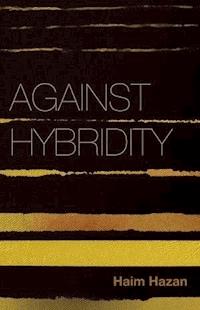
One of the major characteristics of our contemporary culture is a positive, almost banal, view of the transgression and disruption of cultural boundaries. Strangers, migrants and nomads are celebrated in our postmodern world of hybrids and cyborgs. But we pay a price for this celebration of hybridity: the non-hybrid figures in our societies are ignored, rejected, silenced or exterminated. This book tells the story of these non-hybrid figures Ð the anti-heroes of our pop culture.
The main example of non-hybrids in an otherwise hybridized world is that of deep old age. Hazan shows how we fervently distance ourselves from old age by grading and sequencing it into stages such as ‘the third age’, ‘the fourth age’ and so on. Aging bodies are manipulated through anti-aging techniques until it is no longer possible to do it anymore, at which point they become un-transformable and non-marketable objects and hence commercially and socially invisible or masked. Other examples are used to elucidate the same cultural logic of the non-hybrid: pain, the Holocaust, autism, fundamentalism and corporeal death. On the face of it, these examples may seem to have nothing in common, but they all exemplify the same cultural logic of the non-hybrid and provoke similar reactions of criticism, terror, abhorrence and moral indignation.
This highly original and iconoclastic book offers a fresh critique of contemporary Western culture by focusing on that which is perceived as its other Ð the non-hybrid in our midst, often rejected, ignored or silenced and deemed to be in need of globally manageable correction.
Sie lesen das E-Book in den Legimi-Apps auf:
Seitenzahl: 302
Veröffentlichungsjahr: 2015
Ähnliche



















For my grandchildren: Anna, Bar, Alexand those to follow . . .
Copyright © Haim Hazan 2015
The right of Haim Hazan to be identified as Author of this Work has been asserted in accordance with the UK Copyright, Designs and Patents Act 1988.
First published in 2015 by Polity Press
Polity Press
65 Bridge Street
Cambridge CB2 1UR, UK
Polity Press
350 Main Street
Malden, MA 02148, USA
All rights reserved. Except for the quotation of short passages for the purpose of criticism and review, no part of this publication may be reproduced, stored in a retrieval system, or transmitted, in any form or by any means, electronic, mechanical, photocopying, recording or otherwise, without the prior permission of the publisher.
ISBN-13: 978-0-7456-9069-8
ISBN-13: 978-0-7456-9070-4(pb)
ISBN-13: 978-0-7456-9073-5(epub)
ISBN-13: 978-0-7456-9072-8(mobi)
A catalogue record for this book is available from the British Library.
Library of Congress Cataloging-in-Publication Data
Hazan, Haim.
Against hybridity : social impasses in a globalizing world / Haim Hazan.
pages cm
Includes bibliographical references and index.
ISBN 978-0-7456-9069-8 (hardback) – ISBN 978-0-7456-9070-4 (paperback) 1. Culture and globalization. 2. Anthropology–Philosophy. I. Title.
HM621.H393 2015
303.48′2–dc23
2014027254
The publisher has used its best endeavours to ensure that the URLs for external websites referred to in this book are correct and active at the time of going to press. However, the publisher has no responsibility for the websites and can make no guarantee that a site will remain live or that the content is or will remain appropriate.
Every effort has been made to trace all copyright holders, but if any have been inadvertently overlooked the publisher will be pleased to include any necessary credits in any subsequent reprint or edition.
For further information on Polity, visit our website:
politybooks.com
Acknowledgments
Against Hybridity is about recognizing social impasses in a world swamped by faith in the sweeping forces of globalization; about refashioning the age-old idea of otherness in a new anthropological form; about rethinking the sources of dread and anxiety in a highly hybridized era; and last but not least, about enlisting the hitherto marginal study of old age as a key clue to the understanding of contemporary predicaments. Indeed, the book is, to a large extent, an emergent scholarly property of decades of searching and researching aging, and a few of its sections reflect and adapt some of my previously published materials concerning the end of life. To those elderly persons whose cooperation and wisdom molded the ethnographic studies that inform the book, I am immensely grateful.
Along the way of writing and revising the manuscript, I greatly benefited from the generous and constructive critique of several friends and colleagues who took the trouble to peruse various versions of the texts. I am particularly indebted to Professors Gil Eyal, Nigel Rapport, Aviad Raz, and Ido Yoav for their thorough reading and reviewing. I am also thankful to Ms Ayala Raz for her dedicated assistance in preparing the manuscript, and to the Minerva Center for the Interdisciplinary Study of the End of Life at Tel Aviv University for being an intellectual hub for brainstorming ideas and for backing the successful completion of the project. My friend Professor Osvaldo Romberg munificently contributed one of his exquisite works of art for the book's jacket, and for this kind gesture I am immeasurably obliged.
Special thanks are extended to Professor John Thompson and to Dr Elliott Karstadt from Polity Press for their attentive understanding and efficient care throughout the process of publication.
My wife Mercia, my children Gil, Lee, and Dana and granddaughters Anna and Bar enveloped me with love that empowered my conviction in the contents and contentions of Against Hybridity.
Haim Hazan
July 2014
Introduction: Zones and Discourses of Cultural Sturdiness
The cacophonic sounds of culture pervade all walks of life, while their polyphonic orchestration beguiles us into believing that no other music is audible. Thus, we seldom lend our ears to the faint, humming noise of other lives that might play on our fears and imagination as sirens of deadly passions. This book is attuned to listening to these illicit sounds. Let us begin by unfolding the genetics of the cultural that allow for the emergence of such muted mutations, offering alternative forms of life in the midst of the taken-for-granted.
Cultural configurations embody a double helix composed of two central threads of discursive designation: the metaphoric and the metonymic, the learnt and the innate, the social and the natural, the constructed and the essential. The study of culture as practiced in the discipline of anthropology, for example, often hinges on a certain interpretation of the interplay of these dimensions. In its modernist heyday, anthropology contended that the unstable boundaries of culture, the sites of taboos, dangers, fears, and revulsions, are by and large an emergent property of in-between spaces delineated by mixed categories. This is indeed the well-known legacy of structural-functionalist anthropology and sociology, with its fixation on order and disorder that has generated a variety of modern discourses concerning the characteristics of the condition of otherness rooted in zones of such cultural uncertainty. Examples of major discursive tropes of this kind include the social form of “the stranger” (Bauman 1991; Simmel 1971 [1908]), the “roleless” state of liminality in rites of passage (Turner 1969; Van Gennep 1960 [1908]), the forbidden zone of taboos (Steiner 1967 [1956]), the mortified self of inmates (Goffman 1961), and generally speaking all that is anomalous, abominated, polluted, and contaminated (Douglas 1966). These are all, notwithstanding their vast differences, images of the cultural anxieties born and bred in the fold of “between-ness” (Crapanzano 2004).
Lesen Sie weiter in der vollständigen Ausgabe!
Lesen Sie weiter in der vollständigen Ausgabe!
Lesen Sie weiter in der vollständigen Ausgabe!
Lesen Sie weiter in der vollständigen Ausgabe!
Lesen Sie weiter in der vollständigen Ausgabe!
Lesen Sie weiter in der vollständigen Ausgabe!
Lesen Sie weiter in der vollständigen Ausgabe!




