


19,99 €
Mehr erfahren.
- Herausgeber: John Wiley & Sons
- Kategorie: Fachliteratur
- Sprache: Englisch
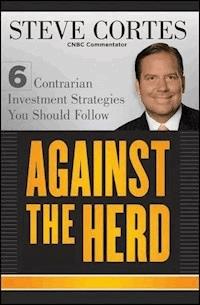
CNBC's Fast Money Commentator Steve Cortes shows how to buck the trend and become a well-informed investor The public needs to think independently and not be duped, particularly because those who are selling their messages or promoting their ideas have a plethora of powerful media through which to do so. Against the Herd presents six contrarian views of major events that will shape the future. Steve Cortes of CNBC pulls no punches in explaining these trends. Many will find his views counterintuitive and even controversial. Some will find his forecasts alarming. But open-minded readers who are willing to heed his well-informed advice will find it illuminating, beneficial, and profitable. * Steve Cortes presents six contrarian views of major events that will shape the future for investors including the fall of China and the end of the golden era of free trade * The contrarian stances are presented because they are actionable * Reveals how these events will affect global markets and specific investments, and how and when to take advantage of these key moves Against the Herd shows you how to profit by bucking conventional wisdom and what to do to get ready when situations call for contrarian investing.
Sie lesen das E-Book in den Legimi-Apps auf:
Seitenzahl: 277
Veröffentlichungsjahr: 2011
Ähnliche



















Table of Contents
Cover
Title page
Copyright page
Introduction
Casting a Fresh Eye on the World Around You
What You’ll Find in This Book
Chapter 1 The Corleones Meet Confucius
Exposing the Myth
Adam Smith’s Revenge: The Folly of Central Planning
Ghost Cities and Construction Cranes
China Too Crowded? Not for Long . . .
Big Brother’s Watching: Censorship and Secrecy
No H-P Garage
If China Catches a Cold, Who Else Will Start Sneezing?
Chapter 2 Dolls Are Meant for Children
We’re Number Two (clap) . . . We’re Number Two (clap) . . .
A Whole New World?
Brother, Can You Spare a Yen?
They Own Pebble Beach and Rockefeller Center?
The “Portfolio” Account
Neither a Borrower Nor a Lender Be
X’s and O’s
Austin Powers Would Not Enjoy Japan
2011 Natural Disaster
The X Factor: How to Invest as Japan Declines
Chapter 3 Can’t Touch This
How Deep Is Your Love?
The Wages of Sin
Helicopter Ben Just Can’t “Make It Rain”
Calling Richard Simmons
John L. Sullivan in the Red Corner
Three’s Company
An Asset for All Seasons
Truly Can’t (Won’t) Touch This
Chapter 4 House of Pain
Can We Protect This House?
The Visible Hand
A Shot to the Privates
The Big Short: The Doctor Makes a House Call
“That ’70s Show”
It’s Not Raining (Working) Men
Ring of Fire
Underwater People
Desert Storm
J. Wellington Wimpy, Borrower
“Don’t Get High on Your Own Supply”
Form Follows Function
If You Build It, They Will Come
Rent
Homes Are Not Investments
Downward Dog
Chapter 5 You Can’t Handle the Truth, or the Volatility
A Good Walk Spoiled
“Losing Is a Disease”
Coach Bill Belichick and John Maynard Keynes
Better Have Strong Hands
“Girls Just Wanna Have Fun”
Sadly, in Investing There Are Valleys Low Enough
A Very Good Place to Start
Unforgettable and Unrepeatable
You Can Handle This Truth
Chapter 6 Still the One
The Right Stuff
American Glasnost
Human Growth
They’re Coming to America
Love Your Mother (Meaning the U.S. Dollar)
Conclusion
Acknowledgments
About the Author
Index
Copyright © 2012 by Steve Cortés. All rights reserved.
Published by John Wiley & Sons, Inc., Hoboken, New Jersey.
Published simultaneously in Canada.
No part of this publication may be reproduced, stored in a retrieval system, or transmitted in any form or by any means, electronic, mechanical, photocopying, recording, scanning, or otherwise, except as permitted under Section 107 or 108 of the 1976 United States Copyright Act, without either the prior written permission of the Publisher, or authorization through payment of the appropriate per-copy fee to the Copyright Clearance Center, Inc., 222 Rosewood Drive, Danvers, MA 01923, (978) 750–8400, fax (978) 646–8600, or on the Web at www.copyright.com. Requests to the Publisher for permission should be addressed to the Permissions Department, John Wiley & Sons, Inc., 111 River Street, Hoboken, NJ 07030, (201) 748–6011, fax (201) 748–6008, or online at http://www.wiley.com/go/permissions.
Limit of Liability/Disclaimer of Warranty: While the publisher and author have used their best efforts in preparing this book, they make no representations or warranties with respect to the accuracy or completeness of the contents of this book and specifically disclaim any implied warranties of merchantability or fitness for a particular purpose. No warranty may be created or extended by sales representatives or written sales materials. The advice and strategies contained herein may not be suitable for your situation. You should consult with a professional where appropriate. Neither the publisher nor author shall be liable for any loss of profit or any other commercial damages, including but not limited to special, incidental, consequential, or other damages.
For general information on our other products and services or for technical support, please contact our Customer Care Department within the United States at (800) 762–2974, outside the United States at (317) 572–3993 or fax (317) 572–4002.
Wiley also publishes its books in a variety of electronic formats. Some content that appears in print may not be available in electronic books. For more information about Wiley products, visit our web site at www.wiley.com.
Library of Congress Cataloging-in-Publication Data:
Cortés, Steve, 1972–
Against the herd: 6 contrarian investment strategies you should follow / Steve Cortés.—1
p. cm.
Includes index.
ISBN 978–1–118–08318–5 (cloth); ISBN 978–1–118–20585–3 (ebk); ISBN 978–1–118–20586–0 (ebk); ISBN 978–1–118–20584–6 (ebk)
1. Investments. I. Title.
[DNLM: 1. Economic history—21st century.]
HG4515.C67 2011
332.6—dc23
2011035471
Introduction
“Safety in numbers.”
That phrase, and that concept, are deeply imbedded in our human psyche. We are clearly social creatures, hard-wired to desire companionship in all its wonderful forms, for benefits both tangible and intangible. Indeed, modern life is largely marked by the constant need for connectivity to each other. The incredible success of Facebook and Google+, and the constant inclination to text and instant message all speak to this yearning for the collective, for connectivity.
But safety in numbers can be illusory. Is the crowd to be followed, or feared? Twitter can inform and enlighten and also form dangerous riots and “flash mobs.” Should we cast a skeptical eye upon the supposed wisdom of the masses? In this digital age, mass opinions form quickly and powerfully, but often with little connection to reality, especially concerning economics and markets. For many investors, financial market analysis properly lies well down their list of priorities, behind family, career, and community. But that lack of market acumen often leaves investors all too willing to accept the conventional wisdom thrust upon them by Wall Street and the financial media. Therefore, maintaining a healthy skepticism becomes paramount to protecting and growing assets. A willingness to think independently forms the backbone of a stable financial life. Moreover, the contrarian thinker must always scour the market landscape for unrecognized risks, for those instances when the masses have whipped themselves into frenzied, widely held, but dangerous beliefs—such as the dot-com bubble of 1999–2000.
As a trader and market researcher, I am constantly searching for just those kinds of risks, which can become opportunities. I look for those instances when conventional wisdom misses the mark, setting us up for an eventual economic reckoning. The subprime housing fiasco represented just such a chasm between accepted opinion and underlying reality. This book is designed to target unrecognized dangers and help you avoid financial pain, if not actually profit from such dangers.
Casting a Fresh Eye on the World Around You
Danger is often found where one least suspects it. And profit is often found in equally unlikely places. For example, if one is asked, “What is the greatest casualty disaster in Chicago history?” most people, even most Chicagoans, would respond “the Chicago Fire.” In fact, the greatest loss of life—and one of the worst maritime disasters in U.S. history—occurred in a mass drowning in 20 feet of calm water in the Chicago River.
On July 24, 1915, the workers and families of a Western Electric plant in Cicero, Illinois, eagerly anticipated a summertime boat ride out to the beaches of northern Indiana and a company-sponsored picnic. For these working class laborers, mostly Czech immigrants, such diversions were rare and much appreciated. But the SS Eastland, the ship selected to transport about 2,700 of the workers and families that fateful morning, already held a spotty safety record. It was simply built too tall and too top-heavy for its structure and was, therefore, prone to listing. Near disasters in past voyages had failed to deter the Eastland from staying in service. In fact, as is often the case, government intervention only exacerbated the problem. Specifically, in 1915 the Seaman’s Act passed Congress; it was a reaction to the Titanic tragedy of 1912. The Act required a vastly increased number of lifeboats on large ships, and the added weight on the Eastland greatly augmented the dangers of its already flawed design.
Ignorant of the design flaws of this vessel, almost 3,000 passengers boarded the Eastland. As if choreographed, the workers and families crowded herd-like, seemingly all at once, onto the top deck’s far port side. Their collective weight capsized the ship into the river, trapping hundreds of passengers under the boat itself and below deck as the boat filled with water. In total, 844 people drowned—in only 20 feet of water and mere yards away from the dock. Jack Woodford of the Herald and Examiner newspaper wrote:
As I watched in disoriented stupefaction a steamer large as an ocean liner slowly turned over on its side as though it were a whale going to take a nap. I didn’t believe a huge steamer had done this before my eyes, lashed to a dock, in perfectly calm water, in excellent weather, with no explosion, no fire, nothing. I thought I had gone crazy.1
We ascertain two important lessons from this dreadful tale.
First, danger is seldom most acute in the most obvious places. Often the bathtub of water presents more danger than furious seas. For example, home mortgages, the stuff of the Bailey Building and Loan in the movie It’s a Wonderful Life, had served for decades as the dependable, and even boring, basis of our “ownership society.”Second, following the herd can be very costly. When masses of people decide assuredly on an opinion, history (and the history of markets) argues to take caution, because the madness and delusions of the crowd can create dangerous and untenable scenarios that imperil all but the most independent thinkers.More than for any other purpose, I write this book hoping it will empower the reader to wisely discern the motivations of the media and Wall Street, and to realize how important it is to truly think. “Think” was the one-word motto of Thomas Watson of IBM, one of history’s greatest capitalists, whom I will describe later in the final chapter. A failure to think cost too many people far too much hard-earned money during the recent credit crisis. Following the herd proved disastrous and provided no safety in numbers but rather incredible risks.
A willingness to think, as Thomas Watson did, requires the courage to be different, given our internal need for connectivity, our inclination tends toward conformity, toward getting along. But the contrarian investor must develop the mindset of a maverick, a willingness to think and act in unpopular ways. The term maverick itself emanates from just such a man, Samuel Augustus Maverick, a Texan (naturally) who, in the nineteenth century, found fortune as a land baron after fighting in the Texas revolution against Mexico. He refused to brand his cattle, which was the convention. His claimed motivation was to spare the cattle the pain of the hot iron, although some speculated he actually wanted the ability to claim all unbranded roaming cattle as his own. Regardless of his reasons, Sam Maverick was unafraid to be different. And thus his name was introduced into our American lexicon to describe a person willing to live unconventionally.
It’s worth mentioning here, though, that not every popular or unanimous mass opinion is wrong. For example, when the United States sent the Dream Team to the Barcelona Olympics in 1992 to reclaim American basketball glory, it was uniformly assumed that Jordan, Barkley, Bird, and Ewing would smash all opposition. The Dream Team did so triumphantly, claiming the gold for U.S. basketball and winning by an average of 43 points per game. Clearly, at times the masses are correct. But just as often, when popular opinion, media attention, and Wall Street analysts all combine to form a universally acknowledged economic “truth,” it often pays to recall, as I was once told by a cynical but streetwise teller at a Las Vegas sports book, “Kid, the masses are asses.” So while it’s important to resist the label of contrarian simply for the sake of the moniker, so too is it vital to think independently, to use the myriad resources now available to anyone willing to think independently, to do his or her homework, and search for unconventional opportunities.
The contrarian thinker is not some grumpy argumentative type, always saying “no,” but rather an adventurous, independent thinker, trying to discern the reality of the world of economics, rather than just following the herd’s thinking. Later in this book, I will present Dr. Michael Burry, made famous by Michael Lewis’s book, The Big Short, which detailed how one man doing serious homework made a fortune for himself and his investors by betting against the excesses of the subprime lending crisis. I will also detail why I think China is so dangerous now and presents a risk to the global economy as severe as the subprime fiasco. As in the case of subprime, finding skeptics about the whole emerging market theme today is not easy. Wall Street and the financial media badly want us to believe that the future lies in places like Shanghai, Bombay, and Abu Dhabi. Of all the most widely held investment beliefs right now, to me the most false by far is the belief that the future belongs to the emerging markets and that America’s economic supremacy is receding. Quite to the contrary, I see massive risks in emerging markets, which may soon become submerging markets. Long term, I foresee boundless opportunities in the United States, which I believe shall remain for many decades the world’s sole superpower in every facet of life—economically, culturally, militarily, politically.
What You’ll Find in This Book
To paraphrase Mark Twain, history might not repeat, but it sure seems to rhyme. Bubbles unfold when the masses decide, often at the behest of the self-interested intelligentsia, that a new order or paradigm is unassailable. I see such thinking currently enveloping the near hysteria surrounding China and its potential, a tale darkly reminiscent of Japan in the 1980s, which will be discussed in Chapter 2. Only a confident, independent, and rigorous thinker can discern when the masses have ventured beyond the reasonable realm of risk and reward. Whether deciding in 1915 to stay lonely on the starboard side of the SS Eastland, or in 2011 to refrain from betting on the Chinese “miracle” (or, in fact, bet against it!), contrarian, independent analysis can, at least, protect capital and, at best, build profit.
This book will also detail the lingering risks that abound in housing and stipulate that, far from being at an assured bottom in prices, housing will languish for years ahead. Given the turbulence of markets in recent years, the natural inclination to hold gold as an investment has grown wildly. On television lately, gold commercials have started to eclipse even the volume of Viagra advertisements. But is the yellow metal a legitimate long-term investment, or a fool’s gold? I believe the latter, and I will lay out the endemic risks in gold. Much of this book bucks the conventional wisdom of Wall Street, which may serve well the interests of the Street but not of the average investor. Nowhere is that gulf more evident than when we scrutinize Wall Street’s typical asset allocation blend. I will make the case that most investors own far too many stocks and cannot handle the incredible volatility that is actually inherent to stock investing.
So I ask that you join me on a global investing adventure and consider where the herd has gotten the story wrong. More than anything, I ask you to think, and in doing so, develop a healthy skepticism toward mass opinion, especially in the realm of financial markets. Thinking independently, developing a healthy skepticism, and acting like a maverick investor, one willing to buck the movement of the herd, can evolve into an exhilarating, secure, and profitable financial existence.
Note
1. Jack Woodford, The Autobiography of Jack Woodford (Seattle, WA: Woodford Memorial Editions, 1962).
Chapter 1
The Corleones Meet Confucius
The Chinese Mirage of Miracle Expansion
In The Godfather II, Michael Corleone consults his advisers in his Lake Tahoe mansion following an unsuccessful assassination attempt against him. The young, powerful Don Corleone considers the likelihood of insider help in the plot, from within the Corleone family organization. Michael counsels:
All our people’s loyalty is based on business; and on that basis, anything is possible.
Whether a crime family, a company, or an ordinary family, if the organization’s central binding ethos is money, then the flow of capital must not cease or the organization splinters quickly. It is not an absurd analogy to compare the motivations of the members of the Corleone family to the majority of the citizens of China. That is, like the Corleones, China is not truly a family. It is not even truly a country. Instead, China is more like a group of countries—a vast collection of disparate, and often confrontational, cultures, languages, and histories. And since the reforms of Deng Xiaoping, the glue that binds the amalgam together is not ideology but commerce. George Friedman, political scientist and founder of the private intelligence corporation Stratfor, correctly postulates:
Lesen Sie weiter in der vollständigen Ausgabe!
Lesen Sie weiter in der vollständigen Ausgabe!
Lesen Sie weiter in der vollständigen Ausgabe!
Lesen Sie weiter in der vollständigen Ausgabe!
Lesen Sie weiter in der vollständigen Ausgabe!
Lesen Sie weiter in der vollständigen Ausgabe!
Lesen Sie weiter in der vollständigen Ausgabe!
Lesen Sie weiter in der vollständigen Ausgabe!
Lesen Sie weiter in der vollständigen Ausgabe!




