


74,99 €
Mehr erfahren.
- Herausgeber: John Wiley & Sons
- Kategorie: Fachliteratur
- Serie: Wiley Finance Series
- Sprache: Englisch
A comprehensive resource for understanding the complexities of agricultural finance
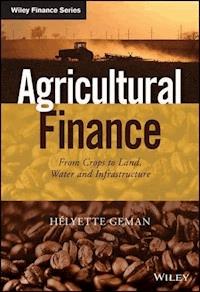
Agricultural Finance: From Crops to Land, Water, and Infrastructure is a pioneering book that offers a comprehensive resource for understanding the worldwide agriculture markets, from spikes in agricultural commodity prices to trading strategies, and the agribusiness industry generally to the challenges of feeding the planet in particular. The book also goes in-depth on the topics of land, water, fertilizers, biofuels, and ethanol. Written by Helyette Geman—an industry expert in commodity derivatives—this book explores the agricultural marketplace and the cycles in agricultural commodity prices that can be the key to investor success.
This resource addresses a wide range of other important topics as well, including agricultural insurance, energy, shipping and bunker prices, sustainability, investments in land, subsidies, agricultural derivatives, and farming risk-management. Other topics covered include structured products and agricultural commodities ETFs; trade finance in an era of credit shortage; securitization and commodity-linked notes; grains: wheat, corn, soybeans; softs: coffee, cocoa, cotton; shipping as a key component of agricultural trade; and the major agricultural shipping routes and the costs. The book:
- Offers the first comprehensive resource that deals with the all aspects of agricultural finance
- Includes information that is crucial for pension funds, asset managers, hedge funds, agribusiness corporates, CTAs and regulators
- Covers a range of topics from agricultural bunker prices, futures, options to major shipping routes and the costs
This text is a must-have resource for accessing the information required to trade successfully in the agricultural marketplace.
Sie lesen das E-Book in den Legimi-Apps auf:
Seitenzahl: 501
Veröffentlichungsjahr: 2014
Ähnliche


















Table of Contents
Title Page
Copyright
Dedication
Acknowledgments
About the Author
Preamble
Chapter 1: Physical and Financial Agricultural Markets
1.1 Agriculture and the Beginning of Human Sedentarization
1.2 The Outlook of Agricultural Commodities Markets
1.3 History of Commodity Futures and Spot Markets
1.4 Shipping and Freight
Chapter 2: Agricultural Commodity Spot Markets
2.1 Introduction
2.2 Price Formation in Agricultural Commodity Markets
2.3 Volatility in Agricultural Markets
Chapter 3: Futures Exchanges – Future and Forward Prices – Theory of Storage – The Forward Curve
3.1 Major Commodity Exchanges
3.2 Forward Contracts
3.3 Futures Contracts
3.4 Relationship between Forward and Futures Prices
3.5 Example of a Future Spread
3.6 Inventory and Theory of Storage
3.7 The Benefits of Forward Curves
3.8 Stochastic Modeling of the Forward Curve
Chapter 4: Plain Vanilla Options on Commodity Spot and Forward Prices. The Bachelier–Black–Scholes Formula, the Merton Formula, the Black Formula
4.1 Introduction
4.2 Classical Strategies involving European Calls and Puts
4.3 Put–Call Parity for a Non-dividend Paying Stock
4.4 Valuation of European Calls: the Bachelier–Black–Scholes Formula and the Greeks
4.5 The Merton (1973) Formula for Dividend-paying Stocks
4.6 Options on Commodity Spot Prices
4.7 Options on Commodity Futures: the Black (1976) Formula
4.8 Monte-Carlo Simulations for Option Pricing
4.9 Implied Volatility, Smile, and Skew in Equity Option Markets
4.10 Volatility Smile in Agricultural Commodity Markets
Chapter 5: Commodity Swaps, Swaptions, Accumulators, Forward-Start, and Asian Options
5.1 Swaps and Swaptions
5.2 Accumulators
5.3 Forward-Start Options (or Calendar Spread Options on the Spot Price)
5.4 Asian Options as Key Instruments in Commodity Markets
5.5 Trading the Shape of the Forward Curve through Floating-strike Asian Options
Chapter 6: Exchange, Spread, and Quanto Options in Commodity Markets
6.1 Exchange Options
6.2 Commodity Spread Options and their Importance in Commodity Markets
6.3 Commodity Quanto Options
Chapter 7: Grain Cereals: Corn, Wheat, Soybean, Rice, and Sorghum
7.1 Introduction
7.2 Corn
7.3 Wheat
7.4 Soybeans
7.5 Rice
7.6 Sorghum
Chapter 8: Sugar, Cocoa, Coffee, and Tea
8.1 Sugar
8.2 Cocoa
8.3 Coffee
8.4 Tea
Chapter 9: Cotton, Timber and Wood, Pulp and Paper, Wool
9.1 Cotton
9.2 Lumber and Wood
9.3 Pulp and Paper
9.4 Wool and Cashmere
Chapter 10: Orange Juice, Livestock, Dairy, and Fishery
10.1 Orange Juice
10.2 Livestock
10.3 Dairy
10.4 Fish Markets
10.5 Poultry and Eggs
Chapter 11: Rubber, Palm Oil, and Biofuels
11.1 Rubber
11.2 PALM OIL
11.3 Ethanol, Biofuels, and Biomass
Chapter 12: Land, Water, and Fertilizers
12.1 Land Types, Yields, and Erosion
12.2 Fertilizers
12.3 Water and Its Crucial Role in the World Economy
12.4 Projections for the Future of Agriculture
12.5 Subsidies and Export Bans
12.6 Market-Oriented Farming
Chapter 13: Infrastructure and Farming Management in the Digital Age
13.1 Introduction
13.2 Agricultural Infrastructure
13.3 Country Risk: The Example of Ukraine in 2014
13.4 Analyzing the Risks Involved in an International Wheat Tender Offer
13.5 Weather Risk and Weather Derivatives
Chapter 14: Investing in Agricultural Commodities, Land, and Physical Assets
14.1 Purchase of Commodity Futures
14.2 Purchase of Commodity Options and Structured Products
14.3 Commodity Index Investing
14.4 Investing in Commodity-Related Equities
14.5 Investing in Land
14.6 Acquisition of Infrastructure and Physical Assets
14.7 Conclusion
Glossary
References
Index
End User License Agreement
Pages
xiii
xv
xvii
xviii
xix
1
2
3
4
5
6
7
8
9
10
11
12
13
14
15
16
17
18
19
20
21
22
23
24
25
26
27
28
29
30
32
31
33
34
35
36
37
38
39
40
41
42
43
44
45
46
47
48
49
50
51
52
53
54
55
56
57
59
60
61
62
63
64
65
66
67
68
69
70
71
72
73
74
75
76
77
78
79
80
81
82
83
84
85
86
87
88
89
90
91
92
93
94
95
96
97
98
99
100
101
102
103
104
105
106
107
108
109
110
111
112
113
114
115
118
116
117
119
120
121
122
123
124
125
126
127
128
129
130
131
133
134
135
136
137
138
139
140
141
142
143
144
145
146
147
148
149
150
151
153
154
155
156
157
158
159
160
161
162
163
164
165
166
167
168
169
170
171
172
173
174
175
177
178
179
180
181
182
183
184
185
186
187
188
189
190
191
192
193
194
195
196
197
198
199
200
201
202
203
204
205
206
207
208
209
210
211
212
213
214
215
216
217
218
219
220
221
222
223
224
225
226
227
228
229
230
231
233
234
235
236
237
238
239
240
241
242
243
244
245
246
247
248
249
250
251
252
253
254
255
256
257
258
259
260
261
262
263
264
265
266
267
268
Guide
Cover
Table of Contents
Begin Reading
List of Illustrations
Figure 1.1
Figure 1.2
Figure 1.3
Figure 1.4
Figure 1.5
Figure 1.6
Figure 1.7
Figure 2.1
Figure 2.2
Figure 2.3
Figure 2.4
Figure 2.5
Figure 2.6
Figure 2.8
Figure 2.9
Figure 2.10
Figure 2.11
Figure 2.12
Figure 3.1
Figure 3.2
Figure 3.3
Figure 3.4
Figure 3.5
Figure 4.1
Figure 4.2
Figure 4.3
Figure 6.1
Figure 6.2
Figure 7.1
Figure 7.2
Figure 7.3
Figure 7.4
Figure 7.5
Figure 7.6
Figure 7.7
Figure 7.8
Figure 7.9
Figure 7.10
Figure 7.11
Figure 7.12
Figure 7.13
Figure 7.14
Figure 7.15
Figure 7.16
Figure 7.17
Figure 7.18
Figure 7.19
Figure 7.20
Figure 8.1
Figure 8.2
Figure 8.3
Figure 8.4
Figure 8.5
Figure 8.6
Figure 8.7
Figure 8.8
Figure 8.9
Figure 8.10
Figure 8.11
Figure 8.12
Figure 8.13
Figure 8.14
Figure 8.15
Figure 8.16
Figure 8.17
Figure 8.18
Figure 8.19
Figure 8.20
Figure 9.1
Figure 9.2
Figure 9.3
Figure 9.4
Figure 9.5
Figure 10.1
Figure 10.2
Figure 10.3
Figure 10.4
Figure 10.5
Figure 10.6
Figure 11.1
Figure 11.2
Figure 11.3
Figure 11.4
Figure 11.5
Figure 11.6
Figure 11.7
Figure 12.1
Figure 12.2
Figure 12.3
Figure 12.4
Figure 12.5
Figure 12.6
List of Tables
Table 2.1
Table 2.2
Table 2.3
Table 3.1
Table 4.1
Table 12.1
Table 12.2
For other titles in the Wiley Finance series
please see www.wiley.com/finance
Agricultural Finance
From Crops to Land, Water and Infrastructure
Hélyette Geman
This edition first published 2015
© 2015 Hélyette Geman
Registered office
John Wiley & Sons Ltd, The Atrium, Southern Gate, Chichester, West Sussex, PO19 8SQ, United Kingdom
For details of our global editorial offices, for customer services and for information about how to apply for permission to reuse the copyright material in this book please see our website at www.wiley.com.
All rights reserved. No part of this publication may be reproduced, stored in a retrieval system, or transmitted, in any form or by any means, electronic, mechanical, photocopying, recording or otherwise, except as permitted by the UK Copyright, Designs and Patents Act 1988, without the prior permission of the publisher.
Wiley publishes in a variety of print and electronic formats and by print-on-demand. Some material included with standard print versions of this book may not be included in e-books or in print-on-demand. If this book refers to media such as a CD or DVD that is not included in the version you purchased, you may download this material at http://booksupport.wiley.com. For more information about Wiley products, visit www.wiley.com.
Designations used by companies to distinguish their products are often claimed as trademarks. All brand names and product names used in this book are trade names, service marks, trademarks or registered trademarks of their respective owners. The publisher is not associated with any product or vendor mentioned in this book.
Limit of Liability/Disclaimer of Warranty: While the publisher and author have used their best efforts in preparing this book, they make no representations or warranties with respect to the accuracy or completeness of the contents of this book and specifically disclaim any implied warranties of merchantability or fitness for a particular purpose. It is sold on the understanding that the publisher is not engaged in rendering professional services and neither the publisher nor the author shall be liable for damages arising herefrom. If professional advice or other expert assistance is required, the services of a competent professional should be sought.
Library of Congress Cataloging-in-Publication Data
Geman, Hélyette.
Agricultural finance : from crops to land, water and infrastructure/Hélyette Geman.
pages cm. – (The Wiley finance series)
Includes bibliographical references and index.
ISBN 978-1-118-82738-3 (hardback)
1. Commodity exchanges. 2. Agricultural prices. 3. Agricultural industries. 4. Investments. I. Title.
HG6046.G457 2015
338.1'3–dc23
2014036004
A catalogue record for this book is available from the British Library.
ISBN 978-1-118-82738-3 (hbk) ISBN 978-1-118-82737-6 (ebk)
ISBN 978-1-118-82736-9 (ebk) ISBN 978-1-118-82735-2 (ebk)
Cover Design: Wiley
Cover Image top: ©istock.com/jenjen42
Cover Image bottom: ©istock.com/77studio
To Arnaud, Laure and Nathanaël
To the memory of my sister
Acknowledgments
First, I would like to extend my very warm thanks to my PhD students Bo Liu for his remarkably intelligent and merciless proofreading of the book – all remaining typos or repetitions are my sole responsibility – and Pedro Vergel and Tara Velez for their talent in building a number of price trajectories and forward curves. I would also like to thank Hugo Forget and Patrick Slama for their help in editing.
Second, I want to express my gratitude to my friends Hilary Till, from Premia Capital Management, and George Martin, from Wood Creek Capital Management, for the great discussions and reports exchanges we had over the years, some of them being reflected in this book.
Lastly, I am grateful to Javier Blas, editor at the Financial Times and other journalists at the FT, the Wall Street Journal, the Economist, the Business Times (Singapore), and other newspapers for their prompt and beautiful coverage of a number of new developments in the world of agricultural commodities; they allowed me to corroborate my own findings. I tried to trace and pay tribute to the first publication, sometimes a World Bank, USDA or another official organization valuable report.
On a side note, I wish to mention that I chose the article ‘he’ throughout the book for ease of use and did not intend to place the male gender above any other gender.
About the Author
Hélyette Geman is Director of the Commodity Finance Centre at Birkbeck, University of London and Research Professor at Johns Hopkins University. She is a graduate of Ecole Normale Supérieure in Mathematics and holds a Master's degree in Theoretical Physics as well as a PhD both in Probability from the University Pierre et Marie Curie and in Finance from the University Panthéon-Sorbonne.
Professor Geman has been a scientific advisor to major financial institutions, energy and mining and commodity companies for the last 21 years, covering the spectrum of interest rates, electricity, crude oil and natural gas, metals, and agriculturals, including fertilizers and land. She was for four years Head of Research at Caisse des Dépôts in Paris and has been a scientific advisor for Louis Dreyfus, EDF Trading, BHP Billiton, Bunge, Total, and many other commodity companies. Professor Geman has published more than 125 papers in top international finance journals. In 1994 she received the First Prize of the Merrill Lynch Awards for her work on exotic derivatives pricing and in 1995 the first AFIR (Actuarial Approach for Insurance Risk) prize for her work on catastrophic risk. She became in 1993 a Member of Honour of the French Society of Actuaries and was in 2000 the first President of the Bachelier Finance Society.
Professor Geman was named in the Hall of Fame of Energy Risk in 2004, and in 2008 she received the Alma Studiorum Prize of the University of Bologna for her contribution to the CGMY model, a pure jump Lévy process widely used in finance.
Her books include Insurance and Weather Derivatives published in 1999 by RISK books, and Commodities and Commodity Derivatives: Energy, Metals and Agriculturals published by Wiley Finance in 2005, which has become the reference on the subject.
In 2010 Professor Geman became a scientific advisor to the European Union on the subject of agricultural commodities. She has been since 2007 a member of the board of the UBS–Bloomberg Commodity Index and counts among her former PhD students Nassim Taleb, author of The Black Swan.
Hélyette Geman is presently on the Board of a green energy company and an active participant in a ‘precision farming’ project involving 12,500 farmers in East Africa.
Preamble
Agriculture has always been at the center of human life. It is today the intersection of challenging issues between growth of the world population, soil erosion, and arable land scarcity on the one hand and trade finance after the 2008 crisis, competition for land with the mining industry, new towns and cities in developing countries, competition for water with other industries such as shale gas fracking or oil sands, or between neighboring countries on the other. Small farmers try to stay competitive in the presence of big investors who can afford better machinery and infrastructure. Governments struggle to find the proper way to provide small farms with the right form of subsidies, be they fertilizers, seeds or minimal prices. International institutions like the World Bank face another type of choice: letting weak economies struggle to feed their population, or helping them and destroying the incentive of self-sufficiency. The same difficult dilemma holds for infrastructure such as water sanitation and distribution.
In this complex picture, commodity trading houses – some of which have existed for more than 160 years – continue to be active in their role of ‘origination’ with local farmers around the world while financial players or ‘speculators’ provide liquidity to producers and agrifood companies needing to hedge their price exposure. In contrast, we have seen over the last decade the arrival (and partial departure) of new players in ‘agricultural finance.’ The well-rehearsed speech on financial speculators driving food prices to very high levels has been defeated by a number of respected academic studies. As we shall depict throughout the book, weather risk and country risk are the two main drivers of price spikes – obviously, these may be made worse by actions that regulators ought to monitor properly. At the same time, confusion between high prices and high volatility – both undesirable, but the former being toxic for the many populations – keeps the picture blurry for the public at large. In some developing countries, agricultural prices pushed higher by governments trying to secure farmers' votes are harmful to the country and to a proper formation of prices in general. In developed countries, the lackadaisical attitude of regulators about the ownership of physical assets, such as power plants, large metal warehouses or grain storage facilities by financial players who were shareholders of the relevant exchanges as well as ‘primary actors’ on these exchanges, proved its damaging effects.
After eight to ten years of significant synchronicity of commodity price moves with equity markets, commodities are decorrelating from these; commodity correlations with equities computed for example on 90-day rolling windows were in the second quarter of 2014 at their lowest since the financial crisis – agricultural commodities, because of their unique specificities, were mildly part of this ‘financialization.’ Regarding the global space of commodities, we are back to the situation that prevailed before 2004, with price dynamics specific to each subclass – metals, energy, and agriculturals – and to each commodity within a class in its own right: in 2013, corn and silver prices collapsed by 40%; gold, coffee, and soy oil decreased by more than 20%; cocoa prices rose by 20%; and palm oil and cotton rose by 10%. In 2014, fundamentals, namely supply/demand, weather risk, and country risk for agricultural commodities, are returning as the main factors of price levels, and drought in Brazil was the main reason for the recent extraordinary rise in coffee prices. Not only has ‘financialization’ greatly receded in all commodity classes – including because of the departure of a number of financial players – but commodity index investing, at least in its previous form(s), is less popular and has to reflect the importance of fundamentals.
On the front of agricultural commodities, China has recognized that, in contrast to the view it had a few years ago, the farming, processing, and safety skills required all along the food supply chain were too demanding and has decided ‘to buy rather than produce.’ China owns one-tenth of world arable land but its food consumption is twice as large compared to available land. After metals and coal, China has turned aggressively to the problem of agricultural commodities, signing loans for crops barter agreements with Ukraine and acting through its gigantic state-owned company COFCO to buy originating and processing companies around the world to properly feed its population. The Chinese sovereign fund has in parallel identified agriculture as a strategic sector and is massively investing in agricultural production worldwide.
Raw materials, be they phosphate rock transformed into fertilizer or soybean crushed into soy oil, remain the center of value. And land is the ultimate source of all of them – a gigantic receptacle of substitutability between mining, crops, and farmland and a reservoir of optionalities/convexities and ‘anti-fragility.’ The ownership of land should ultimately remain in the hands of the nation, and not be acquired from poorer countries by wealthier ones wishing to solve their problem of farmland scarcity by means of ephemeral paper money.
The importance of scarcity, one of my recurrent concerns when analyzing agricultural commodities, was highlighted by the flamboyant economist John Law (1671–1729), author of The Scarcity Theory of Value. Analyzing the famous ‘water/diamond’ paradox, namely that useless diamonds are more highly valued than the more useful water, Law regarded the relative scarcity of goods as the origin of the value of a good in society and any changes in this value were due to variations of demand and supply, the central theme I will also modestly emphasize.
At the end of this preamble, I would like to recognize that agricultural finance is not only a technical subject. It also raises a whole host of moral and ethical issues, which are not discussed in this book. Malthus would be horrified to hear the projections of the World Bank on a population exceeding 9.6 billion on the planet by 2050. At the same time, the rate of increase of the number of obese people (often because of poverty and low quality food) is sadly growing faster than the rate of decline of skinny and underfed human beings – both being terrible news. Some struggle with ‘food safety’ while others suffer from ‘food insecurity.’ Food waste and food needs are not even brought together at the level of a city, let alone at the level of a country or beyond. Besides land erosion, the move of young people to better-paid jobs in cities contributes to the decline of cultivated land in regions where agricultural production is so necessary. At the same time, agricultural price subsidies by governments are wrong, in my view, as they take place at the very beginning of the production chain and distort world prices: there is always a poorer country that won't receive the same subsidies and will be disadvantaged. Directly subsidizing poor people is a better solution.
I will conclude on a scientific note and observe that time and space*, the first state variables in all sciences, are particularly crucial in the agricultural commodities universe: time is the harvest or the news on the harvest – not necessarily calendar time. Space is transportation, infrastructure, and the shipping of spices and raw materials to distant destinations – all large sources of risks that were already depicted centuries ago in Shakespeare's Merchant of Venice.
*
‘Time and Space in Mathematical Finance’ Henry McKean,
First World Congress of the Bachelier Finance Society
, June 2000 – Collège de France, Paris.
Chapter 1Physical and Financial Agricultural Markets
‘You should buy land, they don't make it anymore.'
Mark Twain
1.1 Agriculture and the Beginning of Human Sedentarization
Commodities have been produced and exchanged throughout history and trade is an integral part of human civilization. In fact, one can argue that the rise of the latter has its origin in organized commodity production and distribution. As nomadic men settled on land to cultivate crops and graze their cattle, an agriculture-based economy came to existence, while some became carpenters, ironsmiths, goldsmiths, and shipbuilders. Goods were provided by the producers of diverse crops and livestock products in exchange for services. Farmers would bring their excess crops to a central location where they were carefully weighed – interestingly, the existence of weights can be traced back to several millennia before our era. The crops were then stored in a public building, which was the first form of a warehouse.
It was the emergence of barter and soon-emerged bazaars and markets that today still defines the centers of towns and villages. Trading merchants and artisans were organized into ‘guilds’ as early as the fourth century CE. From the first century CE, gold coins, wine, wheat, and linen were traveling east from the Roman Empire; ivory, silk, and precious stones were sent from India. As civilizations spread over the world, vessels started carrying goods, spices, and silks across the oceans. Indian literature from the beginning of our era mentions the existence in Southern India of separate markets for different commodities, such as grains, spices, cloth, and jewelry, located in particular in towns along the coast. Guilds and merchant groups were formed to represent the population.
Lesen Sie weiter in der vollständigen Ausgabe!
Lesen Sie weiter in der vollständigen Ausgabe!
Lesen Sie weiter in der vollständigen Ausgabe!
Lesen Sie weiter in der vollständigen Ausgabe!
Lesen Sie weiter in der vollständigen Ausgabe!
Lesen Sie weiter in der vollständigen Ausgabe!
Lesen Sie weiter in der vollständigen Ausgabe!
Lesen Sie weiter in der vollständigen Ausgabe!
Lesen Sie weiter in der vollständigen Ausgabe!
Lesen Sie weiter in der vollständigen Ausgabe!
Lesen Sie weiter in der vollständigen Ausgabe!
Lesen Sie weiter in der vollständigen Ausgabe!
Lesen Sie weiter in der vollständigen Ausgabe!
Lesen Sie weiter in der vollständigen Ausgabe!
Lesen Sie weiter in der vollständigen Ausgabe!
Lesen Sie weiter in der vollständigen Ausgabe!
Lesen Sie weiter in der vollständigen Ausgabe!




