


9,99 €
Mehr erfahren.
- Herausgeber: 50Minutes.com
- Kategorie: Sachliteratur, Reportagen, Biografien
- Serie: History
- Sprache: Englisch
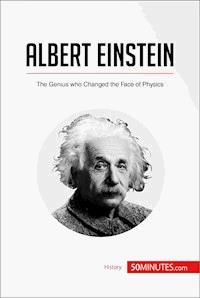
Keen to learn but short on time? Get to grips with the life of Albert Einstein in next to no time with this concise guide.
50Minutes.com provides a clear and engaging analysis of the life and career of Albert Einstein. Einstein’s name has become synonymous with genius, and he remains one of the most influential scientists of all time. His work on relativity revolutionised our understanding of the universe and is one of the pillars of modern physics. He also carried out pioneering work on the photoelectric effect, for which he was awarded a Nobel Prize, and campaigned for causes including nuclear non-proliferation and Jewish rights.
In just 50 minutes you will:
• Learn about the history of physics before Einstein’s revolutionary new theories
• Find out about the impact of his celebrated theory of relativity on modern physics
• Gain an understanding of his other scientific accomplishments, including his work on light and particle theory
ABOUT 50MINUTES.COM | History & Culture
50MINUTES.COM will enable you to quickly understand the main events, people, conflicts and discoveries from world history that have shaped the world we live in today. Our publications present the key information on a wide variety of topics in a quick and accessible way that is guaranteed to save you time on your journey of discovery.
Das E-Book können Sie in Legimi-Apps oder einer beliebigen App lesen, die das folgende Format unterstützen:
Seitenzahl: 30
Veröffentlichungsjahr: 2017
Ähnliche












Albert Einstein
Key information
Born: 14 March 1879 in Ulm, Germany.Died: 18 April 1955 in Princeton, USA.Famous discoveries: the theory of special relativity (1905) and the theory of general relativity (1915) with the formula E = mc2.Impact of his discoveries:Einstein profoundly altered the way we look at the concepts of space and time (by introducing the idea of black holes, the fourth dimension, etc.);He played a role in the development of nuclear fission and informed President Franklin D. Roosevelt of the possibility of creating an atomic bomb;He revolutionised physics by opening up new fields of study, namely nuclear physics and particle physics.Introduction
Even today, Albert Einstein is a household name across the world: he has become the ultimate symbol not only of genius, but also of the humorous and eccentric scientist. How did this nomadic physicist, who left us the celebrated formula E = mc2, become one of the most important historical figures of the 20th century? In order to comprehend this spectacular personality, we must plunge back into Einstein’s troubled century and understand how his strikingly modern scientific and political ideas turned our ideas and way of seeing the world upside down.
Einstein was a brilliant scientist, and he shattered the traditional models inherited from the most eminent figures in physics, from Aristotle (384-322 BC) to Galileo (1564-1642) and Isaac Newton (1642-1727). His theories of special relativity and general relativity revolutionised the concepts of space and time and laid the foundations for modern physics. He was awarded the 1921 Nobel Prize in Physics for his explanation of the photoelectric effect, a topic deemed less subversive than the theory of relativity, which was the subject of heated debate at the time the prize was awarded.
However, Einstein’s rise to worldwide fame was also due to his identity and philosophical and political commitments. As a Jew, German, pacifist, Communist and Zionist, he lived through the major historical events of the 20th century, and his clearly stated stances made him a particularly modern figure.
A brief history of physics
Over the centuries, the greatest thinkers and scientists, like Einstein, have tried to unravel the mysteries of the universe. They have all offered very different responses to the most important natural phenomena.
Aristotle and the natural sciences
Aristotle was one of the most important and most famous intellectuals in ancient Greece. He was the father of natural sciences (physis means ‘nature’ in Greek, a concept which at that time encompassed biology and physics), as well as metaphysics, the branch of philosophy that seeks the reasons behind the existence of our universe. He formulated concepts based on the principles of logic and in particular of syllogism, which involves logical reasoning comprising two propositions which lead to a logical conclusion.
AN EXAMPLE OF A SYLLOGISM
A famous example of a syllogism goes as follows: all men are mortal; Socrates is a man; therefore, Socrates is mortal. For the syllogism to be correct, it must remain logical.




