


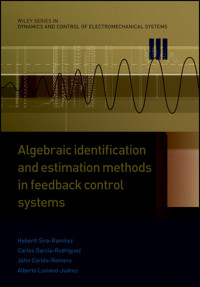
Algebraic Identification and Estimation Methods in Feedback Control Systems E-Book
Hebertt Sira-Ramirez
110,99 €
Mehr erfahren.
- Herausgeber: John Wiley & Sons
- Kategorie: Fachliteratur
- Serie: Wiley Series in Dynamics and Control of Electromechanical Systems
- Sprache: Englisch
Algebraic Identification and Estimation Methods in Feedback Control Systems presents a model-based algebraic approach to online parameter and state estimation in uncertain dynamic feedback control systems. This approach evades the mathematical intricacies of the traditional stochastic approach, proposing a direct model-based scheme with several easy-to-implement computational advantages. The approach can be used with continuous and discrete, linear and nonlinear, mono-variable and multi-variable systems. The estimators based on this approach are not of asymptotic nature, and do not require any statistical knowledge of the corrupting noises to achieve good performance in a noisy environment. These estimators are fast, robust to structured perturbations, and easy to combine with classical or sophisticated control laws.
This book uses module theory, differential algebra, and operational calculus in an easy-to-understand manner and also details how to apply these in the context of feedback control systems. A wide variety of examples, including mechanical systems, power converters, electric motors, and chaotic systems, are also included to illustrate the algebraic methodology.
Key features:
- Presents a radically new approach to online parameter and state estimation.
- Enables the reader to master the use and understand the consequences of the highly theoretical differential algebraic viewpoint in control systems theory.
- Includes examples in a variety of physical applications with experimental results.
- Covers the latest developments and applications.
Algebraic Identification and Estimation Methods in Feedback Control Systems is a comprehensive reference for researchers and practitioners working in the area of automatic control, and is also a useful source of information for graduate and undergraduate students.
Sie lesen das E-Book in den Legimi-Apps auf:
Seitenzahl: 422
Veröffentlichungsjahr: 2014
Ähnliche


















Table of Contents
Cover
Title Page
Copyrignt
Dedication
Series Preface
Preface
Chapter 1: Introduction
1.1 Feedback Control of Dynamic Systems
1.2 The Parameter Identification Problem
1.3 A Brief Survey on Parameter Identification
1.4 The State Estimation Problem
1.5 Algebraic Methods in Control Theory: Differences from Existing Methodologies
1.6 Outline of the Book
References
Chapter 2: Algebraic Parameter Identification in Linear Systems
2.1 Introduction
2.2 Introductory Examples
2.3 A Case Study Introducing a “Sentinel” Criterion
2.4 Remarks
References
Chapter 3: Algebraic Parameter Identification in Nonlinear Systems
3.1 Introduction
3.2 Algebraic Parameter Identification for Nonlinear Systems
3.3 An Alternative Construction of the System of Linear Equations
3.4 Remarks
References
Chapter 4: Algebraic Parameter Identification in Discrete-Time Systems
4.1 Introduction
4.2 Algebraic Parameter Identification in Discrete-Time Systems
4.3 A Nonlinear Filtering Scheme
4.4 Algebraic Identification in Fast-Sampled Linear Systems
4.5 Remarks
References
Chapter 5: State and Parameter Estimation in Linear Systems
5.1 Introduction
5.2 Fast State Estimation
5.3 Recovering Chaotically Encrypted Signals
5.4 Remarks
References
Chapter 6: Control of Nonlinear Systems via Output Feedback
6.1 Introduction
6.2 Time-Derivative Calculations
6.3 The Nonlinear Systems Case
6.4 Remarks
References
Chapter 7: Miscellaneous Applications
7.1 Introduction
7.2 Alternative Elimination of Initial Conditions
7.3 Other Functions of Time for Parameter Estimation
7.4 An Algebraic Denoising Scheme
7.5 Remarks
References
Appendix A: Parameter Identification in Linear Continuous Systems: A Module Approach
A.1 Generalities on Linear Systems Identification
A.2 Some Definitions and Results
A.3 Linear Identifiability
A.4 Structured Perturbations
A.5 The Frequency Domain Alternative
References
Appendix B: Parameter Identification in Linear Discrete Systems: A Module Approach
B.1 A Short Review of Module Theory over Principal Ideal Rings
B.2 Systems
B.3 Perturbations
B.4 Dynamics and Input–Output Systems
B.5 Transfer Matrices
B.6 Identifiability
B.7 An Algebraic Setting for Identifiability
B.8 Linear Identifiability of Transfer Functions
B.9 Linear Identification of Perturbed Systems
B.10 Persistent Trajectories
References
Appendix C: Simultaneous State and Parameter Estimation: An Algebraic Approach
C.1 Rings, Fields, and Extensions
C.2 Nonlinear Systems
C.3 Differential Flatness
C.4 Observability and Identifiability
C.5 Observability
C.6 Identifiable Parameters
C.7 Determinable Variables
C.8 Numerical Differentiation
References
Appendix D: Generalized Proportional Integral Control
D.1 Generalities on GPI Control
D.2 Generalization to MIMO Linear Systems
References
Index
End User License Agreement
Pages
xiii
xv
xvi
1
2
3
4
5
6
7
8
9
10
11
12
13
14
15
16
17
18
19
20
21
22
23
24
25
26
27
28
29
30
31
32
34
33
35
36
37
38
39
40
41
42
43
44
45
46
47
48
49
50
51
52
53
54
55
56
58
59
60
61
57
62
63
64
65
67
66
68
69
71
72
73
74
75
76
77
78
79
80
81
82
83
84
85
86
87
88
89
90
91
92
93
94
95
96
97
98
99
100
101
102
103
104
105
106
107
108
109
110
111
112
113
114
115
116
117
118
119
120
121
122
123
124
125
126
127
128
129
130
131
132
133
134
135
136
137
138
139
140
141
142
143
145
146
147
148
149
150
151
152
153
155
154
156
157
158
159
160
161
162
163
164
165
166
167
168
169
170
171
172
173
174
175
176
177
178
179
180
181
182
183
184
185
186
187
188
189
190
191
192
193
194
195
196
197
198
199
200
201
202
203
204
205
206
207
208
209
210
211
212
213
214
215
216
217
218
219
220
221
222
223
224
225
226
227
228
229
230
231
232
233
234
235
236
237
238
239
240
241
242
243
245
246
247
248
249
250
251
252
253
254
255
256
257
258
259
260
261
262
263
264
265
266
267
268
269
270
271
272
273
274
275
276
277
278
279
281
282
283
284
285
286
287
288
289
290
291
292
293
294
295
296
297
298
299
300
301
302
303
304
305
306
307
308
309
310
311
312
313
314
315
316
317
318
319
320
321
322
323
324
325
326
327
329
330
331
332
333
334
335
336
337
338
339
340
341
342
343
344
345
346
347
348
349
350
351
352
353
354
355
357
358
359
360
361
362
363
368
364
365
366
367
369
370
371
372
373
Guide
Table of Contents
List of Illustrations
Figure 1.1
Figure 1.2
Figure 2.1
Figure 2.2
Figure 2.3
Figure 2.4
Figure 2.5
Figure 2.6
Figure 2.7
Figure 2.8
Figure 2.9
Figure 2.10
Figure 2.11
Figure 2.12
Figure 2.13
Figure 2.14
Figure 2.15
Figure 2.16
Figure 2.17
Figure 2.18
Figure 2.19
Figure 2.20
Figure 2.21
Figure 2.22
Figure 2.23
Figure 2.24
Figure 2.25
Figure 2.26
Figure 2.27
Figure 2.28
Figure 2.29
Figure 2.30
Figure 2.31
Figure 2.32
Figure 3.1
Figure 3.2
Figure 3.3
Figure 3.4
Figure 3.5
Figure 3.6
Figure 3.7
Figure 3.8
Figure 3.9
Figure 3.10
Figure 3.11
Figure 3.12
Figure 3.13
Figure 3.14
Figure 3.15
Figure 3.16
Figure 3.17
Figure 3.18
Figure 3.19
Figure 3.20
Figure 3.21
Figure 3.22
Figure 3.23
Figure 3.24
Figure 3.25
Figure 3.26
Figure 3.27
Figure 3.28
Figure 3.29
Figure 3.30
Figure 3.31
Figure 3.32
Figure 3.33
Figure 3.34
Figure 3.35
Figure 3.36
Figure 3.37
Figure 4.1
Figure 4.2
Figure 4.3
Figure 4.4
Figure 4.5
Figure 4.6
Figure 4.7
Figure 4.8
Figure 4.9
Figure 4.10
Figure 4.11
Figure 4.12
Figure 4.13
Figure 4.14
Figure 4.15
Figure 4.16
Figure 4.17
Figure 4.18
Figure 4.19
Figure 4.20
Figure 4.21
Figure 5.1
Figure 5.2
Figure 5.3
Figure 5.4
Figure 5.5
Figure 5.6
Figure 5.7
Figure 5.8
Figure 5.9
Figure 5.10
Figure 5.11
Figure 5.12
Figure 5.13
Figure 5.14
Figure 5.15
Figure 5.16
Figure 5.17
Figure 5.18
Figure 5.19
Figure 5.20
Figure 5.21
Figure 5.22
Figure 5.23
Figure 5.24
Figure 5.25
Figure 5.26
Figure 5.27
Figure 5.28
Figure 5.29
Figure 5.30
Figure 5.31
Figure 5.32
Figure 5.33
Figure 5.34
Figure 5.35
Figure 5.36
Figure 5.37
Figure 6.1
Figure 6.2
Figure 6.3
Figure 6.4
Figure 6.5
Figure 6.6
Figure 6.7
Figure 6.8
Figure 6.9
Figure 6.10
Figure 6.11
Figure 6.12
Figure 6.13
Figure 6.14
Figure 6.15
Figure 6.16
Figure 6.17
Figure 6.18
Figure 6.19
Figure 6.20
Figure 6.21
Figure 6.22
Figure 6.23
Figure 6.24
Figure 7.1
Figure 7.2
Figure 7.3
Figure 7.4
Figure 7.5
Figure 7.6
Figure 7.7
Figure 7.8
Figure 7.9
Figure 7.10
Figure 7.11
Figure 7.12
Figure 7.13
Figure 7.14
Figure 7.15
Figure 7.16
Figure 7.17
Figure 7.18
Figure 7.19
Figure 7.20
Figure 7.21
Figure 7.22
Figure 7.23
Figure 7.24
Figure 7.25
Figure 7.26
Figure 7.27
Figure D.1
Figure D.2
Figure D.3
Figure D.4
Figure D.5
Figure D.6
ALGEBRAIC IDENTIFICATION AND ESTIMATION METHODS IN FEEDBACK CONTROL SYSTEMS
Hebertt Sira-Ramírez
CINVESTAV-IPN, Mexico
Carlos García-Rodríguez
Technological University of the Mixteca, Mexico
John Cortés-Romero
National University of Colombia, Colombia
Alberto Luviano-Juárez
UPIITA – Instituto Politécnico Nacional, Mexico
This edition first published 2014
© 2014 John Wiley & Sons Ltd
Registered office
John Wiley & Sons Ltd, The Atrium, Southern Gate, Chichester, West Sussex, PO19 8SQ, United Kingdom
For details of our global editorial offices, for customer services and for information about how to apply for permission to reuse the copyright material in this book please see our website at www.wiley.com.
The right of the author to be identified as the author of this work has been asserted in accordance with the Copyright, Designs and Patents Act 1988.
All rights reserved. No part of this publication may be reproduced, stored in a retrieval system, or transmitted, in any form or by any means, electronic, mechanical, photocopying, recording or otherwise, except as permitted by the UK Copyright, Designs and Patents Act 1988, without the prior permission of the publisher.
Wiley also publishes its books in a variety of electronic formats. Some content that appears in print may not be available in electronic books.
Designations used by companies to distinguish their products are often claimed as trademarks. All brand names and product names used in this book are trade names, service marks, trademarks or registered trademarks of their respective owners. The publisher is not associated with any product or vendor mentioned in this book.
Limit of Liability/Disclaimer of Warranty: While the publisher and author have used their best efforts in preparing this book, they make no representations or warranties with respect to the accuracy or completeness of the contents of this book and specifically disclaim any implied warranties of merchantability or fitness for a particular purpose. It is sold on the understanding that the publisher is not engaged in rendering professional services and neither the publisher nor the author shall be liable for damages arising herefrom. If professional advice or other expert assistance is required, the services of a competent professional should be sought.
Library of Congress Cataloging-in-Publication Data
Sira Ramírez, Hebertt J.
Algebraic identification and estimation methods in feedback control systems / Hebertt Sira-Ramirez, Carlos Garcia-Rodriguez, John Alexander Cortes-Romero, Alberto Luviano-Juarez.
pages cm – (Wiley series in dynamics and control of electromechanical systems)
Includes bibliographical references and index.
ISBN 978-1-118-73060-7 (hardback)
1. Feedback control systems\emdash Mathematical models. 2. Control theory—Mathematics. 3. Differential algebra. I. Title.
TJ216.S467 2014
629.8'301512—dc23
2013049876
This book is dedicated to our families, friends, colleagues, and students. Also, to our beloved countries: Venezuela, Mexico, and Colombia
Series Preface
Electromechanical Systems permeate the engineering and technology fields in aerospace, automotive, mechanical, biomedical, civil/structural, electrical, environmental, and industrial systems. The Wiley Book Series on dynamics and control of electromechanical systems will cover a broad range of engineering and technology these fields. As demand increases for innovation in these areas, feedback control of these systems is becoming essential for increased productivity, precision operation, load mitigation, and safe operation. Furthermore, new applications in these areas require a reevaluation of existing control methodologies to meet evolving technological requirements. An example involves distributed control of energy systems. The basics of distributed control systems are well documented in several textbooks, but the nuances of its use for future applications in the evolving area of energy system applications, such as wind turbines and wind farm operations, solar energy systems, smart grids, and energy generation, storage and distribution, require an amelioration of existing distributed control theory to specific energy system needs. The book series serves two main purposes: 1) a delineation and explication of theoretical advancements in electromechanical system dynamics and control, and 2) a presentation of application driven technologies in evolving electromechanical systems.
This book series will embrace the full spectrum of dynamics and control of electromechanical systems from theoretical foundations to real world applications. The level of the presentation should be accessible to senior undergraduate and first-year graduate students, and should prove especially well-suited as a self-study guide for practicing professionals in the fields of mechanical, aerospace, automotive, biomedical, and civil/structural engineering. The aim is an interdisciplinary series ranging from high-level undergraduate/graduate texts, explanation and dissemination of science and technology and good practice, through to important research that is immediately relevant to industrial development and practical applications. It is hoped that this new and unique perspective will be of perennial interest to students, scholars, and employees in aforementioned engineering disciplines. Suggestions for new topics and authors for the series are always welcome.
Mark J. BalasJohn L. CrassidisFlorian HolzapfelSeries Editors
Preface
This work has been made possible thanks to Professor Michel Fliess's professional mathematical vision of real engineering problems. Without his convincing and precise mathematical formulation of fundamental problems in control theory of uncertain systems and signal processing, this book would never have existed.
The quest for an algebraic approach to parameter identification started one lovely summer afternoon in 2002, while having lunch and lively discussions on automatic control matters at Ma Bourgogne restaurant, La Place des Vosges, Paris. I was in the company of Michel and Richard Marquez, an outstanding doctoral student of Michel's in Paris, who had only recently defended his thesis and who had also been a superb Master's student of mine a few years back in Mérida (Venezuela). The discussion ended later that night at Michel's apartment with the distinctive feeling that a “can of crazy worms” had just been opened. Michel and myself worked feverishly over the next few months and years. Sometimes across the Atlantic Ocean, via internet; sometimes in Paris, and on other occasions in the gardens of Cinvestav, in Mexico City. Our colleagues Mamadou Mboup, Hugues Mounier, Cedric Join, Joachim Rudolph, and Johann Reger joined Michel's efforts and quickly found applications and outstanding results of the innovative theory in new and challenging areas such as communications systems, failure detection, and chaotic systems synchronization. As set out by Michel from the beginning, the theory, of course, does not need probability theory and for that reason neither do we.
The approach to parameter estimation, state estimation, and perturbation rejection adopted in this book is radically different from existing approaches in three main respects: (1) it is not based on asymptotic approaches, (2) it does not require a probabilistic setting, and (3) it does not elude the need to compute iterated time derivatives of actual noise-corrupted signals. The fact that the computations do not lead to asymptotic schemes is buried deep in the algebraic nature of the approach. We exploit the system model in performing valid algebraic manipulations, leading to sensible schemes yielding parameters, states, or external perturbations. Naturally, our scheme rests on the category of model-based methods. We should point out, however, that the power of the algebraic approach is of such a nature that it also allows complete reformulation of non-model-based control schemes. One of the crucial assumptions that allows us to free ourselves from probabilistic considerations is that of “high-frequency” noises, or, more precisely, “rapidly varying perturbations.” A complete theory exists nowadays, based on non-standard analysis, for the rigorous characterization and derivation of the fundamental properties of such noises. White noises, characteristic of the existing literature, are known to constitute a “worst-case” idealization, which allows for a comfortable mathematical treatment of the expressions but one that is devoid of any physical reality.
The research work contained in this book has primarily been supported by the Centro de Investigación y Estudios Avanzados del Instituto Politécnico Nacional (Cinvestav-IPN), Mexico City and the generous financial assistance of the Consejo Nacional de Ciencia y Tecnología (CONACYT), Mexico, under Research Projects No. 42231-Y and 60877-Y. Generous financial assistance of the CNRS (France) and of the Stix and Gage Laboratories of the École Polytechnique is gratefully acknowledged. The first author would like to thank Marc Giusti, Emmanuel Delaleau, and Joachim Rudolph for their kind invitations to, respectively, Palaisseau, Brest, and Dresden on several enjoyable occasions. Back at Cinvestav, the generous friendship of Dr. Gerardo Silva-Navarro is sincerely acknowledged and thanked, in many laboratory undertakings by students and challenging academic discussions. We also acknowledge his special administrative skills to produce “ways and means,” as materialized in equipment and infrastructure.
The work gathered by the first author over the years has benefited enormously from the wisdom, patience, and determination of the three co-authors of this book, who set out to clean examples from many mistakes, perform the required computer simulations, and carry out successful laboratory experiments. Carlos García Rodríguez is credited for having obtained, for the first time in the world, an actual experimental application of parameter and derivative estimation, from an algebraic standpoint, in the control of an oscillatory mechanical system. His initial contribution in ordering of the material, finding useful variants, and his remarkable ability to recreate lost simulation files and carry out experiments put us on the trail of pursuing the writing of a book on the subject of algebraic parameter and state estimation. Alberto Luviano-Juárez and John Cortés-Romero, two extraordinary PhD students, joined the venture, giving the available material a definite positive push toward completion. Through countless discussions and revisions of the material, weekly projects involving lots of nightly, and weekend, work on their part, real-life laboratory implementations under adverse conditions, and contagious enthusiasm, they are credited with generously driving the book project to the point of no return. My deepest appreciation to all of them for having endured the difficult times and for the “mountains” of workload involved.
The first author is indebted to Professor Vicente Feliu-Battle of the Universidad de Castilla La Mancha (UCLM), Ciudad Real, Spain and his superb PhD students Juan Ramón Trapero, Jonathan Becedas, and Gabriela Mamani for having put the theory to a definite test with many challenging laboratory experiments that gave us the chance to publish our results in credited journals and conferences. Such an interaction was made possible thanks to Professor Feliu's administrative skills, resulting in a full sabbatical year spent in Ciudad Real. The more recent interaction with Dr. Rafael Morales, of UCLM, has proven to be most fruitful in the use of this theory in some other challenging laboratory applications.
H. Sira-Ramírez dedicates his work in this book to his friend Professor Michel Fliess, for his constant support, kind advice, and encouragement in the writing of this book and in many other academic matters.
Hebertt Sira-Ramírez
Chapter 1Introduction
One of the main obstacles related to key assumptions in many appealing feedback control theories lies in the need to perfectly know the system to be controlled. Even though mathematical models can be derived precisely for many areas of physical systems, using well-established physical laws and principles, the problems remain of gathering the precise values of the relevant system parameters (or, obtaining the information stored in the inaccessible-for-measurement states of the system) and, very importantly, dealing with unknown (i.e., non-structured) perturbations affecting the system evolution through time. These issues have been a constant concern in the feedback control systems literature and a wealth of approaches have been developed over the years to separately, or simultaneously, face some, or all, of these challenging realities involved in physical systems operation. To name but a few, system identification, adaptive control, energy methods, neural networks, and fuzzy systems have all been developed and have tried out disciplines that propose related approaches, from different viewpoints, to deal with, or circumvent, the three fundamental obstacles to make a clean control design work: parameter identification, state estimation, and robustness with respect to external perturbations.
This book deals with a new approach to the three fundamental problems associated with the final implementation of a nicely justified feedback control law. We concentrate on the ways to handle these obstacles from an algebraic viewpoint, that is one resulting from an algebraic vision of systems dynamics and control. As for the preferred theory to deal with the ideal control problem, we emphasize the fact that the methods to be presented are equally applicable to any of the existing theories. We propose examples where sliding-mode control is used, others where passivity-based control methods are preferred, and yet others where flatness and generalized proportional integral controllers are implemented. The algebraic approach is equally suitable when dynamic observers are used. The book therefore does not concentrate on, or favor, any particular feedback control theory. We choose the controller as we please. Naturally, since the theoretical basis of the proposed algorithms and techniques stems from the differential algebraic approach to systems analysis and control, we often present the background material in detail at the end of chapters, so that the mathematically inclined reader has a source for the basics being illustrated in that chapter through numerous physically oriented examples.
Lesen Sie weiter in der vollständigen Ausgabe!
Lesen Sie weiter in der vollständigen Ausgabe!
Lesen Sie weiter in der vollständigen Ausgabe!
Lesen Sie weiter in der vollständigen Ausgabe!
Lesen Sie weiter in der vollständigen Ausgabe!
Lesen Sie weiter in der vollständigen Ausgabe!
Lesen Sie weiter in der vollständigen Ausgabe!
Lesen Sie weiter in der vollständigen Ausgabe!
Lesen Sie weiter in der vollständigen Ausgabe!
Lesen Sie weiter in der vollständigen Ausgabe!
Lesen Sie weiter in der vollständigen Ausgabe!
Lesen Sie weiter in der vollständigen Ausgabe!




