


Erhalten Sie Zugang zu diesem und mehr als 300000 Büchern ab EUR 5,99 monatlich.
- Herausgeber: Pushkin Press
- Kategorie: Gesellschafts- und Liebesromane
- Sprache: Englisch
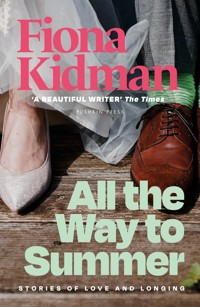
A powerful collection of stories exploring love and longing, from the award-winning author of This Mortal Boy.Two mothers fight about wearing a hat on their children's wedding day. A needle is lost inside a woman's body. A writer waits with a suitcase for a man who never comes.In thirteen short stories written over several decades, Dame Fiona Kidman vividly evokes the glow of desire and the pain of heartbreak, the thrill of illicit liaisons and the twists and turns of unconventional love. Sometimes joyful, often devastating and always beautiful, All the Way to Summer is a searing account of love and loss from a pioneering feminist icon.
Sie lesen das E-Book in den Legimi-Apps auf:
Seitenzahl: 484
Veröffentlichungsjahr: 2025
Das E-Book (TTS) können Sie hören im Abo „Legimi Premium” in Legimi-Apps auf:
Ähnliche

















Dame Fiona Kidman OBE, Légion d’honneur, is one of New Zealand’s foremost contemporary writers. A novelist, short story writer and poet, she is the author of more than 30 books. She has worked as a librarian, radio producer and critic, and as a scriptwriter for radio, television and film. She lives in Wellington.
PRAISE FOR THIS MORTAL BOY
‘Kidman’s prose is precise, detailed, lyric . . . The fluencies and hard-won command of a good writer bring out their own truth’ Irish Times
‘Magnetic . . . The ending of a life involves decisions made by many, Kidman reminds us, with opportunities for compassion that are regularly missed until it’s too late’ New York Times
‘Kidman deftly sketches the personalities behind the headline story, along with the ambiguities and mitigating circumstances surrounding them . . . In the emotional catharsis experienced by the imprisoned Paddy Black, she demonstrates how redemption may be grasped even at the final hour of the darkest day’ Wall Street Journal
‘It’s an amazing novel, this. It’s compelling’ Val McDermid
‘Perfectly captures the life of a young immigrant while taking a sharp look at New Zealand’s social history . . . Moving, compelling and ultimately tragic’ Liz Nugent
‘A haunting read. . . Blends events as they unfold, painting the bigger historical and social picture but it is in the sensitive characterisation of Paddy and his desperate mother, Kathleen, that Kidman excels’ Jess Kidd
‘Stays with you long after you’ve read it . . . It brings home what the death penalty really means for someone who wasn’t bad, just young and misguided’ Lesley Pearse
‘Powerfully explores the ways that young men and women were demonised by politicians . . . a really moving book’ @SamiraAhmed
‘An essential read as a study of wrong choices, ambiguous motives, infinitely nuanced personalities and a grim complex tragedy of a loner . . . A tremendous novel’ Arts Council of Northern Ireland
‘A meticulously researched novel which holds up a dark part of our history to the light . . . [Kidman] expertly brings readers into the lives of all those involved’ New Zealand Herald
‘A tale about violent acts that is infused with humanity and compassion’ New Zealand Listener
Praise for All Day at the Movies
‘All Day at the Movies proves that Kidman is a masterful storyteller’ The Lady
‘A universal and honest book’ San Francisco Book Review
‘A truly gifted writer. She explores the subtleties of human interaction and family with a deft and insightful hand’ Trip Fiction
Praise for Songs from the Violet Café
‘Kidman, a poet, is a beautiful writer’ The Times
‘Readers are in good hands; like all Kidman’s writing, it is engaging and captivating’ The Lady
Praise for The Infinite Air
‘A sweeping saga of a fascinating life and an entertaining insight into the early days of aviation’ Historical Novel Society
‘A thrilling tale of adventure and heartbreak – Kidman has triumphantly brought this inspirational heroine to life’ The Lady
‘It’s a given that Kidman couldn’t produce a poor paragraph if she tried to and this is a narrative that – I have to say it – takes wing’ New Zealand Herald
‘A fascinating read’ Red Magazine
‘Gripping’ Woman’s Own
A Gallic Book
Copyright © Fiona Kidman as per details on page 345
Fiona Kidman has asserted her moral right to be identified
as the author of the work.
First published by Penguin Random House New Zealand Ltd.
This edition published by arrangement with Penguin Random House New Zealand Ltd.
First published in Great Britain in 2024 by Gallic Books,
12 Eccleston Street, London SW1W 9LT
This book is copyright under the Berne Convention
No reproduction without permission
All rights reserved
A CIP record for this book is available from the British Library
isbn978-1-805-334-34-7
Typeset in Garamond by Gallic Books
2 4 6 8 10 9 7 5 3 1
For Jennifer and Peter Beckand life-long friendship
CONTENTS
PREFACE
1 Circling
Circling to Your Left
Hats
Red Bell
2 LONGING
The Honey Frame
Mrs Dixon & Friend
A Needle in the Heart
3 AWRY
Fragrance Rising
Tell Me the Truth about Love
Marvellous Eight
4 AS IT WAS
All the Way to Summer
Silver-Tongued
Silks
Stippled
Acknowledgements
PREFACE
How does one know what love really is? How many varieties of love are there? Does falling in love mean living happily ever after? Can we ever recover when love ends, or are we changed for all time? W.H. Auden, in his famous poem ‘Tell Me the Truth about Love’, from which I have shamelessly borrowed the title for one of the stories in this collection, wonders what it looks and smells and sounds like. It might howl like an Alsatian, or sing riotously at parties, or, more decorously, prefer only classical music. And, he muses, does it feel as prickly as a hedgehog, or as soft as an eiderdown? Some questions of my own: Does it ache like a tooth? Do hearts really break?
I can’t answer these questions any more than the poet, but in the last lines of the poem Auden repeats the refrain, begging to be told the truth about love and asking if love will alter his life altogether. This last question seems central to these stories of mine. For the most part, they are about love that changes the lives of my characters, one way or another; love, long or short, and often dangerous, is never forgotten.
A number of the stories have appeared in my previous collections, written over some thirty years. The theme of love, between all manner of people, has been persistent. This year I turn eighty, and it seems like a good moment to gather up stories that reflect this preoccupation in my writing, but there are some new stories too. For those who have followed the earlier works, the stories are just the same in essence, although this volume has been an opportunity to refresh them, sharpen them up a bit. I am grateful to Harriet Allan for making this possible and for her constancy as my editor over many years of my writing life. The love of good friends matters too.
Some of these stories are written in the first person. If my readers think they recognise me in these, or the character of Jill in ‘Stippled’, they are probably close. We all have our own histories of love.
Fiona Kidman, 2020
1
CIRCLING
CIRCLING TO YOUR LEFT
Miracles, miracles. Alice was sitting at her desk preparing an interview when the phone call came. She works in a radio station, running a magazine programme about lifestyles. Alice is a personality in her own right, and people seek her views on all manner of issues. People say she is a powerful woman, and indeed she feels strong and vital, but she has also reached that more private age when her children worry about who will mow her lawns and what will become of her. The name of her caller is Kathryn Fox, Kathryn spelled with a K and a Y. She is phoning from Auckland, from an insurance company. Alice can see her behind the desk, cool and efficient, wearing a well-cut suit, a muted but pretty scarf arranged artfully at the throat of her plain cotton blouse. She can hear her asking claimants the correct spelling of their names, an instinctive precautionary gesture, which she carries into her own life – this is exactly who I am: Kathryn with a K and a Y. Mrs, she adds, Mrs Kathryn Fox.
‘Yes, Mrs Fox?’ Alice says, preparing to tell her either that she has more life insurance than she can afford, or that she can’t spare an opinion on the subject this morning.
‘It’s about my father,’ says Kathryn Fox, quickly. ‘I believe you knew him when he was young, before he married my mother. His name was Douglas McNaught.’ Her voice has become less assured, dropping a note, as if she expects the rebuff Alice might be preparing. ‘It was a surprise that you might know him.’
‘How did you make the connection?’ Alice asks, the interviewer at work. But she felt the flutter of her own pulse.
‘Well,’ Kathryn takes a deep breath. ‘I heard you on the radio once, and you mentioned Fish Rock. You described a man you had known there, at work in his cowshed. When the cows got stroppy and wouldn’t do what he wanted, he used to yell at them, “I might as well talk to Jesus”.’
Alice puts down her pen. ‘Niall McNaught.’
‘My grandfather. Are you with me?’
‘Yes,’ says Alice. ‘I am.’
‘My father was dying and I had been sent to my grandparents’ farm so that my mother would have more time to nurse him.’ Kathryn’s voice assumes a relentless quality now that she is underway. ‘I was very small. I sat on the railing of the yard and listened to my grandfather say those words every evening one summer. “You might as well talk to Jesus,” he said, and I knew he was talking to more than the cows. I’ve never heard anyone else say that since. Soon afterwards he died, and, not long after that, my father died too.’
‘So your father didn’t die on the farm?’
‘He’d been overseas to fight in Malaya,’ Kathryn says, ‘you know, the one that’s called Malaysia now.’ Of course Alice already knows this, but she doesn’t interrupt. ‘When he came back, he had some jungle illness. He went back to the farm, but he was never able to work the way he had before, and he and my mother moved to town.’
This is something Alice doesn’t know. ‘Did he work again? In town?’ Everyone in Fish Rock knew what you meant when you said ‘town’. The place was to the north, not as big as a city, but it had hotels with starched linen tablecloths in the dining rooms, bookshops and a theatre, warehouses and stock and station agents. It was where you went if you needed the dentist.
‘He went into the stock and station and worked there for as long as he could. You did know them, didn’t you? I’m not wrong?’
‘Yes, I did know them,’ says Alice slowly. There is a silence between them while Alice asks herself whether or not she wants to help the woman at the other end of the call.
As if she senses her hesitation, Kathryn Fox steps in, assertive again. ‘Just tell me what my father was like.’ Not pleading, just matter of fact, and ready to give information of her own. ‘My mother remarried, she couldn’t see how much my father mattered to me. She was very happy with my stepfather, and he was good to my sister and me. “What is there to tell?” she used to say when I asked her about my father. “He was sick and he died.” Whatever it was that she had fancied in him, she’d forgotten. Well, perhaps you wouldn’t know about that, but just something, some of the things he might have said and done. Forgive me, perhaps you don’t remember much about him at all.’
‘He was a gay dog,’ Alice says, instantly regretting it.
‘Gay?’ Kathryn says.
‘Not like that. It’s what we said back then. Language changes.’ Alice recognises the distance between them, between Kathryn’s age and her own, between knowing and not knowing her father. ‘He did a fantastic set of Lancers. Well, we just did a set occasionally at the end of square dancing.’
‘Let me get this straight, you’re telling me my father square-danced?’
‘Yes. But not only that. He was a knockout. I mean, he was very good looking.’
Kathryn says, ‘I would never have imagined that. My mother didn’t keep any photos. Nobody told me he was good looking.’
Alice thinks Kathryn may be sorry she has rung, that Alice is romancing an image for her, or that she doesn’t remember him at all. ‘Was your mother called Rhoda?’ she asks.
‘No.’ Kathryn mentions the name of a woman Alice has never heard of, who, she says, her father had met in hospital soon after his return from the jungle. They had married almost straight away.
This is the miracle, a chunk of missing history, offered to Alice on a morning when the wind whistles between buildings and the traffic five storeys down is blocked by a blown water main and the tower block next door is being evacuated by a faulty alarm system.
Immediately after Alice left school, she went to work in the drapery store at Fish Rock. She pushed her way to the head of a queue of young women who thought it might be fun to work on the main (and only) street for a year or two while they got their glory boxes together. She had turned down the idea of going nursing or teaching. For other women, there was the burden of Catholic choice – to be a nun – but that was beyond the imagination of the Presbyterian circle of Fish Rock, a bizarre impenetrable mystery. Who, they asked themselves in hushed voices, would want to live amongst women?
‘Why do you want to work in my drapery shop?’ Miss Macdonald, the proprietor, asked her. She was a tall, thin woman with hair escaping in wisps from a huge bun. She was proud that she had not cut her hair for twenty years, although no one had ever seen this massive accumulation let loose.
‘I want to earn some money while I decide what to do next.’
‘You mean, until someone comes along and offers to marry you? I don’t want boys hanging around here,’ said Miss Macdonald.
Alice thought it wiser not to tell her prospective employer that she had already been forsaken by Douglas McNaught, although, who knew, he could still turn up some day. Instead, she said, ‘It’ll be hard for my parents if I leave now, just when they’re getting the farm going. I can still help out with the milking at the weekends.’
This appealed to Miss Macdonald, the notion of hard work and thrift, and also that she could hire Alice without committing herself to the long term. ‘You can have a three-month trial, and then we can decide whether we like each other enough for you to stay on.’
This was how Alice came to stand behind the counter of the Fish Rock drapery shop, counting buttons, selling girdles and crêpe de Chine, ordering whirl bras spiral-stitched to pencil-sharp points, suggesting sewing patterns to young women beside whom, only a month before, she had sat in geography class, learning how to do rouleau button loops so she could demonstrate them to others, advising Miss Macdonald when they were low on three-ply in the knitting wool section, and all the while breathing in the steady crisp scent of new linen, which still reminds her of buttercups.
Miss Macdonald had hired Alice first and foremost to sweep out the shop and make cups of tea. All of which she did, but when Alice suggested they order cinch belts because she had heard that these were what the girls in town were wearing (and she yearned for one of her own), her employer gave her a long speculative look, ordered half a dozen and sold out the next day. After that, Miss Macdonald took time out to go to town on a buying expedition and left Alice in charge. When the new stock arrived, turnover increased, and so did Alice’s wages.
Fish Rock is a string of shops divided by a main road. The post office has long closed. People go to town for their clothes, and the drapery shop has gone. A square white church stands beneath a spreading tree, a museum houses the unsmiling faces of the village ancestors, the community hall is showing its age, a monument to Fish Rock’s war dead, surrounded by a heavy chain, stands sentinel beside the road. Douglas McNaught’s name is not amongst the dead.
Douglas didn’t fall in battle, and, besides, his war was a jungle skirmish, his going a young man’s response to the unanswerable in his life, not to a call to arms sweeping a nation. His name is written on a headstone in a quiet cemetery near the sea, where sand lifts and falls in drifts against the tombs and dry grasses bend on windy days. Trooper Douglas McNaught, SAS, Malaya. No name of a wife appears. This much Alice knows.
Her parents’ farm was next to the McNaughts. The McNaughts were an old, settled family, and the Emerys were newcomers, their land a fraction the size of their neighbours’, neglected and overrun with gorse, except for three rich-green river paddocks. Her family had driven into the valley one afternoon in summer near milking time. Their cows were crammed in the back of trucks, their udders near bursting point. Gidday, said the men, standing on the edge of the road. Gidday, Alice’s father had said and gone into the tumble-down shed on the farm to milk the cows as they were unloaded.
One of the onlookers followed him. ‘Let’s know if you need any help,’ said the man. This was Douglas. He was dark and nuggety, with a sinewy throat rising from his black bush singlet. His hair was crinkly beneath the battered grey felt hat he wore. Nests of hair covered his short strong forearms. When he lit a cigarette, he balanced it for an instant with a delicate flick beneath the tip of his tongue and his top lip before drawing it down into his mouth.
Alice’s father managed his farm with care. He’s a dreamy bastard, he farms with a textbook in one hand and a spade in the other, the neighbours said to each other, but they were interested. He used electric fences to make the grass go further. His butterfat average inched up, higher than on the farms around about. You might as well talk to Jesus, said his neighbour Niall McNaught, as try to tell my sons how to do that. Niall’s voice was without envy. He had enough to go round. His three sons had worked on the land since they left school. Malcolm, the eldest, was married and lived in a house across the paddock from his parents; the second and third boys still lived in the old farmhouse. Alan smiled sleepily at people and worked without saying much. He drinks, Alice’s father told her mother, but he’s harmless. Douglas was referred to as the baby of the family, although he was twenty-eight.
The entrance to the older McNaught house was by way of a verandah, bordered with curly wooden fretwork. In the morning, it was full of fierce heat, and even the geraniums wilted in the scuffed earth beside the path. In the afternoons, the dogs slept there.
Inside, it was hard to pick that the McNaughts were well-off. Old newspapers and piles of bills were stacked on the sideboards, and ashtrays were emptied only when they were full. In the sitting room, a shabby suite covered in brown moquette was arranged without much thought. The walls were decorated with calendars from the local shops and two ornately framed pictures of Niall’s parents, posing formally in their best clothes; his mother wore a long, dark dress with a high collar. An old piano stood beneath these portraits. The McNaughts played it on Saturday nights when friends came to drink beer and sing. Alan played until he passed out, and then Tilly, the mother, took over. They sang ‘Roll Out the Barrel’, and ‘Coming In On a Wing and a Prayer’ and ‘She’ll be Coming Round the Mountain’, when she comes, when she comes, she’ll be wearing pink pyjamas when she comes. Presbyterian they might have been, but they were new people now, they said. They didn’t have truck with the old nonsense. ‘Well,’ Niall said to Alice’s father, ‘the boys wouldn’t hang around for long if we did, would they?’ Douglas and Alan slept in the same room they had slept in all their lives, in two of three beds arranged dormitory style, across the passage from their parents’ room.
‘They’ve got money all right,’ Alice’s father said to her mother. If you knew where to look, it wasn’t hard to see. A race horse cantered in the front paddock, and two long-finned American cars stood in a garage at the side of the house. Over at Malcolm’s new house, his wife, Noelene, had arranged a cabinet full of crystal decanters and Belleek cream lustreware decorated with shamrocks. She hung lace curtains at the windows.
The McNaughts and Alice’s parents accepted each others’ difference. Tilly of the overflowing ashtrays and ungathered newspapers kept a scrubbed board and an oven that shone like song. Alice’s father was crazy about the McNaught boys from the start. They made him feel like one of the people, a real farmer. Alice believes that her parents were happy there. Their marriage, which had appeared frayed and thin, bloomed anew in the McNaughts’ benign light.
As for Alice, the McNaughts put up with her.
She thinks of it now in those terms, she can see with hindsight that she was a bumptious, pushy girl with a need to draw attention to herself. She had succeeded at her last school; she resented her new one. The farmers sent their children to boarding school in town if they thought it worth the money, the rest went to Fish Rock High and planned their leaving and marriage. Clover Johnston was one of the exceptions who, if anything, was cleverer than Alice, but made less of it. She was a modest, handsome girl. Her parents farmed at the far end of the district. Alice and Clover became friends, but out of school they were separated by distance.
Tilly was past entertaining teenagers. ‘Why don’t you go and see Noelene?’ she suggested when Alice turned up on her doorstep one afternoon over Easter, looking for company. Tilly’s head was tilted to one side, and she was shaking it furiously. ‘I got peroxide down my ear to shift the wax,’ she explained. ‘Makes it fizz, you know. Here, take this bowl of eggs to Noelene, save me a trip.’
Noelene was going to have a baby. Alice found her in the sitting room, embroidering the front of a baby’s nightgown. She looked impatient and grown up when Alice arrived.
‘What are you going to call the baby?’ Alice asked, hoping to engage her attention.
‘I can’t decide,’ said Noelene. ‘Do you like Pamela for a girl and Todd for a boy?’
‘Awful,’ said Alice.
‘Charmaine?’
‘Blah,’ said Alice, preparing to show off. ‘How about you call it Homer if it’s a boy?’
Noelene looked long-suffering. ‘Would you like to hold the ring over my stomach?’
‘What for?’ said Alice, backing off.
‘To find out whether it’s going to be a girl or a boy. The last time Tilly did it the ring said it was going to be a girl, but I reckon it’s moved too low for that. I’m sure it’s a boy.’ She was slipping her wedding ring off as she spoke. She picked up a reel of cotton and snapped off a thread, tying it to the ring.
‘What do I do?’ Alice asked, as Noelene lay down on the sofa.
‘Well, you hold it over my stomach and see which way the ring goes. If it turns around it’s a girl, up and down it’s a boy. Didn’t you know that?’
‘No.’
‘And if it stops in the middle it’s a disaster.’ Noelene shivered, pulling up her maternity smock to reveal the vast expanse of her stomach. As she lay there, it looked smooth, white and mountainous, then suddenly an oyster-shaped bulge sprouted on its side.
‘See, it’s the baby’s hand,’ said Noelene.
Alice felt sick.
‘Go on, be quick.’
As Alice picked up the ring, a shadow fell across the door. It was Douglas, Noelene’s brother-in-law.
‘Well,’ he said, ‘how’s the son and heir?’ There was something odd in his voice.
‘It’s a girl,’ said Alice, ‘and Noelene’s going to call her Guinevere.’
There was a brief pause. ‘And slowly answered Arthur from the barge,’ Douglas said. In her surprise, Alice nearly dropped the ring.
‘It’s a load of shit,’ said Douglas, turning away. Alice didn’t know whether he meant the baby, the ring, or the poem he was quoting from. But once, she realised, he would have gone to Fish Rock High.
‘I could have had any of them, you know,’ said Noelene when he had gone. She meant the McNaught brothers.
When Alice didn’t say anything, Noelene said, ‘I have to have a boy before the others catch up. You see?’
‘Douglas loves dancing, he goes every fortnight,’ said Tilly through a mouthful of pins. She had taken pity on Alice, who was trying to make a dress from some material sent by her aunt. Alice’s mother was so busy on the farm, she didn’t have time to help.
‘Where does he dance?’ Alice asked. Public dances were held in the hall, but they were few and far between. Most of the girls from school went; they started at fourteen, so tantalisingly close to maturity by Fish Rock standards. Alice’s parents wouldn’t hear of her going without them. She had been once with her mother and father and felt like a baby.
‘Don’t you know about the square dances?’ said Tilly. ‘The club meets in the hall, it’s not an open dance, just about thirty or forty go.’ As soon as she had said it, Alice could see Tilly wished she hadn’t. She gave Alice a sideways look as if something had just dawned on her.
‘You’re a big girl,’ she said, ‘you’re growing a helluva big girl. You started a box yet?’
When the Buick next pulled up at the McNaughts’ gate, with Douglas at the wheel, Alice was lying in wait. She shot out from behind the cream stand and offered to open the gate for him.
‘What brings this on?’ he asked, leaning out the car window after she had pulled the gate shut.
‘Please, could you give me a lift to the square dancing?’
He sighed, looked out the other window. ‘Sure,’ he said finally. ‘If your parents’ll let you.’
That was when Alice began to keep company, of a kind, with Douglas McNaught. He was nearly twice her age. It astonishes her now to think that her parents would let her go with him, but she can see also how it was. They weren’t looking at them as two people who might fall in love; they were looking at a kindly, trusted grown up and a child. Nor, for a long time, did Alice think of Douglas as anything other than a means to get her out of the house and down the road. Looking back, she sees herself as truly innocent, despite her brashness. What did he think? Who did he see? These are questions Alice has asked herself since.
Clover, who had several respectable older brothers, was sometimes allowed to go to the dances too. This may have been one of the reasons Alice was permitted to go with Douglas.
One day, Clover took her aside with a look of shock. ‘I’ve heard another word for sex,’ she said. Her cousins had told her the word (her brothers would never have said this to her, they were that kind of family, protective towards the women). Rooting. That was the word.
They gazed at each other in horror. Pigs rooted in the bush. The connotations were impossibly vulgar, and violent. They knew that sex was a red-hot poker, but they couldn’t imagine how they would be burned or blinded. If that was sex, they didn’t want it. That week, a girl called Marie, who had left school the year before, said she was dating two men at once and went to the cemetery with one or the other on alternate nights: she was still trying to decide which of them had what she described as the better equipment. This story got around and filtered back to school. Clover and Alice were open-mouthed with astonishment, while at the same time doubting that it could be true. Over at the McNaughts’, Noelene had given birth to a daughter, who she said was just the cutest wee thing, and she’d be trying for another just as soon as her stitches had healed.
When Alice went to the dances, she pitched into the routines, snatching a hand, spinning from the waist, moving onto the next partner: older men with red-veined faces, or Douglas, or one of Clover’s older brothers, whoever. They were accompanied by a pianist and a man with an accordion. The caller had slicked-back fair hair and wore a plaid shirt with a neckerchief. He clapped his hands and stamped his foot in time to ‘Red River Valley’: Oh we’re off to the next in the valley /and you circle to your left and to your right / and you choose your girl from the valley / oh you choose your Red River girl.
On the way there and back, Douglas hardly said a word. Alice didn’t mind, though occasionally she spoke to him. One night, as they drove home between the grassy hills, the moon seemed to float and stop and start, trickling along the sky.
‘The moon is a ghostly galleon,’ Alice said.
‘Jesus. Shit,’ he said, his fists bunching around the steering wheel. He was not prepared to lose himself to poetry a second time, she figured.
Each time they got to the McNaughts’ gate, opposite the Emerys’ farm, Alice jumped out of the car and opened the gate for him; he swept through without an acknowledgement, and she closed it behind him, watching the car’s progress over the dewy dust of the track. A kind of happiness had descended on her and the weeks and months that lay between her and the end of school.
That is, until Rhoda Aukett turned up. One square-dance evening, Alice got dressed as usual and went to wait at the mail box. Douglas didn’t arrive. She went back inside and rang his house. In her head, she could hear the phone’s Morse code signal ringing in the McNaughts’ kitchen. Three shorts for an S. Tilly answered after what seemed a long time. ‘Didn’t he tell you he’d be going straight to the village after milking?’ she said, but Alice could tell that she was not surprised.
When she reported that, no, he hadn’t told her, Tilly just said, ‘He must have forgotten, eh?’
‘Won’t he be coming back to pick me up?’
Tilly couldn’t put it off any longer. ‘He’s gone to pick up Rhoda. She’s staying at the hotel. You know about Rhoda, don’t you?’
‘Oh, yeah, sure, I know about Rhoda.’
‘Well, there, that’s all right then.’ Tilly sounded relieved.
Alice’s mother wandered into the room.
‘Douglas running late?’
‘A bit. He has to pick up someone called Rhoda.’
‘Oh, yes, Rhoda,’ she said vaguely, ‘I’ve heard about Rhoda.’ It seemed that everyone had heard about Rhoda.
‘I’m to wait along the road,’ Alice lied. ‘He’ll be in a hurry when he comes.’ She rushed out the door before her mother could ask any more questions.
It was a two-mile walk to Fish Rock. Alice, full of rage, arrived at the dance when it was already nine o’clock and the dance in full swing. She hurried along the darkened main street, passing the drapery where she would soon be working. The women who made the tea sat gossiping in the far corner of the hall. They never danced. Their breasts were encased in shiny satin blouses, and they wore full skirts, but they were not there to dance. The supper plates had been arranged near the slide that separated the kitchen from the dance hall. The zip was coming to the boil. Alice turned it off and filled the urn. At the end of the round, she threw up the shutter and called, in her loudest voice: ‘Come and get it’, just the way the women did.
There was a flurry in the corner and a ripple of surprise amongst the dancers. Alice stood still and smiled a broad, careful grin.
‘Well,’ said one of the older women, ‘isn’t she ever just the little helper?’ She said it quite nicely, although it was clear that neither she nor her friends cared for what Alice had done.
Douglas walked towards her, a woman holding onto his arm. She wore a powder-blue crushed-velvet dress. Alice knew at once that he loved this dark and creamy-skinned creature.
‘Hi, kid,’ he said, ‘I didn’t expect to see you here.’
That was when she knew he had never really seen her.
He introduced her to Rhoda Aukett, who flashed a dazzling smile. Rhoda didn’t appear to mind when Alice climbed into the back of the car to catch a ride home, though Douglas gave a deep scowl in her direction.
Alice later learned that Douglas had met Rhoda in town at the races, where she was a ticket seller on the tote. She had thrown in her job and come to work as a housemaid at the pub in order to be near him. Little by little, Alice got to know her. She would stay out at the farm some weekends, and Tilly would send her over to borrow a cup of sugar or a packet of cigarettes, just the way Alice’s parents borrowed from them. Rhoda didn’t stay every weekend, and seemed to vanish from sight now and then. Her mother guessed Rhoda was twenty-six or twenty-seven. Quite a while to be on the shelf, she said to her husband. Rhoda carried a spicy fragrance about her as if her skin were impregnated with flower petals. Her breasts were heavy ovals cupped above her tiny waist.
Rhoda did most of the talking, in a soft purring rush, a steady stream of comments about herself, Douglas, the McNaughts. Milking was a painful price for being Douglas’s girlfriend, but she had done it when she was a girl, and she supposed she would have to get used to it again when the time came. Men’s and cow’s shit, it was much the same. Alice would be surprised at what she saw at the pub. Alice didn’t know what men were like, oh, you’ll never know, you’ll never know, she said, and Alice thought, with sudden chilling fear, that she might not and that not knowing might be worse than knowing. The couple who ran the pub were mean with hot water, Rhoda said. Inhaling the spontaneous perfume that surrounded her, Alice wouldn’t have thought so, but Rhoda had three baths a day at the weekends, even though it meant saving the water for Douglas when he came in from the shed. Rhoda Aukett, she fluttered on, was kind of hard to say, not that it would bother her for long, not when she became Rhoda McNaught. She supposed Alice would be getting married some day too. How did she get along with Noelene? She wasn’t too sure that Noelene liked her, but there, she was going to get her nose out of joint a bit, having another woman on the property, Noelene had called her little girl Lorraine, and what did Alice think of that for a name? ‘She’s probably afraid I’ll have the first boy,’ Rhoda said. Then she bit her lip as if she had said the wrong thing and something was bothering her. Did Alice want babies when she grew up? Rhoda had asked, changing the subject.
Almost as suddenly as she had arrived, Rhoda Aukett disappeared. At first Alice didn’t notice she had gone, for she no longer visited the McNaughts unless asked to go on a message. One weekend, though, Douglas came over to use the Emerys’ phone because theirs was out of order, or that was what he said. Alice wondered why he hadn’t gone to Malcolm and Noelene’s. Alice heard him tell her father that he would pay for a toll call.
‘It’s all right, son,’ her father said, ‘you go right ahead, make as many calls as you want. I know you’ll pay me.’
Douglas closed the door and talked for a long time. Alice heard his voice raised, and she leaned her head against the door. ‘I’m sorry, I’m sorry, Rhoda, I can’t,’ he said, and she could hear him crying. It grieved her that Rhoda could be so unforgiving. She couldn’t imagine anything bad enough for Rhoda to react like this. It took Alice a while to realise that Rhoda hadn’t been to the farm for some weeks, much longer than the usual intervals between calls. Clearly this was no flash point, the quarrel was well established by the time she had got to hear about it.
‘She won’t be back,’ Alice’s mother said cryptically. She and her husband looked at each other in a meaningful way.
Soon after that, Douglas came to the house with an odd, almost sly, gleeful look about him, like a boy who has built a tree house that he is sure nobody will find. Could he have a letter sent here?
He and Alice’s father went outside and talked. Her father ran his hand through his thinning hair in an anxious way and shook his head once or twice. In the end, she saw him reluctantly agree.
Douglas came in the evenings after milking to check on the arrival of the mail. Alice looked out for a letter from Rhoda. She imagined her handwriting as flowing with untidy loops and an exaggerated incline, like a head held in the hand, a playful smile.
But when the letter came, it was not from Rhoda at all. Alice was there when Douglas picked it up, an official typed envelope sent from Wellington.
‘Thanks, mate,’ he said to her father. Her father stood awkwardly; it was clear that he wanted to know the contents nearly as much as Douglas. Alice can still see them, the two men standing together, Douglas almost like a son. He turned the letter over in his hands and, for her father’s sake, opened it there and then. He took a deep breath and handed it over, his eyes alight. They looked at each other with a mixture of excitement and awe.
‘They’ve taken you,’ her father said. ‘Oh, good man, I knew they would.’
‘I’d better tell the old man,’ said Douglas, and he bit his lip in an uncharacteristic boyish gesture. He took out a cigarette and placed it in his mouth without the usual flick.
A week or so later, Douglas appeared, wearing a uniform. Of course, she had learned his secret by then. He had been accepted to join the crack Special Air Service unit as a paratrooper, bound for Malaya to fight the Communists. His uniform was olive-green with a browny-green shirt and tie. On his head, he wore a maroon beret with a winged dagger and the motto ‘Who Dares Wins’.
Alice couldn’t imagine what the jungle would be like, although now she can. She has stood in the renamed Malaysian jungle and felt the breath of giant butterfly wings against her face, amidst the mingled smells of nutmeg oil and orchids and the lavatory stench of cut durian. The fruit, she was told, can kill a man if it is eaten with alcohol. She has seen a python and a flying frog and spiders that eat birds. Deadly and dangerous and seductive. And, as she has stood there, she has thought of Douglas McNaught.
He had several leaves from the training camp at Waiouru before he embarked. During the last of these, the ailing square dance club held one of its now erratic meetings. Alice had not attended for at least six months, not since Rhoda Aukett first came on the scene. Douglas appeared unexpectedly at the Emerys’ doorstep. His official farewell had already taken place, a formal affair with speeches and a special supper on laden trestle tables set out on the hall. Alice’s father, with tears in his eyes, had given him a Waterman pen, which he could ill afford. Now here Douglas was, resplendent in his uniform, on the doorstep.
‘Feel like a couple of turns, kid?’ he asked.
Alice’s mother looked up from the bench where she was working, as if she might, for the first time, say something to stop Alice going, then changed her mind. Instead she pressed her lips together.
Farewell was in the air. Even though the club was going into recess, there was a bigger turnout than usual. People came up to say goodbye all over again. Old men, wearing baggy greys and tartan shirts, turned up with the helpers and sat against the wall, just watching. At suppertime, they pumped Douglas’s hand, their eyes shining, holding on longer than they needed.
‘You gotta knock the bastards out of them trees, son, little devils, knock ’em out,’ Alice heard one of them say.
‘Give you a tenner for that hat, boy,’ said another. Douglas just smiled; it was clear that in his head he had already moved on. He danced with all the women, young and old, bringing the helpers out of their corner. They sang ‘Red River Valley’ – from this valley they say you are going / we will miss your bright eyes and sweet smile . . .
The air outside was cool as they headed for home. The moon was new, and Alice couldn’t avoid looking at it through the glass. She turned her money over in her pocket and moved closer to Douglas. When he didn’t appear to notice, she moved right up beside him. He shifted slightly in his uniform. A short way up the road, he pulled the Buick over and placed his hand on hers.
What does one say to his daughter now, Alice wonders, remembering. Nothing much. A kiss is a kiss. That is what they did, not much more. When he pressed her against the seat, she whispered, although there was nobody at all in the wide moonlit paddocks who would see or hear them: ‘Are you going to root me now?’
‘No,’ he said and didn’t stop kissing her. ‘It’s all right, I’m not going to give you a baby yet. I’m going to look after you.’ He drew her tongue into his mouth, coaxing it with the tip of his, that flickering, darting tongue she had watched, hotter and sweeter than she had imagined, clean of cigarettes since his training had begun. He kissed her throat, down the length of her arm to her fingertips, turned her hands over and kissed the palms and back up into the crooks of her elbows. He slid her blouse down over her shoulders and drew circles round her nipples with his tongue, and all the time he breathed deeply as if drawing the scent of her body into his. She felt as Rhoda Aukett must have felt. She could smell something familiar, flowery and delicate: her body, like Rhoda’s must have done, blooming under his touch. He parted her legs and momentarily rested his hand between them.
‘Yes,’ said Alice.
‘No,’ he said, replacing her skirt. ‘No.’
He switched on the car engine and reached for her hand. ‘I won’t forget this,’ he said.
She believed that, too late, he had chosen her over Rhoda.
Miss Macdonald was pleased with Alice’s progress. She had introduced a new idea into the shop. When a new consignment of dresses arrived, she appraised each one carefully. Then she made out a list and rang a number of farmers’ wives. ‘I’ve got just the dress here for you,’ she told each one. ‘Would you like me to send it out on the rural delivery for you to try?’
This new service surprised and pleased the customers. Not a single dress was returned. Miss Macdonald said to Alice one morning that it would be a good idea for her to go into town with her to do some buying at the warehouse. She would get an old friend who had helped her out in the past to keep the shop open.
After they had spent the morning amongst rows of dresses, Miss Macdonald sent her off to look at the shops while she settled the bills. Alice could tell that she was still pleased with her.
Outside, she saw Rhoda Aukett. She was walking along the street, her shoulders slightly bowed. She didn’t see Alice as her attention was entirely absorbed by a child, a listless, dreamy-looking boy, perhaps four or five years old. Alice knew at once that it was Rhoda’s child. She could not say how she knew, but there was something about the connection between them, and his look of her, that told her. She watched them from a shop doorway, saw the way she turned to him and smiled. Something had worn thin in Rhoda Aukett, but still she smiled, and the child looked back at her with an open trusting face, a face that could still believe that there are reasons for everything and that disappearances are only temporary.
‘I saw Rhoda Aukett in town today,’ she told her mother when she got home that evening.
‘Did she have her kid with her?’
‘How did you know?’
She looked at Alice, puzzled. ‘Well, Tilly told me. She told everybody when she found out.’ Her mother seemed to have forgotten how recently Alice had crossed over that secret divide between schoolgirl and working woman, and how much might still be hidden from her. All the edges were blurred. Clover Johnston’s parents were sending Clover off to boarding school for another year. It seemed that Clover faced endless childhood, and Alice was sorry for her.
What she did not ask her mother was whether Tilly knew that Douglas cried when he told Rhoda that she could not bring her child to the farm. For she understood now that this was what was happening the night of the phone call.
One other thing happened before Alice left the drapery shop. Douglas had been gone for more than six months when he sent her a postcard. Alice did not know that the jungle had already claimed him. Not to instant death but to the illness that would persist for the rest of his life. She believes that he did not know how ill he was when he posted the card; she is sure he believed that, back on the farm, where the grass grew in broad swathes and the trees were cropped into hedges and the birds were no more dangerous than a circling hawk, he would recover his health.
His postcard came to the shop, and she guessed that this was another of his small ploys to keep his plans to himself. She realised that he must have had news of her, that she was now working at the drapery and was truly grown up and doing well, and she hoped he had also been told that nobody thought she was difficult any longer. His card said, simply, ‘I’m coming home.’ That and his name.
Alice has come across a phrase about women’s lives that stays with her: the fraught and endless narrative. Who am I? Where did I come from? How did I arrive at where I am now? She conducts these interviews with herself. They are not all, or even often, about Douglas McNaught, for a great many other things have happened to her since then. But he is part of the narrative.
Alice remembers a time when postcards were a metaphor for a shorthand account of life: the picture and a dozen words, and you have it all, and, in a way, this was true of Douglas’s postcard, although there was no picture and the message was even shorter. But something happened when it came that even now she cannot entirely explain. Miss Macdonald had collected the mail from the post office. Alice was folding a bolt of voile when she brought the card into the shop. Without commenting, she put it down on the counter. Alice read it at a glance. Then she put the material down on the counter and, picking up the card, she walked outside and along the road through the village centre, towards the grassy hills. The narrow valley stretched before her, above her the sky bleached to nothing, around her lay the singing sunlit air of late autumn. Her father might have the son he had wanted. Two farms would become one profitable enterprise. The bloodlines would run cleanly between them. She wanted to squat against the earth, as if pushing out the first child. She smelt the scent of her own desire all over again.
Then she turned around and retraced her steps. She wondered whether his card was a warning to make ready, or whether it was offering her a chance to go. It was one thing to come home when you already knew what lay beyond the valley; it was another thing to stay without the chance of ever leaving. This, too, he might already know.
Besides, there had been Rhoda Aukett.
Alice could tell any of this to Kathryn, but she doesn’t. She might tell her that if she had been her daughter her name might have been Catherine spelled with a C and an I, or that her name might not have been that at all. Instead, she tells her that it is difficult to remember much more because she left the valley so soon after she finished school, when a cadetship in broadcasting came up, and she moved south to the city. She has only passed through Fish Rock once or twice since then. She has seen Douglas’s grave, and she is sorry about what happened to him. She might, but she does not, tell his daughter that when she rang and said who she was, a shiver like violets shaken before a spring wind had passed through her. She thinks of Kathryn’s father as tenderly as she thinks of any man.
HATS
Like turning your hand over, things could go either way with the weather. Six a.m. and the bay is turbulent and green, but at that hour of the morning anything can happen. Standing at the window, just listening, the whole house is a heartbeat. Looking at the bay, the water, the clouds, I think I can hear the busy clink and chatter of the rigging on the boats parked on the hard at the bay, but that can’t be right, it’s too far away. Oh, you can hear anything, see anything on a morning like this, it’s the day of the wedding. Our son’s getting married.
There is a stirring in the back rooms; there is so much to do, I will never get done, it’s crazy this, but the wedding’s to be here, not at her place but mine. I am speaking now of the bride’s mother and myself. Well, it’s a long story, how the wedding comes to be here instead of there, but that’s the way it is. She’s bringing the food later in the morning, and there’ll be crayfish and scallops like nobody ever had at a wedding before, and mussels of course. They are mussel farmers from the Sounds. They. Well, I mean the bride’s parents.
I love our daughter-in-law to be, I really do. You might think I don’t mean that, mothers-in-law rarely do, but it’s true. Our son’s on a win. I want to see him married.
Perhaps they know that. There are times when I think they haven’t been so keen. Perhaps they think she could have done better. I don’t know. It hasn’t been easy, getting this wedding together. But, if you knew him, our son, you’d know she wouldn’t settle for anyone else. Anyone less. Now there’s a mother talking, but I’ve fallen for it, that same old charm of his, and I’ll go on forever, I guess. He puts his arms around me and says, ‘Love ya, Ma’ and I’ll forgive him anything.
It’s true. He brings out a softness in me. That and rage. But the anger never lasts for long.
There is no time to go on reflecting about it this morning though. There’s the smell of baked meats in the air, I need to open up the house and blow it through, I’ve got the food warmer to collect from the hire depot, and the tablecloths aren’t ready, and I have to set up a place for the presents, and there’s his mother, my husband’s to be got up, and there’re relatives to be greeted, and oh, God, I am so tired. Why didn’t anyone tell me I’d be so tired on our son’s wedding day, it doesn’t seem fair because I want to enjoy it. Oh, by that I mean, I want it to be all right, of course, and I want to do it graciously. We’ve been at it a bit over this wedding. Them and us. But I want to make sure it goes all right today. They’re bringing the food and the flagons of beer; we’re providing the waiters and waitresses in starched uniforms, and the champagne. You have to cater for everyone at a wedding.
Eleven a.m. The food hasn’t come. The flagons haven’t come. She hasn’t come. That’s the bride’s mother. The wedding is at two. I am striding around the house. The furniture is minimal. We’ve cleared everything back. There’s hardly going to be standing room. That’s if there ever is a wedding. There is nothing more I can do. Nothing and everything. If only we had another day. It would have been better if we’d held off another month. The weather would have been better. Not that it’s bad, but the breeze is cold. It’ll be draughty in the church.
The church, ah, the church. It looks so beautiful. The flowers. They are just amazing. Carnations and irises, low bowls of stocks . . . There are the cars now, all the relatives bearing trays and pots and dishes, straggling up the steps. The food looks wonderful. God, those crays, there’re dozens of them. I’m glad they’ve done the food. I could never have done it so well. And the cake. Our daughter-in-law’s aunty has made the cake and it’s perfect too.
Everyone’s exhausted, it’s not just me, they’ve been up all night. Still, I wish they could have got here a bit sooner, and we all have to get dressed yet. It’s cutting things fine. I feel faint, even a little nauseous, as if lights are switching on and off in my brain. She can’t be as tired as I am, nobody could be that tired. How am I going to make it through the rest of the day?
‘I’d better be getting along,’ says the aunt to the bride’s mother. ‘I’ve still got to finish off your hat.’ The aunt has a knack with things, clothes and cakes, she’s the indispensable sort.
Inside me, something freezes. ‘Hat,’ I say, foolishly, in a loud voice. ‘You’re wearing a hat?’
There is a silence in the kitchen.
‘Well, it’s just a little hat,’ she says.
‘You said you weren’t going to wear a hat.’ I hear my voice, without an ounce of grace in it, and I don’t seem able to stop it. There is an ugliness in the air.
The aunty, her sister, says, ‘She needed a hat to finish off the outfit. It wouldn’t look right without it.’
‘But we agreed,’ I say. ‘You said you couldn’t afford a hat, and I said, well, if you’re not wearing one, I won’t.’
The silence extends around the kitchen. She fumbles a lettuce leaf, suddenly awkward at my bench.
‘It’s all right,’ I say, ‘it’s nothing.’ My face is covered with tears. I walk out, leaving them to finish whipping the cream.
‘Where are you going?’ my husband says, following at my heels.
‘Out. Away.’
‘You can’t go away.’
‘I have to. I’m not going to the wedding.’
‘No stop. Don’t be silly.’ He’s really alarmed, I’m right on the edge, and he’s right, I might go off at any moment and make things too awful for everyone to endure. At the rate I’m going, there mightn’t be any wedding.
‘Come into the shed,’ he says, speaking softly, like a zookeeper talking down a wild animal. ‘You’re tired, just tired.’
I follow him. Inside the tool shed I start to cry properly. ‘I want a hat,’ I say, ‘I wanted to wear a hat all along, but I promised her. I promised I wouldn’t get a hat.’
‘I’ll get you a hat. Come along, we’ll go into town and buy you a hat.’
‘It’s too late, the shops will be shut.’
‘We could just make it to James Smith’s,’ he says. But it is too late, I can see that. Even if we broke the speed limit, I’d only have five minutes, it being Saturday. The shops are due to close in half an hour.
‘I can’t go without a hat. What’ll I do?’
‘You’ll think of something,’ he says. ‘You always do. Hey, we can do anything, can’t we?’ He pulls my fists out of my eyes. ‘What can we do? We can . . .’ He waits for me to join in the refrain with him.
‘We can walk on water if we have to,’ I chant.
But I’m not sure how I will.
Back in the kitchen everyone is tiptoeing around. ‘It looks wonderful,’ I say heartily. ‘Just great. Don’t you think you should be getting along, I mean, if you’re going to get dressed?’
They nod. They are not deceived, but they are glad to be excused. They have been afraid to take their leave in my absence.




