


11,99 €
Mehr erfahren.
- Herausgeber: John Wiley & Sons
- Kategorie: Fachliteratur
- Sprache: Englisch
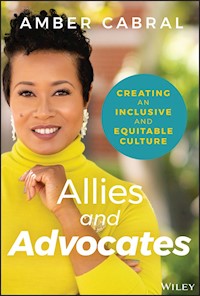
Learn to create an inclusive environment with this actionable and insightful resource Allies and Advocates: Creating an Inclusive and Equitable Culture delivers a powerful and useful message about inclusion and diversity in everyday life. Author Amber Cabral, a celebrated inclusion strategist, speaker, and writer, shows readers how to move away from discriminatory and unjust behaviors to supporting and building meaningful connections with people across our diverse backgrounds and identities. While some books settle for vague advice and catchphrases, readers of Allies and Advocates will benefit from the book's: * Straighforward style and applicable action items * Real-world examples highlighting inclusion best practices * Implementable tactics to assist people in seeing how they can help create an inclusive environment Perfect for anyone who works in a professional environment, Allies and Advocates is especially useful for those in middle and upper management and those involved in the training and orientation of employees. If you are looking forward to building a culture of inclusivity at work or in your personal relationships, and want to learn how to use your privilege to be a better ally, Allies and Advocates: Creating an Inclusive and Equitable Culture is a must-have.
Sie lesen das E-Book in den Legimi-Apps auf:
Seitenzahl: 295
Veröffentlichungsjahr: 2020
Ähnliche


















Table of Contents
Cover
Acknowledgments
Introduction
PART 1: Allies and Advocates
1 The Current Landscape
Note
2 Background on the Black Experience in the United States
History of the Black Experience
Questions to Consider
3 Allyship and Advocacy
What Is Allyship?
Behaviors of an Ally
4 Advocacy
Take Personal Risk
Pitfall: Performative Allyship and Advocacy
PART 2: The Language of Inclusion
5 Language
6 Diversity
Questions to Consider
7 Identity and Intersectionality
Brief Notes on Gender Identity
What Does the x in “Latinx” Mean?
Acronyms
Intersectionality
Questions to Consider
8 Inclusion, Bias, and Unconscious Bias
Bias and Unconscious Bias
Conformity Bias
Similarity Bias
Halo and Horns Effects
Questions to Consider
9 Microaggressions
Questions to Consider
10 Equality and Equity
Questions to Consider
11 Privilege
Questions to Consider
12 System, Systemic, Systematic
13 -Isms and -Ist
-Isms
-Ist
Engaging with Others
White Supremacy
Antiracism
Questions to Consider
14 Resistance Language
Questions to Consider
PART 3: Allyship Starts with You
15 The Work Starts with You
Questions to Consider
16 Role-ModelingInclusion
Broaden Your Perspectives
Be Mindful of Shared Spaces
Use Gender-Inclusive Language and Examples that Appeal to Varied Interests
Demonstrate Equality
Do the Brave Thing
Seek Out Diversity
Practice Perspective Taking
What You Allow, You Teach
Carry the Spirit of Apology
Don't Rely on Spokespeople
Avoid Performative Allyship and Advocacy
Mind Your Micros
Questions to Consider
17 Taking Care of Yourself
I'm Still Worried
Recharging
Moving Forward
About the Author
Index
End User License Agreement
List of Tables
Chapter 9
Table 9.1 : A Few Common Microaggressive Statements
List of Illustrations
Chapter 2
Figure 2.1: Timeline of Black people's existence in the United States of Ame...
Figure 2.2: Timeline of Black people's existence in the United States of Ame...
Figure 2.3: Timeline of Black people's existence in the United States of Ame...
Chapter 10
Figure 10.1: Comparison of equality and equity
Guide
Cover
Table of Contents
Begin Reading
Pages
i
v
vi
vii
ix
xiii
xv
xvi
xvii
xviii
2
3
5
6
7
8
9
10
11
12
13
14
15
16
17
18
19
20
21
22
23
24
25
26
27
28
29
30
31
32
33
34
35
36
37
38
39
40
41
42
43
44
45
46
47
48
49
50
51
53
54
55
56
57
58
59
60
61
63
64
65
67
68
69
71
72
73
74
75
76
77
79
80
81
82
83
84
85
86
87
88
89
90
91
92
93
95
96
97
98
99
101
102
103
104
105
107
108
109
110
111
112
113
114
115
116
117
118
119
120
121
122
123
124
125
127
128
129
130
131
132
133
134
135
136
137
138
139
140
141
142
143
144
145
146
147
148
149
150
151
152
153
154
155
156
157
158
159
161
162
163
164
165
166
167
168
169
170
171
172
173
174
175
“A timely and compelling book with essential guidance on racism and equity. This book contains today's must-have insight on two vital, yet often misunderstood, roles on the road to racial equity: allies and advocates. Highlighting how the unprecedented events of 2020 have further underscored the urgency for equity, Allies and Advocates serves as a roadmap to guide the steps and responsibilities each of us hold toward making racial equity a reality. It is a crucial read for all who seek to embrace anti-racism.”
—Dr. Lauren R. Powell, National Health Equity Leader, President & CEO, The Equitist
“It has been my privilege to have known and worked with Ms. Cabral for several years. The work that it takes to drive inclusion and belonging is not only a mission to change minds but also to change hearts and behaviors. This book is essential not only for those who would like to become more inclusive leaders but also for those who have been enlightened by the events of these turbulent times. There are few people that I have seen as good as Ms. Cabral at understanding what it takes to drive leaders to action on topics that many would find uncomfortable. As leaders, it is our responsibility to do what's best for our organizations but also its employees and their communities. This book provides a step-by-step guide for those who want to take action around D&I but do not know what to do next. That kind of clarity is beneficial regardless of where you are on your D&I journey.”
—Reginald J. Miller, VP, Global Chief Diversity, Equity, & Inclusion Officer, McDonalds
Allies and Advocates
CREATING AN INCLUSIVE AND EQUITABLE CULTURE
AMBER CABRAL
Copyright © 2021 by Cabral Consulting, LLC. All rights reserved.
Published by John Wiley & Sons, Inc., Hoboken, New Jersey.Published simultaneously in Canada.
No part of this publication may be reproduced, stored in a retrieval system, or transmitted in any form or by any means, electronic, mechanical, photocopying, recording, scanning, or otherwise, except as permitted under Section 107 or 108 of the 1976 United States Copyright Act, without either the prior written permission of the Publisher, or authorization through payment of the appropriate per-copy fee to the Copyright Clearance Center, Inc., 222 Rosewood Drive, Danvers, MA 01923, (978) 750-8400, fax (978) 646-8600, or on the Web at www.copyright.com. Requests to the Publisher for permission should be addressed to the Permissions Department, John Wiley & Sons, Inc., 111 River Street, Hoboken, NJ 07030, (201) 748-6011, fax (201) 748-6008, or online at http://www.wiley.com/go/permissions.
Limit of Liability/Disclaimer of Warranty: While the publisher and author have used their best efforts in preparing this book, they make no representations or warranties with respect to the accuracy or completeness of the contents of this book and specifically disclaim any implied warranties of merchantability or fitness for a particular purpose. No warranty may be created or extended by sales representatives or written sales materials. The advice and strategies contained herein may not be suitable for your situation. You should consult with a professional where appropriate. Neither the publisher nor author shall be liable for any loss of profit or any other commercial damages, including but not limited to special, incidental, consequential, or other damages.
For general information on our other products and services or for technical support, please contact our Customer Care Department within the United States at (800) 762-2974, outside the United States at (317) 572-3993 or fax (317) 572-4002.
Wiley publishes in a variety of print and electronic formats and by print-on-demand. Some material included with standard print versions of this book may not be included in e-books or in print-on-demand. If this book refers to media such as a CD or DVD that is not included in the version you purchased, you may download this material at http://booksupport.wiley.com. For more information about Wiley products, visit www.wiley.com.
Library of Congress Cataloging-in-Publication Data is Available:
ISBN 9781119772934 (Hardcover)ISBN 9781119772958 (ePDF)ISBN 9781119772941 (ePub)
Cover Design: Paul MccarthyCover Photograph: Danielle FinneyGraphic art design: Malgosia Kostecka of www.illumistories.com
To Rin—the most magical person I know.
You can have whatever you want.
Acknowledgments
Amanda Miller Littlejohn for far too many things, but mostly for helping me redefine normal
Christopher Parker Djordje for your friendship, trust, and patience with my moods
Aimee L. Strang for leaning in and always feeding the writer
Dr. Kamasi Hill for checking my knowledge
Malgosia Kostecka for your incredible illustrations to help bring this content to life
Jonathan M. Kester, Esq., for your legal mind and forever friendship
Everyone in the MBK group chat + Theo and Cher Nicholson—thank you for always giving me shelter (both literally and figuratively), cheering me on, and giving me space to celebrate the wins
Kirstie Perry, RaSheem Barnett, Carey T. Jones, Joshua Spivey, Conrad Woody, and Keila Hill-Trawick for believing in me even when I had doubt
Pamela and James Estes
Michelle Baker
Antonio Cabral
Introduction
First things first, relax. Put your shoulders down, quiet the anxiety in the pit of your stomach, and take a deep breath. This book is a learning tool. You will meet a lot of challenging and complex information, ideas, and perspectives aimed at helping you figure out how you can move justice and equity forward. The best way to position yourself in context to this material is as a learner in a virtual classroom where you can feel safe bringing your curiosity, showcase your eagerness to learn, and bravely reconsider your existing ideas. This is a “safe space,” as folks say. This book isn't about shaming or lecturing you to do or be better. Likely if you picked up this book, you already have had some bout with these feelings. These feelings are normal, especially if you are new to this work.
This book is about presenting information to help you figure out your place in what is a very long movement toward equity for oppressed people. Throughout these pages I invite you to do the work to move justice and equity forward. We explore some history for context on why oppression is so deeply entrenched in our identities. We cover language because, as my best friend always likes say, “Words mean things.” You will understand why some words are triggering for you and put you on the defensive. You will discover that a lot of the behaviors you are doing are flat-out wrong and be armed with the right behaviors to move forward.
For those of you who think you've got it but are looking for ways to check your friends and family, I have a bit of mixed news. You don't have it. No one does. This book will teach you how to get comfortable with that fact and still learn how to maneuver and push allyship and equity forward. So, if you think you've got it and know, settle in; there will be a lot of nods of agreement but likely still many eye-opening perspectives to lean on as you continue on your allyship journey.
In some ways I consider this book foundational; it gives the basic things you need to understand to communicate with others about allyship and advocacy responsibly. In many ways this book only scratches the surface because inclusion work is ever evolving and has such a rich history that capturing its many facets is virtually impossible. If you are new to this work, consider this a starting place; if you are farther along in allyship and advocacy, consider this a rich refresher.
Thinking of this as a refresher reminds me of the instructions for proper handwashing that flooded the internet when the United States began shutting down due to the coronavirus in March 2020. Likely you knew how to wash your hands, and likely you already washed your hands several times a day. Then the incessant reminders to wash and the “proper handwashing” signs took over, and you had to remind yourself of the bits you had gotten lazy about in your routine. Always, every time, rub the back of one hand with the palm of the other. Always get under the nails. Always use the whole 20 seconds. Don't let routine lull you into lax habits. This work is the same. It can feel like a lot of routine, but relaxing into that routine makes room for the status quo, and that just ain't enough. When leaning into this work, we need to apply the same diligence that we apply to handwashing during a pandemic.
In this book you will learn what to do and how to be, but you will be compelled to action by your own sense of self rather than being convinced or directed by the text. I am not here to convince you. My expectation is that if you are at the point of wanting to call yourself an ally and wanting to know how to be an advocate for others, you are convinced that there need to be changes. I give you the information you need to find your own reasons to act. I want you to discover in these pages the reasons why you cannot sideline this work and why you absolutely have to show up. I want you to discover why you are called to be an ally for others in your own words. That way when someone asks you why it matters, you can speak from a place of candor and vulnerability that gives depth and life to why this work is important. Certainly, you can memorize stats and know the data—I consume copious amounts of data and statistics so I can do my job well. It is for that reason that I can tell you that data doesn't move things forward. Stories do. People who are motivated to action by cause, by purpose, by excitement, by infection—that is what makes change. When people feel it. This book is going to lean into the parts of this work that gets into your bones. There will be emotion. This work is, after all, about our humanity, our lives, and how to make room for the survival of us all.
That said, there is a lot of emotional and difficult history and background in this book. I want to establish some ground rules to help you move through it and get the most out of the material presented.
First, do not take anything in this book personally. Everything in this book is useful, but you have to put yourself in the state of mind where you are able to receive it and be present to the message without being consumed by your personal response. This is not to say that I want you to be numb; rather, feel your feelings and take a break if you need to—but do not stop. Almost everything in this book is about identity, so at times it will be easy to see yourself in the material and get offended. Push those feelings aside. Take a walk if it helps. Keep in mind that these topics are things we typically dance around. It makes sense to feel some discomfort when exploring the racism, police brutality, and social injustices that are being covered openly in the news right now. Even though discussing these things may feel strange and awkward, we all know times are changing. Let's meet the moment with bravery.
Second, on bravery: It is essential for inclusion and antiracism work. Usually for us to be brave in a space, we need a sense of confidence about our identity and a sense of purpose. Right now, you might feel very brave in a number of ways but not necessarily as it relates to being an ally and an advocate for others. That's okay. Bravery is a muscle that can be built, and this book will help you to build it. By learning what being an ally means and how to identify behaviors and habits for yourself that communicate your bravery and confidence to others, you will develop the confidence you need to be brave. As you move through the chapters of this book and identify your own sense of purpose for leaning into this work, your bravery will strengthen.
Third, we are all on the same team. Racial equity, dismantling systemic oppression, physical and psychological safety, and creating an inclusive world require teamwork. If you want any of those things, then we are in this together. Right now you might not be sure you understand the obstacles that keep people from having racial equity, feeling safe or included or why people face systemic oppression, that's okay. We will cover those topics. If you want those things for yourself and everyone else, consider us teammates—even when I share something that doesn't feel so good to read.
Fourth, inclusion and diversity work (which includes antiracism work) consumes energy and makes you think. Throughout this book there are places for you to reflect on your own thoughts and ideas about the content. I ask questions for you to consider and ask that you think about how the information connects to your own experience. Remember, inclusion and diversity work is people work, so I want you, my fellow person, to take time to be thoughtful about how the work shows up in your own life. Additionally, I share tips and tactics to help you navigate certain common encounters and even manage your emotions and energy.
Last, this work requires vulnerability and candor. Inclusion touches everything so we are going to cover: real-life circumstances, actual missteps, relevant examples, and tactics. We are keeping it real here. We won't need to make up scenarios or encounters because when it comes to inclusion work, there is plenty in the real world to draw from. I am going to be candid and cover some topics that may feel awkward. I use and define words we usually are nervous about, such as racism and white supremacy. There is no way to discuss the ways you can show up and do the work of allyship and advocacy without explicitly talking about the things our comfort zones sometimes ask us to avoid. I am going to share with vulnerability so you are able to understand how the work comes to life outside of these pages. In the spirit of keeping it real, as we work through these pages, I am going to challenge you to answer the questions posed to you with the level of vulnerability and candor necessary to help you move the work forward.
This book is a safe space and a learning space, but it also is a challenging one. We cover a lot of material in very simple ways. My goal is to give you a rich starting point from which to begin or accelerate your steps toward allyship. From new concepts and terms to bravely learning to lean into the bold behaviors necessary for being an ally and an advocate, you are in for an informative and emotional ride. I am so excited that you are joining me on this journey.
This book is divided into three parts. Part I focuses on allyship and advocacy and explains the behaviors necessary to being an ally and an advocate. Part II is about the language of inclusion. A lot of terms and topics fall under the umbrella of inclusion and equity, so this part provides a basic understanding of terms and topics you may encounter on your journey to allyship and advocacy. Part III is about the importance of starting with yourself when looking for ways to be an ally or an advocate. Allyship and advocacy require not only awareness but also a willingness to work on your own perspectives.
Let's get started.
1The Current Landscape
The two most common questions I encounter while teaching since the Black Lives Matter protests began in May after the killing of George Floyd in Minneapolis on May 25, 2020, are: “How did racial inequity become such a big problem?” and “Why are these protests happening now?” They are both such important questions that, despite their simplicity, quite a bit of background and context is required to fully understand the answers. As you are likely wondering these things yourself in your work to be an ally and an advocate for others, I'm going to paint a full picture of “how we got here” and “why these protests are happening right now.”
I want to start by discussing the current global landscape and its impact. There are a lot of global shifts happening in the world at the same time—a global pandemic, protests against racial justice, climate change, changes in the political landscape, and much, much more. I think everyone around the globe would agree that 2020 has been a hell of a year. The first two months of the year were probably the closest to what many of us would call “normal,” and they were still pretty eventful. Just to recap, here are a few things that happened in the first 60 days of 2020 around the globe:
Wild bush fires destroyed millions of acres, homes, and wildlife in Australia.
Prince Harry and Meghan Markle announced they were stepping down from their royal duties.
A Ukrainian flight crashed in Tehran, Iran, killing all 176 passengers on board.
Kobe Bryant and his daughter Gigi Bryant, along with seven others, died in a helicopter crash in California.
The United Kingdom exited the European Union, making Brexit a reality.
Donald J. Trump, president of the United States, impeached by the House of Representatives, was acquitted on impeachment charges by the Senate.
Disgraced Hollywood producer Harvey Weinstein, known for
Pulp Fiction
and
Shakespeare in Love,
was convicted of third-degree rape and first-degree criminal sexual acts.
Wild, right? Some of those things feel like they happened years ago, and that's not including all the coronavirus news that happened in that same window of time. In January 2020, the World Health Organization (WHO) was notified about 2019-nCoV virus in China. A couple of weeks later, China reported its first coronavirus death, and by the end of January, the city of Wuhan in Hubei Province in China was on a complete lockdown. By mid-February, WHO officially named the 2019-nCoV disease the name we all know now, COVID-19, and nations around the world began to take notice as concerns about the virus's reach and its severity dominated news cycles. In March, we saw European nations entering varying phases of lockdown to control the virus, and on March 11, 2020, WHO declared COVID-19 a global pandemic.
I remember the moment when the virus got real for me. I was in London in mid-February on what would turn out to be my last business trip of the year. The day of my departure, my client let me know fears of the coronavirus global pandemic had led to the postponement of our March engagement in Lisbon. By February 20, all work my business had booked for 2020 was either postponed or canceled altogether. In a week, my business went from being on track to have the most successful year ever to zero dollars and a commitment to my staff that I would figure it out and not let them go. Suddenly I was trying to figure out rent and health insurance and keeping the business running on the few invoices we had still waiting on payment. It was terrifying.
Everyone has a story, though, as the global pandemic is affecting everyone at the same time and in different ways.
Take a few moments and consider how your life has changed since the global pandemic. Answer the following questions:
How has coronavirus changed the way you live?
What are some concerns you have as a result of the global pandemic?
How has coronavirus changed how you see the world?
What are some new things you have learned, big or small, as a result of coronavirus?
How has the global pandemic affected your loved ones?
Since the onset of the pandemic, some things are uncomfortable, like not being able to get a haircut or go to the gym, and even having air travel restricted. I'm a woman with short hair who traveled a lot for business. I am currently living in DC with a hairstylist in Detroit. This was no problem when I was on the road 85% of the time. I'd plan for a weekend layover in Detroit, get my hair done, and continue on with my life. Having a hairstylist in Detroit, a doctor in Dallas, and a dentist in Atlanta seems silly and irresponsible now that air travel isn't exactly safe. In reality, though, these are just inconveniences. I will survive with a bit of new growth and skipping my annual checkup.
The coronavirus has changed the world in other very remarkable and life-altering ways. The whole world is feeling it, and when you consider that there are over 7 billion people on the planet, it's mind blowing that something we can't see with our naked eyes can have such a massive impact. Some of the major changes include these:
Had you ever heard of “social distancing” or “physical distancing” before the coronavirus? I certainly hadn't. As a result of the coronavirus, we now have an entirely new language around how we should behave. Social distancing, wearing your mask, and washing your hands constantly are a part of everyday life.
What about “essential workers”? Prior to coronavirus, I would have described an essential worker as someone who worked in a hospital or someone that works in a power plant. Today we also think of essential workers as people who help grocery stores run, people who keep transportation moving, both in and out of the country, and even people who work in food plants.
There have been major economic impacts as a result of the coronavirus, including sweeping layoffs and furloughs resulting in millions of people in the United States needing unemployment assistance. The stock market has been volatile, and the government has been a part of a constant conversation about what needs to happen to stimulate the economy and support people and business owners who are unable to work.
Alarming rates of unexpected illness and death have come with the coronavirus. At the time of this writing, over half a million people had died from the virus and there were over 14 million confirmed cases globally. People are losing friends and family and not even having the chance to say good-bye. I have personally lost a number of close friends and some distant family members due to coronavirus.
That leads me to health system strain. We have heard a lot about how we need to be at home, “sheltering in place” so we can reduce the spread of the virus and slow the burden on our health system. Almost nightly there are reports of hospital units in areas hit by a surge in cases being at capacity for patients. When a facility is at capacity, that means it cannot take on more patients, even those with other illnesses, and there is additional pressure put on the hospital staff.
Had you ever heard of PPE before this pandemic? PPE stands for personal protective equipment. It includes the gear that medical staff need to wear to ensure they do not catch the coronavirus when they come in contact with someone with the virus who needs treatment. PPE includes masks, gloves, and face shields. When the coronavirus first hit the United States and everyone was afraid to catch it, it was virtually impossible to find PPE as well as other things that help people stay safe and keep things clean, like hand sanitizer and disinfectant wipes.
On the mental health front, there have been reports of increased levels of stress-induced anxiety, depression, and even domestic abuse since the onset of the pandemic. People are less able to get the help they need with cities shutting down and people sheltering in place to reduce the spread of the virus.
Children are at home with parents full-time; in some cases, parents have had to figure out how to balance doing their jobs while making sure their children are participating in virtual learning. As much as we may love our families, everyone needs a little time apart or with their friends. People are feeling the emotional strain of not being able to manage their relationships as they could pre-pandemic.
Conversely, some people are sheltering in place alone. Instead of feeling the psychological strain of being around a lot of people, they have strong feelings of loneliness and isolation. I am a single woman, living in a new city, with no children. The isolation and loneliness for me during the pandemic has been palpable.
No matter your circumstances, you are feeling something as a result of the many changes to everyday life that have come with COVID-19, and one thing is for sure—everyone is trying to make the best of the new environment.
Let's examine for a moment what pandemic life might be like if you are a member of an underrepresented group. An underrepresented racial and ethnic group is a group of people who make up a smaller percentage of a specific population. In this case, let's zoom in on the American population. Underrepresented racial and ethnic groups in the United States include Black or African Americans, Asian Americans, Hispanic or Latinx people, Native Americans, and Native Hawaiians. Underrepresented racial groups in the United States have an even greater set of impacts due to the onset of the global pandemic.
NOTE “Latinx” refers to both Latinos and Latinas. Since “Latino” and “Latina” connote male and female respectively, the “x” in Latinx includes all genders of the Latin community. We discuss this more in Part II of the book.
Asian Americans are experiencing xenophobia. Xenophobia is dislike or prejudice toward people from another country—or people who appear to be from another country. Since the coronavirus is thought to have begun in China, Asian Americans have reported mistreatment from other Americans, including being told they are nasty, must have the virus, or to “go back where they came from.” Some of our Asian American friends and colleagues have had encounters that have escalated into violence because some feel that an Asian appearance is enough to assume that a person is a carrier of COVID-19. (It is important to note that xenophobia is not unique to the United States; it is a global phenomenon. In fact, in China, there have been reports that anyone who is not Chinese has been met with prejudice because in China people believe the virus was brought in by someone who is not Chinese.)
Another term that is being used in regard to COVID-19 is “community spread.” “Community spread” refers to people being infected with the virus in a particular area, often not knowing how they contracted it. Members of underrepresented racial groups have been seeing higher rates of community spread than members of White communities.
Marginalized people also tend to work many of the jobs we now call “essential,” like meat plant workers and bus drivers, which puts them in contact with more people and increases their opportunity for exposure to the virus. The essential jobs are ones that cannot be done remotely, so such workers have to put themselves at risk by being in contact with other people. Only 16.2% of Hispanic workers and 19.7% of Black workers can telework, according to the Economy Policy Institute.
1
Unemployment has spiked during the pandemic. We know that the novel coronavirus has impacted many jobs, but many of the entry-level and blue-collar jobs that have been impacted are largely worked by people in marginalized groups. As a result, people who are in marginalized groups are more likely to be unemployed during the pandemic.
With job loss on the rise, so is the loss of health coverage. Thus, many in underrepresented racial groups who lost their jobs also lost their health coverage. Underrepresented racial groups tend to be underinsured when compared to White people in general, so the pandemic-driven layoffs have only made the health coverage situation worse. A lack of health insurance often results in individuals choosing to delay care until their health situation is critical. In the case of COVID-19, the decision to delay care can be a fatal one.
In the first few months of the pandemic, some obstacles to testing hit underrepresented groups in particular: First, testing required a doctor's order—which, for many people, means they need to have health insurance, a problem we covered in the previous bullet point. Second, testing sites did not ensure equitable access. Test sites were drive-up, with long lines that were obstacles for those without vehicles or who still had jobs to report to. Early on, test sites were also not placed in the communities where marginalized people live, so they had to travel to get to testing.
Underrepresented racial minorities are more likely to live in multigenerational households, meaning there might be children, parents, and grandparents all living in the same home. When a number of people live in a home, the ability for those in the home to adhere to social or physical distancing, should someone get sick, is reduced. As a result, early reporting showed that entire families were getting ill after one person brought the virus into the home.
NOTE I use the term “underrepresented” or “marginalized” instead of “minority.” Why? Because the root word of minority is “minor,” which suggests that the people who are part of that group do not have major impact. We discuss this more in Part II of the book.
Without a doubt, pandemic life is likely to be tougher for underrepresented racial groups in the United States. This is still only part of the picture though. To get to the answers to the questions I hear most often—“How did we get here?” and “Why are these protests happening now?”—we need to zoom in a bit more and focus on the Black or African American population. How different might surviving a pandemic be for members of this group? In addition to facing all of the experiences described in the earlier bullet points,
Black or African American people are estimated to have the highest rate of coronavirus infections. Their likelihood of being infected is three to six times that of White Americans.
The death rate for Black or African American people who contract the novel coronavirus is the highest of all racial groups.
The unemployment rate for Black or African American people during the pandemic is higher than for all other racial groups.
African Americans start out with health outcomes that are disproportionately poor when compared to White Americans. The Black and African American population is inherently sicker. These health inequities are the result of reduced access to health care and differences in the quality of care Black people receive when they do seek services. In some cases, African Americans avoid seeking services until they are in dire need because of the experiences they have had engaging with culturally incompetent doctors.
A significant amount of risk comes with being Black or African American in the United States. Living under a pandemic only makes




