


Erhalten Sie Zugang zu diesem und mehr als 300000 Büchern ab EUR 5,99 monatlich.
- Herausgeber: Science & Technology Publishing
- Kategorie: Geisteswissenschaft
- Sprache: Englisch
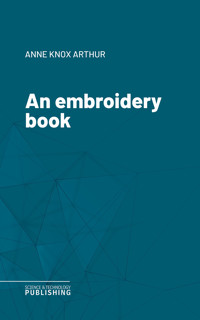
An Embroidery Book is a comprehensive and richly detailed guide to the art of embroidery, originally published in the early 20th century. This classic volume offers both beginners and experienced needleworkers a wealth of practical instruction, inspiration, and historical context. The book covers a wide array of embroidery techniques, including satin stitch, chain stitch, cross-stitch, and more, with clear explanations and step-by-step guidance. It features numerous illustrations and diagrams that demonstrate stitches, patterns, and finished projects, making it easy for readers to follow along and master each method. In addition to technical instruction, An Embroidery Book delves into the artistic aspects of embroidery, discussing color selection, design principles, and the creative possibilities of combining different stitches and materials. The book also explores the history and cultural significance of embroidery, highlighting its evolution and the various styles that have emerged across different regions and eras. Throughout its pages, readers will find a variety of projects suitable for home decoration, personal accessories, and gifts, ranging from simple motifs to elaborate designs. The author’s passion for the craft shines through, encouraging readers to experiment and develop their own unique style. Whether used as a reference manual or a source of inspiration, An Embroidery Book remains a timeless resource for anyone interested in the enduring beauty and creativity of embroidery.
Sie lesen das E-Book in den Legimi-Apps auf:
Seitenzahl: 229
Veröffentlichungsjahr: 2025
Das E-Book (TTS) können Sie hören im Abo „Legimi Premium” in Legimi-Apps auf:
Ähnliche

















Cover
AN EMBROIDERY BOOK
ANCIENT EGYPTIAN, ASSYRIAN, AND PERSIAN COSTUMES AND DECORATIONS.
By Mary G. Houston and Florence S. Hornblower.
Containing 25 full-page illustrations, sixteen of them in colour, and 60 line diagrams in the text.
Small crown quarto.
In this volume the history of Costume is traced from the earliest ages. The illustrations (which are taken chiefly from the British Museum) are given in facsimile from the drawings of the artists of the period, and, where the drawing is too primitive to be easily understood, a garment is also shown drawn in modern style; in addition, every type of garment illustrated is accompanied by a flat pattern showing the cut. Information of this special character on Ancient Costume is usually very difficult to obtain, and it is anticipated that the volume will be of first-rate importance to dress designers, to theatrical designers, and also to the schools in which historical costume and the history of the progress of the human race are subjects for study.
Published by A. & C. BLACK, Ltd., 4, 5 & 6, Soho Square, London, W. 1.
AGENTS
America
The Macmillan Company
64 & 66 Fifth Avenue,
New York
Australasia
Oxford University Press
205, Flinders Lane,
Melbourne
Canada
The Macmillan Company of Canada, Ltd.
St. Martin’s House, 70 Bond Street,
Toronto
India
Macmillan and Company, Ltd.
Macmillan Building,
Bombay
309 Bow Bazaar Street,
Calcutta
PLATE I.
A TABLE MAT. (See page 41.)
AN
EMBROIDERY
BOOK
BY
ANNE KNOX ARTHURGLASGOW SCHOOL OF ART
CONTAINING SIXTEEN FULL-PAGE ILLUSTRATIONS —EIGHT OF THEM IN COLOUR—AND EIGHTY- SEVEN LINE ILLUSTRATIONS IN THE TEXT
A. & C. BLACK, LTD.4, 5 & 6, SOHO SQUARE, LONDON, W. 1.1920
“Go, little booke; God send thee good passage”
TO MY MOTHER
NOTE
The Author’s thanks are due to the owners of the pieces of embroidery illustrated in this book who kindly lent them to her for reproduction:—Miss Beatrice Brooks, Miss Marion Boyd, Miss Janetta S. Gillespie, Miss Mary A. Gill, Miss Martha Stevenson, Miss Elspeth Stewart, Miss Jessie Gibson (students of the Glasgow School of Art); also to Miss Kay, Parkhurst, Cedars, Derby, for the loan of three pieces worked by her pupils.
FOREWORD
Now that many of our busy working people have better regulations as regards the hours of the day’s work, there is great need to provide occupation for the day’s leisure; and needlework, as a leisure craft, is one of the most refreshing and pleasant and profitable sources of entertainment—provided always, that those who undertake it realise that, with right thought and consideration on the part of every worker, each should become, as it were, a law unto herself, so that she should realise also that she need, under no circumstance, be the slave of old traditions, if she can give fitting reasons for making a change which is to the purpose of her work.
To be in a healthy and living state, our art should be constantly changing its fashion; if it stands still, it is retrograde, and for some few generations we may say this of British embroidery. What changes it has undergone are due almost entirely to the commercial enterprise of manufacturers of printed patterns—usually foreign ones. The importation became very considerable with the introduction of so-called Berlin woolwork, and since that period the British needlewoman has set aside her own ingenious arrangements and follows blindly where the merchant leads, and British design for needlework, as an expression of its people, is almost a dead thing.
Most people have a superstition that in knowledge of a multitude of stitches lies the whole mystery of needlework. This is emphatically not the case. There really is no mystery about stitches; they are but the letters of the needleworker’s alphabet, and the words of her language—to be used according to her own ideas. One may embroider poems; another may embroider prayers and praises for her church; another may beautify a fair woman’s garment or sing a little song in stitches for a baby’s robe; yet another may be like a treatise on surgery, repairing and restoring that which has been damaged. But needlework does not exist for the stitches. It is the stitches which—as they are well or ill-used—express the worker, and, if she is a wise worker, she can find out for herself most of the stitches she needs. Nor is it necessary to be at great expense in needlework, indeed, for those who take it up as a recreative craft half the interest may lie in the fact that no material is too common or too homely to be made into something fitting and, therefore, beautiful—since the truest art is to make a thing pleasing to the eye and yet entirely suited to the purpose.
The commonest failing of the designers of this country is that they think that beauty lies in the elaboration of ornament, and this is why the fashions of British dressmakers fall short of those abroad. It is the little simple contrivances, that are almost no more than a sort of loving finish to the actual construction of a piece of work, that give the highest standard of style in garments: and the best training a needlewoman can have is to make her seams, hems, openings and fastenings of garments or household fitments things of beauty, while, at the same time, she considers the uses and purpose of her work. It is as a piece of engineering we should consider the construction of our household hangings and covers of our garments—planning that decoration should be coarse or fine, as fits the material, and taking thought also for the washing and wearing of it.
The fashions of to-day show a very marked tendency to decorative construction, due in great measure to a change in the needlework for school children introduced a few years ago. The tendency shows most interesting results, especially in the fact that the shaping of clothing has become very simple and that garments depend almost entirely on stitchery for their decoration, rather than on manufactured braids and trimmings; and the styles and shapes are infinitely less stereotyped, so that clothing for women tends to express more nearly the personality of the wearer than it has done for many generations.
The work of the hand—as apart from that of the machine—is more and more in demand, and decorative needlework, even in our shops, is becoming more to be desired, for unique and personal characteristics and expression, than it has been for a very long period. This being the case, let our needlewoman take courage and realise that in each mind there are possibilities of new ideas and new inventions—that all materials open up new opportunities, and that with little labour she may greatly enhance and beautify the things she works and find appreciative opening for her skill. Never was there such universal demand for handwork of every kind, and for such household fittings, which tend towards economy and labour saving in particular, the need is almost unlimited. Some of the most interesting embroideries done during the last few years have been planned and carried out in some of our Scottish schools by untrained workers—designs so simple that the workers do not realise that they are designing at all—since they draw largely with needle and thread alone, and have little assistance from chalk and other markings. And it is this type of work, usually sewn in coarse yarns and on rough canvas, flannel or homespun, that is perhaps the most happy and most stimulating for a designer of needlework to begin on. The work is so quickly achieved—so gallant and bright in colour—so utilitarian in purpose and of so little cost in outlay, that it is above all others to be recommended. It needs no experience in stitchery to work in bright wools, if the material is firm and strong, and the writer has pleasant experience of maid-servants and village wives in the north country making admirable rugs, garments, and other embroideries, which command good prices at the Artificers’ Guilds and other places where a high artistic standard of design is required.
It is only by means of such counter attractions in stimulating leisure crafts, which pay their way as well as give pleasure to the workers, that we can contend with the spirit of restless excitement and craving for mere pleasure-giving that is so marked a sign of the early days of peace, and reconstruction can only come by countering this mischievous tendency in young people by giving them something that gives stimulus to their longing for brightness and yet does not unduly tax those whose days may be occupied in strenuous employment.
How desirable it is that such gatherings of women and girls as church sewing meetings, guilds and clubs, should take up such new ideas in needlework and apply for a competent instructor. How almost more desirable is it that men might realise the pleasure a needle can give if applied to bold construction and original work.
It is by no means universal over the world that needlework is a women’s craft; in many countries it is done quite as much, if not more, by the men, and it is probable that if our men took up this craft, it would show a very marked tendency to individual and original expression.
The power of invention is so great and serious a factor, that it is almost too big a thing to touch upon here. We do not exaggerate its importance when we say that this faculty in human beings is what we can justly call the Holy Ghost, for it is that in us which comes, not of ourselves, but from direct inspiration, and the first principle of education ought to be to open our minds to it, in howsoever small and humble a fashion it comes, and to make clear the way for its development and growth towards greater things.
Ann Macbeth.
Glasgow School of Art.
CONTENTS
CHAPTER
PAGE
I.
INTRODUCTORY
1
II.
THE ART AND CRAFT OF EMBROIDERY—THE SIX POINTS
5
III.
CONSTRUCTION AND DESIGN
18
IV.
DARNING STITCHES—BACKGROUNDS AND FILLINGS
29
V.
NEEDLE-WEAVING—RUSSIAN OPEN-WORK—LINKED STITCHES
40
VI.
BUTTON-HOLE AND BORDER STITCHES—HEMSTITCHING AND OPEN FILLINGS
55
VII.
LAID WORK—BASKET AND LINE STITCHES
67
VIII.
COUCHING—FRENCH KNOTS AND BULLION STITCH
79
IX.
BRAIDS AND DESIGN—FAGGOTING—VEINING —ANTIQUE SEAMS—KNOT INSERTION AND EDGING
89
X.
INSERTIONS IN NEEDLE-WEAVING—POINT DE RÉPRISE—INTERLACING AND OPENWORK BACKGROUND
101
XI.
FRINGES AND TASSELS—HAND-MADE BRAIDS —KNOTS AND PICOTS
114
XII.
DRAWN-THREAD AND WHITE WORK—RHODIAN, RICHELIEU AND HEDEBO
134
XIII.
DECORATIVE FLOWERS AND LEAVES—EDGING AND INSERTION
155
INDEX
179
LIST OF ILLUSTRATIONS
PLATE
FACING PAGE
I.
*A TABLE MAT
Frontispiece
II.
SOME USEFUL STITCHES
17
III.
A RUNNER IN CRASH
32
IV.
*A PORTIÈRE
49
V.
*A BUREAU SCARF
64
VI.
A SIDEBOARD CLOTH
69
VII.
A TABLE CENTRE IN WHITE AND BLUE
76
VIII.
*A LUNCHEON MAT
81
IX.
*THREE COLLARS
96
X.
A TEA-COSY COVER
101
XI.
A NIGHTDRESS CASE
108
XII.
*THREE HAT BANDS
113
XIII.
*A BAG IN CANVAS AND WOOL
128
XIV.
CORNER OF COT COVERLET, UNFINISHED
149
XV.
TWO SIMPLE BASKETS
156
XVI.
*A CUSHION COVER
168
*These illustrations are in colour.
AN EMBROIDERY BOOK
CHAPTER I
INTRODUCTORY
“Give her of the fruit of her hands; and let her own works praise her in the gates.”
Needlework, as an artistic and practical craft, is highly interesting from a decorative point of view, and well within the scope of any intelligent worker. It has distinct advantages over most crafts—it neither requires great initial outlay for apparatus or materials, nor does it demand a special workshop; thus, as a domestic art, it commends itself to many of us on account of its adaptability to the conditions of life, as well as for its decorative value—as a means of adding grace and beauty to our daily surroundings.
During the thirteenth and fourteenth centuries England was famed for the beauty and magnificence of its ecclesiastical embroideries. These wonderful works found their way into many countries and were eagerly sought after by patrons of the beautiful; many pieces still exist, preserved in our museums, churches, or in private collections, to show us what extraordinary ability and invention these ancient embroiderers must have had. After the Reformation, when there was no longer the great demand for ecclesiastical work—embroiderers turned their attention to the decoration of garments to be worn by the wealthier classes. In the “Golden Days of Good Queen Bess,” and for some time later, all the ingenuity and skill formerly applied solely to church work was bestowed on the decoration and beautifying of personal clothing—dresses, cloaks, coats, waistcoats, caps, gloves, etc.; neither time, labour, nor expense was spared, the worker’s ideal evidently being to obtain the highest result of which he or she was capable. Some of the quaint pattern books of those days still exist, and they consist mostly of elements—dainty flower sprays, sprigs, fruits, birds, animals, fishes, border patterns and geometrical forms—all intended to assist the workers in the composition and building up of their designs and patterns.
In the busy world of nowadays, we cannot hope ever to attain to such perfection, nor to regain for embroidery the high position it once held in this country; but we still have many clever needlewomen who could produce beautiful work provided they had a better knowledge of how to set about it.
This book has been planned with the hope that it may be of use to many, and that it may create in both girls and women the desire to construct and decorate for themselves those simple articles of daily use which cost so much to buy and which can be made and embroidered, in simple patterns, with a little knowledge of construction and stitchery, at a moderate expenditure of time and money.
Perhaps the reason why so many workers buy their materials already stamped with a design, which often proves unsuitable to the purpose for which it is intended, and which gives small satisfaction when embroidered, is because of a certain distrust of themselves, a want of knowledge of their own powers of invention and ingenuity; or it may be a lack of energy and initiative, a reluctance to plan and create for themselves, due to the fact that they have never been taught to express their own ideas, but rather to depend on those of others. Nevertheless, the sense of beauty is, in a greater or less degree, common to us all. Why, therefore, should a needleworker not develop her own ideas rather than those of other workers? The designer, for example, who may have as little knowledge of stitchery as the needlewoman has of design, and who, therefore, cannot realise the labour involved in its execution, may lose much of his effect and may waste the time of the embroiderer. It is generally agreed that no two people have the same ideas; it is surely, then, of considerable importance that each one should at least make some attempt to express his or her own. If scope is given to the creative and inventive powers they, like other faculties, will grow in a most inspiriting manner; new ideas, inherent instincts, perhaps dormant hitherto, will spring up like flowers to encourage the beginner on the upward path, and as interest becomes keener and confidence grows, difficulties which at first appeared insurmountable will quietly disappear as the worker plans and thinks out a piece of embroidery from the foundation. How interesting and attractive it will be to execute such a piece of work, which will express the personality of the worker in all parts, design, colour and stitchery. Greater technical excellence, as well as charm, must accrue; the embroideress will work with more judgment and understanding, and because it has gained so much in interest to her, she will be able to express herself more freely, and her work will convey and suggest more to others.
CHAPTER II
THE ART AND CRAFT OF EMBROIDERY—THE SIX POINTS
“Chaires, Stooles and Screen, the same, all of Satten Stitch done in Worsteads.”
We shall now consider the six important points of design.
Art and Craft.—Many women have an inherent instinct for needlework—that is, the craft of the needle—for the knowledge of how to use a needle and thread is generally easily acquired; but it is quite otherwise when the design, the artistic or imaginative part, has to be carried out, as it ought to be, by the worker. Then all sorts of difficulties arise, mostly imaginary, as those who make an attempt may find.
Let us here consider the design as a necessary part of the workmanship. We shall be ambitious enough to study embroidery from an artistic point, for the art and the craft ought surely to go hand in hand.
The Habit of Design.—A special knowledge of drawing is not essential for pattern making—a child will make delightful patterns—nor for simple designs composed of straight lines and geometrical forms, such as might be happily applied to borders for articles of daily household use or for personal wear. A ruler, a compass and a sheet of squared paper are sufficient for initial efforts: and once the habit of simple designing is acquired it can become a wonderfully absorbing pastime, for eyes that are opened to see will find designs on every side.
Good Taste and Common Sense.—To carry out a piece of work successfully, however, the embroideress must possess good taste and common sense; these are indeed important qualities, the possession of which will help the beginner enormously: add to these an eye for colour and form, a practical knowledge of the stitches commonly in use, some acquaintance with materials, their utility and adaptability, and the worker will find herself fairly well equipped to start her design.
The Six Points.—There are about six points to be considered in connection with a piece of embroidery:—
The Object and its Use.—We must decide this, bearing in mind the position the work will occupy when finished; choosing a material suitable for the purpose, and with due regard to the restrictions of economy.
The Colour Scheme.—Consider the environment, and let the scheme be in harmony with or in contrast to the background and surroundings.
The Construction.—Plan carefully and arrange for the decoration, which should never interfere with the usefulness of the finished work.
The Building up of the Pattern.—This should always be done with a view to the limitations of the material.
The Stitchery.—This must also be adapted to the material—with bold, effective types for the coarser woven stuffs, and daintier, closer stitchery for the firmly woven textiles.
Finishing Touches.—A beginner rarely realises the importance of these, yet it is well worth while bestowing thought on them; interest may be considerably heightened by such additions or an otherwise good piece of work rendered less attractive by lack of care and thought at the final stages.
It will now be seen that the design—the least mention of which strikes terror to the soul of the uninitiated—does not consist in the drawing or the making up of the pattern alone, and that there are important preliminary stages to be gone through. Indeed the design is well on its way by the time the worker reaches the fourth point, i.e., the building up of the pattern.
The First Point: On the Choosing of Materials, Threads, Tools, Etc.
Materials.—Materials, threads, and needles are important items, and should be chosen carefully; to spend time and labour on embroidery on a poor foundation is an extravagance rather than an economy—the tendency being to make up for the poorness of the quality by the profuseness of the decoration. Materials need not be costly, but they should be good of their kind.
Homely Materials.—Charming things can be made out of homely cloths, remnants and oddments. Texture, tone and colour should be considered, both from a practical and an artistic point of view; a background that is pleasant to work upon is always an advantage. Linens, of varying quality and texture, can be relied upon for domestic purposes—they make for good stitchery, they wash well, and are very durable. (Plate VII.) Some unbleached materials are extremely economical.
Greenhouse Shading.—A soft creamy netting used for greenhouse shading, which may be obtained from any of the large seed merchants, is made in different widths from 54 inches to 72 inches. It has an open mesh and lends itself to all types of darning and needle-weaving—the narrow widths make excellent semi-transparent sash curtains, which may be brightened by applied bands of coloured linen or chintz, and finished with rows of simple running or tacking stitch in wools or in some of the coarser makes of embroidery cottons. (Plate VIII.) The thicker quality has a closer mesh and is admirable for coverlets and hangings. These, when edged and decorated with lines of bright-coloured washing braids, and wide borders of coloured cretonnes—which again may be connected with bars of needle-weaving or darning, or any simple stitchery—make charming and economical articles, such as any housewife might well be proud to possess. (Plates V. and VI.) Covers and runners to match might complete the set. This would be a pleasant and instructive work for a girl’s leisure hours; she might make just such a set for her bedroom, with the addition of chair covers and cushions, adorning them beautifully with some simple design and a colour scheme of her own choosing.
Damask and Huckaback.—Damask linens, with simple-patterned backgrounds, twilled sheetings, of various makes, and huckabacks, can be used most effectively for runners, mats, and luncheon sets; the soft, warm, creamy tone of the unbleached material blends harmoniously with bright-coloured threads and wools.
Titian Canvas.—Many coarser and more loosely woven textures make most charming and desirable backgrounds for bands of needle-weaving. (Plate VI.) Coarse canvas in various colourings, woollen hopsacks, floor-cloths, etc., are adaptable for many household articles.
Russian Crash.—A common roller towelling, or Russian crash, as it is also called, is a delightful material (Plate III.), and may be had in narrow widths, varying from 12 inches to 24 inches; it is woven by the Russian peasantry in small handlooms and varies considerably in texture and quality—but in all cases it is a most durable and suitable linen for domestic purposes.
The Scottish Blanket.—Another pleasing material for wool decoration is the well-washed, worn-out Scottish blanket; with the smaller pieces one can make hassocks and cushions which look wonderfully well in strong colours in any flat stitch; the larger single blanket can be used for coverlets or hangings—with applied decoration where the material is too frail for general hard wear. Decorated with edgings of woollen braids, etc., these will look almost new, and certainly will give immense satisfaction to the worker.
Threads are to be had in great variety and in different makes, many of which are excellent for embroidery. Cottons and flaxes in various sizes and thicknesses in a large range of colours can be combined most successfully.
Embroidery Wools.—Wools and yarns, particularly the types known as fingering, in three, four, and five-ply, are reliable both in colour and quality. It is always advisable to shrink wools before using them for embroidery if they are to be applied to articles which require frequent washing. Crewel and tapestry wools, to be had in hanks, “white heather” mending in balls, are very convenient for needle-weaving and canvas work, and they may be had in beautiful colours.
Silks.—Silks of different makes, embroidery or knitting, filosel, filo-floss and a soft, thick variety known as “Tyrian,” are all good for various purposes. The latter is particularly useful for couching lines; filo-floss—a bright, glossy silk with no twist in it—requires some skill in the manipulating of it, therefore filosel or mallard floss, each of which has a slight twist on it, is better for the less-skilled worker. Carpet chenilles in colours, both cotton and woollen, applied to coarse canvas or sacking, are used for the making of mats and rugs. Woollen and mohair, cotton and brush braids of the common skirt type, carpet and binding braids, cords and French tapes, coloured and washing gimps, all may be used with advantage for embroidery. It is better to shrink some of the loosely woven skirt and carpet braids before applying them to the material, or they are apt to pucker the material after washing.
Good needles should always be used, with well-drilled, good-sized eyes. Care should be taken to choose them so that they may be exactly suited to the thread and to the material; the eye should be large enough to hold the thread easily, in which case it will make a hole in the foundation of a sufficient size to allow the thread being pulled through without roughening it. Scientific sharps are very pleasant to use—numbers four, five and six, are suitable for cotton and flaxes, crewel and chenille, and long-eyed sharps for general embroidery and needle-weaving. For openwork backgrounds such as are shown in Plate XI, H, I, J, K, L, where no threads are withdrawn from the material, a special needle with a large thick stem and a small eye is used; it separates the threads of the material and makes them easier to gather into groups by means of the tightened thread.
In working on loosely woven materials—such as canvases—and for weaving patterns, tapestry, chenille, or rug needles with blunt points are the most comfortable to use; if these are not to hand, work with the eye of the needle foremost.
A well-fitting thimble, preferably vulcanite or silver lined with steel, is necessary. It should be deeply pitted to catch the eye of the needle and well finished, so as not to roughen the thread. Scissors of different sizes are required: a large pair with one sharp and one rounded point—these for the cutting and preparing of the material; a small sharply pointed pair for the snipping of threads; a special pair with a little square knob on the one blade and a sharp point on the other for cutting out threads and sections between embroidered and openworked parts; these are a safeguard and prevent the snipping of the work.
Frames are not necessary for the simpler types of work, but for wide borders in needle-weaving, particularly for the novice, a frame will fix the warp threads by keeping them taut, and prevent puckering of the material—little tambour frames which consist of a couple of rings, the one fitting into the other, will serve the purpose.
Finally, a small emery cushion, for polishing the needle should it get sticky or rusty, a piece of beeswax is useful for flax threads, a stiletto for piercing eyelet holes, a yard measure, a bodkin, and some small pins, are all necessary items, which should always be at hand when wanted.
The Second Point: The Colour Scheme.
Colour lends an inexpressible charm to our daily life—it is in nature that it exists in greatest beauty. The wonderful robe of colour which she displays for us throughout all seasons and in all countries, through the flowers and fruits, trees and foliage, sea and sky, the birds, animal and insect life, all under different aspects and ever-varying circumstances, increase our admiration and pleasure. We reflect and gratify our need for colour in our intimate surroundings—dress, hangings, furniture, carpets, pottery and pictures. The embroideress who has a fine instinct for colour will arrange a scheme wherein beautiful combinations of hues, tints, and shades will mingle and produce a harmonious whole. It is for those less favoured that the following hints are given. A knowledge of the principles of colour will serve as a guide, while the use of a chromatic circle, i.e., a colour circle, will be invaluable to the beginner. This convenient arrangement wherein successive strips of all the colours are placed concentrically in their due proportions—as in the prismatic spectrum—will enable her to study the varieties, the relations and the peculiarities of colour and help her to arrange and select those hues, tints and shades which will combine well together; it will aid her to obtain happy effects with some appreciation of its harmonies and contrasts.
The three primary colours, green, red and blue—green being now generally accepted as a primary instead of yellow—offer the greatest contrast to each other. They are the strongest and most powerful and exercise a greater influence on the mind than any of the others; add to these, orange, yellow, violet, white and black—the sum of these six colours constitutes white, and the absence of all, black—and we have the eight from which all the other colours and their modifications can be made, easily and systematically.
Red (Complementary Colour, Bluish-Green).—Red, the strongest and most powerful, excites and stimulates the eye. It was the first colour to be used for decorative purposes by primitive man, and the first to receive a name: it is the most predominant of the warm colours, and on account of its fresh, bright, cheerful character, is much used by beginners; but this very assertive quality makes it rather difficult to combine with other hues, therefore it is well to use it in small quantities for general purposes. Red, in different hues, has always been the symbol of power and distinction. Scarlet has been used for regal robes and state ceremonials, as well as for military purposes—it indicates bloodshed and war, fierceness and courage. Red of a rosy hue signifies divine love. It has been a favourite colour with the poets from the days of Homer to our own time. The complementary of red is bluish-green.
Blue (Complementary Colour, Yellow).—Blue followed red—it is of a quiet retiring nature, soft and soothing in effect, imparting the same quality to all the hues in which it predominates. It is one of the cool colours and is symbolically emblematical of heaven, piety, and intelligence. The complementary of blue is yellow.
Green (Complementary Colour, Purple




