


43,99 €
Mehr erfahren.
- Herausgeber: John Wiley & Sons
- Kategorie: Fachliteratur
- Serie: The AFP/Wiley Fund Development Series
- Sprache: Englisch
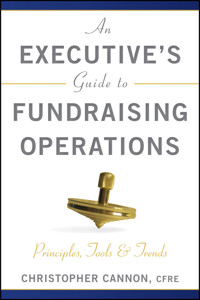
A straightforward guide to the principles of effective fundraising operations An Executive Guide to Fundraising Operations provides fundraisers with easy-to-understand approaches to evaluate and address fundraising operations needs and opportunities. This guide simplifies and focuses on the analysis of problems and needs, allowing a quick return to fundraising. * Provides the essential framework to improve and innovate development operations * Includes dozens of practical tools, including sample policies for data, database, reporting, and business processes * Offers sample workflow illustrations for gift processing and acknowledgment, report specification, and other processes * Features sample reports for campaign management, performance management, and exception management * Delivers effective calculators for operational rules of thumb No matter what the department is called, most fundraisers struggle with evaluating operational issues. This guide leads you through principles of effective fundraising operations, simplifies complicated topics, and offers solutions to some of the most vexing operations dilemmas.
Sie lesen das E-Book in den Legimi-Apps auf:
Seitenzahl: 357
Veröffentlichungsjahr: 2011
Ähnliche


















The AFP Fund Development Series
The AFP Fund Development Series is intended to provide fund development professionals and volunteers, including board members (and others interested in the nonprofit sector), with top-quality publications that help advance philanthropy as voluntary action for the public good. Our goal is to provide practical, timely guidance and information on fundraising, charitable giving, and related subjects. The Association of Fundraising Professionals (AFP) and Wiley each bring to this innovative collaboration unique and important resources that result in a whole greater than the sum of its parts. For information on other books in the series, please visit:
www.afpnet.org
The Association of Fundraising Professionals
The Association of Fundraising Professionals (AFP) represents over 30,000 members in more than 207 chapters throughout the United States, Canada, Mexico, and China, working to advance philanthropy through advocacy, research, education, and certification programs.
The association fosters development and growth of fundraising professionals and promotes high ethical standards in the fundraising profession. For more information or to join the world's largest association of fundraising professionals, visit www.afpnet.org.
2010–2011 AFP Publishing Advisory Committee
CHAIR: D. C. Dreger, ACFRE
Director of Campaigns for the Americas, Habitat for Humanity International
Angela Beers, CFRE
Director of Development, Devereux Pocono Center
Nina P. Berkheiser, CFRE
Principal Consultant, Your Nonprofit Advisor
Linda L. Chew, CFRE
Development Consultant
Stephanie Cory, CFRE, CAP
Director of Development, The Arc of Chester County
Patricia L. Eldred, CFRE
Director of Development, Independent Living Inc.
Samuel N. Gough, CFRE
Principal, The AFRAM Group
Larry Hostetler, CFRE
Director of Marketing and Fund Development, Sierra Vista Child & Family Services
Audrey P. Kintzi, ACFRE
Director of Development, Courage Center
Steven P. Miller, CFRE
Director of Individual Giving, American Kidney Fund
Robert J. Mueller, CFRE
Vice President, Hospice Foundation of Louisville
Maria Elena Noriega
Director, Noriega Malo & Associates
Paula K. Parrish, CFRE
Director of Advancement, Fort Worth Country Day
Michele Pearce
Director of Development, Consumer Credit Counseling Service of Greater Atlanta
Leslie E. Weir, MA, ACFRE
Director of Family Philanthropy, The Winnipeg Foundation
Sharon R. Will, CFRE
Director of Development, South Wind Hospice
Timothy J. Willard, PhD, CFRE
Vice President for Development, Ranken Technical College
John Wiley & Sons, Inc.:
Susan McDermott
Senior Editor (Professional/Trade Division)
AFP Staff:
Rhonda Starr
Vice President, Education and Training
Reed Stockman
AFP Staff Support
Contents
Cover
The AFP Fund Development Series
The Association of Fundraising Professionals
2010–2011 AFP Publishing Advisory Committee
Title Page
Copyright
Dedication
Foreword
Preface
Acknowledgments
Chapter 1: Introduction
Supporting Fundraising
What Is Fundraising Operations and Where Should It Fit in the Organization?
Using This Guide to Improve Decisions
Chapter 2: Principles of Fundraising Operations
Data, Technology, Reporting, Process, and People
Chapter 3: Responsibilities of Your Fundraising Operations Team
Technology Management
Data Maintenance
Gift Processing
Reporting
Prospect Development
Stewardship
Compliance
IT, HR, Finance, and More
Chapter 4: Program Support
Major Giving
Annual and Unrestricted Giving
Constituent Engagement Programs
Events
Special Initiatives or Constituencies
Chapter 5: Trends, Fads, and Staying Ahead of the Curve
Which Curve?
Applying Principles to Trends
Chapter 6: Decision Advice from the Field
Ideas from Practitioners
Making Your Executive Decisions
Chapter 7: Tools for Fundraising Operations
Fundraisingoperations.com
Data
Technology
Reporting
Processes
Staff
Epilogue
Isolate the Problem
Plot the Problem
Solve the Problem
Starting Points to the Solution
Appendix A: Sample Data Dictionary
Gifts
Gift-Related Terms
Other Important Development Terms
Appendix B: APRA Statement of Ethics
Glossary
Bibliography
Useful Sites
About the Author
AFP Code of Ethical Principles and Standards
A Donor Bill of Rights
Index
Copyright © 2011 by Christopher Cannon. All rights reserved.
Published by John Wiley & Sons, Inc., Hoboken, New Jersey.
Published simultaneously in Canada.
No part of this publication may be reproduced, stored in a retrieval system, or transmitted in any form or by any means, electronic, mechanical, photocopying, recording, scanning, or otherwise, except as permitted under Section 107 or 108 of the 1976 United States Copyright Act, without either the prior written permission of the Publisher, or authorization through payment of the appropriate per-copy fee to the Copyright Clearance Center, Inc., 222 Rosewood Drive, Danvers, MA 01923, (978) 750-8400, fax (978) 646-8600, or on the Web at www.copyright.com. Requests to the Publisher for per mission should be addressed to the Permissions Department, John Wiley & Sons, Inc., 111 River Street, Hoboken, NJ 07030, (201) 748-6011, f ax (201) 748-6008, or online at www.wiley.com/go/permissions.
Limit of Liability/Disclaimer ofWarranty: While the publisher and author have used their best efforts in preparing this book, they make no representations or warranties with respect to the accuracy or completeness of the contents of this book and specifically disclaim any implied warranties of merchantability or fitness for a particular purpose. No warranty may be created or extended by sales representatives or written sales materials. The advice and strategies contained herein may not be suitable for your situation. You should consult with a professional where appropriate. Neither the publisher nor author shall be liable for any loss of profit or any other commercial damages, including but not limited to special, incidental, consequential, or other damages.
For general information on our other products and services or for technical support, please contact our Customer Care Department within the United States at (800) 762-2974, outside the United States at (317) 572-3993 or fax (317) 572-4002.
Wiley also publishes its books in a variety of electronic formats. Some content that appears in print may not be available in electronic books. For more information about Wiley products, visit our web site at www.wiley.com.
Library of Congress Cataloging-in-Publication Data:
Cannon, Christopher M.
An Executive‘s Guide to Fundraising Operations: Principles, Tools and Trends/Christopher M. Cannon. p. cm. – (The AFP Fund Development Series)
Includes bibliographical references and index.
ISBN 978-0-470-61001-5 (hardback); 978-1-118-03023-3 (ebk); 978-1-118-03028-8 (ebk); 978-1-118-03029-5 (ebk)
1. Fund raising. I. Title.
HG177.C36 2011
658.15′0224-dc22
2010045664
For Erica, my wife and my best friend
Foreword
Fifty years after Sy Seymour began his important writing on seeking philanthropic support, many of his works regarding strategy and organization of fundraising remained intact. With the enormous exception of the dominant role women had in fundraising progress, little had changed in the field by the 1980s. We saw the emergence of great associations—Association of Fundraising Professionals (AFP), Association for Healthcare Philanthropy (AHP), Council for Advancement and Support of Education (CASE), and others—as well as growth in the size of permanent development staffs and campaign goals, but the overall approaches to securing private gift support had only minimally evolved over a half-century.
In the past 20 years, however, the world of development has changed dramatically because of technology. Today, we have the ability to:
Store vast amounts of data. It is now possible to store long histories of giving and activities, to seek out information from many sources, and to organize the information by individual donor or groups.Sort and target. Today's databases allow development offices to slice their donor base into subgroups to target asks, appeals, and solicitation vehicles. It is now possible to have a million donors and still focus on each one as a distinct person or organization.Analyze actions. Today, we can track the activities of individual development officers and the collective actions of the entire office. We can see the results of each solicitation strategy while simultaneously tracking the income and expenses of different development programs. These advances allow us to manage development offices more effectively and to adjust our programs in a timelier manner.Manage performance. Development officers are able to manage their staff and programs with greater precision. Dashboards, daily action reports, and detailed program evaluations are normal parts of development operations today.Communicate. The Internet has given rise to an entire new generation of vehicles, from simple emails to ever-evolving social media tools. Identification, education, cultivation and stewardship programs—in addition to solicitation appeals—are all being reshaped by technology.Yet even with the emergence of extraordinary technology applications, giving has not increased dramatically. Giving as a percentage of gross domestic product (GDP) in the United States has hovered around 2 percent. Alumni participation rates for colleges and universities have actually declined over the past generation. The percentage of Americans making a charitable gift is less today than 25 years ago. So why hasn't technology made a larger impact on the successes of nonprofit organizations?
Better tools alone do not create progress; the use of better tools creates progress. In this book, Chris Cannon does more than simply expose us to the latest technologies and innovations; he outlines the ways that development offices in the decades ahead must organize their programs and operations for breakthrough results.
First, we have tools that we do not yet understand. Too few development offices know how to fully exploit the advantages of their software or leverage their processes. Some development officers have not yet realized how technology can improve their programs. And many organizations lack the technical and business sophistication to fully implement their new tools.
Second, we have yet to learn how to improve and innovate. Too often, we have used technology to follow the path of past operations instead of reinventing how we do business. While many of Seymour's observations remain true, fundraising can be enhanced by creatively applying our resources.
Third, we need to be efficient and effective so that we have more time for fundraising. The key to selling investment in operations often starts with the budget savings generated. However, as Cannon presents, the opportunity cost of poor operations can frequently keep fundraisers from raising money. Operations that spin like a top will not just save money, but will help generate it.
When I was a new development officer running the annual giving program for Kalamazoo College, we, along with many others, still used addressograph machines to handle mailings to thousands of alumni. The tools were primitive and we struggled to learn to use them. Today, we have new and sophisticated tools, but we sometimes struggle with how to make them useful. Chris Cannon is one of the most important leaders in today's development world; he balances vision and knowledge of the future with practical steps, effectively illustrating concrete methods that development officers and advancement service professionals can use to expand philanthropic support and accomplish more.
An Executive's Guide to Fundraising Operations provides a hands-on look at ways in which operations build stronger fundraising programs. Chris Cannon not only draws on his years of experience consulting with great programs around the globe, but also upon the experiences of practitioners, to craft one of the most important fundraising books of this decade.
Bruce W. FlessnerFounding Principal,Bentz Whaley Flessner
Preface
Fundraising executives must realize that fundraising operations is a means to an end. Raising more money, supporting mission work, and ensuring the future for the organization are the reasons that data, technology, reporting, processes, and operations team members matter. The central challenges to operations, such as balancing accuracy, speed, and volume, exist no matter how new or old the processes and how large or small the organization.
This book uses the imagery of a spinning top to convey the interrelated balancing act required by fundraising operations. Data must be accurate. Technology and reporting must be easy to use. Processes must be efficient and effective. The team must be committed and capable. The executive's responsibility is to help operations spin smoothly. No wobbles, no worries.
I started this guide with one simple idea: fundraising executives would benefit from having a framework to evaluate fundraising operations, distinguish between success, mediocrity, and failure, and get back to raising money—quickly, accurately, and efficiently. Of course, fundraising operations is an invaluable part of the fundraising puzzle. But the less time fundraisers spend on operations, the more time they have for soliciting passionate prospects and loyal donors.
Chapter 1 introduces the book and important parameters for fundraising operations.Chapter 2 presents a framework for assessing operational activities.Chapter 3 delves into the responsibilities of the fundraising operations team.Chapter 4 connects operations to program-specific considerations for integrating fundraising teams.Chapter 5 covers emerging trends that may require your operations team to recalibrate.Chapters 6 and 7 offer advice from the field and tools and calculators for fundraising executives.This guide provides you with resources to improve fundraising operations. Fundraising environments move pretty quickly. From environmental factors like recessions or hurricanes to board-driven directives or donor-centered scenarios, no two days are alike. The variability in your day is the reason to rely on the principles and tools in this guide. In a world of constant change, using the metaphor of the spinning top will strengthen your fundraising operations so you can improve your fundraising.
Acknowledgments
This guide is influenced by thousands of people. The principles, responsibilities, and tools presented here were honed from years of involvement with my clients, my colleagues, and my constituents. My joie de vivre stems from my family and friends.
Professionally, I would like to thank more people than I have space to include. As my undergraduate mentor at Truman State University, John Ishiyama, PhD, was an early source of intellectual inspiration for me. While he and the good people at the University of Kansas's Department of Political Science helped me explore a life in academia, my switch to the world of nonprofits was fortuitous. I was unqualified for my first job at a nonprofit organization when I joined the Saint Louis Science Center, but the experience immediately imprinted on me the efficacy of this work. I had found my vocation.
My next stop, the world-famous Saint Louis Zoo, allowed me to grow and improve as a fundraiser. I have Cynthia Holter to thank for much of this growth. When I moved to Saint Louis University to work for Don Whelan and Paul Schnabel as the director of research and development services, I could not have had better training and preparation. Once at the university, Don and Paul were generous with their time and the opportunities to deepen my understanding of fundraising operations. When Terry Handler called about joining Bentz Whaley Flessner, I was reminded of all of the hard-working people who had helped me at my St. Louis institutions. For each of those people, their time, and ideas, I am grateful.
My colleagues at Bentz Whaley Flessner expanded my ideas on fundraising operations. The principals of the firm—Bruce Flessner, Bill Tippie, Bruce Dreon, and Josh Birkholz—have supported me and advanced the fundraising profession in more ways than I can count. My other colleagues have sharpened my thinking. I owe a particular debt of gratitude to Cassie Hunt, who helped me improve this book through her careful edits and good thinking. And I benefitted from the excellent research support of Erika Adams, Rachel Schaefer, and Jeff Lockhart, as well as other industrious members of my firm.
My clients and my colleagues in the field have been the ultimate testing ground for my approach to fundraising operations. Some of my clients and colleagues graciously offered their time for interviews in this book. Others have shared comments that forced me to recalibrate my thinking. I am grateful to each of these wonderful people and each of these important organizations that are working each day to achieve their missions, help their constituents, and make the world a better place.
Personally, my life has been shaped by wonderful family, friends, and mentors. My parents, Barry and Loretta, created a nurturing environment and helped me believe in myself. My brothers, Matt and Mark, led by example and pushed me to become a more complete person. My close friends and mentors have shaped my thinking.
Most importantly, I want to acknowledge and thank my wife, Erica. We met on January 1, 2002, and my life has been more and more amazing since that day. Erica's love, support, and friendship made this book and everything I do possible.
On June 23, 2009, Elaine “Laney” Christine Cannon joined our family. Laney has had a role in this book, too. When I take her to the Saint Louis Zoo or the Science Center, or when I stroll across a college campus or into a children's hospital, I am reminded that someday, Laney may benefit from the tremendous work that all of you in fundraising accomplish every day.
Chapter 1
Introduction
The first thing every fundraising executive must know about fundraising operations is this: You cannot know everything. In fact, when it comes to fundraising operations, it is often true that the less you know, the better.
Think about this: If you question your reports, do you trust your data? If you distrust your data, do you have confidence your database? If you worry about your technology, does that make you wonder about your processes and procedures? And if you begin to distrust all of those things, how does this make you feel about your people?
The answers to each of these questions are interdependent. One bad report. One bad acknowledgment letter. One bad apple. Any of these things can affect your trust in your fundraising operations. Once that trust is bruised, it is easily broken. All of this diminishes fundraising success.
But should this be the case? How much of this can be attributed to perception, and how much is “real”? How can you determine what is systemic versus anecdotal and trivial? Are there tricks that will help you work through the occasional misstep while maintaining an eye on the measures that matter? Most importantly, are there tools that will help you understand and improve complicated processes or systems in fundraising operations?
Lesen Sie weiter in der vollständigen Ausgabe!
Lesen Sie weiter in der vollständigen Ausgabe!
Lesen Sie weiter in der vollständigen Ausgabe!
Lesen Sie weiter in der vollständigen Ausgabe!
Lesen Sie weiter in der vollständigen Ausgabe!
Lesen Sie weiter in der vollständigen Ausgabe!
Lesen Sie weiter in der vollständigen Ausgabe!
Lesen Sie weiter in der vollständigen Ausgabe!
Lesen Sie weiter in der vollständigen Ausgabe!
Lesen Sie weiter in der vollständigen Ausgabe!
Lesen Sie weiter in der vollständigen Ausgabe!
Lesen Sie weiter in der vollständigen Ausgabe!
Lesen Sie weiter in der vollständigen Ausgabe!
Lesen Sie weiter in der vollständigen Ausgabe!
Lesen Sie weiter in der vollständigen Ausgabe!




