


36,99 €
Mehr erfahren.
- Herausgeber: John Wiley & Sons
- Kategorie: Fachliteratur
- Serie: Wiley Finance Series
- Sprache: Englisch
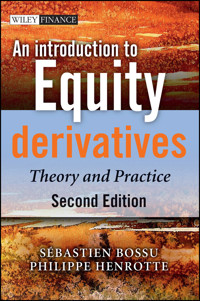
Everything you need to get a grip on the complex world of derivatives Written by the internationally respected academic/finance professional author team of Sebastien Bossu and Philipe Henrotte, An Introduction to Equity Derivatives is the fully updated and expanded second edition of the popular Finance and Derivatives. It covers all of the fundamentals of quantitative finance clearly and concisely without going into unnecessary technical detail. Designed for both new practitioners and students, it requires no prior background in finance and features twelve chapters of gradually increasing difficulty, beginning with basic principles of interest rate and discounting, and ending with advanced concepts in derivatives, volatility trading, and exotic products. Each chapter includes numerous illustrations and exercises accompanied by the relevant financial theory. Topics covered include present value, arbitrage pricing, portfolio theory, derivates pricing, delta-hedging, the Black-Scholes model, and more. * An excellent resource for finance professionals and investors looking to acquire an understanding of financial derivatives theory and practice * Completely revised and updated with new chapters, including coverage of cutting-edge concepts in volatility trading and exotic products An accompanying website is available which contains additional resources including powerpoint slides and spreadsheets. Visit www.introeqd.com for details.
Sie lesen das E-Book in den Legimi-Apps auf:
Seitenzahl: 306
Veröffentlichungsjahr: 2012
Ähnliche


















Contents
Cover
Title Page
Copyright
Foreword
Preface
Disclaimer
Addendum: A Path to Economic Renaissance
Part I: Building Blocks
1: Interest Rate
1-1 Measuring Time
1-2 Interest Rate
1-3 Discounting
1-4 Problems
2: Classical Investment Rules
2-1 Rate of Return. Time of Return
2-2 Net Present Value (NPV)
2-3 Internal Rate of Return (IRR)
2-4 Other Investment Rules
2-5 Further Reading
2-6 Problems
3: Fixed Income
3-1 Financial Markets
3-2 Bonds
3-3 Yield
3-4 Zero-Coupon Yield Curve. Arbitrage Price
3-5 Further Reading
3-6 Problems
4: Portfolio Theory
4-1 Risk and Return of an Asset
4-2 Risk and Return of a Portfolio
4-3 Gains of Diversification. Portfolio Optimization
4-4 Capital Asset Pricing Model
4-5 Further Reading
4-6 Problems
Part II: First Steps in Equity Derivatives
5: Equity Derivatives
5-1 Introduction
5-2 Forward Contracts
5-3 ‘Plain Vanilla’ Options
5-4 Further Reading
5-5 Problems
6: The Binomial Model
6-1 One-Step Binomial Model
6-2 Multi-Step Binomial Trees
6-3 Binomial Valuation Algorithm
6-4 Further Reading
6-5 Problems
7: The Lognormal Model
7-1 Fair Value
7-2 Closed-Form Formulas for European Options
7-3 Monte-Carlo Method
7-4 Further Reading
7-5 Problems
8: Dynamic Hedging
8-1 Hedging Option Risks
8-2 The P&L of Delta-hedged Options
8-3 Further Reading
8-4 Problems
Part III: Advanced Models and Techniques
9: Models for Asset Prices in Continuous Time
9-1 Continuously Compounded Interest Rate
9-2 Introduction to Models for the Behavior of Asset Prices in Continuous Time
9-3 Introduction to Stochastic Processes
9-4 Introduction to Stochastic Calculus
9-5 Further Reading
9-6 Problems
10: The Black-Scholes Model
10-1 The Black-Scholes Partial Differential Equation
10-2 The Black-Scholes Formulas for European Vanilla Options
10-3 Volatility
10-4 Further Reading
10-5 Problems
11: Volatility Trading
11-1 Implied and Realized Volatilities
11-2 Volatility Trading Using Options
11-3 Volatility Trading Using Variance Swaps
11-4 Further Reading
11-5 Problems
12: Exotic Derivatives
12-1 Single-Asset Exotics
12-2 Multi-Asset Exotics
12-3 Beyond Black-Scholes
12-4 Further Reading
12-5 Problems
Solutions
Problem Solutions
Chapter 1
Chapter 2
Chapter 3
Chapter 4
Chapter 5
Chapter 6
Chapter 7
Chapter 8
Chapter 9
Chapter 10
Chapter 11
Chapter 12
Appendices
A: Probability Review
A-1 States of Nature. Random Variables. Events
A-2 Probability. Expectation. Variance
A-3 Distribution. Normal Distribution
A-4 Independence. Correlation
A-5 Probability Formulas
A-6 Further Reading
B: Calculus Review
B-1 Functions of Two Variables x and y
B-2 Taylor Expansions
C: Finance Formulas
C-1 Rates and Yields
C-2 Present Value. Arbitrage Price
C-3 Forward Contracts
C-4 Options
C-5 Volatility
C-6 Stochastic Processes. Stochastic Calculus
C-7 Greeks etc.
Index
This English language edition published 2012 © 2012 Sébastien Bossu and Philippe Henrotte
Translated from the original French edition, Finance des Marchés: Techniques Quantitatives et Applications Practiques, copyright © Dunod, Paris, 2008, 2nd edition.
Registered Office
John Wiley & Sons Ltd, The Atrium, Southern Gate, Chichester, West Sussex, PO19 8SQ, United Kingdom
For details of our global editorial offices, for customer services and for information about how to apply for permission to reuse the copyright material in this book please see our website at www.wiley.com.
The right of the author to be identified as the author of this work has been asserted in accordance with the Copyright, Designs and Patents Act 1988.
All rights reserved. No part of this publication may be reproduced, stored in a retrieval system, or transmitted, in any form or by any means, electronic, mechanical, photocopying, recording or otherwise, except as permitted by the UK Copyright, Designs and Patents Act 1988, without the prior permission of the publisher.
Wiley publishes in a variety of print and electronic formats and by print-on-demand. Some material included with standard print versions of this book may not be included in e-books or in print-on-demand. If this book refers to media such as a CD or DVD that is not included in the version you purchased, you may download this material at http://booksupport.wiley.com. For more information about Wiley products, visit www.wiley.com.
Designations used by companies to distinguish their products are often claimed as trademarks. All brand names and product names used in this book are trade names, service marks, trademarks or registered trademarks of their respective owners. The publisher is not associated with any product or vendor mentioned in this book. This publication is designed to provide accurate and authoritative information in regard to the subject matter covered. It is sold on the understanding that the publisher is not engaged in rendering professional services. If professional advice or other expert assistance is required, the services of a competent professional should be sought.
Library of Congress Cataloging-in-Publication Data
Bossu, Sébastien.
[Finance des marchés. English]
An introduction to equity derivatives : theory and practice / Sébastien Bossu, Philippe Henrotte.
p. cm.
Includes bibliographical references and index.
ISBN 978-1-119-96185-7 (cloth)
1. Investments–Mathematical models. 2. Derivative securities. I. Henrotte, Philippe. II. Henrotte, Philippe.
III. Title.
HG4515.2.B6713 2012
332.64′57–dc23 2011051096
A catalogue record for this book is available from the British Library.
ISBN 978-1-119-96185-7 (hardback) ISBN 978-1-119-96902-0 (ebk)
ISBN 978-1-119-96903-7 (ebk) ISBN 978-1-119-96904-4 (ebk)
Original cover artwork courtesy of MGB: sites.google.com/site/artsmgb
Foreword
Today, equity derivatives are used by hundreds of thousands of people around the world – not only sophisticated investors such as hedge funds, institutional investors, or investment banks, but also private investors. Their popularity is due to the wide array of applications they offer: directional strategies, risk hedging, volatility trading, structured products, to name a few.
This book will be an ideal partner for anyone discovering equity derivatives or who wants to learn more about them. The text is remarkably well structured and accessible, starting with basic concepts and slowly increasing the level of complexity. The problems and accompanying solutions add a lot of insight, and the two new chapters on volatility trading and exotic options are a must-read.
I was very pleased to be asked to write the foreword of this new edition from Sébastien Bossu under the authority of my colleague Philippe Henrotte at HEC Paris. Once again, Sébastien demonstrates his ability to combine his sleek and sharp academic style together with his first-rate practical experience. Along with his constant interaction with many market practitioners, he continues to successfully leverage off his ongoing personal research on some of the most topical pricing and modeling challenges faced by our always-evolving industry.
Olivier Bossard Senior Managing Director Head of Derivatives Trading EMEA at Macquarie Bank
Before joining Macquarie, Olivier Bossard has developed from scratch and led over a decade the exceptional growth of Lehman's Structured Products business in Europe. He has twenty years of experience as an exotic option trader, and has also been teaching Financial Engineering at HEC Paris Business School since 1998.
Preface
For this new edition of our 2005 title Finance and Derivatives we have considerably redrafted our text and focused our attention on equity derivatives which is our core area of expertise. There are two new chapters, numerous chapter additions, several new problems with solutions, more figures and illustrations, and more examples. As before our aim is to suit the needs of both professionals and aspiring professionals discovering the field. No prior knowledge in finance is assumed, the only required background is an undergraduate level in mathematics.
The chapters form a sequence of gradual difficulty which we grouped within three parts:
Part I: Building Blocks (Chapters 1 to 4) covers the fundamental concepts used in quantitative finance: interest rates, the time value of money, bonds and yields, portfolio valuation, risk and return, diversification.Part II: First Steps in Equity Derivatives (Chapters 5 to 8) covers forward contracts, options and option strategies, the binomial model, the lognormal model, Monte-Carlo simulations, and dynamic hedging. This part only relies on discrete time concepts in order to remain widely accessible.Part III: Advanced Models and Techniques (Chapters 9 to 12) goes one level higher into continuous time finance and covers models for asset prices, stochastic processes and calculus, the Black-Scholes model, volatility trading, exotic derivatives, and advanced models.Our approach was to focus on the fundamentals while covering a fair amount of practical applications. We endeavored to keep our text as concise and straightforward as possible, leaving non-essential concepts and technical proofs to problems of higher difficulty which are identified with an asterisk (*).
The 2007–2008 financial crisis highlighted the fact that derivatives were often poorly understood. We do not think that the solution is to ban them altogether: when you are in the passenger seat and have just escaped a fatal car crash after speeding, you typically don't get rid of the car. Rather, we believe that more information and training is needed in the field (along with better drivers), and we hope that this new edition will prove useful and insightful to a large audience.
Disclaimer
This is a book about finance intended for professionals and future professionals. We are not trying to sell you any security, or give you any investment advice. The views expressed here are solely ours and do not necessarily reflect those of any entity directly or indirectly related to us. We took great care in proof-reading this book, but we disclaim any responsibility for any remaining errors and any use to which the contents of this book are put.
Addendum: A Path to Economic Renaissance
The following opinion piece only reflects the personal views of the author and does not engage any other contributor to this book.
This new publication provides me with the opportunity to comment on the current economic and cultural climate, which has changed markedly since the last edition. In particular, derivatives came into the spotlight and have been heavily criticized.
I want to emphasize that equity derivatives are not inherently harmful. When used competently, derivatives can reduce risk or, more precisely, they allow investors to select certain types of risks over others. While it is true that credit derivatives compounded losses early on in the recent economic crisis, they are not to be blamed for the culture of “real estate envy”, cheap money and ostentation which then prevailed.
The crisis is far from being fully resolved. There is a distressing gap between the pessimism in mainstream political and management discourse, and the reality in large banks and corporations where profits are close to record highs and executive pay is on the rise.
To paraphrase Ronald Reagan, there is a rising sentiment that our leaders are the problem, not the solution, as expressed by many popular movements such as ‘Occupy Wall Street’. Rather than reshuffling cards in favor of the next generation – a process known as ‘creative destruction’ in Schumpeter's theory – we just seem to be doubling down on the people who failed.
It is urgent, in my opinion, to take actions to increase the circulation of wealth in the economy in order to restore confidence in economic growth and progress. A few years ago, in a joint op-ed article published by a respected French economics newspaper, I proposed to cut on income taxes, which would give a much-needed break to the middle class, and introduce in its place a small annual tax on individual net worth (i.e. assets minus liabilities.) Unfortunately this piece was not published in equivalent newspapers or magazines in the US and the UK, perhaps because it was then perceived as too unorthodox.
Meanwhile, I have been distressed by the flurry of extravagant proposals dominating the media space: salary caps, bans on speculation, bans on derivatives, taxes on financial transactions, to name a few. All these proposals would result in costly bureaucratic rigidities at a time when we need to foster entrepreneurship, mobility and innovation.
The desire to protect consumers is of course legitimate, but the best protection is often provided through transparency. For example, I have suggested that financial retailers clearly break down the price of investments they offer between the present values of their fees and wholesale costs. This would help consumers understand how much of their money is effectually spent on financial assets, and promote competition between providers.
Every financial investment, from buying a house to purchasing Treasury bonds or options, is speculative in nature. Some people manage to get rich very quickly through talent, vision and hard work, and that's admirable. Others manage to stay rich by promoting a culture of entitlement, status quo and cronyism, and we should resist against that.
I have no doubt we will get back on track as soon as the obvious choices are made. On the corporate side, expensive and redundant management layers must be cut in order to make room for new talent. On the political and economic side, we must promote a more equitable circulation of wealth. Above all, we must begin to select leaders not only because of their performance but also based on their ethics, bearing in mind the wisdom of ancient Greek philosophers who held that virtue cannot be taught: either you have it, or you don’t.
Sébastien Bossu, February 2012
Part I
Building Blocks
Lesen Sie weiter in der vollständigen Ausgabe!
Lesen Sie weiter in der vollständigen Ausgabe!
Lesen Sie weiter in der vollständigen Ausgabe!
Lesen Sie weiter in der vollständigen Ausgabe!
Lesen Sie weiter in der vollständigen Ausgabe!
Lesen Sie weiter in der vollständigen Ausgabe!
Lesen Sie weiter in der vollständigen Ausgabe!
Lesen Sie weiter in der vollständigen Ausgabe!
Lesen Sie weiter in der vollständigen Ausgabe!
Lesen Sie weiter in der vollständigen Ausgabe!
Lesen Sie weiter in der vollständigen Ausgabe!
Lesen Sie weiter in der vollständigen Ausgabe!
Lesen Sie weiter in der vollständigen Ausgabe!
Lesen Sie weiter in der vollständigen Ausgabe!
Lesen Sie weiter in der vollständigen Ausgabe!
Lesen Sie weiter in der vollständigen Ausgabe!
Lesen Sie weiter in der vollständigen Ausgabe!
Lesen Sie weiter in der vollständigen Ausgabe!
Lesen Sie weiter in der vollständigen Ausgabe!
Lesen Sie weiter in der vollständigen Ausgabe!




