


35,99 €
Mehr erfahren.
- Herausgeber: John Wiley & Sons
- Kategorie: Fachliteratur
- Serie: At a Glance
- Sprache: Englisch
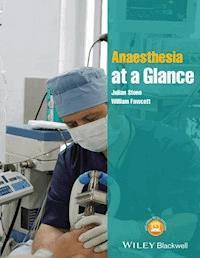
Anaesthesia at a Glance is a brand new title that provides a concise and visually-orientated summary of a comprehensive lecture course in anaesthesia. Ideal for clinical undergraduate medical students and Foundation Programme doctors undertaking anaesthesia attachments, it gives a systematic, broad view of anaesthesia in various specialties, taking the reader through preparation, management and the pharmacology behind anaesthetic medicine.
Anaesthesia at a Glance is supported by a companion website at www.ataglanceseries.com/anaesthesia containing interactive multiple-choice questions and answers together with a selection of interactive cases – perfect for study and revision.
Whether you want to refresh your knowledge or need a thorough overview of the specialty, Anaesthesia at a Glance presents all the vital clinical information you need.
Sie lesen das E-Book in den Legimi-Apps auf:
Seitenzahl: 194
Veröffentlichungsjahr: 2013
Ähnliche



















Table of Contents
Title page
Copyright page
Preface
How to use your textbook
Features contained within your textbook
About the companion website
Abbreviations
1: History of anaesthesia
First documented anaesthetic
Ether and chloroform
Anaesthesia as a medical specialty
The development and use of local anaesthetics
Typical career path in anaesthesia
Useful links
2: Monitoring
Electrocardiography (ECG)
Oximetry
Blood pressure (BP) and cardiac output
Gas analysis
End tidal CO2 (ETCO2) monitoring
Airway pressure
Central venous pressure (CVP)
3: Equipment
Anaesthetic machine
Vaporizer
Safety features
Breathing circuits
4: Airway devices
Supraglottic devices
Infraglottic devices
Emergency airway devices
5: Fluid management
Fluid compartments
Intravenous fluids
Fluid prescribing
Assessment of fluid status
6: Preoperative preparation of the patient for surgery
Timing of surgery
Assessment of risk
Preoperative assessment clinics
Fasting
Preoperative care
Arrival in theatre
7: Temperature regulation
Consequences of hypothermia
Monitoring temperature during anaesthesia
Maintaining temperature during anaesthesia
Postoperative shivering
8: The perioperative patient journey
Preoperative stage
Intraoperative stage
Postoperative stage
9: General anaesthesia – inhalational anaesthetics
Minimum alveolar concentration (MAC)
General effects
10: General anaesthesia – intravenous anaesthetics
Propofol (2,6-diisopropylphenol)
Thiopental
Benzodiazepines (e.g. midazolam)
Ketamine
Etomidate
11: Local anaesthetics
Uses
Mechanism of action
Speed of onset of action
Duration of action
Toxicity
Other side effects
Eutectic mixture of local anaesthetics (EMLA) and intravenous regional anaesthesia (IVRA)
12: Neuromuscular blocking drugs
Depolarizing neuromuscular blocking drugs (NMBDs) – suxamethonium
Non-depolarizing neuromuscular blocking drugs
Monitoring of muscle paralysis
13: Acute pain
Pain management
14: Postoperative nausea and vomiting
Mechanism
Treatment
Management
15: Chronic pain
Neuropathic pain
Chronic back pain
Neck pain
Fibromyalgia (FMS) and myofascial (MFS) syndromes
Headache and facial pain
16: The airway
Airway assessment
Management of the airway (basic)
The expected difficult airway
The unexpected difficult airway
Unstable neck
17: Emergency anaesthesia
What is an emergency?
Resuscitation
Gastric emptying
Preparing a patient for emergency surgery
18: Obstetric anaesthesia
Epidurals for pain relief in labour
Lower segment Caesarean section
Other areas
Risks
19: Ophthalmic anaesthesia
Cataract surgery
Squint surgery
Vitreoretinal surgery
Penetrating eye injury
Problems in ophthalmic anaesthesia
20: Paediatric anaesthesia
Anaesthetic management of children
Areas of interest
21: Cardiac and thoracic anaesthesia
Cardiac anaesthesia
Thoracic surgery
22: Regional anaesthesia
Central (neuraxial) blockade
Nerve plexus blockade
23: Anaesthetic emergencies in the operating theatre
Aspiration
Air embolism
Laryngospasm
Failed or difficult intubation
Malignant hyperthermia (MH)
24: Anaesthetic emergencies in the wider hospital
Anaphylaxis
Cardiac arrest
Status asthmaticus
Choking/airway obstruction
25: Trauma
Primary survey
Secondary survey
Investigations
26: Orthopaedic anaesthesia
Preoperative care
Peroperative care
Postoperative care
27: Anaesthesia and obesity
Fat distribution
Respiratory system
Cardiovascular system
Other factors
Anaesthetic management
28: Anaesthesia and old age
Anaesthetic management of elderly patients
29: Anaesthesia and diabetes
General management of blood glucose in patients with diabetes
Management of blood glucose for diabetic patients undergoing surgery
General management of diabetic patients undergoing surgery
30: Anaesthesia for vascular surgery
Preoperative assessment
Preoperative treatment
Postoperative care
Ruptured abdominal aortic aneurysm (AAA): a common vascular emergency
31: Anaesthesia for ENT and maxillofacial surgery
Preoperative assessment
Special areas
Emergency surgery
32: Awareness
Causes of awareness
Methods of assessment and measurement
33: Anaesthesia for ECT, dental surgery and special needs
Anaesthesia for electroconvulsive therapy
Anaesthesia for dental surgery
Anaesthesia for those with special needs
34: Postoperative management
Analgesia
Fluids
Referral to high dependency unit/intensive care unit
Early warning scores (EWS)
Oxygen therapy
Others
35: Anaesthesia away from the hospital setting
Trauma
Battle scenarios
Index
This edition first published 2013 © 2013 by Julian Stone and William Fawcett.
Registered office: John Wiley & Sons, Ltd, The Atrium, Southern Gate, Chichester, West Sussex, PO19 8SQ, UK
Editorial offices: 9600 Garsington Road, Oxford, OX4 2DQ, UK
The Atrium, Southern Gate, Chichester, West Sussex, PO19 8SQ, UK
111 River Street, Hoboken, NJ 07030-5774, USA
For details of our global editorial offices, for customer services and for information about how to apply for permission to reuse the copyright material in this book please see our website at www.wiley.com/wiley-blackwell
The right of the author to be identified as the author of this work has been asserted in accordance with the UK Copyright, Designs and Patents Act 1988.
All rights reserved. No part of this publication may be reproduced, stored in a retrieval system, or transmitted, in any form or by any means, electronic, mechanical, photocopying, recording or otherwise, except as permitted by the UK Copyright, Designs and Patents Act 1988, without the prior permission of the publisher.
Designations used by companies to distinguish their products are often claimed as trademarks. All brand names and product names used in this book are trade names, service marks, trademarks or registered trademarks of their respective owners. The publisher is not associated with any product or vendor mentioned in this book. It is sold on the understanding that the publisher is not engaged in rendering professional services. If professional advice or other expert assistance is required, the services of a competent professional should be sought.
The contents of this work are intended to further general scientific research, understanding, and discussion only and are not intended and should not be relied upon as recommending or promoting a specific method, diagnosis, or treatment by health science practitioners for any particular patient. The publisher and the author make no representations or warranties with respect to the accuracy or completeness of the contents of this work and specifically disclaim all warranties, including without limitation any implied warranties of fitness for a particular purpose. In view of ongoing research, equipment modifications, changes in governmental regulations, and the constant flow of information relating to the use of medicines, equipment, and devices, the reader is urged to review and evaluate the information provided in the package insert or instructions for each medicine, equipment, or device for, among other things, any changes in the instructions or indication of usage and for added warnings and precautions. Readers should consult with a specialist where appropriate. The fact that an organization or Website is referred to in this work as a citation and/or a potential source of further information does not mean that the author or the publisher endorses the information the organization or Website may provide or recommendations it may make. Further, readers should be aware that Internet Websites listed in this work may have changed or disappeared between when this work was written and when it is read. No warranty may be created or extended by any promotional statements for this work. Neither the publisher nor the author shall be liable for any damages arising herefrom.
Library of Congress Cataloging-in-Publication Data
Stone, Julian, author.
Anaesthesia at a glance / Julian Stone, William Fawcett.
p. ; cm. – (At a glance)
Includes bibliographical references and index.
ISBN 978-1-4051-8756-5 (pbk. : alk. paper) – ISBN 978-1-118-76533-3 (ePub) – ISBN 978-1-118-76532-6 – ISBN 978-1-118-76531-9 – ISBN 978-1-118-76530-2 (Mobi) – ISBN 978-1-118-76529-6
I. Fawcett, William, 1962– author. II. Title. III. Series: At a glance series (Oxford, England)
[DNLM: 1. Anesthesia–methods. 2. Anesthesiology–instrumentation. 3. Anesthetics. WO 200]
RD81
617.9′6–dc23
2013018954
A catalogue record for this book is available from the British Library.
Wiley also publishes its books in a variety of electronic formats. Some content that appears in print may not be available in electronic books.
Cover image: © iStockphoto/Beerkoff
Cover design by Meaden Creative
Preface
Anaesthesia is often intimidating for students. Within the relatively short time allocated to this disciplines on most undergraduate curricula, there seems to be a bewildering array of unfamiliar drugs, equipment and practical procedures. Yet at the very heart of anaesthesia is the modern concept of perioperative medicine. The fundamentals of anaesthesia, such as assessment and management of the airway, respiration, circulation and analgesia, are applicable to all hospital staff involved in the care of the surgical patient.
Both authors are practising clinical anaesthetists and also actively involved in undergraduate teaching. Moreover, as anaesthetists are the largest single group of doctors within hospital medicine it seems appropriate that a contemporary undergraduate textbook is available as an introduction to the specialty.
The aim of the authors has been to cover the practice of anaesthesia to a level appropriate for a medical student who is about to embark on the Foundation Programme. Certain specialized subjects that are traditionally taught, such as physics, have therefore been omitted.
Each chapter has a self assessment section of both multiple choice questions and case studies. The answers are not exhaustive, but should encourage further reading on the subject.
Whilst this book is aimed primarily at undergraduate medical students, it may also prove of value to Foundation Doctors looking after patients in the perioperative period, doctors embarking on a career in anaesthesia and theatre staff such as Operating Department Practitioners
The authors would like to thank Laura Murphy, Helen Harvey, Elizabeth Norton, Simon Jones, Ruth Swan, Kevin Fung and Brenda Sibbald. They acknowledge and dedicate this book to those who have given encouragement and support throughout. JS would like to thank Edwina, Freddie, Hugo and Lucinda. WF would like to thank Victoria, George, Alice and Joseph.
Julian Stone
William Fawcett
How to use your textbook
Features contained within your textbook
Each topic is presented in a double-page spread with clear, easy-to-follow diagrams supported by succinct explanatory text.
Section not available in this digital edition
About the companion website
This book is accompanied by a companion website:
The website includes:
Interactive MCQsInteractive case studiesLesen Sie weiter in der vollständigen Ausgabe!
Lesen Sie weiter in der vollständigen Ausgabe!
Lesen Sie weiter in der vollständigen Ausgabe!
Lesen Sie weiter in der vollständigen Ausgabe!
Lesen Sie weiter in der vollständigen Ausgabe!
Lesen Sie weiter in der vollständigen Ausgabe!
Lesen Sie weiter in der vollständigen Ausgabe!
Lesen Sie weiter in der vollständigen Ausgabe!
Lesen Sie weiter in der vollständigen Ausgabe!
Lesen Sie weiter in der vollständigen Ausgabe!
Lesen Sie weiter in der vollständigen Ausgabe!
Lesen Sie weiter in der vollständigen Ausgabe!
Lesen Sie weiter in der vollständigen Ausgabe!
Lesen Sie weiter in der vollständigen Ausgabe!
Lesen Sie weiter in der vollständigen Ausgabe!
Lesen Sie weiter in der vollständigen Ausgabe!
Lesen Sie weiter in der vollständigen Ausgabe!
Lesen Sie weiter in der vollständigen Ausgabe!
Lesen Sie weiter in der vollständigen Ausgabe!
Lesen Sie weiter in der vollständigen Ausgabe!
Lesen Sie weiter in der vollständigen Ausgabe!
Lesen Sie weiter in der vollständigen Ausgabe!
Lesen Sie weiter in der vollständigen Ausgabe!
Lesen Sie weiter in der vollständigen Ausgabe!
Lesen Sie weiter in der vollständigen Ausgabe!
Lesen Sie weiter in der vollständigen Ausgabe!
Lesen Sie weiter in der vollständigen Ausgabe!
Lesen Sie weiter in der vollständigen Ausgabe!
Lesen Sie weiter in der vollständigen Ausgabe!
Lesen Sie weiter in der vollständigen Ausgabe!
Lesen Sie weiter in der vollständigen Ausgabe!
Lesen Sie weiter in der vollständigen Ausgabe!
Lesen Sie weiter in der vollständigen Ausgabe!
Lesen Sie weiter in der vollständigen Ausgabe!
Lesen Sie weiter in der vollständigen Ausgabe!
Lesen Sie weiter in der vollständigen Ausgabe!
Lesen Sie weiter in der vollständigen Ausgabe!




