


39,99 €
Mehr erfahren.
- Herausgeber: Thieme Medical Publishers
- Kategorie: Fachliteratur
- Sprache: Englisch
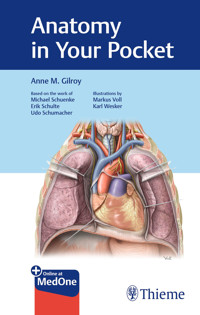
Exquisitely illustrated portable anatomical study tool a must-have for medical students
Anatomy in Your Pocket by Anne Gilroy is based on the award-winning textbook Atlas of Anatomy and the work of Michael Schuenke, Erik Schulte, and Udo Schumacher. This volume is organized by seven sections: the back, thorax, abdomen, pelvis, upper limb, lower limb, and head and neck. Each card features a full-color illustration with numerical labels only, while the reverse side provides the answers, an ideal format for self-testing.
Key Highlights
- More than 400 exceptionally detailed full-color illustrations by Markus Voll and Karl Wesker supplemented by high-quality photos delineate body structures
- Tables, high-yield clinical correlations, didactically relevant Q&A, and superb illustrations enable studying, memorizing, and reviewing the most important concepts in human anatomy
- The compact spiral binding protects the cards and is perfect for on-the-go studying and quick reference
First-year medical students studying gross anatomy and second-year medical students preparing for the USMLE® Step 1 or COMLEX will benefit from using this resource as a study companion. It is also a go-to anatomical reference for other medical trainees who need a succinct yet thorough review of key anatomy.
Das E-Book können Sie in Legimi-Apps oder einer beliebigen App lesen, die das folgende Format unterstützen:
Veröffentlichungsjahr: 2018
Ähnliche


















To access additional material or resources available with this e-book, please visit http://www.thieme.com/bonuscontent. After completing a short form to verify your e-book purchase, you will be provided with the instructions and access codes necessary to retrieve any bonus content.
Anatomy in Your Pocket
Edited byAnne M. Gilroy, MAProfessorDepartment of RadiologyUniversity of Massachusetts Medical SchoolWorcester, Massachusetts
Based on the work ofMichael Schuenke, MD, PhDInstitute of AnatomyChristian Albrecht University KielKiel, Germany
Erik Schulte, MDDepartment of Functional and Clinical AnatomyUniversity MedicineJohannes Gutenberg UniversityMainz, Germany
Udo Schumacher, MD, FRCPath, CBiol, FSB, DScInstitute of Anatomy and Experimental MorphologyCenter for Experimental MedicineUniversity Cancer CenterUniversity Medical Center Hamburg-EppendorfHamburg, Germany
Illustrations byMarkus VollKarl Wesker
442 illustrations
ThiemeNew York • Stuttgart • Delhi • Rio de Janeiro
Executive Editor: Delia DeTurris
Managing Editor: Torsten Scheihagen
Director, Editorial Services: Mary Jo Casey
Production Editor: Barbara Chernow
International Production Director: Andreas Schabert
Editorial Director: Sue Hodgson
International Marketing Director: Fiona Henderson
International Sales Director: Louisa Turrell
Director of Institutional Sales: Adam Bernacki
Senior Vice President and Chief Operating Officer: Sarah Vanderbilt
President: Brian D. Scanlan
Library of Congress Cataloging-in-Publication Data
Names: Gilroy, Anne M., editor. | Voll, Markus M., illustrator. | Wesker, Karl, illustrator. | Based on (work): Schuenke, Michael. Thieme atlas of anatomy.
Title: Anatomy in your pocket / edited by Anne M. Gilroy; based on the work of Michael Schuenke, Erik Schulte, Udo Schumacher; illustrations by Markus Voll, Karl Wesker.
Description: New York : Thieme, [2018] |
Identifiers: LCCN 2017056187 (print) | LCCN 2017057413 (ebook) | ISBN 9781626239135 () | ISBN 9781626239128 (alk. paper) | ISBN 9781626239135 (ebook)
Subjects: | MESH: Anatomy | Handbooks | Atlases
Classification: LCC QM25 (ebook) | LCC QM25 (print) | NLM QS 39 | DDC 612.0022/3—dc23
LC record available at https://lccn.loc.gov/2017056187
Copyright © 2018 by Thieme Medical Publishers, Inc.
Thieme Publishers New York333 Seventh Avenue, New York, NY 10001 USA+1 800 782 3488, [email protected]
Thieme Publishers StuttgartRüdigerstrasse 14, 70469 Stuttgart, Germany+49 [0]711 8931 421, [email protected]
Thieme Publishers DelhiA-12, Second Floor, Sector-2, Noida-201301Uttar Pradesh, India+91 120 45 566 00, [email protected]
Thieme Publishers Rio de Janeiro, ThiemePublicações Ltda.Edifício Rodolpho de Paoli, 25⍛ andarAv. Nilo Peçanha, 50 – Sala 2508,Rio de Janeiro 20020-906 Brasil+55 21 3172-2297 / +55 21 3172-1896
Cover design: Thieme Publishing Group
Typesetting by Carol Pierson, Chernow Editorial Services, Inc.
Printed in India by Replika Press Pvt. Ltd. 5 4 3 2 1
ISBN 978-1-62623-912-8
Also available as an e-book:eISBN 978-1-62623-913-5
Important note: Medicine is an ever-changing science undergoing continual development. Research and clinical experience are continually expanding our knowledge, in particular our knowledge of proper treatment and drug therapy. Insofar as this book mentions any dosage or application, readers may rest assured that the authors, editors, and publishers have made every effort to ensure that such references are in accordance with the state of knowledge at the time of production of the book.
Nevertheless, this does not involve, imply, or express any guarantee or responsibility on the part of the publishers in respect to any dosage instructions and forms of applications stated in the book. Every user is requested to examine carefully the manufacturers’ leaflets accompanying each drug and to check, if necessary in consultation with a physician or specialist, whether the dosage schedules mentioned therein or the contraindications stated by the manufacturers differ from the statements made in the present book. Such examination is particularly important with drugs that are either rarely used or have been newly released on the market. Every dosage schedule or every form of application used is entirely at the user’s own risk and responsibility. The authors and publishers request every user to report to the publishers any discrepancies or inaccuracies noticed. If errors in this work are found after publication, errata will be posted at www.thieme.com on the product description page.
Some of the product names, patents, and registered designs referred to in this book are in fact registered trademarks or proprietary names even though specific reference to this fact is not always made in the text. Therefore, the appearance of a name without designation as proprietary is not to be construed as a representation by the publisher that it is in the public domain.
This book, including all parts thereof, is legally protected by copyright. Any use, exploitation, or commercialization outside the narrow limits set by copyright legislation, without the publisher’s consent, is illegal and liable to prosecution. This applies in particular to photostat reproduction, copying, mimeographing, preparation of microfilms, and electronic data processing and storage.
“It is not length of life,but depth of life that matters.”
~Ralph Waldo Emerson
To Luke, thank you for the inspiration of a life lived with courage and grace,
And
To Laila, Harvey, Eva, and Finn, the future is yours.
Contents
1 Back
2 Thorax
3 Abdomen
4 Pelvis
5 Upper Limb
6 Lower Limb
7 Head and Neck
Icon Key
Question
Answer
Comment
Clinical
Each card in this set features a full-color illustration with key structures labeled numerically. The reverse side of every card lists the labels. Where questions appear on the front of the card, corresponding answers are supplied on the back. Comments provide helpful information, and clinical correlates describe relevant applications of anatomy.
Back
Bony Vertebral Column
Structural Elements of a Vertebra
Cervical Spine
Atlas
Axis
Typical Cervical Vertebra (C4)
Thoracic Spine
Lumbar Spine
Sacrum and Coccyx, Anterior View
Sacrum and Coccyx, Posterior View
Joints of the Vertebral Column
Ligaments of the Cervical Spine
Ligaments of the Vertebral Column: Thoracolumbar Junction
Short Nuchal and Craniovertebral Joint Muscles
Superficial Intrinsic Back Muscles
Intermediate Intrinsic Back Muscles I
Intermediate Intrinsic Back Muscles II
Posterior Intercostal Arteries
Posterior Intercostal Veins
Spinal Meningeal Layers
Cervical Spinal Cord In Situ: Transverse Section
Cauda Equina in the Vertebral Canal
Spinal Cord Segment
Bony Vertebral Column
Fig. 2.1B. From Atlas of Anatomy, Third Edition, p. 4.
intervertebral foramina
intervertebral disc
sacral promontory
coccyx
sacrum (S1–S5 vertebrae)
L1–L5 vertebrae
T1–T12 vertebrae
C1–C7 vertebrae
The characteristic curvatures of the adult spine appear over the course of postnatal development, being only partially present in a newborn. The newborn has a kyphotic spinal curvature; lumbar lordosis develops later and becomes stable at puberty.
Structural Elements of a Vertebra
Fig. 2.4. From Atlas of Anatomy, Third Edition, p. 7.
superior articular process
transverse process
spinous process
inferior articular process
lamina
pedicle
vertebral arch
vertebral body
With the exception of the atlas (C1) and axis (C2), all vertebrae consist of the same structural elements. The pedicles and laminae make up the vertebral arch, which, together with the vertebral body, encloses the vertebral foramen. The combined vertebral foramina of all of the vertebrae create the vertebral canal.
Cervical Spine
Fig. 2.6A,B. From Atlas of Anatomy, Third Edition, p. 8.
posterior arch of atlas
spinous process of C2
spinous process of C7
transverse foramen
uncinate process
groove for spinal n.
C2 (axis)
The cervical spine is prone to hyperextension injuries, such as whiplash, which can occur when the head extends back much farther than it normally would. The most common injuries of the cervical spine are fractures of the dens of the atlas, traumatic spondylolisthesis (anterior slippage of a vertebral body), and atlas fractures. Patient prognosis largely depends on the spinal level of the injury.
Atlas
Fig. 2.7A,C. From Atlas of Anatomy, Third Edition, p. 8–9.
How does the basic structure of the atlas (C1) differ from typical cervical vertebrae?
posterior tubercle
posterior arch
transverse process
inferior articular facet
transverse foramen
anterior tubercle
anterior arch
facet for den
superior articular facet
The atlas lacks a vertebral body and a spinous process characteristic of C2–C7. Superiorly it articulates with the occipital condyles of the occipital bone of the skull.
Axis
Fig. 2.8A,C. From Atlas of Anatomy, Third Edition, p. 8–9.
spinous process
vertebral arch
inferior articular facet
transverse foramen
superior articular facet
anterior articular facet
dens
vertebral foramen
The axis is unique among vertebrae in having a superiorly projecting process, the dens, which articulates with the anterior arch of the atlas.
Typical Cervical Vertebra (C4)
Fig. 2.9A,C. From Atlas of Anatomy, Third Edition, p. 8–9.
What structure is transmitted through the transverse foramina of most (usually C1–C6) cervical vertebrae?
transverse foramen
superior articular facet
spinous process
inferior articular facet
body
transverse process
vertebral arch
pedicle
lamina
vertebral foramen
The vertebral arteries, which originate from the subclavian arteries, pass through the transverse foramina of C1–C6.
Thoracic Spine
Fig. 2.10. From Atlas of Anatomy, Third Edition, p. 10.
spinous process
inferior articular process
superior articular process
transverse process
costal facet on transverse process
zygapophyseal joint
superior vertebral notch
inferior vertebral notch
intervertebral foramen
superior costal facet
inferior costal facet
Lumbar Spine
Fig. 2.12 and Clinical Box 2.3A. From Atlas of Anatomy, Third Edition, p. 11.
superior articular process
transverse process
spinous process
inferior articular facet
vertebral body
superior vertebral notch
inferior vertebral notch
intervertebral foramen
Sacrum and Coccyx, Anterior View
Fig. 2.14A. From Atlas of Anatomy, Third Edition, p. 12.
What structures pass through the anterior sacral foramina?
wing of sacrum
sacrococcygeal joint
coccyx
apex of sacrum
anterior sacral foramina
promontory
Anterior rami of the sacral spinal nerves pass through the anterior foramina to join the sacral plexus.
Sacrum and Coccyx, Posterior View
Fig. 2.14B. From Atlas of Anatomy, Third Edition, p. 12.
sacral canal
superior articular facet
sacral tuberosity
auricular surface
lateral sacral crest
median sacral crest
medial sacral crest
sacral hiatus
sacral cornua
posterior sacral foramina
Joints of the Vertebral Column
Table 2.2. From Atlas of Anatomy, Third Edition, p. 16.
atlantooccipital joint
atlantoaxial joint
uncovertebral joint
intervertebral joint
zygopophyseal joint
Craniovertebral joints
Atlanto-occipital joints
Occiput–C1
Atlantoaxial joints
C1–C2
Joints of the vertebral bodies
Uncovertebral joints
C3–C7
Intervertebral joints
C2–S1
Joints of the vertebral arch
Zygapophyseal joints
C2–S1
Ligaments of the Cervical Spine
Fig. 2.28A. From Atlas of Anatomy, Third Edition, p. 21.
dens of axis (C2)
posterior atlanto-occipital membrane
nuchal lig.
ligamenta flava
supraspinous lig.
posterior longitudinal lig.
anterior longitudinal lig.
anterior arch of atlas (C1)
anterior atlanto-occipital membrane
occipital bone
The nuchal ligament is the broadened, sagittally oriented part of the supraspinous ligament that extends from the vertebra prominens (C7) to the external occipital protuberance.
Ligaments of the Vertebral Column: Thoracolumbar Junction
Fig. 2.29. From Atlas of Anatomy, Third Edition, p. 22.
posterior longitudinal lig.
ligamenta flava
interspinous ligs.
supraspinous lig.
anterior longitudinal lig.
nucleus pulposus
anulus fibrosus
intervertebral disk
The ligaments of the spinal column bind the vertebrae securely to one another and enable the spine to withstand high mechanical loads and shearing stresses.
Short Nuchal and Craniovertebral Joint Muscles
Fig. 3.6A,B. From Atlas of Anatomy, Third Edition, p. 30.
superior nuchal line
rectus capitis posterior minor
obliquus capitis superior
rectus capitis posterior major
transverse process of atlas (C1)
obliquus capitis inferior
spinous process of axis (C2)
Superficial Intrinsic Back Muscles
Fig. 3.10A. From Atlas of Anatomy, Third Edition, p. 33.
serratus posterior superior
serratus posterior inferior
splenius capitis
splenius cervicis
Intermediate Intrinsic Back Muscles I
Fig. 3.9A, 3.10B. From Atlas of Anatomy, Third Edition, p. 32–33.
iliocostalis cervicis
iliocostalis thoracis
iliocostalis lumborum
Intermediate Intrinsic Back Muscles II
Fig. 3.9B,C, 3.10B. From Atlas of Anatomy, Third Edition, p. 32–33.
longissimus capitis
longissimus cervicis
longissimus thoracis
spinalis cervicis
spinalis thoracis
Posterior Intercostal Arteries
Fig. 4.1C. From Atlas of Anatomy, Third Edition, p. 36.
dorsal branch of posterior intercostal a.
medial cutaneous branch
thoracic aorta
posterior intercostal a.
lateral cutaneous branch
anterior intercostal a.
anterior cutaneous branch
internal thoracic a.
The structures of the back are supplied by branches of the posterior intercostal arteries, which arise from the thoracic aorta or the subclavian artery. They give rise to cutaneous and muscular branches as well as spinal branches, which supply the spinal cord.
Posterior Intercostal Veins
Fig. 4.2C. From Atlas of Anatomy, Third Edition, p. 37.
intervertebral v.
hemiazygos v.
anterior external vertebral venous plexus
internal thoracic vv.
anterior intercostal v.
azygos v.
anterior external vertebral venous plexus
posterior internal vertebral venous plexus
posterior intercostal v.
The veins of the back drain into the azygos vein via the superior intercostal veins, hemiazygos veins, and ascending lumbar veins. The interior of the spinal column is drained by the vertebral venous plexus, which runs the length of the spine.
Spinal Meningeal Layers
Fig. 4.7. From Atlas of Anatomy, Third Edition, p. 40.
anterior spinal vv.
subarachnoid space
posterior root
anterior root
spinal n.
denticulate lig.
anterior rootlets
dura mater
subdural space
arachnoid (mater)
pia mater
anterior spinal a.
Cervical Spinal Cord In Situ: Transverse Section
Fig. 4.8. From Atlas of Anatomy, Third Edition, p. 40.
What is contained in the epidural and subarachnoid spaces surrounding the spinal cord?
posterior internal vertebral venous plexus
intervertebral foramen
spinal ganglion
spinal n.
anterior internal vertebral venous plexus
vertebral a.
anterior root
posterior root
dura mater
arachnoid (mater)
subarachnoid space
epidural space
The epidural space contains fat and the internal vertebral venous plexus. The subarachnoid space contains the cerebrospinal fluid and is traversed by the denticulate ligaments, which anchor the pia mater to the dura.
Cauda Equina in the Vertebral Canal
Fig. 4.9. From Atlas of Anatomy, Third Edition, p. 41.
spinal ganglion
dura mater
arachnoid (mater)
filum terminale
sacral hiatus
cauda equina
conus medullaris
Although the spinal cord ends at the conus medullaris, the lower spinal roots, L2–Co1 (known as the cauda equina), extend inferiorly within the lumbar cistern, an expansion of the subarachnoid space surrounded by the dural sac.
Spinal Cord Segment
Fig. 4.12. From Atlas of Anatomy, Third Edition, p. 42.
What is the destination of the anterior and posterior rami of the spinal nerves?
posterior rootlets
posterior root with spinal ganglion
spinal n.
posterior ramus
anterior ramus
gray ramus communicans
white ramus communicans
sympathetic trunk
splanchnic nn.
anterior root
anterior rootlets
gray matter, anterior horn
white matter
gray matter, posterior horn
Anterior rami innervate the anterolateral trunk wall and limbs:
• C1–C4 form the cervical plexus
• C5–T1 form the brachial plexus
• T1–T12 remain as segmental (intercostal) nn.
• L1–L4 become the lumbar plexus
• L5–S3 become the sacral plexus
Posterior rami innervate the skin and muscles of the back and posterior scalp.
Thorax
Thoracic Skeleton
Muscles of the Thoracic Wall I
Muscles of the Thoracic Wall II
Diaphragm, Coronal Section
Arteries of the Thoracic Wall
Neurovasculature of the Diaphragm
Structures of the Breast
The Aortic Arch
Azygos System
Lymphatic Trunks in the Thorax
Contents of the Mediastinum
Mediastinum, Right Lateral View
Mediastinum, Left Lateral View
Heart In Situ
Posterior Pericardium
Anterior Surface of the Heart
Posterior Surface (Base) of the Heart
Right Ventricle of the Heart, Anterior View
Right Atrium of the Heart, Right Lateral View
Left Atrium and Ventricle of the Heart, Left Lateral View
Cardiac Valves
Coronary Arteries and Cardiac Veins, Anterior View
Coronary Arteries and Cardiac Veins, Posteroinferior View
Cardiac Conduction System
Autonomic Nerves of the Heart
Prenatal Circulation
Esophagus In Situ
Parietal Pleura
Pleura and the Costodiaphragmatic Recess, Coronal Section, Anterior View
Right Lung
Left Lung
Trachea
Bronchial Tree: Conduction Portion
Bronchial Tree: Respiratory Portion
Pulmonary Arteries and Veins
Lymph Nodes and Trunks of the Pleural Cavity
Radiographic Appearance of the Heart, Posteroanterior View
Radiographic Appearance of the Heart, Left Lateral View
Pleural Recesses
Thoracic Skeleton
Fig. 7.1. From Atlas of Anatomy, Third Edition, p. 56.
Distinguish between true, false, and floating ribs.
superior thoracic aperture
jugular notch
manubrium
sternal angle
body
xiphoid process
costal cartilage
costal margin (arch)
inferior thoracic aperture
clavicular notch
True ribs (1–7) attach to the sternum via individual costal cartilages. False ribs (8–10) attach to the sternum indirectly though costal cartilages that connect to the one superior to it. Floating ribs (11–12) have no costal cartilage and are not connected to the sternum.
Muscles of the Thoracic Wall I
Fig. 7.9A, Fig. 7.10. From Atlas of Anatomy, Third Edition, p. 62–63.
anterior scalene
middle scalene
posterior scalene
1st rib




