


27,99 €
Mehr erfahren.
- Herausgeber: John Wiley & Sons
- Kategorie: Geisteswissenschaft
- Serie: Ancient Cultures
- Sprache: Englisch
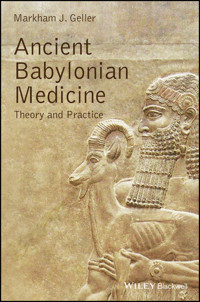
Utilizing a great variety of previously unknown cuneiform tablets, Ancient Babylonian Medicine: Theory and Practice examines the way medicine was practiced by various Babylonian professionals of the 2nd and 1st millennium B.C.
- Represents the first overview of Babylonian medicine utilizing cuneiform sources, including archives of court letters, medical recipes, and commentaries written by ancient scholars
- Attempts to reconcile the ways in which medicine and magic were related
- Assigns authorship to various types of medical literature that were previously considered anonymous
- Rejects the approach of other scholars that have attempted to apply modern diagnostic methods to ancient illnesses
Sie lesen das E-Book in den Legimi-Apps auf:
Seitenzahl: 441
Veröffentlichungsjahr: 2015
Ähnliche




















Table of Contents
Cover
Series
Title
Copyright
Dedication
Illustrations
Abbreviations
Acknowledgments
Introduction to Babylonian Medicine and Magic
Dissection and Disease Taxonomy
The Sources
Is Medicine Magic and Is Magic Medicine?
1: Medicine as Science
“Scientific” Medicine
Academic Medicine
Anatomical Science
Medical Predictions
Medical Prescriptions
Sumerian and Akkadian Therapeutic Magic
Psychosomatic Illness
Divination
2: Who Did What to Whom?
Professional Title Classification
The Exorcist in Sumerian Literature
Priest vs Layman
Quacks and Quacksalvers
3: The Politics of Medicine
Letters from the Kingdom of Mari (Syria), Eighteenth Century BC
Physicians in Babylonia (Eighteenth–Seventeenth Century BC)
Second-Millennium BC Medical Corpus
Epidemics
Middle Babylonian Letters (c. Fifteenth Century BC)
Neo-Assyrian Court Letters
Literary Hypochondria
Urad-Nanaya, Chief Physician to Esarhaddon
4: Medicine as Literature
Diagnostic Handbook
Medical Incantations
Therapeutic Prescriptions as Genre
Poetry Within Therapeutic Prescriptions
The Babylonian Background to Greco-Roman Pharmacology
5: Medicine and Philosophy
Innovation
Ascendance of the Exorcist and Decline of the Physician
6: Medical Training: MD or PhD?
Academic Titles
The Meaning of ana tāmarti “for Reading”
The Case of Anu-ikur of Uruk
7: Uruk Medical Commentaries
Commentaries on the Diagnostic Handbook and General Themes of Prognosis
Medical Terminology in Commentaries
Writing Down of Medical Knowledge
8: Medicine and Magic as Independent Approaches to Healing
Practice
Theory
Appendix: An Edition of a Medical Commentary
Translation
The Source Text
Translation of ll. 1–9
Notes
References
Subject Index
Selective Index of Akkadian and Greek Words
Index of Akkadian Personal Names
End User License Agreement
List of Illustrations
Introduction to Babylonian Medicine and Magic
Map 1 The Near East (Mark W. Chavalas,
The Ancient Near East
, Blackwell, 2006)
1: Medicine as Science
Figure 1.1 Medical tablet from Babylon mentioning Hammurapi’s mother (BM 41293+44866; copy M. J. Geller)
Figure 1.2 Exorcists performing a ritual, dressed as fish-men
apkallu
sages (Vorderasiatisches Museum, Berlin; drawing Tessa Rickards)
Figure 1.3 Clay model of a sheep liver used for divination, from Mari in Syria, second millennium BC (Musée du Louvre; photo Florentina Badalanova Geller)
2: Who Did What to Whom?
Figure 2.1 Ceramic plaque from the Assyrian period (c. 700 BC) showing an exorcist dressed as an
apkallu
sage (photo Florentina Badalanova Geller)
Figure 2.2 Exorcism ritual carried out in a reed
šutukku
-hut, with one woman fumigating and another wailing; early first millennium BC (Collon 1987: No. 803; photo courtesy D. Collon)
Figure 2.3 Exorcists trying to heal a patient in bed, Lamaštu-amulet (Wiggermann 2007: 107, No. 2; drawing F. A. M. Wiggermann)
3: The Politics of Medicine
Figure 3.1 Bust of Hammurabi, king of Babylon (Musée du Louvre Sb 95; photo Florentina Badalanova Geller)
Figure 3.2 Seal of physician Ur-lugal-edina (Collon 1987: No. 638; drawing courtesy D. Collon)
Figure 3.3 Bust of an Assyrian courtier (Musée du Louvre; photo Florentina Badalanova Geller)
Figure 3.4 Ceramic plaque showing healer and patient, second millennium BC (Musée du Louvre AO 6622; photo Florentina Badalanova Geller)
4: Medicine as Literature
Figure 4.1 Healing goddess Gula with her dog, holding a scalpel in her right hand and a tablet in her left hand (Collon 1987: No. 793; photo courtesy D. Collon)
Figure 4.2 Assur recipes
BAM
116 and duplicate recipes (Babylonisch-assyrische Medizin
Figure 4.3 Duplicate recipes (
Babylonisch-assyrische Medizin
)
Figure 4.4
BAM
104 and duplicates (
Babylonisch-assyrische Medizin
)
Figure 4.5
AMT
56,1 and duplicates
(Assyrian Medical Texts
and
Babylonischassyrische Medizin)
Figure 4.6 Healing goddess Gula with her dog, seated before the god Latarak (R. Ellis, Fs. J. J. Finkelstein, figure no. 3; drawing F. A. M. Wiggermann)
5: Medicine and Philosophy
Figure 5.1 Patient being healed (Wiggermann 2007: 107, No. 1; drawing courtesy F. A. M. Wiggermann)
6: Medical Training: MD or PhD?
Figure 6.1 Scribes and officials from Til Barsip (ninth century BC) showing scribes writing on both leather and clay (photo Florentina Badalanova Geller)
Appendix: An Edition of a Medical Commentary
Figure A.1 Photo of MLC 1863 taken by A. T. Clay (photo courtesy Ulla Kasten, Yale Babylonian Collection)
Guide
Cover
Table of Contents
Begin Reading
Pages
Cover
Contents
ii
iii
iv
v
viii
x
xi
xii
1
2
3
4
5
6
7
8
9
10
11
12
13
14
15
16
17
18
19
20
21
22
23
24
25
26
27
28
29
30
31
32
33
34
35
36
37
38
39
40
41
42
43
44
45
46
47
48
49
50
51
52
53
54
55
56
57
58
59
60
61
62
63
64
65
66
67
68
69
70
71
72
73
74
75
76
77
78
79
80
81
82
83
84
85
86
87
88
89
90
91
92
93
94
95
96
97
98
99
100
101
102
103
104
105
106
107
108
109
110
111
112
113
114
115
116
117
118
119
120
121
122
123
124
125
126
127
128
129
130
131
132
133
134
135
136
137
138
139
140
141
142
143
144
145
146
147
148
149
150
151
152
153
154
155
156
157
158
159
160
161
162
163
164
165
166
167
168
169
170
171
172
173
174
175
176
177
178
179
180
181
182
183
184
185
186
187
188
189
190
191
192
193
194
195
196
197
198
199
200
201
202
203
204
205
206
207
208
209
210
211
212
213
214
215
216
217
218
219
220
221
Ancient Cultures
These enjoyable, straightforward surveys of key themes in ancient culture are ideal for anyone new to the study of the ancient world. Each book reveals the excitement of discovering the diverse lifestyles, ideals, and beliefs of ancient peoples.
Published
Ancient Babylonian MedicineMarkham J. Geller
The SpartansNigel Kennell
Sport and Spectacle in the Ancient WorldDonald G. Kyle
Food in the Ancient WorldJohn M. Wilkins and Shaun Hill
Greek Political ThoughtRyan K. Balot
Sexuality in Greek and Roman CultureMarilyn B. Skinner
Theories of MythologyEric Csapo
In preparation
Science in the Ancient WorldDaryn Lehoux
Ethnicity and Identity in the Ancient WorldKathryn Lomas
Roman Law and SocietyThomas McGinn
Economies of the Greek and Roman WorldJeremy Paterson
Economies of the Greco-Roman WorldGary Reger
The City of RomeJohn Patterson
Family in Greek and Roman CultureEmma Griffiths and Tim Parkin
Ancient Babylonian Medicine
Theory and Practice
Markham J. Geller
This edition first published 2010
© 2010 Markham J. Geller
Blackwell Publishing was acquired by John Wiley & Sons in February 2007. Blackwell’s publishing program has been merged with Wiley’s global Scientific, Technical, and Medical business to form Wiley-Blackwell.
Registered Office
John Wiley & Sons Ltd, The Atrium, Southern Gate, Chichester, West Sussex, PO19 8SQ, United Kingdom
Editorial Offices
350 Main Street, Malden, MA 02148-5020, USA
9600 Garsington Road, Oxford, OX4 2DQ, UK
The Atrium, Southern Gate, Chichester, West Sussex, PO19 8SQ, UK
For details of our global editorial offices, for customer services, and for information about how to apply for permission to reuse the copyright material in this book please see our website at www.wiley.com/wiley-blackwell.
The right of Markham J. Geller to be identified as the author of this work has been asserted in accordance with the UK Copyright, Designs and Patents Act 1988.
All rights reserved. No part of this publication may be reproduced, stored in a retrieval system, or transmitted, in any form or by any means, electronic, mechanical, photocopying, recording or otherwise, except as permitted by the UK Copyright, Designs and Patents Act 1988, without the prior permission of the publisher.
Wiley also publishes its books in a variety of electronic formats. Some content that appears in print may not be available in electronic books.
Designations used by companies to distinguish their products are often claimed as trademarks. All brand names and product names used in this book are trade names, service marks, trademarks or registered trademarks of their respective owners. The publisher is not associated with any product or vendor mentioned in this book. This publication is designed to provide accurate and authoritative information in regard to the subject matter covered. It is sold on the understanding that the publisher is not engaged in rendering professional services. If professional advice or other expert assistance is required, the services of a competent professional should be sought.
Library of Congress Cataloging-in-Publication Data
Geller, Markham J.
Ancient Babylonian medicine : theory and practice / Markham J. Geller.
v. cm. – (Ancient cultures)
Includes bibliographical references and index.
Contents: Introduction to Babylonian medicine and magic – Medicine as science – Who did what to whom? – The politics of medicine – Medicine as literature – Medicine and philosophy – Medical training : MD or PhD? – Uruk medical commentaries – Medicine and magic as independent approaches to healing – Appendix: An edition of a medical commentary.
ISBN 978-1-4051-2652-6 (hardcover : alk. paper) 1. Medicine, Assyro-Babylonian.
2. Medicine, Assyro-Babylonian–Philosophy. 3. Medicine, Assyro-Babylonian–Methodology. 4. Magic, Assyro-Babylonian. I. Title.
R135.3.G44 2010
610.938–dc22
2009046375
A catalogue record for this book is available from the British Library
I 2010
To Florentina
Illustrations
Map
Map 1 The Near East (Mark W. Chavalas,
The Ancient Near East
, Blackwell, 2006)
Figures
1.1 Medical tablet from Babylon mentioning Hammurapi’s mother (BM 41293+44866; copy M. J. Geller)
1.2 Exorcists performing a ritual, dressed as fish-men
apkallu
sages (Vorderasiatisches Museum, Berlin; drawing Tessa Rickards)
1.3 Clay model of a sheep liver used for divination, from Mari in Syria, second millennium BC (Musée du Louvre; photo Florentina Badalanova Geller)
2.1 Ceramic plaque from the Assyrian period (c. 700 BC) showing an exorcist dressed as an
apkallu
sage (photo Florentina Badalanova Geller)
2.2 Exorcism ritual carried out in a reed
šutukku
-hut, with one woman fumigating and another wailing; early first millennium BC (Collon 1987: No. 803; photo courtesy D. Collon)
2.3 Exorcists trying to heal a patient in bed, Lamaštu-amulet (Wiggermann 2007: 107, No. 2; drawing F. A. M. Wiggermann)
3.1 Bust of Hammurabi, king of Babylon (Musée du Louvre Sb 95; photo Florentina Badalanova Geller)
3.2 Seal of physician Ur-lugal-edina (Collon 1987: No. 638; drawing courtesy D. Collon)
3.3 Bust of an Assyrian courtier (Musée du Louvre; photo Florentina Badalanova Geller)
3.4 Ceramic plaque showing healer and patient, second millennium BC (Musée du Louvre AO 6622; photo Florentina Badalanova Geller)
4.1 Healing goddess Gula with her dog, holding a scalpel in her right hand and a tablet in her left hand (Collon 1987: No. 793; photo courtesy D. Collon)
4.2 Assur recipes
BAM
116 and duplicate recipes (
Babylonisch-assyrische Medizin
)
4.3 Duplicate recipes (
Babylonisch-assyrische Medizin
)
4.4
BAM
104 and duplicates (
Babylonisch-assyrische Medizin
)
4.5
AMT
56,1 and duplicates (
Assyrian Medical Texts
and
Babylonisch-assyrische Medizin
)
4.6 Healing goddess Gula with her dog, seated before the god Latarak (R. Ellis, Fs. J. J. Finkelstein, figure no. 3; drawing F. A. M. Wiggermann)
5.1 Patient being healed (Wiggermann 2007: 107, No. 1; drawing courtesy F. A. M. Wiggermann)
6.1 Scribes and officials from Til Barsip (ninth century BC) showing scribes writing on both leather and clay (photo Florentina Badalanova Geller)
A.1 Photo of MLC 1863 taken by A. T. Clay (photo courtesy Ulla Kasten, Yale Babylonian Collection)
Acknowledgments
This book was made possible by a grant from the Wellcome Trust, which allowed me to spend the 2005–6 academic year at the Collège de France and École Pratique des Hautes Études, Paris, through the invitation of J.-M. Durand. Further work on the manuscript was carried out during two research visits to the Max Planck Institut für Wissenschaftsgeschichte, Berlin, courtesy of Peter Damerow and Jürgen Renn. These visits were funded by grants from the Alexander von Humboldt-Stiftung (Wiederaufnahme Stipendium) and the TOPOI Excellence Cluster of the Freie Universität Berlin, with Eva Cancik-Kirschbaum as my Betreurerin.
The manuscript received a thorough and highly critical reading from Irving Finkel, which resulted in a major redrafting of the text.
I would like to thank a number of colleagues who have generously helped in providing illustrations for this volume. Frans Wiggermann and Dominique Collon kindly sent along their original drawings as well as photos from their own archives, and Tessa Rickards provided her drawing of an object in the Vorderasiatisches Museum, Berlin. Ulla Kasten supplied an old photo from the Yale Babylonian Collection taken by A. T. Clay, with permission to publish it. Béatrice André-Salvini graciously granted permission to publish photos from the Louvre taken by Florentina Badalanova Geller, to whom this volume is dedicated.
Finally, I would like to thank Galen Smith of Wiley-Blackwell for seeing this work through to publication and Clare Creffield for copy-editing the manuscript.
Introduction to Babylonian Medicine and Magic
If a man has pain in his kidney, his groin constantly hurts him, and his urine is white like donkey-urine, and later on his urine shows blood, that man suffers from “discharge” (muû-disease). You boil 2 shekels of myrrh, 2 shekels of baluhhu-resin, (and) 2 sila-measures of vinegar together in a jug; cool it and mix it in equal measure in pressed oil. You pour half into his urethra via a copper tube, half mix in premium beer, you leave it out overnight and he drinks it on an empty stomach and he will get better.
Babylonian recipe for disease of the kidneys, BAM 7 35
[If a] man has intestinal colic, he constantly scratches himself, he retains wind in his anus, food and fluids are regurgitated (and) he suffers from constipation of the rectum – its “redness” is raised and troubles him [without] giving him relief – you desiccate a lion skin and mix it with lion fat, you dry (it) a second time, crush and mix it in cedar oil, make a pessary and insert it into his anus.
Babylonian recipe for disease of the anus, 7 151
Lesen Sie weiter in der vollständigen Ausgabe!
Lesen Sie weiter in der vollständigen Ausgabe!
Lesen Sie weiter in der vollständigen Ausgabe!
Lesen Sie weiter in der vollständigen Ausgabe!
Lesen Sie weiter in der vollständigen Ausgabe!
Lesen Sie weiter in der vollständigen Ausgabe!
Lesen Sie weiter in der vollständigen Ausgabe!
Lesen Sie weiter in der vollständigen Ausgabe!
Lesen Sie weiter in der vollständigen Ausgabe!
Lesen Sie weiter in der vollständigen Ausgabe!
Lesen Sie weiter in der vollständigen Ausgabe!
Lesen Sie weiter in der vollständigen Ausgabe!
Lesen Sie weiter in der vollständigen Ausgabe!
Lesen Sie weiter in der vollständigen Ausgabe!
Lesen Sie weiter in der vollständigen Ausgabe!




