


8,49 €
Mehr erfahren.
- Herausgeber: Press & Archeos
- Kategorie: Geisteswissenschaft
- Sprache: Englisch
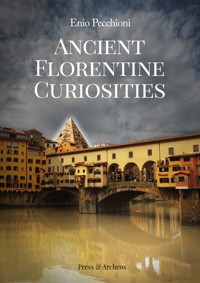
Those who approach this book intrigued by the cover image, bearing the silhouette of a pyramid located near the Ponte Vecchio, should not expect to find esoteric allusions or archaeo-mystical fantasies.
Instead, that figure is meant to be a metaphor, a fantastic and eternally living image of the curiosity that any citizen, visitor and tourist can address to the past of Florence and Fiesole. And therefore it symbolizes the passion for history and archaeology that springs from participation in the city’s most intimate life.
We have chosen this image, one of many possible, for the new edition of Antiche Curiosità Fiorentine (Ancient Florentine Curiosities), successfully published over the past thirty years, updated and reintegrated with the spirit and authenticity of all time.
But know that a pyramid, in the Oltrarno, really existed!
- - -
Enio Pecchioni has been writing about the ancient history of Fiesole and Florence since the 1960s. Among his best-known publications we mention Storia di Fiesole (1979), Brief history of the Etruscan people (1984), Stilicone (2010). With Press & Archeos he has published, together with Giovanni Spini, Firenze Etrusca (2011), Totila and Belisario (2013), Figli di Enea (2014) and Urbicus-i gliadiatori di Firenze (2015).
Das E-Book können Sie in Legimi-Apps oder einer beliebigen App lesen, die das folgende Format unterstützen:
Veröffentlichungsjahr: 2023
Ähnliche




















Enio Pecchioni
Ancient Florentine Curiosities
Ancient Florentine Curiosities
by Enio Pecchioni
1989-2019
Edizioni Press & Archeos
via Cittadella, 9
50144 Firenze - Italy
www.pressandarcheos.com
© Proprietà letteraria riservata 1989-2022
Edizione On Demand. Aggiornamento del dicembre 2022
Ricerche iconografiche a cura dell’autore
Per altre foto e illustrazioni, l’editore si è occupato delle relative autorizzazioni degli aventi diritti.
Nel caso di coloro i cui nominativi sono risultati irreperibili, si resta a disposizione per regolare eventuali spettanze.
Indice dei contenuti
Etruscan and Roman age
Early Florence. Where to find Etruscan Florence?
The Etruscan Tombs of Quinto Fiorentino and Comeana near Florence
The city’s oldest monument can be found in the Santa Croce area, the remains of the Amphitheatre
The Roman Theatre
The city walls of the Roman quadratus and the round tower in Via del Proconsolo
The Forum and the Column of Abundance
The Roman Aqueduct
The Wool Guild in Roman Florence
The Church of Santa Felicita and the lost Pyramid
The Church of Santa Reparata
The Roman Hippodrome
The Church of St. Miniatus
Piazza del Limbo with the Church of SS. Apostoli
Templars & Pazzino, with the Explosion of the Cart
Dante’s part of the City
Piazza Santa Trinita a nd its monuments
The Medici family
The Ancient Florentine Hotels
Week-end in Fiesole
The Hill of St. Francis
The Badia Fiesolana
Mino da Fiesole
The Hill of Vincigliata and its Castle
The Indian of Florence
The American Church
Etruscan and Roman age
The ancient Etruscan cities were usually situated high up. On the top of a hill it was easier to defend oneself and healthier to live in.
Fiesole was a knot in the network of Etruscan roads which ran over Tuscany. It was reached by way of mountain roads which were the safest, even if very tiring.
The hills of Fiesole formed the last promontory of the woody Appennine chain; the Arno river, flowing from east to west, with its stream and even more with its marshes barred the way to whoever wanted to go from north to south.
The crossing of the river by flat-bottomed boat was at all times possible at the point where the waters narrow, at the current Ponte Vecchio, a little above the meeting-point of the Mugnone torrent, which used to flow into the Arno where Ponte Santa Trinita was later built. Further downstream the marshes began again.
From Fiesole groups of men spread towards the river, and one of these had its village and cemetery where was later the centre of Florence, a little necropolis which goes back to eight hundred years before Christ and from which have come terracotta ossuary vases of the Villanova type.
In the meantime the Etruscan civilization spread over Tuscany. In the VII Cent. B.C. the whole region had become covered with the network of their road & cities.
Fiesole dominated the central valley of the Arno and the Etruscan nucleus fixing itself on the river ought to have become its direct dependant. Perhaps it had a name, but we do not know. It was at the same time a traffic point and a bridge-head. Fiesole was high up defended by thick walls, and this kinde of paludal village, beside the river, subject to the floods and to enemy assaults, had to undergo rather dramatic vicissitudes.
In the III and II Centuries B.C. Rome, enlarging its dominions, was bound to meet with the Etruscan cities, and first of all with villages like that which was situated at the crossing-point like the one on the Arno.
The Romans, spreading out from their city constructing roads gave great importance to crossing-point of the rivers. We remember how the roads were called by the names of the Consuls, and that a magistrate had the title of “Pontifex” or Bridge-builder.
Before blotting-out Fiesole, the Romans occupied the bridge-head over the Arno and after the wars of Sulla and Catiline was founded here a colony of veterans comes from Filippi war of 42 B.C.
The Cesar’s agrarian law of 59 B.C. and the Lex Triumviralis of Ottaviano, Antonio and Lepido of 43 B.C. gave the veterans the right to found new cities. Mindful of their past the veterans became colonists, giving their cities the form of military castrum, that is the quadrangular form of the camp of war, divided into four by two cross-intersecting roads.
The place had the importance of Municipium and its name was Florentia.
The ancient legends imagine an “old king of Fiesole”, called Fiorino (more likely a Roman commander in chief) killed and buried in a field of lilies by the bank of the Arno, and from him the name to the city. Some have thought that the name of Florentia is derived from the “flowing” waters of the river. Instead, it must believed that the name of Florentia derived from Flora the vegetations divinity; one of those auspicious names which the veterans gave to their colonies. The augury was that the new city should prosper and become “flourishing”.
The augury came true and the colony certainly did flourish.
The old Roman “castrum” of rectangular form, (but the part West to East was slightly longer than the part North to South), was all situated on the right bank of the Arno. In the brick walls, the first circle, four principal gates opened, flanked by towers, according to the cardinal points. The southern one gave access to the crossing of the river, opposite the present Ponte Vecchio (in the Middle Ages this gate was called Por Santa Maria).
From the old Roman city has remained the topographical impress upon the centre of Florence, where it is possible to recognize the “cardo maximus” in the present Via Strozzi, Via degli Speziali and Via del Corso; the “decumanus” in the Via Por Santa Maria, Via Calimala and Via Roma.
The centre, or Forum, was where now stands the Piazza della Repubblica. Nothing has remained of the old Roman architecture except few traces and pieces recovered during casual excavation work and now to bee seen in the Florentine Archaeological Museum. They are fragments and relics of little artistic value. They reveal nothing exceptional in a city which later gave to the world a vision of unparalleled beauty.
So we must imagine Augustan Florence as very similar to all the other cities of Roman origin and civilization. In the centre, the Forum where the citizens met for their affairs. On the Forum stood the Capitol (where now are the arcades of Hard Rock Cafe): the adjacent street still bears this name, Via del Campidoglio. The greater Temple was facing to the east, was reached by a marble stairway leading to a portico with six or eight columns of Lunigiana marble, in corinthian style surmounted by a triangular tympanum. The Temple was divided into three parts, with images of the greater gods: Jupiter sitting in the middle, Juno and Minerva standing at the sides.
The Theatre was in the present Piazza della Signoria, under Palazzo Vecchio. Baths are located in Via delle Terme, in Piazza Signoria and in the area of Via Vecchietti-Strozzi. The Circus was at Croce al Trebbio (close to Santa Maria Novella) and the Amphitheatre near the present Piazza Santa Croce: on its perimeter were later built the house of the Peruzzi, which have in fact a curved facade and one of the roads which circles it is still called Via Torta.
We think that the city was dedicated to Mars, god of war. In the times of Dante there existed at the foot of the Ponte Vecchio an old statue of warrior on horseback (probably a representation of Diocleziano), which tradition indicated as Mars. It was carried away by a river flood.
For a long time it was believed that the Baptistery was built on an old pagan temple dedicated to Mars, and that St. John, patron of the city, had replaced it. But this, however, has not been confirmed by the excavations, because under the present building we found the rest of a Roman Domus.
So we think that the Baptistery was an original Longobard construction (VII cent. A.D.).
Early Florence. Where to find Etruscan Florence?
One of the results of the archeologic discoveries from Piazza Signoria, dating from the Oriental period (VIII cent. B.C.), is that Florence’s Etruscan origins are once more proposed in a serious way.
If we study the topographical map of Florence, we notice at once that the roads around Piazza della Repubblica are in echelon formation; we can easily make out the nucleus of the Roman city in the square formed by Via Cerretani-Proconsolo-Vacchereccia-Tornabuoni.
Moreover, if we observe the map with care, we can discover a similar though less accentuated situation in an area nearby: the urban network beyond Palazzo Vecchio formed by Via Anguillara-Benci-Malenchini-Saponai-Castellani-Leoni-Piazza S. Firenze, lying parallel to the flow of the Arno. The almost rectangular plan of this corner of Florence leads us believe it is probably of Etruscan origin.
Although at the moment it is only an hypothesis, there are some interesting data about it.
We know that the Romans built their Florence on virgin soil (or so they believed), as was their custom, in the area around Piazza della Repubblica something less the middle of I cent. B.C. However an archaic and particularly large Villanovian necropolis previously occupied this site, therefore there must have been a village on or near it, probably built somewhere in the area.
The excavations carried out in Piazza Signoria show that Florence has incredibly ancient origins. Ceramic fragments found on the site were produced in Greece in the second half of VIII century B.C. They are the oldest Grecian clay shards to have been found to this day in northern Tuscany. This was not all. At the same time, finds of Bronze Age origin were excavated, thus backdating the first human settlement of Florence to as early as the II millennium B.C.
Judging from the ancient tombs in Piazza della Repubblica, the Villanovan Village must have stood somewhere in the area around Orsanmichele, whereas the later civilian settlement of the Etruscan township was probably situated in the rectangular network formed by Via Anguillara-Benci-Malenchini-Saponai-Castellani-Leoni-Piazza San Firenze with a perimeter of 1100 metres. The centre was the “Fanum Sacnicla” temple of tutelary deity, where now St. Remigio church is.
The little Etruscan city or trade centre (emporium) close the Arno would have been built with the typical, very simple single-storey houses standing on foundations formed of blocks of squared stone, with walls made either from bricks of unfired clay dried in the sun or interwoven trellises of stakes, wooden beams and cane. An entrance corridor led into an open courtyard in the centre which in its turn opened into smaller rooms, which were used for the kitchen, larder, workrooms and bedrooms.
However, no trace of the perishable Etruscan houses remained by the time the mediaeval city spread to this area. Furthermore the floods of the Arno had obliterated everything. But the streets, on the other hand, appear to follow the same lines as the original ones underneath. Therefore, if we are to believe that there really was once a Etruscan settlement in this part of Florence, then the so-called medieval “Porto dei Fiesolani” on the river Arno and in front Piazza Mentana must also have existed opposite it.
We know that the Arno was easily navigable in ancient times and therefore there were presumably facilities of some sort for the loading and unloading of merchandise. The oldest Florentine records talk about a fluvial landing stage which was situated precisely in this area and near what was later, in the XIII century, the Porta de’ Buoi (Gate of the Oxen): “de’ foderi i navaioli qui vadunt per Arnum ad Florentiam” we read in Bonaini (1218). The de’ Foderi wharf of the Arno was the legitimate successor of the Etruscan Harbour and this is also confirmed in a very ancient document of 1162 that describes the sale of a house “in loco qui vocatur a la fonte al porto prope fluvio Arno”.
Therefore it is unlikely that the shape of the road system depended on agricultural centuriation, because there must have been warehouses or other commercial buildings between the port and the Roman city.




