


11,49 €
Mehr erfahren.
- Herausgeber: Atlantic Books
- Kategorie: Geisteswissenschaft
- Sprache: Englisch
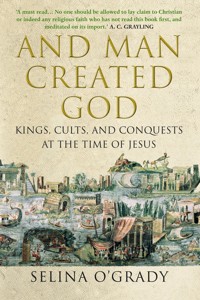
And Man Created God is a sweeping exploration of the changing religions of the empires and peoples of the world at the time of Jesus: a work of extraordinary richness and ambition, this is popular history at its best. At the time of Jesus's birth, the world was in ferment. Across Europe, North Africa, the Middle East and Asia - societies rife with gods and messiahs, priests and warriors - the old certainties of family, village and tribe were being overturned. Religion was becoming the source of order and stability. And Man Created God takes the reader on a dazzling journey across the empires of the ancient world to reveal how emperors and kings manipulated religion to consolidate their power. In Rome, Augustus was deified by his brilliant spin doctors; in what is now Sudan, the warrior queen Amanirenas exploited her godlike status to inspire her armies to face, and defeat, Rome; while in China, the usurper Wang Mang won and lost the throne over his obsession with Confucianism. In this riveting account of the interplay of faith and power, Selina O'Grady answers the most urgent question of all: how did the tiny Jesus cult triumph over more popular religions - the goddess Isis, the miracle worker Apollonius, even the cult of Augustus - to become the world's dominant faith?
Das E-Book können Sie in Legimi-Apps oder einer beliebigen App lesen, die das folgende Format unterstützen:
Veröffentlichungsjahr: 2012
Ähnliche



















AND MAN CREATED
Isis and Horus. Wellcome Library, London
Published in hardback and trade paperback in Great Britain in 2012 by Atlantic Books, an imprint of Atlantic Books Ltd.
Copyright © Selina O’Grady, 2012.
The moral right of Selina O’Grady to be identified as the author of this work has been asserted by her in accordance with the Copyright, Designs and Patents Act of 1988.
All rights reserved. No part of this publication may be reproduced, stored in a retrieval system, or transmitted in any form or by any means, electronic, mechanical, photocopying, recording, or otherwise, without the prior permission of both the copyright owner and the above publisher of this book.
9 8 7 6 5 4 3 2 1
A CIP catalogue record for this book is available from the British Library.
Hardback ISBN: 978 1 84354 696 2 Trade paperback ISBN: 978 1 84887 430 5 eISBN: 978 0 85789 876 0
Printed in Great Britain.
Atlantic Books An imprint of Atlantic Books Ltd Ormond House 26-27 Boswell Street London WC1N 3JZ
www.atlantic-books.co.uk
To my darling Anna and Sibby who put up with my obsession
Acknowledgements
Thanks to my ebullient and constantly helpful agent, Ivan Mulcahy; to Toby Mundy, who got me thinking about this book; to all those who read and commented – Claudia Fitzherbert, Daniel Jeffreys, Lucy Lethbridge, Kathy O’Shaughnessy, Graeme and Terrence Mitchison and Oliver Ramsbotham; to my academic readers – Dr Lindsay Allen, Nell Aubrey, Professor Timothy Barrett, Dr Tadeusz Skorupski, and William Fitzgerald – who saved me from at least some of the oversimplifications which drives experts mad; to Rebecca Fraser, Anthony Grayling and Malise Ruthven for their incredibly generous comments; to my brother Jeremy for his titles and masterly editorial eye; to my ever-supportive sister Jane; to Caroline Law; to my daughters; to Richard Milbank for being a learned and wonderful editor; to Sarah Norman and Margaret Stead, who were my editors for all too short a time; to my copyeditor Helen Gray; and above all, to Tony Curzon Price.
Contents
Illustrations
Maps
Timeline
Introduction
1 The Rebranding of Rome
2 Augustus: God and First Citizen
3 Alexandria: Gods in the City
4 The African Goddess-Queen
5 The Mirage of Arabia: Rome’s Fiasco
6 How Herod and the Pharisees Radicalized the Jews
7 Galilee: Jesus and the Messiah-Bandits
8 Castrating Priests and Trading Gods in Palmyra
9 Political and Religious Chaos in Parthia
10 A ‘Pagan Christ’ in Babylon
11 India: Brahmins versus Monks
12 The Buddha in a Toga
13 Confucius’ Religion for Civil Servants
14 Wang Mang the Pious Usurper
15 The Dragon Who Flew Too High
16 Recalcitrant Spirits: The German Resistance
17 Rome: The Emperor Becomes God
18 The Death of Jesus
19 And Paul Created Christ
Notes
Select Bibliography
Index
A Note on the Author
Illustrations
Frontispiece: Isis and Horus. Wellcome Library, London
1. Apollonius. ©2006 Alinari / TopFoto
2. Livia. Giovanni Dall’Orto / Wikimedia Commons
3. House in Marib. Prisma Bildagentur AG / Alamy
4. Maecenas. ©2006 Alinari / TopFoto
5. Agrippa. akg-images
6. Tiberius. akg-images
7. Josephus. akg-images
8. The Kiosk at Naqa. © Nigel Pavitt/JAI/Corbis
9. Suren. Aytakin / Wikimedia Commons
10. Banqueters, Palmyra. Lessing Photo Archive
11. Temple of Bel. De Agostini / Getty
12. Kushan prince. akg-images / RIA Novosti
13. King Juba. De Agostini / Getty
14. St Paul. Leemage / Getty
15. Coin of Varus. INTERFOTO / Sammlung Rauch / Mary Evans
16. Coin of Gondophares. World Imaging / Wikimedia Commons
17. Antonia fortress. deror avi / Wikimedia Commons
18. Augustus. Alinari via Getty Images
19. Seated Buddha. akg-images
20. Queen Mother of the West. The Granger Collection / TopFoto
Timeline
Note: Many of these dates are approximate
BC
1500–1000 Aryan (Indo-Iranian) tribesmen from the steppes of southern Russia move into the Indus Valley – in present-day Pakistan and north-west India – and begin to compile the hymns of the Rig Veda, the oldest sacred text of Hinduism
1200 The Aryan priest Zoroaster has a vision of the first supreme god Ahura Mazda and begins preaching in ancient Iran
1070 Egypt loses control of Meroe – present-day southern Egypt and Sudan – and it becomes an independent kingdom
1070–AD 350 EMPIRE OF MEROE
753 Legendary date for the founding of the city of Rome by Romulus and Remus
744–609 Assyrian (NEO-ASSYRIAN) EMPIRE
—Originally a kingdom of northern Mesopotamia – modern-day northern Iraq – Assyria acquires a vast territory and has its capital at Nineveh on the banks of the Tigris River
727 Meroite King Pye invades Egypt and founds the twenty-fifth dynasty of pharaohs which rules Egypt 727–653
727–653 Twenty-fifth dynasty of Egypt
722 Assyria conquers northern Israel and Jews are deported
700 Construction of Marib Dam in South Arabia
—Towards the end of the 7th century Rome becomes an organized city-state
626 The kingdom of Babylonia in southern Mesopotamia – part of modern Iraq – defeats Assyria
626–539 BABYLONIAN (NEO-BABYLONIAN) EMPIRE
587–537 Captivity of the Jews in the city of Babylon – near present-day Baghdad – under Nebuchadnezzar
586 Babylonia conquers southern Israel (the kingdom of Judah)
563–483 The life of Siddhãrtha Gautama, the Buddha
558–479 The life of Confucius
540 Babylonian (Neo-Babylonian) Empire falls to the Persian King Cyrus
540–331 PERSIAN (ACHAEMENID) EMPIRE
539 Cyrus allows the Jews to return home
510 The last king of Rome is expelled; Etruscan rule ends and the Republic is established at Rome
510–27 Roman Republic
497–425 Vardhamana Mahavira, the son of a chieftain in the Indian kingdom of Magadha, in north-east India, establishes the central tenets of Jainism
396 Rome begins its conquest of Italy
341–270 Life of Epicurus, founder of Epicureanism
335–263 Life of Zeno, founder of Stoicism
334–328 Alexander of Macedonia defeats Darius and conquers the Persian Empire
334–328 EMPIRE OF ALEXANDER THE GREAT
328 At Alexander’s death his general Seleucus ‘inherits’ the eastern part of the Persian Empire
312–204 SELEUCID EMPIRE
321 Chandragupta Maurya founds India’s first and greatest empire; his chief minister Kautilya writes the Arthashastra
321–185 BC MAURYAN EMPIRE
269–232 Reign of Ashoka Maurya, first Buddhist emperor of the Indian subcontinent
264 The first of the Punic Wars between Carthage – in present-day Tunisia – and Rome; Rome’s conquest of Sicily signals the beginning of its imperial expansion beyond the borders of peninsular Italy
250 Parni nomads from Central Asia settle in Parthia – in present-day Iran – and begin their conquest of the Seleucid Empire
250 BC–AD 224 PARTHIAN (ARSACID) EMPIRE
220 Qín Shi Huáng, king of the state of Qin in western China, defeats rival warring states and becomes the first emperor of a unified China; he extends the Great Wall, begun in the 4th century BC, to keep out invading nomads
220–AD 1912 CHINESE EMPIRE
218–202 The Carthaginian general Hannibal invades Italy but is eventually defeated by Scipio
206–AD 9 FORMER (WESTERN) HAN DYNASTY (CHINA)
146 Greece reduced to a Roman province
135–132 Slave revolt in Sicily led by Eunus, a Syrian slave inspired by the mystery cult of Atargatis
63 Pompey captures Jerusalem; Palestine becomes a client state of Rome
53 Parthians defeat the Romans at the Battle of Carrhae
50 Yuezhi/Kushan tribesmen from western China push into India
44 Julius Caesar is assassinated
37–4 Reign of Herod the Great
31 Octavian/Augustus, great-nephew of Julius Caesar, defeats Mark Antony and Cleopatra at the Battle of Actium
27 The Senate bestow on Octavian the title of ‘Augustus’, the revered one
27–AD 14 Reign of Augustus, the first Roman emperor
27–AD 476/1453 ROMAN EMPIRE
The Western part of the empire collapses in AD 476 and the Eastern part – the Byzantine Empire – with the fall of Constantinople in AD 1453
26 Aelius Gallus leads disastrous Roman ‘expedition’ into South Arabia
25 Juba installed as King of Mauretania – part of present-day Algeria and Morocco
—Queen Amanirenas of Meroe leads her army against Roman-controlled Egypt
20 Peace treaty between Augustus and Queen Amanirenas settles the border disputes between Roman Egypt and Meroe – present-day southern Egypt and Sudan
4 Jewish students in Jerusalem smash the golden eagle erected by Herod the Great on one of the Temple gates
—Death of Herod the Great
—Most likely date for the birth of Jesus
4/2 Former slave-girl Musa murders her husband and becomes co-ruler of Parthia with her son/new husband Phraataces
3 Cult of the Queen Mother of the West sweeps through China
2 Augustus is proclaimed pater patriae (‘father of the fatherland’)
AD
2 Parthians and Romans celebrate their peace agreement on the banks of the Euphrates
6 Rome takes direct control of Judaea and orders a census so that the province can be assessed for tax; Judas the Galilean and Zadok call for a mass boycott – this marks the birth of the Zealots, the radical wing of Pharisaism
9 Battle of Teutoburg Forest; German tribesmen, led by Arminius, wipe out almost the whole Roman army of the Rhine
—China’s acting emperor Wang Mang seizes the throne and proclaims the Xin (‘new’) dynasty
9–23 Rule of Wang Mang
14 Augustus dies and is declared to be a god by the Senate
14–37 Tiberius, Augustus’ thirty-year-old stepson, becomes emperor
20–46 Gondophares rules over the kingdom of Gandhara – a vast region in present-day eastern Afghanistan, northern Pakistan and northern India – within the Parthian Empire; whether he rules as a loyal client king or has broken away from Parthia is unclear; his capital city is Taxila, near presentday Islamabad in Pakistan
23 Wang Mang, the usurper of the Han throne, is defeated and killed
24 Pontius Pilate is appointed procurator (governor) of Judaea
25 Emperor Guangwu restores the Chinese Han Dynasty
25-220 LATER (EASTERN) HAN DYNASTY
28/29 John the Baptist baptizes his cousin Jesus
—Jesus begins his mission
—John the Baptist is beheaded
—Many of John’s disciples become followers of Jesus
30–80 Kujula Kadphises, chief of the Yuezhi tribesmen from Central Asia, becomes the first Kushan emperor
First–Third centuries KUSHAN EMPIRE (present-day Central Asia and northern India)
—Kujula and his successors are patrons of a more populist form of Buddhism, Mahayana Buddhism, which they export to China
30 Rome takes control of Palmyra
31/33 Jesus is crucified
32 Paul’s conversion on the road to Damascus
37 Death of Tiberius; his nephew Caligula becomes emperor
38 Pogrom inflicted on the Jewish community of Alexandria; the Roman prefect Aulus Avillius Flaccus forces Jews to live in one area – the world’s first ghetto
—Apollonius, the wandering holy man and miracle worker, visits the Parthian province of Mesopotamia, where the Parthian King Vardanes I is embroiled in a civil war
40 Paul begins his missionary work in the Near East (modern Turkey and the Middle East) and Gree
41 Caligula is assassinated; his uncle, Claudius, becomes emperor
43 Claudius conquers Britain
48 Paul and Barnabas set off on their first missionary journey
—Paul preaches his first recorded sermon at ‘Psidian Antioch’ (in modern Turkey)
49 Claudius imposes martial law on an increasingly violent Palestine, and expels the Jewish community from Rome
—Paul travels to Jerusalem for a conference to try to heal the differences between the ‘party of the circumcision’, led by Jesus’ brother James, and the ‘party of the uncircumcision’, led by Paul
54 Death of Claudius; his stepson Nero becomes emperor
58 Paul returns to Jerusalem, where he is arrested in the Temple; he demands to be tried as a Roman citizen under Roman law and is taken to Rome
60/61 Boudicca, queen of the Iceni, leads a rebellion in Britain against the Romans, but is defeated and commits suicide
64 Great fire of Rome; Nero blames the Christians who are rounded up to be crucified, torn apart by wild beasts, or burned alive; Paul and Peter may have been among the victims
65 Kujula Kadphises and his Central Asian nomadic army conquer Gondophares’ Indo-Parthian kingdom in Gandhara (today’s northern Pakistan and eastern Afghanistan)
66–73/4 First Jewish Revolt/War against the Romans
68 Nero commits suicide; his death marks the end of the Julio-Claudian dynasty; he is succeeded by Galba
70 The Temple and Jerusalem are razed to the ground by the victorious armies of the Emperor Vespasian’s son Titus
79 Eruption of Vesuvius overwhelms Pompeii
132–135 Second Jewish Revolt / War against the Romans. After the Jews’ defeat Hadrian expels them from Jerusalem and the rest of Judaea
—Jerusalem is renamed Aelia Capitolina
224 The last of the Parthian kings is killed in battle; the succeeding Sasanian dynasty imposes its authority over the empire, adopting Zoroastrianism as the state religion
312 Conversion of Constantine to Christianity
—Constantine defeats Maxentius, his rival as emperor, at the Milvian Bridge in Rome
335 Emperor Ezana of Aksum converts to Christianity, and makes Christianity the official state religion
391 Theodosius bans all non-Christian rites and orders the destruction of all temples, cult images and ancient festivals
—Christianity is established as the official religion of the Roman Empire
395 After the death of Theodosius the Roman Empire is irrevocably split into the Western and Eastern (Byzantine) Empires
INTRODUCTION
At the end of the first century BC, the world was full of gods. Thousands of them jostled, competed and merged with one another. Many of them flourished briefly before vanishing from view. In Syria ecstatic devotees castrated themselves in the streets so as to become priests of Atargatis – goddess of love and war, of fertility and virginity – the contradictory, but for pagans entirely unproblematic, result of a fusion of Syrian, Phoenician, Babylonian and Canaanite goddesses. In the Galilee of Jesus’ time, a region that had been forcibly converted to Judaism only a century earlier, holy men turned oil into wine, healed the sick, drove out devils, and claimed to be the Messiah. One of the most famous preachers of his day, a neo-Pythagorean from Tarsus in modern-day Turkey, who raised a girl from the dead and – according to his disciples – came back to life shortly after his death, preached to the Parthian emperor in Babylon. And he preached further away still – to the ruler of the rising Kushan Empire in what is now Afghanistan and Pakistan, where images of the Buddha dressed in a toga, and standing in the attitude of a Greek god, were being carved into the mountainsides.
Kings, queens and emperors were riding on the back of religion as they had always done. Augustus, the first emperor of Rome, though he never dared use the title in the sense of a permanent supreme authority, was manoeuvring his way to becoming worshipped as a god; the creation of the Roman cult of emperor-worship formed part of one of the most brilliant makeovers ever undertaken by a state. But what for Augustus was a delicate matter was effortless for the stout, one-eyed warrior-queen Amanirenas of the empire of Meroe in north-east Africa: divinity was her inheritance. In China an administrator named Wang Mang, who like Augustus wore platform shoes to enhance his less than impressive height, usurped the imperial throne by manufacturing Confucian omens to prove he had Heaven’s backing. But though he began his rise to power by cynically using Confucianism he lost both his throne and his life as a result of his obsession with it.
Gods were getting bigger – small divinities were coalescing with others to become more powerful. But all of them – except, to the amused bewilderment of the pagan observers, the jealous God of the Jews – tolerated the existence of other gods. In the cities that were springing up around the Roman world, under the relative peace that Rome had established, temples were built to the Greek/Roman god Jupiter, to the Turkish goddess Cybele, to the Babylonian god Bel, and to the myriad gods in their numberless forms that populated the ancient world.
This great churn of gods and religions was powered by trade and the city. Cities and towns were booming along the trade routes that threaded together four empires – Roman, Parthian (formerly Persian), Kushan and Chinese. To the cities came merchants, artisans and peasants from every part of the trading world, thousands of immigrants trying to make a home for themselves, all bringing their gods with them. Alexandria, the Roman Empire’s greatest commercial city, was home to a notoriously aggressive and turbulent population of 600,000 people, rivalled by the equally tumultuous and vast city of Seleucia in the Parthian Empire and China’s twelve-gated city of Chang’an with its nine heavily regulated markets. People were on the move as they had never been before, and as they would never be again until Victorian times.1 A babble of languages rose up from the quaysides and marketplaces of these booming cities, where the poor built makeshift homes on derelict sites or jammed themselves into tenement blocks.
In the absence of constant warfare, there was money to spend. And so, like small cities on the march, merchants – protected by armed guards if they were lucky – struggled over mountains, plodded with thousands of heavily laden camels through deserts, or risked shipwreck and pirates to bring silk from China, frankincense and myrrh from Southern Arabia, spices and pearls from India, and pomegranates and rugs from Parthia to people who were discovering the delights of luxury goods.
Trade and the cities it created are at the heart of this book. Pockmarked with building sites, crammed with strangers – all with their own distinctive customs, languages, foods, clothes and religious practices – the cities ripped apart the old ties to tribe and neighbour, the old traditions and certainties. They magnified old needs and gave birth to new ones.
A large measure of peace was essential for the growth of cities, yet peace, paradoxically, was hugely disruptive. The trade it brought created a bewildering, potentially incendiary mix of peoples and ideas and an increasingly wealthy group of merchants who were struggling for status against the entrenched interests of the landed aristocracy. The ancient worldF1 was undergoing a period of globalization every bit as dislocating and traumatic as our own.
And much as they do today, people looked for ways to build new communities as they left their old ones behind or saw them disintegrating. Surrounded by strangers, living in splintered ethnic groups which periodically exploded in violence, they needed to find comfort and reassurance in a new community, a new set of shared beliefs and rituals that took account of the complexity of their new urban world. Having lost the traditions and customs laid down by the family, village or tribe, they needed to find a new sense of meaning, a new guide to behaviour, to find a moral system under which the Samaritan would treat a stranger – even his historic enemy, the Judaean Jew – as a neighbour to be cared for rather than an outsider to be reviled.
For the rulers, peace posed a different sort of problem: a problem of legitimacy. How could they secure loyalty to their rule now that they could no longer command it by military might? The bargain between ruler and ruled that the English political philosopher Thomas Hobbes would describe some 1,650 years later – that is, the gift of stability in exchange for the people’s obedience – no longer worked in a time of relative peace. Rulers required a different form of legitimation and a new way of binding together disparate peoples. Force, of course, was always available if persuasion did not work. But persuasion was cheaper and ultimately more efficient – willing subjects are far more faithful than coerced ones; and force was anyway not always successful. Rome’s expedition to seize the incense-rich kingdoms of Southern Arabia in 26 BC ended in disaster thanks to a bungling leader who failed to see through the clever tactics of an ‘unscrupulously ambitious and cruel’ Arabian minister; around 21 BC the one-eyed African Queen Amanirenas successfully invaded Rome’s province of Egypt, though she was eventually beaten back; and, most catastrophic of all, in AD 9 Rome’s army of the Rhine was wiped out by German tribesmen in the Teutoburg Forest.
Each of the four great empires of the Eurasian landmass used religion, to varying degrees, as a means of establishing and strengthening a centralized grip on its territory and peoples. Rulers needed religions to keep them on their thrones, just as religions needed rulers to help spread their message and protect their followers
Empire and religion often used each other, but it was not always possible. In Palestine the violent opposition of the Pharisees to Herod the Great, most loyal of all Rome’s ‘vassal’ kings, proved that Judaism was incapable of allying itself to an invading imperial power: the nationalism that lay at the heart of Judaism – and that had kept the Jews together as a nation without a land during the ‘Babylonian Captivity’ of the sixth century BC – inevitably put it at odds with foreign rule.
Nor could all religions adapt to the changing conditions created by trade. Cities killed off most of the old pagan gods. It is not for nothing that the early Christians called non-Christians pagani: the Latin paganus means ‘country-dweller’. The pagan gods offered insurance against disaster, as long as they received an appropriate bribe in the form of sacrifice. But they did not provide what the mystery cults such as Isis and certain other religions were beginning to offer: a way to live one’s earthly life, the promise of an afterlife and a personal relationship with god. Such comforts as these, which today are seen as defining elements of what constitutes a religion, were increasingly necessary in the alien world of the cities of the late first century BC.
The grand causal chain of history is, of course, always twisted by the randomness of the individual. Perhaps Confucianism would never have become so essential to the Chinese Empire had it not been for the usurper Wang Mang’s ineptness as a politician, his indecisiveness and belief in magic. The Jesus cult was lucky to have the bandy-legged, touchy, obsessive, brilliant galvanizer, theologian and letter-writer Saul/Paul – the best creative thinker and marketer any religion has probably ever had. Paul’s remoulding of Jesus, whom he had never even met, transformed a minor Jewish cult into a religion fit for an empire.F2 The wandering philosopher and holy man Apollonius, on the other hand – a near contemporary of Jesus but in his lifetime much more famous – did not find in his biographer Philostratus as passionate and subtle a champion and theologian as Jesus would find in Paul.
Under the forcing house of globalization, pagan gods rose and fell and fluid sets of beliefs and practice coalesced into what we now think of as the ‘world religions’ – Judaism, Christianity, Brahmanism, or Hinduism as it came to be called, and Buddhism. The fifth world religion, Islam, would not of course emerge and go on its journey with empire for another six centuries.
Why amongst the countless religious options available did empire and religion make the particular pairings they did? Why was the tiny Jesus cult, rather than the Isis cult, eventually adopted by Rome’s emperors? Isiacism was a religion far more popular and widespread, which also promised some sort of afterlife, believed in some sort of resurrection and had a compassionate goddess. Why did China’s rulers hitch their fate to Confucianism, a philosophy more than a religion, which almost uniquely made no attempt to popularize itself and spread its appeal beyond the elite? How religion uses empire and empire uses religion is the subject of this book.
1
THE REBRANDING OF ROME
What race is so distant from us, what race is so barbarous, O Caesar, that from it no spectator is present in your city! The cultivator of Rhodope [in Thrace] is here from Haemus, sacred to Orpheus. The Scythian who drinks the blood of his horses is here; he, too, who quaffs the waters of the Nile nearest their springing; and he also whose shore is laved by the most distant ocean. The Arabian has hastened hither; the Sabaeans have hastened; and here the Cilicians have anointed themselves with their own native perfume. Here come the Sicambrians with their hair all twisted into a knot, and here the frizzled Ethiopians. Yet though their speech is all so different, they all speak together hailing you, O Emperor, as the true father of your country.
Martial, Epigrams, IX.3, c.AD 8196
But it were a difficult thing to administer so great a dominion otherwise than by turning it over to one man, as to a father.
Strabo, Geographia, VI.4, c.20 BCAD 23
In the life of Augustus, we behold the tyrant of the republic, converted, almost by imperceptible degrees, into the father of his country, and of human kind.
Gibbon, Decline and Fall of the Roman Empire, vol. II, ch. 18, 1781
Roman, remember by your strength to rule
Earths peoples for your arts are to be these:
To pacify, to impose the rule of law,
To spare the conquered, battle down the proud.
Virgil, Aeneid, VI, 115154 2919 BC
Zero AD in Rome, the largest city in the world. Nearly one million people lived there, packed into its stinking tenement blocks or squatting in its vacant lots and abandoned buildings. Among them were more than 30,000 Jews, many of whom had been brought back as slaves by Pompey after his capture of Jerusalem in 63 BC.
At night, wagons rumbled through the narrow streets, bringing huge pine trunks, stone and marble blocks for the new imperial buildings which were rising up out of the wooden city, where old tenement blocks either constantly collapsed because of their height, burned down or were knocked down and rebuilt (though according to the new building regulations they could not be more than 21 metres high). The alleyways were dark and deserted the haunts of muggers and gangs of well-born youths out to beat up passers-by, manhandle women or smash up shops. Flaming torches or horn-covered lanterns occasionally lit up the four-storey apartment buildings as a troop of slaves ran by bearing a litter, its perfumed occupant reclining inside behind drawn silken curtains. At major crossroads, lamps flickered behind stone masks with gaping holes for eyes and mouth. Only the wide boulevards were fully lit by oil lamps burning in every shop.
Out on the streets during the day the butcher cut up meat, the barber shaved his customers. Drink-sellers and cake-sellers hawked their custom. At countless bars and cafes men ate hot sausages, pastries and olives or drank wine mixed with water. From the new public baths came the sounds that would infuriate neighbours like the Stoic philosopher Seneca: men grunting over their weights, people singing, the splash of swimmers and the thin screech of the hair-removal expert, who was only silent when hes plucking a customers armpits and can make someone else do the yelling for him.
In the Subura, to the south of what is today Romes main railway station a red-light district then as it still is now water boys waited outside the brothel doors with bidets; in the classier establishments hairdressers repaired the ravaged locks of the vainer, more fastidious clients. A 33-metre-high fire-resistant wall separated the crumbling alleyways and lath-and-plaster houses of the Subura from the vast new Forum Augustum.
Lesen Sie weiter in der vollständigen Ausgabe!
Lesen Sie weiter in der vollständigen Ausgabe!
Lesen Sie weiter in der vollständigen Ausgabe!
Lesen Sie weiter in der vollständigen Ausgabe!
Lesen Sie weiter in der vollständigen Ausgabe!
Lesen Sie weiter in der vollständigen Ausgabe!
Lesen Sie weiter in der vollständigen Ausgabe!
Lesen Sie weiter in der vollständigen Ausgabe!
Lesen Sie weiter in der vollständigen Ausgabe!
Lesen Sie weiter in der vollständigen Ausgabe!
Lesen Sie weiter in der vollständigen Ausgabe!
Lesen Sie weiter in der vollständigen Ausgabe!
Lesen Sie weiter in der vollständigen Ausgabe!
Lesen Sie weiter in der vollständigen Ausgabe!
Lesen Sie weiter in der vollständigen Ausgabe!
Lesen Sie weiter in der vollständigen Ausgabe!
Lesen Sie weiter in der vollständigen Ausgabe!
Lesen Sie weiter in der vollständigen Ausgabe!
Lesen Sie weiter in der vollständigen Ausgabe!
Lesen Sie weiter in der vollständigen Ausgabe!
Lesen Sie weiter in der vollständigen Ausgabe!
Lesen Sie weiter in der vollständigen Ausgabe!
Lesen Sie weiter in der vollständigen Ausgabe!




