


Erhalten Sie Zugang zu diesem und mehr als 300000 Büchern ab EUR 5,99 monatlich.
- Herausgeber: Atlantic Books
- Kategorie: Fachliteratur
- Sprache: Englisch
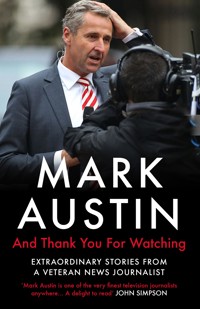
'This insightful and superb book takes you to World Cups, to conflicts in war-torn countries, to division in Trump's America... A terrific read.' - Gary Lineker For over thirty years, Mark Austin has covered the biggest stories in the world for ITN and Sky News. As a foreign correspondent and anchorman he has witnessed first-hand some of the most significant events of our times, including the Iraq War, the historic transition in South Africa from the brutality of apartheid to democracy, the horrors of the Rwandan genocide, and natural disasters such as the Haiti earthquake and the Mozambique floods. Full of high drama, raw emotion and the sometimes hilarious happenings from the life of a veteran reporter, Mark Austin's memoir gives startling insight into the stories behind the headlines. 'A must read.' - Sir Trevor McDonald
Sie lesen das E-Book in den Legimi-Apps auf:
Seitenzahl: 496
Veröffentlichungsjahr: 2018
Das E-Book (TTS) können Sie hören im Abo „Legimi Premium” in Legimi-Apps auf:
Ähnliche



















AND THANK YOUFOR WATCHING
Mark Austin worked at ITN for thirty years, where he presented the News at Ten and the Evening News, often on location from around the world, including the Antarctic, Iraq, Libya, Haiti, Nepal and Mogadishu. He has twice been named the RTS Presenter of the Year, won five BAFTA awards, an international Emmy for his reporting on the devastating floods in Mozambique and a Golden Nymph for his coverage of the war in Kosovo. He is now a presenter for Sky News.
‘Mark Austin is one of the very finest television journalists anywhere, and his charming, insightful view of the world, as laid back yet gutsy as the man himself, is a delight to read.’
John Simpson
‘Mark Austin made his name as a distinguished journalist and one of the popular news anchors on Independent Television News. His assignments took him to some of the most important parts of Europe, Asia, Africa and the Middle East, where with brilliant clarity he analysed the most significant developments of our time. His great good fortune was to get sent to Washington to report on the Trump administration, surely one of the most unorthodox presidencies of our time. For this alone his book is a must read.’
Sir Trevor McDonald
‘Authoritative, searching and honest – Austin writes as brilliantly about the personal as about the professional encounters he’s had. He has landed in America and – with humour and warmth – cast his ever-perceptive eye over a country we simply can’t understand well enough.’
Emily Maitlis
‘Mark Austin is a ballsy, brilliant journalist who believes the best way to report a story is to go to where it is happening, whether that is a war zone or Trump’s White House. This is a riveting book for those who love news by one of the best in the business.’
Piers Morgan
‘This insightful and superb book takes you to World Cups, to conflicts in war-torn countries, to division in Trump’s America. On location or in the studio, Mark Austin has covered it all and done so with skill, integrity and accuracy. A terrific read.’
Gary Lineker
‘Mark Austin is a brilliant journalist and a great guy. Read this book to be informed, entertained – and moved.’
Jeremy Bowen
AND THANK YOUFOR WATCHING
Mark Austin
First published in hardback in Great Britain in 2018 by Atlantic Books, an imprint of Atlantic Books Ltd.
This paperback edition first published in Great Britain in 2019 by Atlantic Books.
Copyright © Mark Austin, 2018
The moral right of Mark Austin to be identified as the author of this work has been asserted by him in accordance with the Copyright, Designs and Patents Act of 1988.
All rights reserved. No part of this publication may be reproduced, stored in a retrieval system, or transmitted in any form or by any means, electronic, mechanical, photocopying, recording, or otherwise, without the prior permission of both the copyright owner and the above publisher of this book.
The list of picture credits on p.337 constitute an extension of this copyright page.
Every effort has been made to trace or contact all copyright holders. The publishers will be pleased to make good any omissions or rectify any mistakes brought to their attention at the earliest opportunity.
1 3 5 7 9 10 8 6 4 2
A CIP catalogue record for this book is available from the British Library.
E-book ISBN: 978-1-78649-451-1Paperback ISBN: 978-1-78649-450-4
Printed in Great Britain.
Atlantic Books
An Imprint of Atlantic Books Ltd
Ormond House
26–27 Boswell Street
London WC1N 3JZ
www.atlantic-books.co.uk
To my family, especially Maddy, who has been to hell and back, and then had the courage to help others.
And to Didier Drogba19.05.2012
CONTENTS
Introduction
1. Trumptown
2. Notes from a Small Newspaper
3. Sporting Life
4. Mandela
5. Rwanda
6. Journeys
7. The Flood
8. Terry Lloyd
9. Getting Away With It
10. Anchorman
11. Maddy
12. Journalism
13. And Finally… From Trumptown
Acknowledgements
Index
INTRODUCTION
THIS WAS NOT how it was meant to be. I had always wanted to play cricket for England or be a drummer in a rock ’n’ roll band. So what the hell was I doing standing on parched scrubland in the South African bush with a gun to my head?
I had been marched into the field at gunpoint, ordered to look straight ahead and say nothing. If I turned around they would shoot. My mouth was as dry as the terrain around us. The men were angry, very angry, and kept screaming at me. I couldn’t understand a word they were saying. I was gripped with fear, felt nauseous and thought I was probably going to die. My young producer, standing alongside me, thought we were definitely going to die. He was shaking. It was his first major foreign assignment. And there we were, side by side, facing possible death at the hands of screaming Afrikaner militiamen. In Bophuthatswana, for God’s sake. A place no one had heard of. On a wretched story no one would remember in a few months’ time – and, worse, would not matter in a few weeks’ time. What a way to go. Wrong place, wrong time… again!
Or not, because the two most prized boasts of the foreign correspondent are ‘I was there’ and, even better, ‘I was there first’. It is what we do. We go. We always go. It is not – in most cases – through any great bravery, or a warped desire to notch up a close scrape in a South African field. It is because we want to be there, we want to witness what is happening and we want to get the story out to the world.
So, wrong place, wrong time? No. In fact, in this business the opposite applies. It is the madness of what we TV news people do. What we choose to do. I was actually in the right place at the right time. It may have turned out to have been the wrong place had that gunman pulled the trigger. But I was where I wanted to be, and yes, where I had to be if I wanted to get the story.
I say this because, if you are reading a book about the life of a foreign correspondent and travelling anchorman, it helps, I guess, to understand what motivates us. It is sometimes glamorous, often exciting and frequently fascinating. But it also can be tedious, dispiriting and routine. And yet time and again we are drawn to places like Afghanistan, Bosnia, Iraq, Syria and Sierra Leone. It is part competitive urge, part a need to be there, and part the desire to seek out the truth – or as close to it as it is possible to get.
I am not one of those war junkie correspondents who thrive on the adrenaline of conflict and witnessing bad stuff. I have known many reporters – male and female – who are in their element in war zones, who love the challenge, who relish the hardship and even find the danger quite alluring. I say this not in criticism; in fact, quite the opposite. I have undiluted admiration for the journalists who do feel that way. They are brave, courageous and resourceful. And the bottom line is this: if they did not go to the godawful places to bear witness, who would do it? Who would be there to cast a light on those dark corners of the world where conflict rages, war crimes are committed and atrocities take place? The answer: no one.
And that is just what those who perpetrate such monstrous outrages want to happen. They want to operate in obscurity, in darkness. Good war reporters don’t allow that. They shine a light. The Anthony Loyds, Jeremy Bowens, Marie Colvins (God rest her soul), Christina Lambs, Kim Senguptas, and countless cameramen and women and photographers of this world should be saluted for the work they do.
However, I am not someone who welcomes the danger. I have been to many war zones, but I don’t relish it, I don’t feel some sort of missionary zeal to do it and I certainly don’t enjoy it. The fact is, if you’re daft enough to agree to go to these places, and you do it often enough, you will get into difficulties. More often than not the threat is sudden and comes from nowhere, and whether you live or die can be pure luck – which road you take, which hilltop you film from, which hotel you stay in, which local fixer you hire, and who you take advice from.
I have good friends who have been killed or seriously injured in war zones. I was with the ITN reporter Terry Lloyd the night before he and his cameraman and their fixer were killed in Iraq. That story is in this book. The BBC’s John Simpson, one of the great foreign correspondents of our age, was with his camera team in northern Iraq when they were bombed by ‘friendly forces’ who got their coordinates wrong. He survived. Terry didn’t. The lottery of war.
I survived, or at least I have so far, largely due to an innate cowardice. In fact, I’ve found that cowardice is a much better protection than any amount of flak jackets, helmets and armoured vehicles. Cowardice has stopped me going to many places and doing many things in war zones, and I think there are many camera crews and producers who would probably thank me for that. My cowardice has served me well.
This book is not supposed to be just about war stories or close brushes with death. I have included them because that is what I get asked about most often, but also because most intensely insecure TV reporters, particularly those who later sneak off to the comfort and sanctuary of the studio to become presenters, like it to be known that they have earned their spurs, they have seen action and they’ve been in the thick of it. I guess it’s the feeling that you haven’t made it until you’ve been shot at. It really is that pathetic. Honestly.
But this book is also about the other big stories I have been privileged to cover in thirty years as a foreign correspondent and presenter for ITN, and now as Washington correspondent for Sky News.
I write about the Rwandan genocide in 1994 and what it’s like to report on a story where almost a million people died at the hands of machete-wielding, grenade-throwing murderers, just because of their ethnicity. Recent African history is replete with outbursts of tribal slaughter, but this was a massacre on an altogether different scale. It was not a simple tale of mutual hatred between rival ethnic groups descending into terrible violence. This was a carefully planned, meticulously carriedout genocide. ‘Genocide’ is an oft-misused word. Not in this context, though. A green, lush, beautiful land of rolling hills and endless valleys became a vast human abattoir. It is by far and away the most grotesque story I have ever covered. I have yet to meet a journalist who was not deeply affected by what they witnessed there. My friend, the BBC correspondent Fergal Keane, to this day has nightmares about being at the bottom of a pile of rotting corpses that are moving and touching him, ‘like a mound of eels at the supermarket’.
I have always managed to compartmentalize much of the bad stuff: detach it, file it away to be forgotten about. But not Rwanda, not what I saw there. Not then, not now, not ever. In his brilliantly written book, Season of Blood: A Rwandan Journey, Fergal recalls: ‘Although I had seen war before, had seen the face of cruelty, Rwanda belonged in a nightmare zone where my capacity to understand, much less to rationalize, was overwhelmed. This was a country of corpses and orphans and terrible absences. This was where the spirit withered.’
That is it. That is what I felt. Right there… in words I will not be able to match. But I hope nevertheless to convey some sense of what occurred in that godforsaken country.
I also hope there is much to uplift you in this book. I spent time with Nelson Mandela just before and after he became President of South Africa. What a time to be living in Johannesburg that was. Those were intoxicating days in South Africa, a roller coaster of emotion that was mercifully to lead to one of the great moments in modern African history: the inauguration of the country’s first-ever black president. I will never forget standing on the lawns in front of the government buildings in Pretoria, looking up at the skies as South African military aircraft staged a flypast in tribute to Mandela. That’s the same military that for decades used its machines of war to oppress the entire black population. I listened as Mandela’s booming voice rang out: ‘We shall build a society in which all South Africans, both black and white, will be able to walk tall, without any fear in their hearts, assured of their inalienable right to human dignity – a rainbow nation at peace with itself and the world.’
It was a magical time. And how joyous, just a couple of weeks earlier, to be up at dawn as the sun rose in the sky, to film the endless queues of people waiting patiently to cast a vote for the very first time. And how they waited. Some standing in line for hours. But they sang and chanted and cheered, knowing that this was the day that would change their lives and their children’s lives forever.
Yes, 1994 was quite some year in my life. Mandela’s rise, South Africa’s freedom, followed by Rwanda’s horror – all within a few months of each other. And it was a year made even more memorable by the birth in Johannesburg of our first daughter, Madeleine. Born in the new South Africa, a child of the rainbow nation, she has always held that country close to her heart, as we all have. The few years we spent living there were perhaps the most inspiring period of our lives – or at least they were for me.
But Maddy also features in this book in a way that I would much prefer she didn’t. At the age of seventeen, she became seriously ill with the eating disorder anorexia. It nearly killed her. That it didn’t was down more to good fortune than anything else. Her ordeal lasted three years, thankfully short for a sufferer of anorexia; it can last for years, even a lifetime. So this book is, on a very personal level, about what happens when your own child becomes the biggest story in your life.
I have written much about the terrible toll that it took. Angered by the lack of resources in this country to deal with anorexia, Maddy and I made a documentary about it. But here I try to describe what it is really like, trying to read the news in front of millions of people every night when your daughter is wasting away at home and you can do absolutely nothing about it. It is an awful condition to witness; it tears away at the very fabric of family life and it tears away at your heart. They were terrible days, watching my sticklike teenager – hollow-eyed, emaciated and devoid of life – just wither away without seeming to care. Why didn’t I just stop working? Why didn’t I just stay at home and devote all my attention to try to make her better? It’s a question I have been asked many times since I first wrote about it. And in this book I try to come up with an answer.
Much of this book was written in the United States, in my apartment in Georgetown, Washington DC, from where I have observed the most extraordinary story in modern politics.
The book opens and closes with the political phenomenon that is Donald J. Trump. As I write, the true extent of the Trump challenge to American democracy and to the cherished ideals and norms of this great country is still being determined. Some – those who voted for him, primarily – would say that is no bad thing. He has upended orthodoxy, changed the Republican Party, infuriated the establishment and ripped up the foreign policy rulebook. But he has done nothing he didn’t say he would do. He has been true to himself, to his campaign and to his promises. And in that, there is a core honesty to the man not often acknowledged.
But to others, he represents a crisis of political morality of considerable magnitude that is unsettling and not a little frightening. It is not the fear induced by a clever, strategic, manipulative demagogue who is out to entrench autocratic rule, overturn the rule of law and ditch well-honed democratic principles and freedoms. No, it is the fear – or for some, the excitement – inspired by the unpredictable, the chaotic, the abnormal and the dysfunctional, all of which coexist in this presidency of the bizarre.
That perfect storm is buffeting America right now. The Trump chapters thus have the benefit of being composed virtually as things happen, but such immediacy also imposes unavoidable limitations and risks. Reporting almost as it happens is imperfect for a book like this. It offers little time for proper reflection and perspective, and there will be some events that are overemphasized and others that will appear underplayed in light of new developments.
But at least with Trump there should be no issue of memory failing me. In other chapters covering events and incidents occurring two or three decades ago, that will inevitably be the case, and for that I apologize. I write of those days as I remember them, without diary or perfect recall, and I regret error if and where it appears.
If it sounds a rather harrowing read in parts, I’m afraid it is. But I hope it is also as entertaining and as much fun as this job can often be. There has been so much enjoyment and there have been so many laughs along the way. The crazy journeys, the tales of the unexpected, the mistakes, the humiliations and the great moments of sport I have been lucky enough to witness first-hand – these have all made it an enormously eventful but enjoyable career so far.
When things go wrong in television news, which they often do, we tend to take ourselves far too seriously. I know I do. We think it is the most important job in the world. We hate losing to the opposition, we hate falling short. But I’ve come to learn that perspective is one of the greatest qualities a journalist can possess, but one that is most often in short supply.
My wife – an A & E doctor – is far more rational. She really does work in a world that is life and death on a daily basis. She does it quietly and undramatically. And she will always throw the same words at me when I bang on about a failure or a mistake or a job badly done.
‘Yes, it’s important,’ she will say, ‘but in the end, it’s only television.’
And she’s right.
TRUMPTOWN
NO ONE SAW it coming. No one. No one, that is, except a rock band called Rage Against The Machine. In 2000, while shooting a video on Wall Street, they forced the New York Stock Exchange to close early. At one point in the finished video, you see an onlooker holding up a sign proclaiming ‘Donald J. Trump for President’. Protest and prescience… quite some performance. In truth, it probably had more to do with the director of the video, Michael Moore.
‘I think it was either Michael Moore’s idea or one of his staffers,’ Rage guitarist Tom Morello told a New York newspaper. ‘It wasn’t a warning, it was just meant to be a joke – pure humour. But it turned out to be Nostradamus-like.’
If it was Moore, a well-known leftwing filmmaker and activist, then hats off to him. But even he can’t have meant it seriously. Not sixteen years before the event. Much later he did predict that Trump would be the Republican nominee for president. And he went on the following year to foresee his eventual victory. In a now-celebrated blog he said: ‘This wretched, ignorant, dangerous part-time clown and full-time sociopath is going to be our next president. President Trump. Go ahead and say the words, ’cause you’ll be saying them for the next four years: “PRESIDENT TRUMP.”’
And, of course, that is exactly what the world is saying: President Trump. And the world is getting used to it. President Trump… it trips off the tongue like you never thought it would.
Michael Moore – whose political bias against Trump is self-evident – may choke when he says those words, but he saw it on the horizon, he saw what was happening in America and elsewhere; he saw the new politics that was unfolding.
Most of the rest of us didn’t. Certainly I didn’t, and neither did others supposedly more in tune than me with what is happening here in the US. Not the media – at least, not the increasingly smug, complacent, centre-left-leaning, liberal progressive, mainstream media – who failed to appreciate what was happening outside their immediate metropolitan elite circles. Not the politicians, and not even the pollsters, whose job it is to know these things.
To all of them, the political events of 2016 came as a terrible shock. Brexit, Trump and the rise of the populist far right in continental Europe were unforeseen, inexplicable and alien. To them, it was as if the world had lost its senses, as if the natural order of things was thrown into tumult, as if prejudice and ignorance was running amok. It was unsettling and it challenged assumptions.
The game had changed. Out was the old politics of left and right. In was a new politics, more complex and more assertive. It was the politics of revolt.
Trump has an innate ability to identify an opportunity and exploit it. He spoke to, persuaded and eventually dazzled parts of America that felt the country was no longer theirs, and who were crying out for someone to speak up on their behalf. Trump was that man. For all his foibles, weaknesses and character flaws, he was the one politician who seemed to care – and he played the part brilliantly.
His timing was ingenious. America was ready for him, and he was ready for America. He had also become a big name. It helped that he had starred in a primetime reality show, The Apprentice, for fourteen seasons, and had given hundreds of interviews. CNN worked out that he had spent more time in front of a camera than even the Hollywood movie actor Ronald Reagan.
So, Trump mastered the media, then manipulated it for his own purposes and ultimately turned it into enemy number one. It was all very clever, insightful and perfectly legitimate as a political calculation, and highlights the great strength of Donald Trump.
Less legitimate – in fact, downright cynical – was his courting of a subset of American voters who remain consumed by racial prejudice. These are not only white supremacists, but also a substantial block of the white working class who fear immigration and harbour resentment against the black and Latin American minorities in America.
How did he do it? Well, partly by questioning the birthplace of America’s first black president, Barack Obama. ‘I’m starting to think that he was not born here,’ he said. There was not a shred of evidence to support Trump’s claims, but it gained traction with a racist minority that he decided were his potential voters. It was deeply cynical, hugely offensive to many, but also highly effective.
And just as effective was his promise to build the wall along the border with Mexico. He played on the fears of many white working people about the growth of immigration. Across the Midwest rust belt of America, in towns where steel and coal jobs were being decimated and livelihoods ruined, he spread the message that immigrants were the problem: You don’t have your jobs because of immigrants. It wasn’t true. Their jobs were gone. No one had them. But again it resonated, it hit home.
Even the Access Hollywood tape – in which he can be heard boasting about how he treats women, and how when you’re a powerful celebrity you can do anything, even ‘grab ’em by the pussy’ – even that didn’t stall his progress to the White House. It was extraordinary.
It was also, of course, as much a vote against Hillary Clinton as it was for Donald Trump. While Trump courted the white working class, Hillary Clinton ignored it. Part of the blame, perhaps, lies indirectly with her husband Bill. The immensely popular former president expanded the appeal of the Democratic Party, and it became the party of choice for the professional classes of America.
Lawyers, teachers and the educated classes began embracing the party of Bill Clinton in large numbers. The Democrats, for so long the natural home for blue-collar workers across America, had changed. Many in the working classes saw this transformation and resented it. It also didn’t help that while Trump made several visits to the Midwest of the US, Hillary made only a few.
For all these reasons, the greatest political earthquake in the history of modern America was triggered.
At the election in 2016, Trump won 63 million votes, and tens of millions of voters continue to support him. No one believed it until it happened. He stunned America, the world – and, by his own admission to colleagues, himself.
Yes, Trump is in the White House. It’s for real. And it’s the single most extraordinary political story of my lifetime. So when the opportunity came to spend a year covering this phenomenon called the ‘Trump presidency’ for Sky News, I leapt at the chance and hotfooted it to Washington DC, where this bizarre, thrilling, crazy, intoxicating, unedifying, depressing, unpredictable drama is being played out on a daily basis.
Every day, almost every hour, seems to bring another remarkable twist or turn in the Trump story. It is a story like no other, and it raises all sorts of questions about how to report it.
Just as there are no rules for President Donald Trump – or no rules that we recognize – so the rules have changed when it comes to covering him. On my several visits to Washington pre-Trump, it always surprised me how deferential journalists were towards presidents, and senior politicians in general. But particularly presidents. There has long been a reverence among reporters for the office of the president, which has always translated to whichever individual happens to be occupying the White House. It is just the way it is. It is a marked contrast to Britain, where, if anything, the general attitude of the press towards politicians, even prime ministers, is one of scepticism, suspicion, sometimes ridicule and often outright contempt.
In America, those who go into politics are genuinely seen as serving the American people and serving the country. In Britain, they are often seen as serving themselves, and in it for the publicity and the expenses. Broadly speaking, Britain is way too disdainful; and America has been way too respectful.
Not anymore. With Trump has come an erosion of the media’s respect for the presidency. In fact, following his sustained attack on many of the country’s mainstream news outlets and his tedious ‘fake news’ retort to anything he disagrees with, it is not so much an erosion as a complete disintegration of respect for the president. It makes for an uncomfortable and often unpleasant relationship. It is tense, demeaning and unedifying. And it is ultimately bad for democracy, and for holding the government to account.
On arriving in Washington DC, in September 2017, I had a problem: how to cover this extraordinary story and this unusual, unpredictable and nonconformist president.
I had noticed the reporting of many mainstream TV correspondents was tinged with a kind of haughty disdain for Trump, which at times turned to outright contempt. Certainly, CNN and MSNBC are openly and unapologetically critical of Trump. They really do have nothing good to say about him. I am stunned by some of the coverage from previously largely impartial media outlets.
There is no question that Trump – with his weird combover, orange complexion, habitual tweeting, glib pronouncements, and strange ways – cuts a vaguely comedic figure as president. But he is also occupying the office of the most powerful leader in the world. Everything he says and does is significant, has consequences and shouldn’t be trivialized or dismissed.
As I flew across the pond, I also thought that he deserved to be treated with the same seriousness and respect as previous presidents. He had won an election, after all. The people of America had decided that Donald J. Trump was the man to represent and lead them around the world, and that was important. Free elections sometimes throw up random and awkward results, but that is the nature of democracy – and the job of a journalist, or at least a correspondent working for an impartial British television news channel, should be to report in good faith and without bias what the president does and says, what it may mean, and what the consequences are likely to be.
Anyway, who’s to say this was an ‘awkward’ or ‘random’ result? As I arrived in Washington, some journalists and columnists were already reporting the Trump presidency as some sort of political ‘freak show’. It is much easier to mock this president than to take him seriously, but trying to be fair is the challenge you have to set yourself every day. My view was that if enough Americans had deemed him a suitable candidate for the White House, why should I sneer?
In London, before flying out, I’d asked John Ryley, the boss of Sky News, how he thought I should go about reporting this strange phenomenon. ‘You must report it as it deserves to be reported,’ he said. ‘And try not to lose the sense of impartiality.’ He said this as if he knew it might be difficult.
So I pitched up in DC with the firm intent to give President Trump the benefit of the doubt. I wanted to find out about his followers and what motivates and drives their support for him, and I wanted to ensure I gave their views a real airing. In short, I wanted to cover President Trump as I would any other American president.
It soon became obvious that this would be impossible. The sheer unrelenting deluge of news from the Trump White House was overwhelming. Almost every week brought a new drama that would provoke a media frenzy for seventy-two hours or so, until, as sure as night follows day, it would be usurped by the next one. And it would be Trump’s reaction to the media reaction to the initial drama that would keep the story rolling frenetically along.
Covering this White House is unremitting, and a bit like trying to drink from a fire hose. You can’t really do it, and no one turns the fire hose off, so in the end you just stand there and get drenched. Trump is a day-to-day, moment-to-moment presence in your working life, and one’s reporting of him becomes instinctive and emotionally driven in a way that I am not sure is terribly useful to the public.
‘You know Trump is a pathological liar,’ a senior correspondent with a top US broadcaster said to me within a few days of my arrival in Washington. ‘He tells untruths and seldom gets called out for it.’
I disagree with him. I think Trump tells lies but he does generally get caught out and challenged. The fact checking site, PolitiFact, has never been busier… Early in the presidency it deemed that just 5 per cent of Trump’s statements were true and 26 per cent were mostly true. But a huge 69 per cent were found to be basically porky pies – the worst rating for a president. And most papers or political magazines have tried to chronicle Trumps fibs at one time or another. The Washington Post decided that Trump made 492 false or misleading claims in his first 100 days. Politico’s Maria Konnikova made the point that all presidents lie but that Trump ‘is in a different category. The sheer frequency, spontaneity and seeming irrelevance of his lies have no precedent.’
She argues that Nixon, Reagan and Clinton were economical with the truth or lied to protect their own reputations, but ‘Trump seems to lie for the pure joy of it’.
It began on day one, with his claims of the largest inauguration crowd ever. It set a pattern. He also claimed Hillary Clinton had five million illegal voters and that he had the longest list of congressional achievements since Roosevelt, even before his tax bill was passed. It was preposterous.
Elizabeth Drew, a political journalist and author who has covered six presidents, told me: ‘Trump lies far more than any president ever. He lies all the time, every day. You’ve seen the statistics, they’re stunning.’
The New York Times columnist, Charles M. Blow, went further: ‘Trump’s incessant lying is obscene. It is a collapse in morality; it is an ethical assault.’
I know what he means. The danger is that, eventually, constant lying will batter a nation and its people into submission. It becomes a kind of distorted reality, and in the end people are too exhausted to question or fight back.
Watching him up close in Washington and around the country, I am not at all sure that Donald Trump is wilfully dishonest. It seems to me that he sometimes says the first thing that comes into his head to defend his position. I am certainly not saying that Trump has even a token obedience to the truth, but sometimes he just repeats claims he’s heard that suit his arguments, and other times I think he just lazily throws out figures or what he believes are facts.
The one thing about Trump is that he hates being wrong – he can’t be wrong – so he has a habit of trying to persuade his audiences that he’s not wrong. And sometimes that involves some creative thinking.
What he unequivocally does do, it seems to me, is sow confusion at every turn. I was sat in my Washington apartment one evening when a news alert sounded on my mobile. It was nothing major, but it was to become hugely illustrative of the way the Trump presidency was playing out.
The alert said: ‘Democrat leaders say deal agreed with Trump on Dreamers, tied to border security and excluding the wall.’ In short, it was about a group of several hundred thousand immigrants who had come to America illegally with their parents and who had no official papers. President Obama had afforded these so-called Dreamers some protection, but Donald Trump, playing to his core support on immigration, wanted to remove that protection. So, it was a good story if Mr Trump had changed his mind, an even better one if he was also giving up his plans to build that big wall all along the Mexican border.
The following morning, Donald Trump tweeted: ‘No deal was made last night on DACA. Massive border security would have to be agreed to in exchange for consent’.
Then this: ‘The WALL …will be built’.
The clear suggestion of the tweets was that the wall was part of the deal over protection of the immigrants’ status. But a few hours later, he arrived in Florida on a visit and told reporter that the wall would be built but would come later.
By now, everyone having to report on this was scratching their heads. And then this presidential tweet pinged onto journalist’s iPhones: ‘Does anybody really want to throw out good educated and accomplished young people who have jobs, some serving in the military? Really!’
So a man whose campaign promise had been to build a wall as soon as he came to power, and to end the protection for the Dreamers, was now less than committed to both plans. Or at least he seemed to be. No one quite knew.
I was asked to go on air and talk to Kay Burley in London about the story. ‘Give me a few minutes,’ I said. We phoned the White House for clarity. We didn’t get it. ‘The president’s words speak for themselves,’ I was told. And that, loosely translated, means they didn’t know. I am not even sure if Trump himself knew. Or whether the White House knew whether he knew…
I went on national television and tried to explain. I don’t think I got away with it.
But Trump does get away with it. The very fact that he’s in the White House is evidence of that. He’s living proof that politicians can get away with telling voters just about anything that sounds good, no matter how unlikely or implausible it is. After all, Trump promised to cut taxes, and to his credit, he delivered; but he also promised to increase spending on infrastructure. He promised to provide healthcare to all Americans and pay off the national debt. He promised to build a wall at Mexico’s expense. He promised all these things, and paid no price for the obvious inconsistency of the promises.
Now, show me a politician who doesn’t spray around empty promises at election time and I’ll show you a pig soaring through the sky. But the Donald took this to a new level of disingenuousness. He just said things that he thought would appeal to millions of voters, fed up with the political elite and the establishment, and the people, or at least many of them, lapped it up.
But delivering on those promises is another matter altogether. It is notoriously difficult for any American president to do half the stuff they’ve pledged to do during a campaign. President Obama won the White House, but fought a constant battle with both Houses of Congress, often dominated by his political opponents. He struggled.
Now, President Trump has all the advantages of a Republican president working with a Republican-controlled Congress, so it should be easier. But not so. Such is the extraordinary nature of Trump’s promises that when they collide with political realities they sometimes crash and burn.
But, here’s the thing about Donald Trump. However many problems or obstacles he encounters in delivering on his pledges, however many unfulfilled promises or uncovered lies, his core support seems to be unwavering. And that is largely because they believe he is really trying to deliver on his campaign pledges. And they also believe him when he says others are to blame when he can’t deliver. It’s the fault of the Democrats or the establishment or the system. Anyone and anything, but not Trump. Not at all.
And there is something about the way Trump relates to and connects with his supporters, something in his language and tone, that means he is able to carry it off. It is a skill that is instinctive and natural to him. It cannot be taught, and I am not sure I have seen a politician anywhere in the world who carries it off with quite the same success.
Within weeks of arriving in Washington, I realized he was an extraordinary political animal who operates like no other politician. He is a bruiser, a narcissist and an instinctive purveyor of untruths, but he is also a clever political operator. Elizabeth Drew – who knows a thing or two about presidents – believes Trump is ‘shrewd but not wise’.
He knows what will appeal to his core vote and he is unafraid to pander to it, even if it means alienating supposed allies. And he has no hesitation in jeopardizing America’s special relationship with the UK if it means he can score a hit with his supporters.
Shortly after I arrived for my assignment, I was awoken early by a call from London telling me there had been a terror attack on a tube train in Parsons Green, in south-west London. Only scant details were known. ‘What’s it got to do with me?’ I asked rather petulantly.
What it had to do with me was that Donald Trump was already commenting about the attack on Twitter, his favoured form of communication. His first offering was this: ‘Another attack in London by a loser terrorist. These are sick and demented people who were in the sights of Scotland Yard. Must be proactive!’
How on earth did he know the perpetrators were known to the police? How did he even know who they were? It had only just happened.
And a moment later this: ‘Loser terrorists must be dealt with in a much tougher manner.’
And then, tellingly, Trump added that his own proposed ban on visitors to the US from predominantly Muslim countries should be ‘far larger, tougher and more specific’.
So there he is, spouting forth about an attack in Britain, and at the same time promoting his own controversial measures and policies – even if it meant, at the same time, annoying the authorities in Britain. In Trump’s world, that’s fine.
Now if Trump really did know the intelligence about who the attackers were, it was a grotesque breach of protocol that undermines the relationship between the US and the UK. If he didn’t, if he was just guessing – or worse, just talking tough to appeal to his voters – then that is equally unacceptable. I know for a fact that senior figures at Scotland Yard and within MI5 were furious at the unwarranted and unwelcome intervention.
But, the point is, Trump doesn’t care. It suited him domestically to appear tough on terrorism. He’d upset Republicans by apparently reaching out to Democrats on the Dreamer issue and here was the opportunity to rebalance things and mollify his political base.
He’d done exactly the same thing earlier that year. In June, he had criticized London’s mayor Sadiq Khan over the city’s response to another terrorist attack. Again it was on Twitter, and again an unguarded post caused no end of diplomatic trouble.
How Donald Trump got his ‘intelligence’ information so soon after the Parsons Green bombing is also instructive of the modus operandi of Donald Trump.
Shortly before his initial fusillade of tweets that September morning, a security analyst, Jim Hanson, had appeared on Fox News, the right-wing TV station in the US that Trump watches habitually in the morning. Hanson had said: ‘My fear again is that we’re going to find out this is someone who is known to the police.’
A website for Mr Hanson’s firm, Security Studies Group, says it focuses on ‘defending the value of American power against the true threats we face’, and talks about a Washington elite that has been ‘unable or unwilling to address and communicate the most basic requirements of American nationhood’. So, in other words, Mr Hanson is a ‘Make America Great Again’ Trump supporter.
The most likely scenario is that the president was watching his mate on Fox, took what he said at face value, because why wouldn’t he, and then fired off his tweets. The White House did not deny he had been watching Fox. Jim Hanson or MI6? I know which I would trust.
It was ten hours before Trump tweeted what he should have tweeted in the first place: ‘Our hearts & prayers go out to the people of London’.
The whole thing summed up the Trump way of doing things. The picture is of a president who makes instinctive policy decisions on the hoof, depending on the political weather at that particular time. In my first few weeks in Washington, as hard as I tried, it was difficult to detect any consistent political philosophy underpinning the Trump presidency.
It was rather a never-ending series of adjustments or recalculations designed to satisfy or enrage whoever he felt needed satisfying or enraging. Trump is a tactician rather than a strategist. He is a dealmaker, he is transactional, and like all politicians he keeps a close eye on the opinion polls. The Trump strategy is that there is no strategy.
Elizabeth Drew put it to me like this: ‘Trump makes a lot of noise and dominates the scene through sheer force of personality and lack of inhibition, feeling no need to observe the norms, which can take him into risky territory… The sheer dazzlingness of his performance makes us forget what it’s about.’ She calls him the ‘somewhat corpulent Flying Wallenda of politics’. And she is not alone in expressing alarm at the lasting damage he may be doing to American political culture and institutions including the Republican Party.
What many people also worry about is what he is doing to America’s standing in the world. Whoever the president was, whoever was leading the country – whether Republican or Democrat – there has long been an acceptance, in the West certainly, that, despite all the flaws, America is, broadly speaking, a force for good. Not simply a heavily armed policeman patrolling the globe, restraining, tackling or extinguishing threats to peace and stability; but a beacon of freedom and liberty and democracy, a country upholding an enlightened world order.
But Donald Trump seems dismissive of the notion that America should stand up for anything but itself. The ‘America First’ philosophy is popular in many parts of the country, but my concern is that it turns the country in on itself rather than embracing the interconnectivity of this world.
‘America First does not mean America alone’ is an oft-repeated mantra of the Trump administration. And yet, slowly but surely, the United States is becoming more isolated from its traditional allies. Trump’s decision to withdraw from the Iran nuclear agreement is a case in point. Trump was so set on scrapping the deal – and some believe it was simply because it was Obama’s signature achievement – that he had no qualms about upsetting every single Western European ally.
I witnessed the most extraordinary diplomatic love-in between Trump and French president Emmanuel Macron in Washington. It was a spring romance to lift the heart. But – and here’s the point – it did not even survive the month of May. Trump’s decision on Iran did for that. Une affaire provisoire. And Trump – who apparently knows a thing or two about affairs – didn’t care. The only really special relationship seems to be between Trump and his core supporters.
Correction: he also cares about his relationship with Israel. His decision – long considered but never implemented by previous presidents – to move the US embassy in Israel from Tel Aviv to Jerusalem was again done in the face of huge opposition from European allies. But it played well with many Jewish voters, and, particularly, with a few very wealthy Jewish donors. The fact it was also followed by bloodshed and dozens of deaths among protesting Palestinians didn’t seem to matter. He sent his son-in-law, Jared Kushner, to Israel for the occasion. It was also Kushner’s job to resuscitate a peace process the move to Jerusalem had effectively killed off.
Successive American presidents of either party have always advocated that a democratic and unified Europe was in the best interests of the United States. But Donald Trump seems to think otherwise. He fetes nationalists set on dismantling the European Union, for instance. He pointedly met Nigel Farage, the former leader of the UK Independence Party, before he met Prime Minister Theresa May. He cheered Brexit, and taunted Germany over their trade imbalance with the US.
Further, he called NATO ‘obsolete’ and complained about American obligations to an organization whose members were not all paying their way. It actually worked. Trump’s threat to leave brought an immediate dividend of about $30 billion in extra revenue.
To stand alone, strong but isolated, above all others but also apart? Is that really the way forward? Trump maybe thinks so. It reminds me of a saying that has always stuck with me: ‘If you want to go fast, go alone. If you want to go far, go together.’
Trump is often teased for his apparent respect for authoritarian leaders like Russia’s President Putin. It was a predilection that manifested itself in the strangest of ways as he began the second year of his presidency.
He ordered the Pentagon to come up with options for a grand military parade through Washington DC. He had admired the pageantry of the Bastille Day parade on a visit to Paris, and wanted to ‘outdo’ the French with a display of American military might.
This from a president who had appointed several serving or former generals to key positions in his administration, and who had made many heavily political speeches and announcements in front of military audiences.
It was another break with an established norm: that the military’s separation from partisan politics was to be respected by the executive. This was Trump politicizing the military, turning it into a political prop for him to use to satisfy his base and also to send out a warning to his political enemies. It was as if he were saying, ‘I have supreme power because I own the military.’ It was the stuff of autocratic regimes, and it unsettled many in both the military and politics.
It may simply be that Donald Trump saw a military parade as an extension of his tactic of using patriotism, and the flag as a core issue that played well for him. But it leads the military into difficult waters. At best, it makes life awkward for the generals; at worst, it tarnishes the military’s integrity and compromises its independence.
As one Iraq veteran put it: ‘Our service members have better things to do than march in Washington, at a time when we remain committed in Syria, Iraq and Afghanistan.’
It is sometimes difficult to know quite how the rest of the world views Trump, although there was a telling moment after one of his first major overseas trips. I was sitting in the Sky News office in DC one lunchtime, when the White House suddenly announced an address by the president that afternoon. Trump had just returned from a two-week, five-country, three-summit trip to Asia, and had received, at best, lukewarm reviews in the mainstream media. The New York Times – or the ‘Failing New York Times’ in Trump-speak – had described him as a ‘bewildering figure to countries that had already viewed [him] with anxiety’, and they questioned his achievements on the tour.
Trump was clearly furious. First, he posted a series of angry tweets calling the NYT ‘naive’, ‘dumb’ and ‘failing’, and then he called an astonishing press conference. It amounted to a thirty-minute paean to himself. It was self-indulgent, self-justifying and self-congratulatory: ‘They treated me personally with warmth, hospitality and respect… real respect.’ He said he was leading the ‘Great American Comeback’ and insisted America’s standing in the world had never been greater.
There was no question Trump had been welcomed warmly. There were red carpets, state banquets, ceremonial welcomes and fawning speeches. The New York Times said President Trump made the mistake of mistaking flattery, which was doled out in spades, for respect. It was enough for Donald Trump to be able to say ‘they loved me’; ergo, it was a triumph. But the truth of the trip was there was little of substance to report and little to shout about. The whole performance was extraordinary… and definitely not normal.
Trump came to power partly on a promise to change things and ‘drain the swamp’ of Washington politics. It was a noble intention, but he filled his cabinet with zillionaires and a few have been embroiled in allegations of spending public money in wasteful ways. Just the sort of behaviour he professed to want to eradicate.
Washington needs to change, but in attempting to do so Trump is also trampling on some of the accepted norms in American public life. And the erosion of customs and traditions is worrying many Americans. Centuries to forge; months to dismantle; years to rebuild? That is how they fear it could be.
While I was in DC I was asked many times why I didn’t forget about Trump and report more on other stuff going on around America. And it’s true, it was very easy just to concentrate on the incessant news emerging from the White House, to the exclusion of other important issues.
But my feeling was that to stop reporting all the Trump stuff, the day-to-day craziness of the presidency, would be to accept that it was becoming routine and normal. I felt strongly we shouldn’t do that. The last thing America and the West needs during the Trump presidency is a lazy, compliant, accepting media. Holding power to account is always the responsibility of a free press.
In a way, the Trump White House has become a sort of cult of personality rather than a regular presidency. There is nothing necessarily wrong with that. In fact, his speeches can be riveting. He breaks away from the script with ad-libbed passages delivered in a language his supporters understand and relate to. It is hugely effective on occasions, it is not easy to do, and it’s brave. Trump does not get enough credit for his speeches.
But just as it was Trump’s character and personality that won him the office and served him well during the campaign, so it was to become less helpful to him once he was actually governing. Many of his problems stem from his character, particularly his impulsiveness.
His firing of the FBI director James Comey may have satisfied his Apprentice-style love of summarily dispatching people from his presence. But it was to cause him no end of trouble. Comey was leading a criminal investigation into whether Mr Trump’s top advisers colluded with the Russian government to try to steer the outcome of the 2016 election.
It was bizarre timing, and raised the immediate spectre of political interference by a sitting president into an investigation by the main law enforcement agency. It was a rash move that was to have far-reaching consequences. It immediately led to Democratic calls for a special counsel to lead the Russian inquiry. And it was that investigation, led by Robert Mueller, that was to haunt Trump for months.
The inquiry became an obsession with the media, it arguably took attention away from alleged wrongdoing by the Clinton campaign involving a secret dossier on Trump and the Russians, and it drove the president to distraction. At every press conference he would scream, ‘No collusion,’ and repeat it several times. It was a PR disaster of the president’s own making.
He also became convinced of political bias among top FBI and Department of Justice officials – some of whom he had appointed. He waged war against them, believing they deliberately precipitated the investigation into collusion with Russia by somehow joining forces with a British former MI6 officer in the pay of his enemy Hillary Clinton, who produced a secret dossier.
He even insisted that a classified memo, produced by the Republican leader of the House of Representatives’ intelligence committee, be released without redactions, a move that infuriated his own intelligence chiefs.
Democratic leaders believed that Trump would use the memo – which was not all it seemed – as reason to fire Robert Mueller. That would have been political suicide for Trump, and he probably knew it. He desisted, or at least he had at the time of writing. But he was determined, at the very least, to undermine the investigation into his Russia links. It seemed to become his mission in life.
And the extent of Trump’s links to Russia is the great mystery of his presidency. It is difficult to work out. There has been a good deal of speculation that his real estate empire had taken large amounts of money from oligarchs linked to the Kremlin; there were unsubstantiated rumours that he had engaged in sexual shenanigans with hookers while he was in Moscow running the Miss Universe contest; and there were unconfirmed claims that Russian intelligence had compromising material.
His reaction to the Special Counsel’s indictments against thirteen Russian individuals for meddling in the 2016 elections was strange. He didn’t respond to Russia’s assault on America’s democracy at all. He was muted and quiescent in a way that was truly bizarre. And it was seized upon by the New York Times columnist Thomas Friedman, who couldn’t come up with a reason for Trump’s reticence:
… whatever it is, Trump is either trying so hard to hide it or is so naïve about Russia that he is ready to not only resist mounting a proper defense of our democracy, he’s actually ready to undermine some of our most important institutions, the FBI and the Justice Department, to keep his compromised status hidden.
That must not be tolerated. This is code red. The biggest threat to the integrity of our democracy today is in the Oval Office.
What also became clear to me, after a year of covering this president, is that there are in fact many Donald Trumps. There is Trump the dealmaker; there is Trump the base seducer, who indulges his core support at every opportunity; there is Trump the flip-flopper, the guy who listens to the last person to talk to him; and there’s Trump the gunslinger, who fires off insults and abuse to anyone who offends him.
In January 2018, the many Trumps all started fighting each other and there was no clear winner. They basically started brawling on the Oval Office carpet while, outside, the government was grinding to a halt. Congress was at loggerheads over the funding bill, and at midnight on Friday 19 January, the government shut down.
The date is significant because the following day marked a year since he was sworn into office. On that anniversary, the government was shut down, there were women’s marches in cities across America, and the Trumps were beating themselves up in the White House. It was not how it was meant to be.
The Trump punch-up was over the issue of the Dreamers – the children of illegal immigrant parents who the Democrats were insisting be given protected status. Republicans and Democrats in the Senate could not agree on a funding bill with Dreamer protection linked to it. Trump the dealmaker wanted to forge an agreement; Trump the base seducer wanted to stand firm and appear tough on immigration; Trump the flip-flopper couldn’t make up his mind; and Trump the gunslinger just wanted to fire off tweets blaming the Democrats for the crisis.
Result: Trump sat stewing in the White House while political chaos reigned. In the end, the shutdown was short-lived and it was the Democrats who backed down, but Trump was still the target of their criticism.
The Senate minority leader, Chuck Schumer, said: ‘The great dealmaking president just sat on the sidelines.’ Many Republicans also bemoaned a president who didn’t seem to understand the complex issues involved, and who didn’t stand up to be counted when it mattered. I think it is unfair criticism - Congress got him into the mess, and he felt Congress should get him out of it.
But the point is that the Democrats backed down, and Trump could claim victory very quickly. At this point, the gunslinger Trump kicked in and he taunted the Democrats, not something that would make a deal any easier. It was as if winning the political battle was more important than the issue itself. I am not sure he actually cared about the Dreamers.
The whole spectacle of the government shutting down as both parties squabbled over highly partisan policies was pretty unedifying. It was a good example of why Trump’s election mantra – ‘Drain the Swamp’ – caught the mood of many Americans. The whole situation reminded me of a line in one of Marvin Gaye’s protest songs: ‘Politics and hypocrites is turning us all into lunatics.’
And if the Trump circus wasn’t enough, my arrival in Washington coincided with hurricane season in the United States.




