


13,99 €
Mehr erfahren.
- Herausgeber: Parkstone International
- Kategorie: Geisteswissenschaft
- Sprache: Englisch
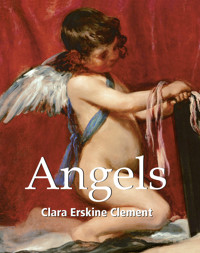
Even today, the splendid appearance of angels remains undiminished. Images of these heavenly and powerful messengers convey protection, innocence and calm, and have been an inspiration to religious artists throughout the history of art. This book illustrates the most impressive representations of angels, from delicate, whimsical cupids to majestic depictions of the archangel Michael, and from medieval to modern times.
Das E-Book können Sie in Legimi-Apps oder einer beliebigen App lesen, die das folgende Format unterstützen:
Seitenzahl: 73
Veröffentlichungsjahr: 2023
Ähnliche



















Clara Erskine Clement
Author: Clara Erskine Clement
© 2023, Confidential Concepts, Worldwide, USA
© 2023, Parkstone Press USA, New York
© Image-Barwww.image-bar.com
All rights reserved
No part of this publication may be reproduced or adapted without the permission of the copyright holder, throughout the world. Unless otherwise specified, copyright on the works reproduced lies with the respective photographers. Despite intensive research, it has not always been possible to establish copyright ownership. Where this is the case, we would appreciate notification.
ISBN: 978-1-78160-953-8
CONTENTS
Introduction
Archangels
Guardian angels, angel choristers and adoring angels
Pictures of angels as authorised by the scriptures
Angels in pictures of the virgin mary
Index of Artists
List of Illustrations
"When angels visit us, we do not hear the rustle of wings, nor feel the feathery touch of the breast of a dove; but we know their presence by the love they create in our hearts"
Introduction
Angels and archangels, cherubim and seraphim, and all the glorious hosts of heaven were a fruitful source of inspiration to the oldest painters and sculptors.
The Almighty declared to Job that the creation of the world was welcomed with shouts of joy by “all the sons of God”, and the story of the words and works of the angels written in the Scriptures from the placement of the cherubim at the east of the Garden of Eden to the worship of the angel by John in the last chapter of Revelation, presents them to us as heavenly guides, consolers, protectors, and chastisers of human beings.
What study is more appealing than that of the angels or more interesting to observe than the manner in which the artists of various nations and periods have expressed their ideas concerning these celestial messengers of God? What more fascinating, more stimulating to the imagination and further removed from the exhausting tension of our day and generation?
The Old Testament presents angels as an innumerable host, discerning good and evil by reason of superior intelligence, and without passion following the will of God. While they have the power to slay, the force is only exercised upon the command of the Almighty, and not until after the Captivity do we read of evil angels who work wickedness among men.
The angels of the New Testament, while exempt from need and suffering, have sympathy for human sorrow, rejoice over repentance of sin, attend to prayerful souls, and escort the spirits of the just to heaven when the earthly life has passed.
However it is highly unlikely that scriptural teaching concerning angels would encourage a universal interest in their representation, and the personal sympathy with it, which is commonly shared by all sorts and conditions of men, did they not cherish a belief consciously or otherwise that beings superior to themselves exist, and employ their super-human powers for the blessing of our race, and for the welfare of individuals.
As early as the fourth century, the Christian Church had developed a profound belief in the existence of both good and evil angels, the former persuading human beings to pursue good and forsake evil, the latter luring human beings to sin and indulgence. This faith is devoutly maintained in the writings of the Fathers of the Church, in which we are also taught that angelic aid may be invoked in our need, and that a consciousness of the abiding presence of celestial beings should be a supreme solace to human sorrow and suffering.
The theologians of the Middle Ages exercised their imaginations to create a systematic classification of the Orders of the Heavenly Host, assigning to each rank its distinctive office. To the sceptical mind, the warrant for these discriminations may seem insufficient, but as their results are manifested in the works of the old masters, basic knowledge of them is imperative to art students; without it, a large portion of the famous religious pictures of the world are utterly void of meaning.
Speaking broadly, this classification was based on of the theories of St. Paul, when he speaks of “the principalities and powers in heavenly places” and of the “thrones and dominions”, on Jude's account of the fall of the “angels which kept not their first estate” on the triumphs of the Archangel Michael, and on a few other Scripture texts. Upon this premise, the angelic host was divided into three hierarchies, and these hierarchies were further separated into nine choirs.
The first hierarchy embraces seraphim, cherubim, and thrones, the first mention being sometimes given to the cherubim. Dionysius, the Areopagite to whom St. Paul confided all that he had seen, when transported to the seventh heaven accords the first rank to the seraphim, while the familiar hymn of St. Ambrose has accustomed us to saying, “To Thee, cherubim and seraphim continually do cry”. Dante gives preference to Dionysius as an authority, and says of him: “For he had learn’d/ Both this and much beside of these our orbs/ From an eye-witness to Heaven’s mysteries”.
The second hierarchy includes dominations, virtues, and powers; the third, princedoms, archangels, and angels. The first hierarchy receives its glory directly from the Almighty, and transmits it to the second, which in turn illuminates the third, which is especially dedicated to the care and service of the human race.
The third hierarchy is constructed of the ministers and messengers of God; the second is composed of governors, and the first consisted of councillors. The choristers of heaven are also angels, and the making of music is revered as an angelic duty.
The seraphim immediately surround the throne of God, and are ever lost in adoration and love, which is expressed in their very name, seraph coming from a Hebrew root meaning ‘love’. The cherubim also worship God and are assigned special duties; they are superior in knowledge. The word cherub, by definition, means ‘to know’.
Madonna and Child Enthroned with Two Angels and SS. Francis and Dominic
Cimabue (Cenni di Pepo). Tempera on wood panel, 133 x 81 cm. Galleria degli Uffizi, Florence
Rucellai Madonna
Duccio di Buoninsegna, 1285. Tempera on wood panel, 450 x 290 cm. Galleria degli Uffizi, Florence
Flight into Egypt
Giotto di Bondone, 1304-1306. Fresco, 200 x 185 cm. Cappella Scrovegni (Arena Chapel), Padua
Ognissanti Madonna (Madonna in Maestà)
Giotto di Bondone, c. 1310. Tempera on wood panel, 325 x 204 cm. Galleria degli Uffizi, Florence
Maestà (detail)
Simone Martini, 1315. Fresco, 763 x 970 cm. Palazzo Pubblico, Siena
The Annunciation and Two Saints
Simone Martini and Lippo Memmi, 1333. Tempera on wood panel, 184 x 210 cm. Galleria degli Uffizi, Florence
Small Maestà
Ambrogio Lorenzetti, 1335-1340. Tempera on wood panel, 49 x 32.5 cm. Pinacoteca Nazionale, Siena
St. Bernard’s Vision of the Virgin with Saints (triptych)
Matteo di Pacino. Tempera on wood panel, 175 x 200 cm. Galleria dell’Accademia, Florence
Nativity
Master of Hohenfurth, c. 1350. Panel, 99 x 93 cm. Národní Galerie, Prague
Madonna of Humility with Six Angels
Agnolo Gaddi, c. 1390. Tempera on wood panel, 118 x 62.5 cm. Galleria dell’Accademia, Florence
The second hierarchy governs the elements and the stars. Princedoms protect earthly monarchies, while archangels and angels are the agents of God in his dealings with humanity. The title of angel signifies a messenger and is often given to a man bearing important tidings. Thus, the Evangelists are represented with wings, and St. John the Baptist is considered an angel. In addition, the Greeks sometimes depict Christ with wings and call him “The Great Angel of the Will of God”.
Very early in the history of art, a system of religious symbolism existed, knowledge of which greatly enhances the pleasure derived from representations of sacred subjects. In no case was this symbolism more carefully explored than in the representations of angels. The aureole or nimbus is rarely omitted from the head of an angel and is always used as the symbol of sanctity.
Wings are the distinctive angelic symbol and emblematic of spirit, power and swiftness. Seraphim and cherubim are usually represented by heads with one, two or three pairs of wings, which symbolise pure spirit, informed by love and intelligence. The head remains an emblem of the soul, love and knowledge.
This manner of representing the two highest orders of angels is ancient, and in the earliest instances of their existence the faces are human, thoughtful and mature. Gradually they became increasingly more childlike and are depicted as little baby heads with small wings folded under the chin, symbolising innocence. Evidently, these illustrations fail to convey the original, spiritual significance of the seraphic and cherubic head.




