


13,99 €
Mehr erfahren.
- Herausgeber: Elliott & Thompson
- Kategorie: Lebensstil
- Sprache: Englisch
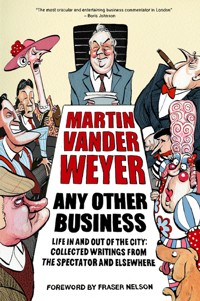
'This book is, like Martin's column, a collection of tales from Britain's financial front line with the fun bits left in. A romp through the city, its characters and their foibles, then into Yorkshire, with occasional diversions to violin competitions in Kazakhstan, the cuisine of the Dordogne and the lagoons of Bora Bora. The world of business is mad, sometimes bad and always thrillingly unpredictable - but, as Spectator readers know, there is no better guide.'--Fraser Nelson, from the forewordSince 1992, the financial and business life of the UK and many other parts of the world has changed beyond all recognition; that change has been expertly and incisively charted in the writings of Martin Vander Weyer, business columnist of The Spectator.From 'Big Bang' of 1986, which irrevocably changed the culture of banking - and of the UK - through to the global crisis of 2008 and the subsequent financial scandals, the people, ideas and very existence of the City have been under scrutiny as never before. In this anthology of his very best writings from The Spectator and elsewhere, Martin Vander Weyer brings a sharp eye and a very personal style to bear on often controversial topics, alongside recollections of life in the City and dissections of the current state of play; deliciously evocative accounts of travel, culture, food and daily life; and, very occasionally, reflections on the travails of middle age. Beautifully written, this collection offers a warm, witty and insightful perspective on our changing times.
Das E-Book können Sie in Legimi-Apps oder einer beliebigen App lesen, die das folgende Format unterstützen:
Seitenzahl: 445
Veröffentlichungsjahr: 2014
Ähnliche

















ANY OTHER BUSINESS
ANY OTHER BUSINESS
LIFE IN AND OUT OF THE CITY
COLLECTED WRITINGS FROMTHE SPECTATOR AND ELSEWHERE
MARTIN VANDER WEYER
FOREWORD BY FRASER NELSON
Contents
Foreword by Fraser Nelson
Introduction
1: In the City
2: Other Business
3: Heroes and Villains
4: West to East
5: Chinese Takeaways
6: Americana
7: French Leave
8: Yorkshire Life
9: Performing Arts
10: Real Life
Index
Foreword
When I started out as a business journalist, there was an unwritten rule separating my colleagues and I from the general news reporters. They regarded us as being unable to write, and we regarded them as unable to understand anything more complex than a lunch receipt. It was part of the strange tension that has long existed in British journalism between those who do numbers and those who do words – and, underlying it, the notion that the term ‘financial writer’ is a contradiction in terms.
I’d like to say that this was all senseless bigotry, but then I can’t think of a financial writer as good as Martin Vander Weyer. His columns have been informing and entertaining Spectator readers for more than two decades, and are still without equal. He routinely exposes the humour and absurdity behind much of what passes for high finance. He can see and describe the personalities behind the businesses and the clashing egos which power the City – and then jump on the train and talk about life in the country.
Crucially, he did not start out a journalist. The son of a banker, he was in the trade himself before he started to write about it for fun – his starting point was knowing all about the City. This is far better than those who, like me, went straight from journalism school to the financial pages, tried to work out what the hell was going on and vainly searched for stories through the footnotes of company reports. It was the devil’s own job to try to get to know the people behind business: an army of public relations men made it their job to see that you never got close. And that the press was fed nothing but dull stories: about the Interim Results of Widgets Plc, and its EBITDA edging higher.
Martin has never had any involvement in this world. His contacts book was full when he entered journalism, and he has fished in different (and deeper) waters than his rivals. In short, he has only ever been interested in the fun stuff. What started as a distraction became a profession as demand for his writing grew. It was not just the quality of his prose, but the depth of his insight – and his ability to explain, in just a few paragraphs, what the businesses pages say in a thousand words that no one can bring themselves to read.
The Spectator has only had a few business columnists – three, in fact, over the last six decades – all of them sharing knowledge, wit, flair and a knack for exposition. The longest serving was Nicholas Davenport, who started in 1953, survived nine editors and was asking for more space than usual in the week’s issue of his death in 1979. Next came Christopher Fildes, whose City & Suburban column in The Spectator was as legendary as the man himself. He and Martin first met in the City in 1976; the two kept in touch and eventually he converted Martin from a Spectator subscriber to a Spectator writer.
So, like many of our columnists – from Matthew Parris to Rod Liddle – Martin came to writing as a second career. And, like them, he’s a natural: incapable of writing a dull sentence, as was clear from his very first pieces for the magazine. In 1992, the year he left banking, he wrote a prescient warning about the mega-bank mergers then in vogue (Midland Bank had just been gobbled up by HSBC). He is too modest to include the piece in this collection, but some of it does bear repeating.
‘It is a safe piece of advice for a new chairman of a large international bank that at any given moment somebody, somewhere in your group, will be doing something utterly disastrous,’ he wrote. ‘Your Swiss foreign exchange manager is a fraudster; half the board want you to bid for Standard Chartered; someone else just recruited forty equity analysts in New York.’ Making banks bigger would only increase the risk, he wrote: they would have mind-boggling diversity ‘coupled with the complexity of the market risks involved and a fatal lack of comprehension between colleagues’. Result? ‘A recipe for things to go awry.’
So it was to prove. But there have been plenty of histories of the crash, and not enough good writing about the business life outside it. And nowhere near enough writing that you actually want to read. This book is, like Martin’s column, a collection of tales from Britain’s financial front line with the fun bits left in. A romp through the City, its characters and their foibles, then into Yorkshire, with occasional diversions to violin competitions in Kazakhstan, the cuisine of the Dordogne and the lagoons of Bora Bora. The world of business is mad, sometimes bad and always thrillingly unpredictable – but, as Spectator readers know, there is no better guide.
Fraser Nelson
Introduction
I think myself lucky. Not in every aspect of life, to be sure, and not without making mistakes and wrong turnings – but in the way in which my second career as a journalist and financial commentator was born out of the demise of my first career as a banker and made space for what I think of as my third and fourth careers, in the performing arts and as an active, even hyperactive, citizen of my Yorkshire town of Helmsley.
I decided at the age of seventeen that I wanted to be a writer, and specifically that I wanted to write for The Spectator, which I had begun reading at home and at school during the editorship of Nigel Lawson in the late 1960s. At Oxford in the mid 1970s I somehow forgot that aspiration and decided to follow my father into the banking world, where I stayed for a decade and a half. I didn’t hate it but I never loved it and it only ever engaged my brain fully when I was working abroad, in postings to Brussels, Kuala Lumpur, Tokyo and Hong Kong, and on assignments that took me to exotic spots from Bangkok to Budapest. In London I was habitually bored – and troubled by the thought that I had chosen the wrong career, or allowed it to choose me.
So my survival strategy was to jump on aeroplanes at every opportunity, and if you had met me in Hong Kong at my first-career zenith you might have thought me a caricature of the globe-trotting 1980s merchant banker: well tailored, wreathed in cigar smoke, with a chauffeured Mercedes at my disposal and a card that said ‘managing director’.
I was undeservedly lucky to have got that far, given my lack of zest for the deal-making that marks out banking’s real high-fliers, but I was even luckier in June 1989 to find myself – on a flight to Taipei – staring at a picture in Country Life of the house in Helmsley that I decided should become my home. It was, literally, a life-changing moment. I’ve always had a feeling that if I had not invested so much energy in that house over the following two years after I returned to a disagreeable City job – by now the card said ‘chief operating officer’ – my banking career might not have petered out when it did. And I might not have found the garden gate into journalism that opened for me so magically at the age of thirty-six.
But that’s what happened next. One cold, sunny morning in January 1992 I was summarily sacked, and when a friend happened to telephone me a few minutes later I said, ‘Well, maybe now I can start writing for The Spectator.’ With a little help from Christopher Fildes, doyen of City commentators, and under the patronage of the magazine’s then editor Dominic Lawson, I achieved that ambition a few weeks later – beginning with the first piece in this collection, ‘The Phantom of the Gravy Train’.
I am lucky to be writing for it still, despite many changes of editorial regime. I eventually succeeded Christopher as The Spectator’s weekly financial columnist, and I can honestly say that to have been a member of the extended Spectator family all these years, to have experienced the last boozy breath of literary bohemia in its old house in Bloomsbury and the electric buzz of political intrigue in its new house in Westminster, has been the happiest passage of my life.
Meanwhile, under the tutelage of the incomparable Hugh Massingberd, I found another congenial niche as the author of the Daily Telegraph’s obituaries of businesspeople – a collection of which was published in 2006 as Closing Balances. I wrote comment, features and reviews for the Telegraph and many other parts of the national press. And because I was pigeonholed as that chap who broke out of the City and knew from the inside how the money world works, editors encouraged me to draw parables from personal experience – allowing me the luxury of telling my own life story in anecdotal episodes.
I thought it would be fun to collect some of those pieces (mostly from The Spectator, but from other sources where indicated) into a kind of autobiographical jigsaw puzzle, interspersed with travelogue and samples of my poetry. I hope this isn’t just an exercise in vanity, and that the selection conveys a mischievous enjoyment of everything I do and observe – but also a set of underlying principles, including a belief in the positive power of capitalism, an admiration for entrepreneurship, and a fear that the financial sector in which I once worked is permanently prone to greed and delusion.
This selection also records other evolutions of my post-banking life, as an amateur actor, an occasional playwright, a promoter of arts projects, an elected town councillor, and briefly as a would-be MP. People often ask me how I fitted all this in. I don’t really know the answer, except that I might have done some things better if I had not done so many other things, and that I abide by one more guiding principle – never have a dull day.
And looking back on what I might pompously call my body of work, written and otherwise, I can see that if there has been a consistent fault it is probably a consequence of thinking myself lucky: I have tended to err on the side of cheerfulness. Except for a bleak moment of financial crisis in 2008 when I recommended readers to take a shotgun and a bottle of whisky into the woods, I have always seen the light at the end of the tunnel and looked forward to the bounce that follows the crash. The cyclical nature of economic life is such that both the doomsters and the diehard optimists are always right in the end – but if I aimed a bit high or called the recovery a bit early, it’s not a fault of which I’m particularly ashamed.
Besides Dominic Lawson at The Spectator and later at the Sunday Telegraph, there are many other editors and their deputies whom I must thank for giving me these opportunities to say what I wanted to say: notably Boris Johnson, who appointed me as his business editor, followed by Matthew d’Ancona and Fraser Nelson, at The Spectator; Sir Max Hastings and Charles Moore at the Daily Telegraph; Mark Law at both Telegraph titles; Sir Max again at the Evening Standard. I salute all my friends on the staff of those papers, past and present.
It was in my Telegraph obituary work that I came across a phrase which became yet another guiding principle, and which I have recommended to many other people including the school prize-giving audiences I have occasionally been asked to address. I found it in an interview with the late Lord King of Wartnaby, a self-made grandee best known for his battling chairmanship of British Airways, who had started out as a car salesman and was not someone I would have cited as a role model except for this one remark: ‘I am now what I always imagined myself to be.’ I’m extraordinarily lucky – I sincerely hope this doesn’t sound smug – to be able to say that too.
CHAPTER 1
In the City
THE PHANTOM OF THE GRAVY TRAIN
Merchant banking was the ultimate eighties career. It found its time in the middle of that decade in a great blaze of swaggering hubris, just as membership of the Soviet Communist Party had peaked as a lifestyle choice a few years earlier. How appropriate, for me, that it should come to an abrupt end just ahead of a general election which, whatever the outcome, completes the postscript to the Thatcher era.
For times change. An occupation which had once been the most luxurious of international gravy trains had transmuted itself into something more like British Rail’s new InterCity 225: high-tech but unstable, full of disgruntled and ill-matched people for whom, even though their numbers were shrinking, there were somehow never quite enough seats. It was certainly time to get off. One January morning I arrived to find the decision had been taken for me.
The feeling is one of rage mixed with relief, and nostalgia for the heyday of a few years ago. And what a heyday it was, for this was a job which offered practically everything: glamorous travel, an ecstasy of name-dropping, a gold Mercedes with a chauffeur, a key to the executive toilet and the opportunity to blunder like Flashman into every boudoir and battlefield of the financial world.
One of the merchant banker defendants in the Guinness trials,* Lord Spens, was described as a noted stamp collector. Many merchant bankers have that particular mentality, but, rather than postage stamps, we tended to treasure the sort of stamps you get in your passport, and the names of the most obscure and exotic airports en route: Gdansk, Penang, Misawa and Memphis spring to mind. We collected book matches from every restaurant and nightclub, casually displaying them in large glass bowls all over south-west London. An almost random handful gives me The Good Time Club of Roppongi, Iberia Airways, the Palace Hotel in Prague, the Tahiti Beachcomber, Annabel’s, the Ginza karaoke in Albemarle Street, Delmonico’s off Wall Street, the Lai Lai Sheraton in Taipei and the Auberge des Trois Bonheurs in the rue Saint-Honoré.
And on the way through, I recall, I shook the silken hand of Asil Nadir and was shaken by the granite fist of Gerald Ronson. I had my elbow grasped by the soon-to-be-disgraced Ronald Li of the Hong Kong stock exchange muttering ‘We can do deals together’ and I actually employed the Recruit Company of Japanese scandal fame to recruit someone. I exchanged pleasantries with President Iliescu of Romania and I bumped into Richard Nixon in a lift lobby. I went backstage to meet a starlet of the Royal Ballet, played pool with a cowboy in the Fort Worth stockyards, carried a briefcase through the bazaar in Kathmandu, got sprayed with holy water by Thailand’s highest priest and held a meeting stark naked in the Riverside Sauna in Seoul.
I could fill pages with these lists, but there was a day in May 1989 which, looking back, seems to have been the zenith (perhaps it was two days, but memory condenses them). Did I really try to gain access to the hotel bedroom of Taiwan’s Finance Minister, Mrs Shirley Kuo, in the company of a knighted fellow of All Souls? Did I attend a meeting in Beijing’s Great Hall of the People addressed by President Yang Shangkun, witness the first of the great student demonstrations in Tiananmen Square, and take afternoon tea with a minister of the Papua New Guinea government who was high as a kite? Did I then go on, posing uncomfortably as the All Souls knight’s wife, to crash Merrill Lynch’s invitation-only cocktail party in a closed pavilion of the Forbidden City? Yes I did, and at the time it seemed as normal a way to spend the day as the dentist at his chair or the potter at his wheel.
But what did I actually do, you may well ask. What is a merchant banker anyway, apart from a man who avoids rhyming slang? Well, at the beginning of the eighties, for instance, I could have told you how to price syndicated loans to Brazil and Mexico; the pricing didn’t really matter in the long run because, as everybody knows, practically none of those loans ever came back. Late 1982 found me writing papers on the legality of British local authority interest rate swaps. Whoops; eight years later a judge found that some London boroughs had used this particular piece of arithmetic to gamble themselves into perdition. He told us to our grief and amazement that we couldn’t make them pay us back, because it had been illegal (for them, not us) all the time. Somewhere in the mid eighties we discovered cross-border mergers and acquisitions, which meant spending years trying to persuade giant Japanese corporations to buy every famous European brand name from Aquascutum to Zeiss. The end of the decade found us in liberated Eastern Europe, taking tea with ministers and selling them Mrs Thatcher’s great gift to merchant bankers, better than any tax cut, the concept of privatisation.
In parallel with all this there was Big Bang, the revolution of the London securities market which put us in bed with the brokers and traders, the ‘big swinging dicks’ of Michael Lewis’s Liar’s Poker (1989), who apparently thought we were pussies. Of course we looked down on them. They were coarse, shallow and greedy (greedier even than we were) and they didn’t know how to take tea with the Minister. But they had fun, and sometimes we got to join in. A big international share placing may be the most exciting half-hour you will ever spend in business: the adrenalin of a huge risk taken for a very short time; the stadium clamour of a roomful of salesmen who’ve all seen Wall Street in the cinema; the cash-register ring of a colossal profit materialising before your very eyes.
Of course, as always, it can go horribly wrong, now or later. I spent an exhilarating night on a London trading floor selling many millions of dollars’ worth of paper called Perpetual Floating Rate Notes to investors in Japan. Now, thanks to obscure changes in international regulations on bank capital, they will show a substantial loss on them forever. There was another long and memorable night in October 1987 when we watched the Hong Kong stock market drop like a Korean airliner over Kamchatka. It was a night which included, in the Far Eastern lunch-hour, a pre-dawn break for beer, darts and fried breakfast (but sadly no bookmatches) in the Fox & Anchor in Smithfield. The meat porters probably thought we were pussies too, but we thought we were tremendous.
How was it, you may well also ask, for our employers? More pertinently, how was it for their shareholders, footing the bill for this ten-year ego-trip? It wasn’t all bad: collectively we got into and out of all kinds of booms as well as busts, we broke new ground, we were ahead of the game, in some instances we even invented the game. We were proud of what we built but it never looked anything like the three-year plan said it should, and stable growth was not a feature; this was the roller-coaster gravy train. When we were not making enough money for them we thought of ourselves as the go-faster stripes on the livery, adding the lustre their rolling-stock lacked, and we asked for bigger bonuses. When we were making enough money for them, which was not often but sometimes, we asked for bigger bonuses still, lest we go and do all this for some other company.
At its best it was so much fun that we should have been paying them, but they didn’t know that. Often they did give us bigger bonuses. Sometimes they gave us phantom ones as well, as an incentive to stay, artificial share options which couldn’t be cashed in for several years. And what a grim world the survivors found themselves in by the time the day arrived to encash the phantom options, like coming out of your bunker after the bomb to find the banknotes of some obliterated state wafting in the nuclear wind.
Gone is the iconic figure of the eighties, whisked for the last time from the Hong Kong Mandarin to Kai Tak airport in the back of a white Rolls Royce. If he’s still got a job at all, he’s stuck at Frankfurt on his way back from Warsaw with a Eurotraveller Economy ticket, a ham roll and a bout of flu. He may recover: markets and bank proprietors have short memories, the gravy train may roll again in all its glory. But not for a while. For now perhaps, the iconic figure of the nineties, the one who’s ahead of the game, is the former merchant banker cultivating his garden and relishing his memories: been there, done that, met the Minister, got the bookmatches.
April 1992
NICE WORK IF YOU CAN GET IT
When I talk about my office in the City, I no longer mean to imply that I have a job there. Like many professionals and business people, I have not had one of those for some time.
What I mean is that I enjoy a co-operative office arrangement that is a model of survival for middle-class victims of the recession. An elegant building within a stone’s throw of the Bank of England, much of it has been ‘To Let’ for as long as I can remember. On the floors that are occupied, only one small company is still fully operational.
Perhaps half a dozen people in the building actually draw salaries. The rest of us are ‘between jobs’, ‘looking at new ventures’, ‘doing a bit of consultancy work’ or just passing the time of day. I gather that one or two have not got around to telling their wives that their employment circumstances have changed. It is sociable, convenient and discreetly impressive if you bump into former colleagues in the street outside.
Such set-ups are increasingly common as the rate of executive job losses rises. In the financial sector, that rate has reached 30,000 per year – with the greatest concentration among the overpaid young bucks of the City. Even lawyers and accountants are feeling the chill breeze up their striped trouser-legs.
Worst hit of all are the professions caught by the property slump. According to the RIBA, more than a third of all salaried architects have been axed; many scratch along doing loft conversions, some run sandwich bars or draw cartoons. For surveyors, so little activity is in prospect, so many young people are still seeking to qualify, that middle-aged job-losers may never find work in the profession again.
Computer programmers, advertising executives, fine art specialists, all feature on the casualty lists. Overall, the carnage is more severe than at any time since the early 1930s, when the number of ‘black-coated’ unemployed passed 300,000.
The social consequences include unpaid school fees and respectable wives driven to pyramid selling. I am not about to mock the distress of redundancy. It is traumatic, whoever you are. But it is surely much worse for a miner than a merchant banker, who may be more susceptive to a dent in the ego but is almost certainly better cushioned financially. What it does present to him is a test of personality – a rare opportunity to show true grit, to rise to the difficult occasion.
Perhaps, in the spirit of ‘Dear Mary’, I can offer some useful tips, starting with how to conduct yourself when the chopper falls. The time allowed to you may be a matter of weeks or it may be no longer than it takes to fill a bin-liner with personal belongings and depart under the eyes of a security guard. They may even bar you from the building when you’ve gone out to lunch.
Conventional minor-public-school advice, to retreat in silent dignity, is best ignored. This is a rare opportunity for a short burst of cathartic rage of the sort which you might otherwise pay $10,000 to an exclusive Arizona clinic to induce. The perpetrators of your redundancy should be made to feel absolutely rotten, to provoke them to pay maximum compensation.
Social embarrassment, however, is no longer something you have to feel, now that so many of your confrères are occupationally challenged. The P45 form is this year’s fashion accessory, a lifetime office career is ‘as eighties as a Filofax’; or so you can tell your friends. Nonchalance on your part will make it easier for them to look you in the eye, and will make you feel better: the dice have rolled, so many other things to be done, so much demand for your kind of wisdom; the world is your oyster.
The best display of this I saw came from a senior banker in New York, whose departure ‘by mutual agreement’ had just been announced. Still entitled to the privileges of rank, he entertained me in a panelled Wall Street dining room. ‘I may go and do political work in Washington, on foreign policy issues,’ he drawled, casually ringing for the butler, ‘or get together with some friends and make another fortune.’
But, however you behave, getting fired is irrevocable. You cannot get unfired, and you have to work out what to do next.
My own response was, as it happens, a good example of what sensible career advisers urge people not to do. I gathered suggestions as varied as joining the Foreign Office and buying a motorcycle repair business in Clapham, and took a series of holidays. Then I listed the choices which appealed: find some consultancy work until something more exciting comes along; write; dabble in politics; or look for a serious job. I decided to do all of them, except the last.
As a stopgap, ‘consultancy’ is nice work if you can get it. Several of my friends have successfully resorted to it. One of them even invented the title ‘Leisure Consultant’ for his business card. Daily fees are attuned to the rates charged by big firms with all the usual office overheads, so if you operate from a briefcase, the money looks quite good.
Other areas of keeping busy are equally crowded with involuntary non-executives. Local politics is a haven for slightly downtrodden men in their fifties who used to be ‘big in knitwear’ or ‘something at ICI’. In the literary world, itself hard hit by falling sales, new manuscripts arrive by every post. ‘My dear,’ an agent told me breezily, ‘all the unemployed are writing novels.’
For some sufferers from executive joblessness, treatment is available in the form of ‘outplacement’. This sounds nasty, like colonic irrigation, and I was curious to find out what it actually is: counselling paid for by the ex-employer (or ‘sponsor’, as he now becomes) to assist the ex-employee (the ‘prospect’) to cross the ‘employment gap’. It is, you may guess, an American invention. I visited Coutts Career Consultants, the first British firm to offer the service.
The first thing that happened, as I waited for a lift, was that a man from a different company sprang out of his office and said that if I was going to see Coutts I should come to see him as well, as he was in ‘executive search’ and had lots of opportunities to offer. It seemed possible that this is staged as part of the therapy, to cheer the new prospect as he arrives.
Colin Walkinshaw, a reassuringly ex-naval Coutts director, told me that new prospects often need ‘picking up off the floor’, especially those who have been dismissed with particular abruptness. Counselling aims not to restore self-respect, but to combat complacency in those who expect a new job just to turn up; or in others, the irrational urge to ‘go self-employed’ or drop out of the rat race for ever. The key to the treatment is momentum and focus, making people work at finding a viable new future, rather than sloping off to the bookies after a quick browse through the Sits Vac.
But outplacement, which costs the ‘sponsor’ several thousand pounds a time, is not offered to everyone. For many others, the last resort is the Jobcentre, and with it the dole. The middle-class unjobbed don’t usually admit to claiming – a notable exception being Kevin Maxwell,* whose weekly handout was detailed to the penny in the national press. Proud ignorance of the various entitlements is probably a more typical attitude.
One friend of mine said, ‘I went into one of those benefits offices but I came straight out again, it just wasn’t for me. It seemed somehow, you know, unethical to claim.’ ‘But you’ve paid plenty of tax in the past,’ I suggested. ‘Why shouldn’t you claim something back when you need it?’ ‘Oh sure,’ he agreed, rather spoiling the effect. ‘But the thing is I’ve got this consultancy contract . . .’*
Hunched into a raincoat for fear of meeting anyone I knew, I set off to sample the experience at my local small-town Jobcentre. The ground-floor shopfront had been abandoned, its display stands forlornly empty on the day that the number of vacancies across the country slumped to an eleven-year low. An arrow directed me up linoleum stairs. I anticipated a long wait, passively smoking among hostile ex-cons, punks and new-age travellers. I could not have been more wrong.
It looked exactly like a travel agency, and a good deal smarter than my last real office in the City; just like Coutts Career Consultants, in fact. The only other ‘client’ – which is what Jobcentres now call their prospects – was a respectable middle-aged man in a suit. On the wall was the Jobseeker’s Charter (‘If you have an appointment, we aim to start on time. If you do not, we aim to see you within ten minutes . . .’).
I had no appointment, but a matronly woman labelled ‘Reception’ saw me immediately. She showed me a copy of New Executive Post, a mixture of vacancy ads and features on ‘opportunities in franchising’, ‘coping with stress’, ‘It’ll never happen to me!’ and ‘Why you need financial planning’. I learned about Executive Job Clubs, now to be found in most big cities, providing office facilities and ‘networking opportunities’ for managerial job-hunters.
And how much dole would I get, if it came to the crunch? The answer was £43.10p per week, plus up to £30 on Income Support. In the tradition of this sort of journalism, I made an excuse and left. But (for job-seeking rather than benefit-claiming) the experience was not an unpleasant one. Whoever has redesigned the Employment Service is to be congratulated. If you have, as it were, nothing better to do, it may be worth a visit.
There is, however, an alternative last resort (some would place it higher up the order) and that is the ‘on yer bike’ solution, going abroad to find new fortune. Hong Kong, always a mobile job market, is still a good bet for the last boom before the Union Jack comes down; and an all-in expatriate package will solve most financial problems. For the really bold, Eastern Europe offers long odds for all kinds of otherwise redundant skills and enterprise.
In Poland last year, for example, I came across Alan Bond’s ex-finance director, shaking off his former boss’s business crash and trying to re-launch a local brewery. Prague was full of young chancers ‘bored with the City’, looking at ‘leisure opportunities’. Albanian contacts report that the irrepressible Peter Earl, a 1980s City takeover merchant fallen on tough times, has been spotted in Tirana.
Earl is also, I hear, planning to climb Everest, and I take my hat off to him. If your job or your business has gone, there’s no point in repining. It may be a ghastly shock, but it is also a moment of what Clinton-speakers now call empowerment – of taking responsibility for your own destiny, of making things happen. If that means trying to achieve your wildest fantasy, why not?
Those who need an inspirational role model should remember how Jalal ud Din, youthful ruler of Bokhara and Samarkand, faced his employment gap. Having lost the day against the Mongol hordes, he galloped his horse over a cliff, swam the Kabul river and went on to conquer another splendid kingdom.* Go for it, is the moral of the story; you cannot go back.
December 1992
THE GENERATION THAT FAILED
I am looking at a group photograph of the Oxford University Gridiron Club in the summer of 1976. There I am in the second row, with big lapels and hair like Starsky’s.
‘The Grid’ was an enclave for public-school undergraduates, housed above a menswear shop in Queen Street in rooms which were regularly vandalised by the club’s own members. Though it was disreputable, its denizens were unusually pleased with themselves. The line-up of jutting jaws and buttoned blazers speaks across the years of an assumption of God-given advantage, a belief that the future would offer effortless success wherever they might go – including the City. What is interesting about them now is not what prats they were then, but how insignificant, in City terms, they became. I am looking at a portrait of the generation that failed.
There are seventy of us in that picture, and I do not exclude myself from this analysis; on the contrary, I am a prime example. We can, however, leave out the two distinguished senior members, Warden Sparrow of All Souls and the historian Richard Cobb, as well as the long-suffering steward Mr Tippler – whose eventual successor is said to have resigned in protest at being addressed as ‘Tippler’. And we might as well omit the half-dozen leaders of the pack who were too rich and dangerous for any sort of serious career.
Of the remainder, at least half ended up in the Square Mile, in banking, stockbroking, investment, accountancy or insurance. Among those who took other paths, I can pick out a former Tory minister, a general and a prominent QC. But among the City boys, I can see only one person who could unequivocally be said to have made it to the top:* the impeccable John Varley, a close colleague during my own banking days, who is due to become chief executive of Barclays at the end of this year. The rest have either (like me) changed career altogether, or achieved nothing more than well-heeled obscurity.
The Bollinger-fuelled hooligans of the Grid can hardly be held up as a cross-section of a whole generation. But if, in the summer of 1986, ten years after that picture was taken and a few months before the Big Bang reform which changed the City for ever, I had labelled it with the names of the employers of those smart young men, it would have included a roll call of historic houses – Hambro, Kleinwort, Baring, Montagu, Rothschild – and the London branches of several powerful foreign firms besides. And I would have felt safe to predict that a fair proportion of us would end up running the whole show before we were fifty.
But apart from Varley (and the hereditary Roddie Fleming of Flemings), none of us did, and even if I stretch my survey to include everyone else I can think of who entered the City as a conventional Oxbridge graduate between 1974 and 1979, my assertion still holds good. Almost all failed the Darwinian test: somehow we lacked the stamina, aggression, adaptability or luck that was needed to reach the summit of the seething anthill that the money world became. I think I know why, and it is not a problem of worn-out genes: we were the product of our times, and we were peculiarly ill-adapted for the times that came afterwards.
The Grid photograph was taken a few weeks after the accession as prime minister of James Callaghan, whose administration our editor has recently declared the worst in modern times. For four years prior to that, since the industrial crises of 1972, the country had passed through economic hell: the three-day week, the OPEC oil-price hike, the collapse of property and stock markets, high inflation, high interest rates and crippling taxes.
I took my A levels in 1972; it was probably also the year in which I first began to form a view about Britain’s, and my own, prospects. It was hard to grow up thinking positive; despite the bizarre claim by the New Economics Foundation last week that 1976 was the best year we ever had, my recollection is that things seemed only to get worse and worse.
By the time I started as a £54-a-week graduate trainee at Schroder Wagg – one of the elite merchant banks known as Accepting Houses – in August that year, the outlook was as bleak as ever and the public finances in total disarray. In November, I took part in a training course at the Bank of England for all the Accepting Houses’ graduate intake (among whom, if memory serves, the only one to achieve any sort of fame was Peter Norris, the chief executive of Barings at the time of its crash). In that very same week, Chancellor Denis Healey was eyeball-to-eyeball with the men from the IMF, who had arrived to demand huge cuts in public spending as a precondition for a humiliating bail-out.
No wonder my lot lacked in the sort of drive that was later encapsulated by Michael Lewis in Liar’s Poker, quoting one the chiefs of Salomon Brothers’ trading floor in New York, as the readiness to ‘bite the ass off a bear’. No wonder that for the duration of the Callaghan era, the most exciting part of our day was the hour we spent on The Times crossword at lunchtime – though we must have struggled with words like ‘enterprise’ and ‘incentive’, which barely entered our vocabulary.
It was not that there was no one around who would eventually go on to glory. In my first months I worked for Nicholas Roditi, a hard-edged investment expert who became George Soros’s man in London; as a junior clerk I sat alongside a prankster called Piers Pottinger, who became one of the City’s most successful PR men. We were lectured on how computers worked (being arts graduates, we could barely be bothered to listen) by an unusually self-assured back-office manager called Chris Gent, who went on to build Vodafone into one of the world’s most successful companies.* But thrusters like them were not what pompous Grid men would have called ‘people like us’ – not so much in the class sense as in the sense that, had we but known it, they were the vanguard of the share-price-driven, media-conscious, technology-literate, bear’s-ass-biting business world of the eighties – whereas we were the rearguard of the City’s gentleman-amateur past.
Ironically, the generation that started work a decade before us fared better. That was partly because they had a longer run before the script was rewritten in the mid eighties by deregulation, ownership changes and American competition; and partly because they had more to get their teeth into in their early years. The sixties City stood on its nineteenth-century dignity, but was also, in some respects, very progressive. Eurobond issues and contested takeovers were the new fashion, and some financiers who learned their skills back then are still around as veterans today. They were battle-hardened by the early-seventies boom and bust, and when the crunch came again twenty years later, they turned out tougher and more resilient than we were. ‘It’s not as if we didn’t offer to take over from them,’ lamented one ex-stockbroker contemporary of mine, now running holiday cottages in the West Country, ‘but they just didn’t trust us.’
In a sense they were probably right. On the other hand, it was they rather than we who took the disastrous decisions which eventually destroyed so many of those historic City houses, or turned them into departments of American and German conglomerates – and, in the process, derailed the careers of so many of my peers. ‘If the City hadn’t gone and bloody well changed,’ said another, an ex-banker now importing Chinese silk scarves, ‘we’d have been great.’
So a big bouquet to John Varley of Barclays, last standard-bearer of the Gridiron class of ’76 and the man described to me by one of our bosses long ago as ‘the best I’ve worked with in thirty years in the City’. As for the rest of us, we might as well relax and enjoy our second careers as booksellers, bar owners, poets, parish councillors and (in my case) pantomime dames. If it’s any consolation, chaps, I hear the tree-hugging, trustafarian, post-Thatcher generation of the nineties is even limper than we were.
March 2004
THE SCANDINAVIAN SOLUTION
At the historic moment when the House of Representatives passed Hank Paulson’s bail-out bill last Friday night – thus, we must hope despite early indications to the contrary, significantly improving the world’s chances of avoiding economic cataclysm – I was conducting some research into the Scandinavian solution.
I don’t mean the policies followed by the Swedish government to steer its banking sector through a near-terminal crisis in the early 1990s, of which more in a moment. I mean I was sitting in the back row of a packed cinema watching Mamma Mia!, the Abba-singalong movie, and observing the impact of a mass inoculation of feel-good on a crowd that had been battered with bad news all week. I can only describe the effect as a euphoric group high – and it occurred to me that if only the global financial community could be persuaded to take half a day off, head for their nearest multiplex and lose themselves in this cheerful, escapist fantasy, maybe the panic would start to subside.
That may sound flippant, especially if you are one of the 300,000 British savers whose cash is currently locked up in Icesave, the internet-based subsidiary of the probably insolvent Landsbanki of Iceland. But there is a serious point here. What we have been witnessing is a bankers’ and traders’ nervous breakdown, a collapse of confidence so overwhelming that it has temporarily lost all touch with rationality.
I don’t mean, I’m afraid, that the economic damage can still be limited to a short downturn if only the City would unclench its collective sphincter and return to something like business as usual. That is what I thought a month ago, but we have passed into unknown territory since then. As every day goes by in which banks decline to lend, traumatised consumers decide not to buy new cars and houses, and businesses of all kinds contemplate their strangulated cash flows and the redundancies they will have to make this winter, the depth of the coming recession becomes more apparent.
What I do mean is that gibbering fear on the part of the people who move markets is now driving this crisis towards consequences that no one could seriously have foreseen. Tired of listening to financial pundits on Tuesday night, I asked a psychotherapist what she thought was the root cause: ‘This isn’t a fashionable word in my profession these days,’ she replied, ‘but it’s pure hysteria.’
And the measures needed to restore sanity, we agreed, have more to do with mass psychology than with any textbook of central banking practice. What matters is what works, not what reinforces the principle of moral hazard or follows any particular ideology. To accuse politicians of dithering is unfair when the condition they are trying to treat mutates wildly day by day. There are precedents for this situation, but they are not the most talked-about ones of 1973 and 1929. To me (because I happened to be there at the time) it feels more like post-Soviet Eastern Europe, in the early months when bankers like me, as I was then, and economists and newly elected politicians, were thrashing around trying to invent innovative ways of kick-starting moribund economies and giving citizens a stake in them. Often you would hear the old joke about an Irishman who is asked for directions by a tourist and replies, ‘Well, if I was you I wouldn’t start from here.’
Right now, the free world’s banking industry is in much more urgent need of kick-starting than, say, the Czech steel industry in 1991. But the similarity is that you wouldn’t want to start from here, that any positive idea is worth considering, that big, bold schemes are more likely to work than small, footling ones, and that well-phrased, comforting speeches make no difference at all. That line of argument has led experts latterly to reconsider a more direct precedent – which was the muscular, hands-on solution to the early 1990s Scandinavian banking crisis. There the Swedish government issued a blanket guarantee on deposits, nationalised some banks and injected capital into others, and swept bad loans into a special-purpose bank which gradually realised the underlying assets and minimised the loss to Swedish taxpayers. Banks which recovered were eventually returned to the private sector. It worked so well that many people forgot it ever happened.
In the first half of this week, all this came sharply into focus. The conventional nineteenth- and twentieth-century remedy of injecting ‘abundant’ liquidity through central banks wasn’t working. Banks continued to refuse to lend to each other, and rumours of near-insolvency blew from the canyons of Canary Wharf to the capitals of Europe, where a series of banks with very large balance sheets but unfamiliar names – Fortis, Dexia, Hypo Real Estate – suddenly went into intensive care. Even the Paulson bail-out in its revised form made no difference to market sentiment: in this mood of madness, there were those who were prepared to declare it a failure even before the ink was dry.
And so, on this side of the pond, bank shares started to collapse – particularly those of Royal Bank of Scotland, until last year the aggressive front-runner of British commercial banking, and the ailing HBOS, whose forced merger with Lloyds TSB looked in doubt. On Monday night, we heard that the major high-street banks were in conclave with the Chancellor. On Tuesday, Robert Peston of the BBC – now the nation’s town crier – announced that a capital injection by the government was imminent; Barclays, for one, responded that it had not asked for capital and did not need it. Then we woke on Wednesday morning to find that Gordon Brown and Alistair Darling had decided to do something really bold and in Brown’s word, ‘far-reaching’: to inject up to £50 billion of taxpayers’ money in the form of new equity for British banks and up to £200 billion of additional liquidity to free up interbank lending markets. RBS and HBOS looked certain to take up the new capital on offer. For fear of further attacks on their shares and credit ratings, others may follow. Only HSBC looked strong enough to stand aside from the scheme.
Meanwhile, it was not in the least surprising that the grossly overextended Icelandic banking system had descended into frozen chaos: that was the one feature of the week’s drama we could all have seen coming – and the Chancellor was right to say he would guarantee Icesave’s depositors rather than leave them to find out whether there’s any cash in Reykjavik to pay them out. Likewise, it was predictable that the artificial construct of a single European monetary regime would be swept aside in a rush by national governments – the Irish, Danes, Germans and Greeks so far – to reassure their own citizens that their bank deposits are safe.
The lesson so far, at least on this side of the Atlantic, is that citizens still have some faith in national governments, despite the fact that national governments are at least as prone to folly as commercial bankers. But the European Central Bank, without political traction or the support of a European fiscal authority, turns out to carry hardly any psychological clout at all. Ardent eurosceptics leapt on these developments as evidence that the euro is doomed (like the now forgotten late nineteenth-century monetary union between France, Belgium, Switzerland, Italy and Greece) for want of political underpinning. Objective observers might agree that its survival chances are now less good than those of our high street banks.
And if you want my opinion, our high street banks will survive. To have the government as a shareholder for a few years will be an uncomfortable but useful discipline, and no worse than having sovereign wealth funds from China or the Middle East breathing down their necks. The ultimate cost to the taxpayer, when all is worked out, will be much smaller than this week’s headline figures. And there is now a lot more reason than there was a week ago for markets to stabilise; in the short term they may not, but sometime soon they will surely pause for thought. Which brings me back to my own remedy for mass hysteria, Mamma Mia! See it as often as you need to, until you start to feel calmer. Sing along to all its familiar refrains, except perhaps the one that goes: ‘Money, money, money/ Always sunny/ In the rich man’s world.’ Not any more it isn’t, but we’ll get through this nevertheless.
September 2008
THE OLD GREEN MAN
Robert Swannell, the veteran Citigroup financier, has been named as Sir Stuart Rose’s likely successor as chairman of Marks & Spencer. Swannell is an old-style, safe pair of City hands, of a breed whose presence in any boardroom is as reassuring to institutional shareholders as it is disappointing to journalists in search of colour. What’s more, reports suggest he will do the M&S job for a smaller pay package than Rose’s, dousing any possible controversy on that front. Indeed, the only downside I can see to Swannell’s appointment is that it scotches my own chance of a non-executive directorship of the great retailer, since I must have made such a bad impression when we last met. It was long ago when he had just joined Schroders, where I was a very junior banker. He was on an induction tour to learn what we all did (in my case, very little) and came to see me immediately after lunch – which in my case had been a very liquid lunch in a dank Victorian pub, now gone, called The Green Man in Bucklersbury. I can still see the clean-cut young Swannell, who had trained both as an accountant and a barrister and was clearly going to go far, glinting at me as I tried to form a coherent sentence without falling off my chair. Was there, in that encounter, a glimpse of how our future career paths would diverge? I fear there was.
August 2010
ULTIMATE SOLUTION
Worried that banks such as HSBC might leave these shores altogether if new capital requirements crush their shareholder returns, David Cameron is said to be keen that the ring-fencing of their retail operations ‘is of a “light-touch” variety’. All I can say is that we tried that with my golden retriever Douglas as his hormonal urges began to get the better of him, but matters came to a head at Easter when the scent of the local hairdresser’s spaniel drove him to bust repeatedly through inadequate harnesses and hedges like the bulldog in the ‘Tom and Jerry’ cartoons – or a banker with a sniff of a seven-digit bonus. The ultimate solution (one which Vince Cable would no doubt advocate for the whole City if he could) was to castrate the poor chap. If you’re going to ring-fence, do it properly or not at all.
September 2011
FORM-FILLING
My recent remarks item about the diminished state of the Court of the Bank of England, of which my father was a member, elicited an explanation of the problem from a distinguished City gent. ‘Some years ago I applied to join the Court,’ he told me. ‘In the modern way, a vacancy had been advertised, and applicants were required to complete a twenty-page questionnaire. The process was handled, no doubt at great cost, by a leading headhunter on behalf of the Treasury. As the deadline approached I was told there would be a delay – probably because no suitable grandees could be bothered to fill a form of such length and crassness. Months later I was informed that my application had been unsuccessful, but the message came by an email sent to all losing candidates, accidentally revealing our names to each other. This produced several enjoyable lunches and, we may hope, the sacking of the headhunter.’ In short, the old boys’ network and the traditional tap on the shoulder was a much more reliable recruitment method.
June 2011
WHAT ARE MY ODDS?
Curious that the Treasury chose to advertise for the next governor of the Bank of England in The Economist but not in The Spectator. Given the embarrassing paucity of obvious candidates – so many having been knocked back in the Paddy Power odds by their proximity to money-laundering, sanctions-busting and Libor scandals – it might prove more fruitful to appeal to the sort of sophisticated dark-horse who spends Sunday afternoons browsing the small ads at the back of this paper. Tuscan farmhouse, tantric massage, ‘advanced understanding of financial markets . . . strong communicator . . . good interpersonal skills’: it all fits the image of Spectator Renaissance man.
Indeed, perhaps I should shake off my natural modesty and whack in an application myself. Here’s a first draft. In my previous globe-trotting career as an investment banker, I spent plenty of time hanging around the lobbies of exotic central banks and freeloading on the international conference circuit, plus I’m on nodding terms with the present governor’s butler, so I think I’ve got a fair idea what’s involved. In terms of the technicalities of monetary management, I’m sure I could press ‘Print’ on the Quantitative Easing machine in the Threadneedle Street basement. Unlike other names in the frame, I combine an appetite for a big City lunch with a close view of provincial, small-business life. As an economic forecaster, I could hardly be more wrong than the Bank itself has been these past few years. And I certainly have the attribute that was missing from the ad but must be essential in a job whose incumbent is blamed for all economic ills and financial failures but rarely praised for disasters averted and corners turned: a good sense of humour.
September 2012




