


9,99 €
Mehr erfahren.
- Herausgeber: 50Minutes.com
- Kategorie: Geisteswissenschaft
- Serie: History
- Sprache: Englisch
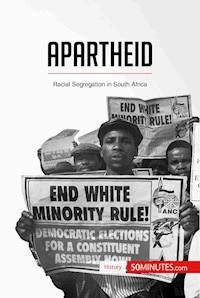
Keen to learn but short on time? Get to grips with the history of apartheid in next to no time with this concise guide.
50Minutes.com provides a clear and engaging analysis of apartheid in South Africa. For over 40 years, South Africa maintained a white supremacist regime which denied black citizens the same rights and opportunities as their white counterparts. The regime, which was established and maintained by a series of laws codifying racial segregation, attracted international condemnation and determined opposition from activists, including Nelson Mandela. Apartheid was finally dismantled in 1991, but had lasting effects on South African politics and society.
In just 50 minutes you will:
• Learn about the laws implemented during apartheid to enforce racial segregation
• Identify the most influential figures and central events of the apartheid period
• Analyse the immediate impact and long-term consequences of apartheid, both in South Africa and abroad
ABOUT 50MINUTES.COM | History & Culture
50MINUTES.COM will enable you to quickly understand the main events, people, conflicts and discoveries from world history that have shaped the world we live in today. Our publications present the key information on a wide variety of topics in a quick and accessible way that is guaranteed to save you time on your journey of discovery.
Das E-Book können Sie in Legimi-Apps oder einer beliebigen App lesen, die das folgende Format unterstützen:
Seitenzahl: 34
Veröffentlichungsjahr: 2017
Ähnliche

















Apartheid
Key information
When: 1948-1991.Where: South Africa.Context: the rise to power of Afrikaner nationalists.Key protagonists:Daniel Malan, South African politician (1874-1959).Nelson Mandela, South African lawyer and statesman (1918-2013).F.W. de Klerk, South African statesman (born in 1936).Impact:The restoration of democracy in South Africa.The election of Nelson Mandela as President of South Africa in 1994.Introduction
The apartheid regime is undoubtedly one of the most significant events of the second half of the 20th century. For those who lived through it, this period left a major impression and cannot be separated from Nelson Mandela, the man who symbolised its fall and who became one of the most important representatives of the fight against racism. The segregation that South Africa’s non-white population endured in this period is shocking because of its cruelty and duration, as well as its international impact.
‘Apartheid’ is an Afrikaans word meaning ‘separateness’ or ‘the state of being apart’ (literally ‘apart-hood’). It refers to a policy of ‘separate development’, in which different populations are kept in particular geographical areas based on ethnic or linguistic criteria. This policy was implemented by the National Party in 1948, with the aid of laws and rules which sought to regulate the relationships between white and non-white populations in South Africa in order to ensure the economic, social and political domination of the former over the latter. There were two types of apartheid, known as petty apartheid, which governed everyday contact in the public sphere, and grand apartheid, which aimed to create separated, ethnically determined geographical zones.
As such, until the system was abolished in 1991, South African society was based on an official regime of racial segregation, in spite of increasing international condemnation and violently repressed opposition, symbolised by the African National Congress (ANC) and one of its charismatic leaders, Nelson Mandela. Although the country successfully transitioned to nonracial democracy, South Africa now faces a number of economic and social challenges.
Context
South Africa: colonisation and rivalries
The colonisation of South Africa began in 1652 with the creation of Cape Colony by the Dutch East India Company. Dutch Calvinist immigrants flocked to this new territory, where they were gradually joined by other Calvinists from France, Germany, Scandinavia and the Republic of the Seven United Netherlands (the northern part of the present-day Netherlands). From the beginning, these white populations, who were called Afrikaners, were afraid of being lost in the crowd of the pre-existing black Bantu population. For this reason, a strong Afrikaner identity took shape, based on a language (Afrikaans), a religion (Calvinism) and activities such as slave trading and the use of slaves in farming. This identity-based position was strengthened with the arrival of the British, who the Afrikaners viewed unfavourably, in the 19th century. This solidified their nationalism, which was then presented as a movement of resistance against British oppression. The doctrine of this nationalism was based on the idea that the Afrikaners were a chosen people, destined to rule the land occupied by the first colonisers.
However, Cape Colony was definitively handed over to the British Crown in 1814, and the English were quick to establish cultural and political hegemony. They even went so far as to directly attack Afrikaner identity by removing Afrikaans as a national language in 1822, and to jeopardise their economy by abolishing slavery in 1833. The abolition of slavery drove 14 000 Afrikaners to leave the coastal regions and head inland (the Great Trek, 1835-1840) to create independent republics north of Cape Town, in particular the Transvaal and the Orange Free Street.
The situation deteriorated during the second half of the 19th




