


117,99 €
Mehr erfahren.
- Herausgeber: John Wiley & Sons
- Kategorie: Fachliteratur
- Sprache: Englisch
Aquaculture, Resource Use, and the Environment places aquaculture within the larger context of global population growth, increased demand for sustainable, reliable sources of food, and the responsible use of natural resources. Aquaculture production has grown rapidly in recent decades as over-exploitation and environmental degradation have drastically reduced wild fish stocks. As fish production has increased, questions have persisted about the environmental sustainability of current aquaculture practices.
Aquaculture, Resource Use, and the Environment is a timely synthesis and analysis of critical issues facing the continued growth and acceptance of aquaculture practices and products. Chapters look at the past, present, and future demands for food, aquaculture production, and tackle key issues ranging from environmental impacts of aquaculture to practical best management practices in aquaculture production.
Providing broad coverage of issues that are essential to the continued development of aquaculture production, Aquaculture, Resource Use, and the Environment will be vital resource for anyone involved in the field of aquaculture.Sie lesen das E-Book in den Legimi-Apps auf:
Seitenzahl: 740
Veröffentlichungsjahr: 2014
Ähnliche



















Aquaculture, Resource Use, and the Environment
Claude E. BoydProfessor, Water QualitySchool of Fisheries, Aquaculture and Aquatic SciencesCollege of AgricultureAuburn UniversityAlabama, USA
Aaron A. McNevinDirector, AquacultureWorld Wildlife FundWashington, DC, USA
Copyright © 2015 by John Wiley & Sons, Inc. All rights reserved.
Published by John Wiley & Sons, Inc., Hoboken, New Jersey. Published simultaneously in Canada.
No part of this publication may be reproduced, stored in a retrieval system, or transmitted in any form or by any means, electronic, mechanical, photocopying, recording, scanning, or otherwise, except as permitted under Section 107 or 108 of the 1976 United States Copyright Act, without either the prior written permission of the Publisher, or authorization through payment of the appropriate per-copy fee to the Copyright Clearance Center, Inc., 222 Rosewood Drive, Danvers, MA 01923, (978) 750-8400, fax (978) 750-4470, or on the web at www.copyright.com. Requests to the Publisher for permission should be addressed to the Permissions Department, John Wiley & Sons, Inc., 111 River Street, Hoboken, NJ 07030, (201) 748-6011, fax (201) 748-6008, or online at http://www.wiley.com/go/permission.
Limit of Liability/Disclaimer of Warranty: While the publisher and author have used their best efforts in preparing this book, they make no representations or warranties with respect to the accuracy or completeness of the contents of this book and specifically disclaim any implied warranties of merchantability or fitness for a particular purpose. No warranty may be created or extended by sales representatives or written sales materials. The advice and strategies contained herein may not be suitable for your situation. You should consult with a professional where appropriate. Neither the publisher nor author shall be liable for any loss of profit or any other commercial damages, including but not limited to special, incidental, consequential, or other damages.
For general information on our other products and services or for technical support, please contact our Customer Care Department within the United States at (800) 762-2974, outside the United States at (317) 572-3993 or fax (317) 572-4002.
Wiley also publishes its books in a variety of electronic formats. Some content that appears in print may not be available in electronic formats. For more information about Wiley products, visit our web site at www.wiley.com.
Library of Congress Cataloging-in-Publication Data
Boyd, Claude E. Aquaculture : resource use, and the environment / Claude E. Boyd and Aaron McNevin. pages cm Includes index. ISBN 978-0-470-95919-0 (cloth) 1. Aquaculture–Environmental aspects. I. McNevin, Aaron. II. Title. SH135.B69 2015 639.8–dc23
2014038157
A catalogue record for this book is available from the British Library.
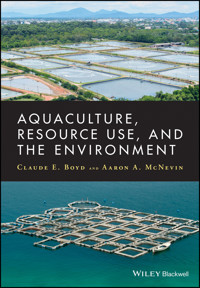
Cover images: Fish farm ©iStock/ imagedepotpro, The Shrimp farming ©iStock/ pinyoj
Contents
Foreword
Foreword
Foreword
Abbreviations
Units of measurement
Organizations
Other terms
Preface
Chapter 1 An overview of aquaculture
History
Culture species
Water sources and culture systems
Ponds
Environmental issues
Conclusions
The eNGO perspective
References
Chapter 2 World population
Historical demographics
World population and its distribution
The future
Conclusions
The eNGO perspective
References
Chapter 3 World food production
Agricultural production
Fisheries production
Aquaculture
Seaweed production
International trade
Conclusions
The eNGO perspective
References
Chapter 4 Assessing resource use and environmental impacts
Sources of information
Environmental impact assessment
Life cycle assessment
Footprints
Food miles
Effluent and environmental monitoring
Indicators
Conclusions
The eNGO perspective
References
Endnotes
Chapter 5 Land use
Major land uses
Land use in aquaculture
Comparison of land use in aquaculture and agriculture
Land use conversions by aquaculture
Conclusions
The eNGO perspective
References
Chapter 6 Water use by aquaculture systems
Availability of freshwater
Water footprint
Water use in aquaculture
Water availability for aquaculture
Water conservation in aquaculture
Conclusions
The eNGO perspective
References
Chapter 7 Energy use and atmospheric emissions
Global energy use
Energy for the world food system
Atmospheric emissions
Solar radiation, atmospheric gases, and temperature
Effects of anthropogenic greenhouse gas increase
Effects of sulfur and nitrogen dioxide
Actions to combat atmospheric emissions
Conclusions
The eNGO perspective
References
Chapter 8 Protein conversion and the fish meal and oil issue
Amino acids and proteins
Protein conversion in aquaculture
Fish meal and fish oil
Fish in–fish out ratio
Conclusions
The eNGO perspective
References
Chapter 9 Chemicals in aquaculture
Chemical use
Liming materials
Fertilizers
Therapeutants
Anesthetics
Hormones
Oxidants
Algicides
Aquatic herbicides
Fish toxicants
Coagulants
Antifoulants
Osmoregulators and ionic balance adjustors
Feed additives
Bacterial products
Fuels and lubricants
Conclusions
The eNGO perspective
References
Chapter 10 Water pollution
Pollution potential of production systems
Methods for enhancing production capacity
System waste loads
Assimilation and removal of wastes
Effluent quality
Reducing concentrations and loads of pollutants
Best management practices
Perspectives on pollution by aquaculture
Fisheries processing effluents
Conclusions
The eNGO perspective
References
Chapter 11 Biodiversity
Major concerns about biodiversity
Aquaculture effluents and biodiversity
Effects of land and water use on biodiversity
Escapes of farm stock
Exotic species
Genetically modified organisms
Predator control
Impingement of aquatic animals
Movement of aquaculture species
Capture of wild larvae and broodstock
Disease transmission between farmed and wild animals
Beneficial effects of aquaculture on biodiversity
Conclusions
The eNGO perspective
References
Chapter 12 Governmental regulations
Land and water use
Wetlands
Bird and other predator control
Importations of aquaculture species
Aquatic animal disease regulations
Seafood regulations
Effluent discharge permits
Stream classification
Wastewater discharge permits
Aquaculture effluent rule
Other regulations
Conclusions
The eNGO perspective
References
Chapter 13 Best management practices
Background
Development of aquaculture BMPs
Adoption and effectiveness of aquaculture BMPs
Conclusions
The eNGO perspective
References
Chapter 14 Eco‐label certification
Environmental ratings of aquaculture products
Sourcing policies
Association standards
History of eco‐labeling
Principles of eco‐labeling
Organic certification
Aquaculture eco‐label certification programs
Trans‐national partnerships
Demand for certified products
Conclusions
The eNGO perspective
References
Endnotes
Chapter 15 Some final thoughts
The eNGO perspective
Index
End User License Agreement
List of Tables
Chapter 1
Table 1.1
Table 1.2
Table 1.3
Table 1.4
Chapter 2
Table 2.1
Table 2.2
Table 2.3
Table 2.4
Table 2.5
Chapter 3
Table 3.1
Table 3.2
Table 3.3
Table 3.4
Table 3.5
Table 3.6
Table 3.7
Table 3.8
Table 3.9
Table 3.10
Table 3.11
Table 3.12
Table 3.13
Table 3.14
Table 3.15
Chapter 4
Table 4.1
Table 4.2
Table 4.3
Table 4.4
Table 4.5
Table 4.6
Table 4.7
Chapter 5
Table 5.1
Table 5.2
Table 5.3
Table 5.4
Table 5.5
Table 5.6
Table 5.7
Table 5.8
Chapter 6
Table 6.1
Table 6.2
Table 6.3
Table 6.4
Table 6.5
Table 6.6
Table 6.7
Table 6.8
Table 6.9
Table 6.10
Table 6.11
Chapter 7
Table 7.1
Table 7.2
Table 7.3
Table 7.4
Table 7.5
Table 7.6
Table 7.7
Table 7.8
Table 7.9
Table 7.10
Table 7.11
Table 7.12
Table 7.13
Chapter 8
Table 8.1
Table 8.2
Table 8.3
Table 8.4
Chapter 9
Table 9.1
Table 9.2
Table 9.3
Table 9.4
Table 9.5
Table 9.6
Table 9.7
Table 9.8
Chapter 10
Table 10.1
Table 10.2
Table 10.3
Table 10.4
Chapter 11
Table 11.1
Table 11.2
Chapter 12
Table 12.1
Table 12.2
Table 12.3
Chapter 13
Table 13.1
Table 13.2
Table 13.3
Table 13.4
Table 13.5
Table 13.6
Chapter 14
Table 14.1
Table 14.2
Table 14.3
Table 14.4
List of Illustrations
Chapter 1
Figure 1.1
Total world fisheries and aquaculture production since 1950.
Source:
FAO (2011).
Figure 1.2
Watershed pond showing the dam and a portion of the watershed (left); a complex of watershed ponds on the E. W. Shell Fisheries Center at Auburn University in Alabama (United States) (right).
Figure 1.3
Illustration of overflow structure and drain pipe in a pond.
Figure 1.4
Deep‐water intake structure.
Figure 1.5
An excavated fish pond in Thailand. Courtesy of David Cline.
Figure 1.6
Embankment ponds used for channel catfish farming in the United States.
Figure 1.7
Plastic‐lined ponds on the Claude Peteet Mariculture Center, Gulf Shores, Alabama (United States). Courtesy of David Cline.
Figure 1.8
Round ponds at a shrimp farm in Belize.
Figure 1.9
A trout raceway in the United States.
Figure 1.10
Large cages in a lake (left); a small cage in a pond (right). Courtesy of David Cline.
Figure 1.11
Example of a net pen culture system.
Figure 1.12
Schematic of an outdoor, water reuse system for tilapia culture.
Figure 1.13
Schematic of a water reuse system with water purification equipment and enclosed in a greenhouse.
Figure 1.14
A simple, partitioned aquaculture system at the Delta Research and Extension Center, Stoneville, Mississippi (United States). Fish are held in the smaller part of the divided pond and water is circulated between the waste-treatment area and the fish-holding area by a slow-turning paddlewheel. The standard, paddlewheel aerators prevent low dissolved oxygen concentration in the fish-holding area at night.
Figure 1.15
Oyster culture in off‐bottom cages in the intertidal zone. Courtesy of David Cline.
Chapter 2
Figure 2.1
World population growth over time.
Chapter 3
Figure 3.1
Global production of all agricultural crops and of the top 20 crops with per capita supply of each category from 1961 to 2010.
Source:
FAO. FAOSTAT. Production. 2013. Accessed: 10/15/2013. URI: http://faostat3.fao.org/faostat-gateway/go/to/download/Q/*/E.
Figure 3.2
Global production of wheat, rice, corn, and soybeans from 1961 to 2010.
Source:
FAO. FAOSTAT. Production. 2013. Accessed: 10/15/2013. URI: http://faostat3.fao.org/faostat-gateway/go/to/download/Q/*/E.
Figure 3.3
Global average yields of wheat, rice, corn, and soybeans from 1960 to 2010.
Source:
www.fas.usda.gov/psdonline.
Figure 3.4
Percentage of corn used for ethanol production in the United States.
Source:
FAO. FAOSTAT. Production. 2013. Accessed: 10/15/2013. URI: http://faostat3.fao.org/faostat-gateway/go/to/download/Q/*/E.
Figure 3.5
Ethanol yield of selected crops.
Source:
FAO (2011).
Figure 3.6
Global production of milk and meat with per capita supply of each from 1961 to 2010.
Source:
FAO (2011).
Figure 3.7
Aquaculture growth by continent and region from 1950 to 2010.
Source:
(http://www.agecon.msstate.edu/what/farm/budget/catfish/php) and FAO (2011).
Figure 3.8
Global production by aquaculture of tilapia, whiteleg shrimp, and Atlantic salmon from 1950 to 2010.
Source:
FAO (2011) and FAO. FAOSTAT. Production. 2013. Accessed: 10/15/2013. URI: http://faostat3.fao.org/faostat-gateway/go/to/download/Q/*/E.
Figure 3.9
Production of channel catfish in the United States from 1975 to 2012 (http://www.agecon.msstate.edu/what/farm/budget/catfish/php) and for world from 1988 to 2010 (www.fao.org/fishery/statistics).
Source:
FAO (2011) and FAO. FAOSTAT. Production. 2013. Accessed: 10/15/2013. URI: http://faostat3.fao.org/faostat-gateway/go/to/download/Q/*/E.
Figure 3.10
Average annual growth rates at 10‐year intervals for major meat products.
Source:
FAO. FAOSTAT. Production. 2013. Accessed: 10/15/2013. URI: http://faostat3.fao.org/faostat-gateway/go/to/download/Q/*/E.
Figure 3.11
Average value of some major food products.
Source:
FAO (2012).
Figure 3.12
Global production and value of some major food products.
Source:
FAO (2011).
Figure 3.13
Estimated global employment by capture fisheries and aquaculture.
Source:
FAO (2011).
Figure 3.14
Global seaweed production from 1990 to 2010.
Source:
FAO (2011, 2012).
Figure 3.15
Export share of total aquaculture and capture fisheries production (for human food). From www.fao.org/fishery/statistics.
Figure 3.16
Total export value in 2009 of fisheries products and other selected commodities from less developed countries. From www.fao.org/fishery/statistics and http://faostat.fao.org.
Chapter 4
Figure 4.1
Example of using the results of a toxicity test to determine the LC50 of a chemical compound to fish.
Source:
Boyd, C. E., J. Queiroz, J. Lee, M. Rowan, G. N. Whitis, and A. Gross. Environmental assessment of channel catfish, Ictalurus punctatus, farming in Alabama.
Journal of the World Aquaculture Society
31:511–544. Copyright © 2000, John Wiley & Sons, Inc.
Figure 4.2
A simplified life cycle flow chart for the production of channel catfish meat.
Chapter 5
Figure 5.1
Mangrove wetland.
Figure 5.2
Left: Bottom of former Mississippi channel catfish farm prepared for planting corn. Right: corn crop in former channel catfish pond. Courtesy of Travis Brown and David Cline.
Chapter 6
Figure 6.1
The hydrologic cycle or water cycle.
Figure 6.2
Illustration of annual, renewable, and available freshwater.
Figure 6.3
The water cycle for agricultural and nonagricultural land.
Figure 6.4
Integrated seaweed–abalone culture in Shandong Province, China.
Source:
David Cline.
Chapter 7
Figure 7.1
Annual estimates of global primary fuel use and energy use per capita.
Source:
Data for constructing figure from BP (2009, 2012).
Figure 7.2
The world carbon budget.
Figure 7.3
Annual estimates of global, anthropogenic carbon dioxide emissions at 10‐year intervals (dots) (1850–2030) and changes in atmospheric carbon dioxide concentrations measured at Mauna Loa, Hawaii from 1958 to 2012 (circles).
Source:
http://cdiac.ornl.gov/#.
Figure 7.4
Annual estimates of anthropogenic sulfur dioxide emissions at 25‐year intervals (1850–2005) for China, United States (US) and Canada, and the world.
Source:
Data for constructing figure from Smith et al. (2011).
Figure 7.5
Electromagnetic spectrum.
Figure 7.6
Solar irradiance from 1600 to 2000 showing the Maunder Minimum (M) and the Dalton Minimum (D).
Source:
Bard, E., G. Reinbeck, F. Yiou, and J. Jouzel. Solar irradiance during the last 1200 years based on cosmogenic nuclides.
Tellus
52B:985–992. Copyright © 2000, John Wiley & Sons, Inc.
Figure 7.7
Schematic of earth's radiation budget.
Figure 7.8
Schematic of greenhouse effect of earth's atmosphere.
Figure 7.9
Deviations from the global, 10‐year average air temperature (1979–1988) from 1850 to 2012.
Source:
http://www.climate4you.com/GlobalTemperatures.htm.
Figure 7.10
Heat content of the 0–700 m layer of the ocean. The baseline (0 ZJ) is heat content for 1985.
Source:
http://www.rodc.noaa.gov/OC5/3M_HEAT_CONTENT/.
Figure 7.11
Sea level rise since 1860. The baseline (0‐mm deviation) was measured at sea level in 1880.
Source:
NOAA (2010).
Chapter 8
Figure 8.1
Annual production of fish meal and fish oil: 1962–2009.
Source:
www.iffo.net.
Figure 8.2
Landing of most economically important species of fish for fish meal and oil production.
Source:
FAO (2011).
Chapter 9
Figure 9.1
Global fertilizer nutrient use from 1961–2009.
Source:
http://faostat3.fao.org/faostat-gateway/go/to/download/R/RF/E.
Figure 9.2
Copper concentrations before and after treatment of channel catfish ponds with copper sulfate. Modified from McNevin, A. A. and C. E. Boyd. Copper concentrations in channel catfish Ictalurus punctatus ponds treated with copper sulfate.
Journal of the World Aquaculture Society
35:16–24. Copyright © 2004, John Wiley & Sons, Inc.
Chapter 10
Figure 10.1
Illustration of the use of the end of a raceway for solids removal. Drawing not to scale.
Figure 10.2
Mean concentrations and standard deviations for water quality variables measured at different stages of pond water level drawdown for harvest at an inland, low‐salinity shrimp farm in Alabama.
Source:
Prapaiwong, “Water quality in inland ponds for low-salinity culture of Pacific white shrimp
Litopenaeus vannamei
” Auburn University, 2011.
Figure 10.3
Illustration of method of retaining storage volume in ponds to avoid overflow after rainfall events.
Figure 10.4
Illustration of use of reservoir to allow water from pond draining to be reused.
Figure 10.5
Illustration of sedimentation basin (not to scale). V
s
, terminal settling velocity; V
cs
, critical settling velocity.
Chapter 13
Figure 13.1
Satellite image of channel catfish farm in Alabama, USA.
Source:
Map data © 2013 Google Earth Pro.
Figure 13.2
Typical placement of aerators in a channel catfish pond.
Figure 13.3
Cattle in an aquaculture pond. Courtesy of David Cline.
Figure 13.4
Riprap‐lined plunge basin to prevent erosion by pond discharge pipe.
Figure 13.5
Extension of pipe to prevent erosion by discharge at the shallow edge of the stream.
Chapter 14
Figure 14.1
The desired effect of adopting more environmentally responsible aquaculture practices.
Guide
Cover
Table of Contents
Preface
Pages
vii
viii
ix
x
xi
xiii
xiv
xv
xvi
xvii
xix
xx
xxi
xxiii
xxiv
xxv
1
2
3
4
5
6
7
8
9
10
11
12
13
14
15
16
17
18
19
20
21
22
23
24
25
26
27
28
29
30
31
32
33
35
36
37
38
40
41
42
43
44
45
47
48
49
50
52
53
54
55
56
57
58
59
60
61
62
63
64
65
66
67
68
69
70
71
72
73
74
75
76
77
78
79
81
82
83
84
85
86
87
88
89
90
91
92
93
94
95
96
97
98
99
100
101
102
103
104
105
106
107
108
109
110
111
112
113
114
115
116
117
118
119
120
121
122
123
124
125
126
127
128
129
130
131
132
133
134
135
136
137
138
139
140
141
142
143
144
145
146
147
148
149
150
151
152
153
154
155
157
158
159
160
161
162
163
164
165
166
167
168
169
170
171
173
174
175
176
177
178
179
180
181
182
183
184
185
186
187
188
189
190
191
192
193
194
195
196
197
198
199
200
201
202
203
204
205
206
207
208
209
210
211
212
213
214
216
217
218
219
220
221
222
223
224
225
226
227
228
229
230
231
232
233
234
235
236
237
238
239
240
241
242
243
244
245
246
247
248
249
250
251
253
254
255
256
257
258
259
261
262
263
264
265
266
267
268
269
270
271
272
273
274
275
276
277
279
280
281
282
283
285
286
287
288
289
290
291
292
293
294
295
296
297
298
299
301
302
303
304
305
306
307
308
309
310
311
312
313
314
315
316
317
318
319
321
322
323
324
325
326
327
329
330
331
332
333
334
335
336
337
Foreword
If you happen to travel frequently, as I do, perhaps you too marvel at how commonplace, safe, and comfortable air travel has become. Such achievements, of course, did not happen all at once. It took many tries before Orville and Wilbur Wright's motorized glider took flight to become the world's first viable airplane. Humanity's remarkable progress in science and engineering has been achieved in countless small steps that have built upon each other in an age‐old process of continuous improvement. Even major scientific breakthroughs have been the product of preceding advances. As Isaac Newton said, “If I have seen further than others, it is by standing upon the shoulders of giants.”
In a corresponding way, humanity has also added an increasing environmental burden to our planet over the ages. As our population continues to grow, we recognize the impending limits of our consumption, and we strive for sustainability. The journey of aquaculture toward sustainability has also been one of continuous improvement that has come in steps—sometimes small steps and even missteps.
In the case of shrimp farming, Dr. Motosaku Fujinaga achieved the first breakthroughs in closing the life cycle of shrimp during the 1930s. Early shrimp farmers made mistakes such as choosing mangrove sites for shrimp ponds and relying on antibiotics to manage diseases. As with pioneers in aviation, they learned and improved. Today's operators use specific pathogen‐free, genetically improved animals to produce high yields in biosecure ponds with zero water exchange and vegetable‐protein feeds. They continue to err, but their mistakes are fewer and farther between.
Urging aquaculture forward is the rising global demand for seafood. This is driven not only by increasing population, but also by the rising middle class in China and elsewhere, which is increasing per capita consumption. Marine fisheries cannot supply this increasing demand, because landings have been stagnant for over a decade and most of the valuable species are either fully exploited or over exploited. Aquaculture is the only means of meeting rising seafood demand, and it has become the fastest growing sector of global food production.
While global aquaculture production doubled during the 1990s, its growth has slowed since then, due to increasing constraints such as environmental limits, disease outbreaks, and availability of feed ingredients. The way forward is to produce more efficiently and responsibly. This is gradually being achieved through advances in genetic improvement, recycling of wastes, zone management, reduced reliance on fishmeal in feeds, and other innovations.
In today's age of instant access to information, consumers are keen to know more about the environmental, social, and food safety attributes of farmed seafood. Market acceptance relies more and more on compliance with international standards of best practice as indicated by certified eco‐labels.
From this author's perspective, as President of the Global Aquaculture Alliance (GAA), certification standards are a unifying force in guiding the aquaculture industry forward in its journey of continuous improvement toward sustainability. We are still in the early stages of this journey, and we have much to learn. It is tempting to immediately set aspirational standards in hopes of stimulating a quantum leap toward a future goal, but stakeholders may disengage if the bar is set too high. Imagine challenging medieval man to develop a system of air travel where one can enjoy a hot meal while seated comfortably in a plane flying between continents! The enormity of an unrealistic challenge may paralyze further progress.
GAA's Best Aquaculture Practices (BAP) certification standards for aquaculture facilities seek to effect immediate improvements by engaging as many facilities as possible through stringent but pragmatic standards. As combined efforts, great and small, of researchers and producers around the world continually raise the bar for what aquaculture can be, certification standards are raised in step. It is a dynamic ever‐advancing process. As Heraclites said over 2000 years ago, “No man ever steps in the same river twice, for it's not the same river and he's not the same man.”
The work contained within this volume helps explain these complex and evolving issues, which are so important to the future of our seafood supply and our planet. Dr. Claude Boyd is eminently qualified to guide this discussion, because he has been an active player in the development of the aquaculture sustainability movement. Dr. Aaron A. McNevin also has much experience with aquaculture certification through his work with the World Wildlife Fund Aquaculture Dialogues. He provides insight about the reasons that environmental NGOs have taken certain positions on aquaculture.
Dr. Boyd assisted GAA in the development of its initial BAP standards for shrimp farms—released in 2003 as the seafood industry's first such certification standards. Since then, BAP certification has come to encompass farms for salmon, tilapia, Pangasius and other farmed species, as well as hatcheries, feed mills, and processing plants. Standards for mussel farms and revised standards for finfish and crustacean farms were released in early 2013. The annual volume of BAP certified products now exceeds 2.1 million tonne.
The Global Aquaculture Alliance appreciates the extensive knowledge, research, and insights that Drs. Boyd and McNevin share in this new publication. They address both a historical perspective and an excellent overview of some of the challenges in land and water use, energy consumption, protein conversion, and conservation of biodiversity. Fittingly, the final chapters describe best management practices and certification programs that help guide aquaculture on its journey to responsibly feed the world.
George W. Chamberlain
President, Global Aquaculture Alliance
Saint Louis, MO, USA
Foreword
Aquaculture is the only form of agriculture I can think of that evolved from mainly subsistence food production into an important part of international economy within one human generation. Coincident with—or perhaps caused by—its rapid expansion came dramatic changes in the way people viewed the relationship between aquaculture and the environment. All this provided a unique opportunity for individual scientists of a certain age to personally witness the arc of aquaculture's development and environmental performance.
Lesen Sie weiter in der vollständigen Ausgabe!
Lesen Sie weiter in der vollständigen Ausgabe!
Lesen Sie weiter in der vollständigen Ausgabe!
Lesen Sie weiter in der vollständigen Ausgabe!
Lesen Sie weiter in der vollständigen Ausgabe!
Lesen Sie weiter in der vollständigen Ausgabe!
Lesen Sie weiter in der vollständigen Ausgabe!
Lesen Sie weiter in der vollständigen Ausgabe!
Lesen Sie weiter in der vollständigen Ausgabe!
Lesen Sie weiter in der vollständigen Ausgabe!
Lesen Sie weiter in der vollständigen Ausgabe!
Lesen Sie weiter in der vollständigen Ausgabe!
Lesen Sie weiter in der vollständigen Ausgabe!
Lesen Sie weiter in der vollständigen Ausgabe!
Lesen Sie weiter in der vollständigen Ausgabe!
Lesen Sie weiter in der vollständigen Ausgabe!
Lesen Sie weiter in der vollständigen Ausgabe!
Lesen Sie weiter in der vollständigen Ausgabe!
Lesen Sie weiter in der vollständigen Ausgabe!




