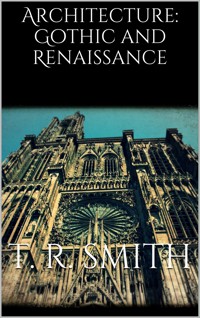
Architecture: Gothic and Renaissance - T. Roger Smith - E-Book

Architecture: Gothic and Renaissance E-Book

T. Roger Smith

0,0
2,99 €

oder
-100%
Sammeln Sie Punkte in unserem Gutscheinprogramm und kaufen Sie E-Books und Hörbücher mit bis zu 100% Rabatt.

Mehr erfahren.
Beschreibung

THE history, the features, and the most famous examples of European architecture, during a period extending from the rise of the Gothic, or pointed, style in the twelfth century to the general depression which overtook the Renaissance style at the close of the eighteenth, form the subject of this little volume. I have endeavoured to adopt as free and simple a mode of treatment as is compatible with the accurate statement of at least the outlines of so very technical a subject.
Though it is to be hoped that many professional students of architecture will find this hand-book serviceable to them in their elementary studies, it has been my principal endeavour to adapt it to the requirements of those who are preparing for the professional pursuit of the sister arts, and of that large and happily increasing number of students who pursue the fine arts as a necessary part of a complete liberal education, and who know that a solid and comprehensive acquaintance with art, especially if joined to some skill in the use of the pencil, the brush, the modelling tool, or the etching needle, will open sources of pleasure and interest of the most refined description.

Das E-Book können Sie in Legimi-Apps oder einer beliebigen App lesen, die das folgende Format unterstützen:

EPUB

Veröffentlichungsjahr: 2015

Bewertungen
0,0
0
0
0
0
0
Mehr Informationen
Mehr Informationen
Legimi prüft nicht, ob Rezensionen von Nutzern stammen, die den betreffenden Titel tatsächlich gekauft oder gelesen/gehört haben. Wir entfernen aber gefälschte Rezensionen.


T. Roger Smith

Architecture: Gothic and Renaissance

UUID: 1fb3d746-8c41-11e5-a0e8-119a1b5d0361
This ebook was created with StreetLib Write (http://write.streetlib.com)by Simplicissimus Book Farm

Table of contents

PREFACE.

GLOSSARY OF TECHNICAL WORDS.

CHAPTER I.INTRODUCTION.

CHAPTER II.THE BUILDINGS OF THE MIDDLE AGES.

CHAPTER III.GOTHIC ARCHITECTURE IN GREAT BRITAIN.

CHAPTER IV.GOTHIC ARCHITECTURE.—ENGLAND.

CHAPTER V.GOTHIC ARCHITECTURE.—ENGLAND.

CHAPTER VI.GOTHIC ARCHITECTURE IN WESTERN EUROPE.

FRANCE.—CHRONOLOGICAL SKETCH.

CHAPTER VII.GOTHIC ARCHITECTURE IN CENTRAL AND NORTHERN EUROPE.

CHAPTER VIII.GOTHIC ARCHITECTURE IN SOUTHERN EUROPE.

CHAPTER X.GENERAL VIEW.

CHAPTER XI.RENAISSANCE ARCHITECTURE IN ITALY.

CHAPTER XII.RENAISSANCE ARCHITECTURE IN FRANCE AND NORTH EUROPE.

CHAPTER XIII.RENAISSANCE ARCHITECTURE IN GREAT BRITAIN, SPAIN, AND PORTUGAL.

THE CERTOSA, NEAR PAVIA. From the Cloisters.

PREFACE.

THE history, the features, and the most famous examples of European architecture, during a period extending from the rise of the Gothic, or pointed, style in the twelfth century to the general depression which overtook the Renaissance style at the close of the eighteenth, form the subject of this little volume. I have endeavoured to adopt as free and simple a mode of treatment as is compatible with the accurate statement of at least the outlines of so very technical a subject.Though it is to be hoped that many professional students of architecture will find this hand-book serviceable to them in their elementary studies, it has been my principal endeavour to adapt it to the requirements of those who are preparing for the professional pursuit of the sister arts, and of that large and happily increasing number of students who pursue the fine arts as a necessary part of a complete liberal education, and who know that a solid and comprehensive acquaintance with art, especially if joined to some skill in the use of the pencil, the brush, the modelling tool, or the etching needle, will open sources of pleasure and interest of the most refined description.The broad facts of all art history; the principles which underlie each of the fine arts; and the most precious or most noteworthy examples of each, ought to be familiar to every art student, whatever special branch he may follow. Beyond these limits I have not attempted to carry this account of Gothic and Renaissance architecture; within them I have endeavoured to make the work as complete as the space at my disposal permitted.Some portions of the text formed part of two courses of lectures delivered before the students of the School of Military Engineering at Chatham, and are introduced here by the kind permission of Sir John Stokes. Many of the descriptive and critical remarks are transcripts of notes made by myself, almost under the shadow of the buildings to which they refer. It would, however, have been impossible to give a condensed view of so extended a subject had not every part of it been treated at much greater length by previous writers. The number and variety of the books consulted renders it impossible to make any other acknowledgment here than this general recognition of my indebtedness to their authors.T. R. S.

GLOSSARY OF TECHNICAL WORDS.

Abacus.—The upper portion of the capital of a column, upon which the weight to be carried rests.Aisle (Lat. ala).—The side subdivision in a church; occasionally all the subdivisions, including the nave, are called aisles.Apse.—A semicircular or polygonal termination to, or projection from, a church or other public building.Arcade.—A range of arches, supported on piers or columns.Arch.—A construction of wedge-shaped blocks of stone, or of bricks, of a curved outline, and spanning an open space. The principal forms of arch in use are Semicircular; Acutely-pointed, or Lancet; Equilateral, or Less Acutely-pointed; Four-centred, or Depressed Tudor; Three-centred, or Elliptic; Ogival; Segmental; and Stilted. (Figs. a to f.)Architrave.—(1) The stone which in Classic and Renaissance architecture is thrown from one column or pilaster to the next. (2) The moulding which in the same styles is used to ornament the margin of a door or window opening or arch.Ashlar.—Finely-wrought masonry, employed for the facing of a wall of coarser masonry or brick.Attic (In Renaissance Architecture).—A low upper story, distinctly marked in the architecture of the building, usually surmounting an order; (2) in ordinary building, any story in a roof.Bailey (from vallum).—The enclosure of the courtyard of a castle.Ball-flower.—An ornament representing a globular bud, placed usually in a hollow moulding.Baluster.—A species of small column, generally of curved outline.Balustrade.—A parapet or rail formed of balusters.Fig. a.—Semicircular Arch.Fig. b.—Stilted Arch.

Lesen Sie weiter in der vollständigen Ausgabe!

Lesen Sie weiter in der vollständigen Ausgabe!

Lesen Sie weiter in der vollständigen Ausgabe!

Lesen Sie weiter in der vollständigen Ausgabe!

Lesen Sie weiter in der vollständigen Ausgabe!

Lesen Sie weiter in der vollständigen Ausgabe!

Lesen Sie weiter in der vollständigen Ausgabe!

Lesen Sie weiter in der vollständigen Ausgabe!

Lesen Sie weiter in der vollständigen Ausgabe!

Lesen Sie weiter in der vollständigen Ausgabe!

Lesen Sie weiter in der vollständigen Ausgabe!

Lesen Sie weiter in der vollständigen Ausgabe!

Lesen Sie weiter in der vollständigen Ausgabe!