


12,99 €
Mehr erfahren.
- Herausgeber: John Wiley & Sons
- Kategorie: Geisteswissenschaft
- Serie: New Human Frontiers - Polity
- Sprache: Englisch
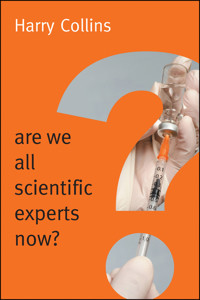
To ordinary people, science used to seem infallible. Scientists were heroes, selflessly pursuing knowledge for the common good. More recently, a series of scientific scandals, frauds and failures have led us to question science’s pre-eminence. Revelations such as Climategate, or debates about the safety of the MMR vaccine, have dented our confidence in science.
In this provocative new book Harry Collins seeks to redeem scientific expertise, and reasserts science’s special status. Despite the messy realities of day-to-day scientific endeavor, he emphasizes the superior moral qualities of science, dismissing the dubious “default” expertise displayed by many of those outside the scientific community. Science, he argues, should serve as an example to ordinary citizens of how to think and act, and not the other way round.
Sie lesen das E-Book in den Legimi-Apps auf:
Seitenzahl: 156
Veröffentlichungsjahr: 2014
Ähnliche


















Table of Contents
Cover
Title page
Copyright page
Figures and Tables
Introduction: The Growing Crisis of Expertise
Climategate
One: Academics and How the World Feels
Interim summary
Two: Experts
Models of expertise
A table of expertises
Three: Citizen Sceptics
Science as a collective activity and tacit knowledge
Four: Citizen Whistle-blowers
Vaccine protestors
Conclusion: Are We All Experts Now?
Ubiquitous expertise
Specialist expertise
Meta-expertise
Default expertise
In sum
Bibliography
Index
Copyright © Harry Collins 2014
The right of Harry Collins to be identified as Author of this Work has been asserted in accordance with the UK Copyright, Designs and Patents Act 1988.
First published in 2014 by Polity Press
Polity Press
65 Bridge Street
Cambridge CB2 1UR, UK
Polity Press
350 Main Street
Malden, MA 02148, USA
All rights reserved. Except for the quotation of short passages for the purpose of criticism and review, no part of this publication may be reproduced, stored in a retrieval system, or transmitted, in any form or by any means, electronic, mechanical, photocopying, recording or otherwise, without the prior permission of the publisher.
ISBN-13: 978-0-7456-8203-7
ISBN-13: 978-0-7456-8204-4(pb)
ISBN-13: 978-0-7456-8274-7(epub)
ISBN-13: 978-0-7456-8273-0(mobi)
A catalogue record for this book is available from the British Library.
The publisher has used its best endeavours to ensure that the URLs for external websites referred to in this book are correct and active at the time of going to press. However, the publisher has no responsibility for the websites and can make no guarantee that a site will remain live or that the content is or will remain appropriate.
Figure 0.1 is reproduced from Wikimedia Commons (their history/Wikimedia Commons)
Every effort has been made to trace all copyright holders, but if any have been inadvertently overlooked the publisher will be pleased to include any necessary credits in any subsequent reprint or edition.
For further information on Polity, visit our website: www.politybooks.com
Figures and Tables
Figures
Tables
Introduction
The growing crisis of expertise
In 1951 my parents took me to the Festival of Britain. I stood under the ‘Skylon’ – a vertical, 300-foot, pointed, aluminium cigar, suspended 50 feet above the ground on steel cables. The Skylon seemed to float and it was a thrill for a kid to stand directly underneath, thinking that if scientists and engineers were not so clever the massive object would spear down through the top of my head.
Figure 0.1 The Skylon
A hundred years after the Great Exhibition, the Festival of Britain was meant to show Britons that they could recover from the war through the enterprise of the people, and the brave new world of science and engineering. Just a few years later, in 1956, the world's first commercial nuclear power station, Calder Hall, was connected to the national electricity grid. A year after that ZETA, the first ever fusion-power reactor, was completed. The radio, the newspapers and the newsreels (the Collins family couldn't afford a television) were saturated with these events. Today, the post-war cadences on old recordings still evoke that sense of a bright future. Calder Hall had tamed the fearsome power of the atom bomb and used it to bring electricity into the home. ZETA was to tame the still more limitless power of the hydrogen bomb – the power of the Sun. In a speech in 1954, anticipating the development of fission and fusion power, Lewis Strauss, the Chairman of the United States Atomic Energy Commission, told the National Association of Science Writers: ‘Our children will enjoy in their homes electrical energy too cheap to meter.’ And along with Skylon there was nylon – shirts and blouses so much easier to wash – and jet airliners, penicillin, polio vaccine and new economic theories assuring the end of unemployment. These wonderful things were the products of experts, remote, powerful and few in number.
Lesen Sie weiter in der vollständigen Ausgabe!
Lesen Sie weiter in der vollständigen Ausgabe!
Lesen Sie weiter in der vollständigen Ausgabe!
Lesen Sie weiter in der vollständigen Ausgabe!
Lesen Sie weiter in der vollständigen Ausgabe!
Lesen Sie weiter in der vollständigen Ausgabe!
Lesen Sie weiter in der vollständigen Ausgabe!




