


12,99 €
Mehr erfahren.
- Herausgeber: ibidem
- Kategorie: Geisteswissenschaft
- Serie: Berliner Schriften zum Theater der Unterdrückten
- Sprache: Englisch
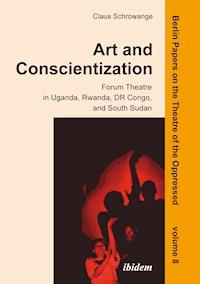
How can the performing arts add value to peacebuilding programs? Is it possible to use participatory theatre to reconnect and reconcile enemies? What is the trauma-healing effect for those acting in a theatre troupe? Claus Schrowange has explored these questions and the opportunities of using forum theatre in peace work in Uganda, South Sudan, Rwanda, and DR Congo. His conclusion is that forum theatre is more than mere entertainment. It is an aesthetic tool for social change. But the value of theatre is not generated automatically, the way it is done matters. If it is done in a participatory manner with an authentic, be¬lie¬vable acting style, involving both the audience and stage actor in a vivid and touching experience, the impact is immediately felt. This book presents the approach Schrowange developed together with a team of African theatre practitioners in a variety of circumstances and environments. It is illustrated with case studies taken from the author´s direct experience of using the approach he describes in Eastern DR Congo and Rwanda.
Das E-Book können Sie in Legimi-Apps oder einer beliebigen App lesen, die das folgende Format unterstützen:
Seitenzahl: 154
Veröffentlichungsjahr: 2015
Ähnliche




















ibidemPress, Stuttgart
This book is an expandedversion of the article “Forum theatre for peace—Experiences in Uganda, Rwanda, DR Congo and South Sudan”, published byThe Civil Peace Service Network (CPS)in “Theatre for Peace—CPS work in Cameroon, DR Congo, Nepal, Rwanda, Sierra Leone, South Sudan and Uganda”, Bafoussam, Berlin 2014.The publication was supported by Brot für die Welt—Evangelischer Entwicklungsdienst (Bread for the World—Church Development Service) and financed through the German Ministry for Economic Cooperation (BMZ).
Table of Contents
Foreword
It has been nine years since the start of the book seriesBerlin Papers on the Theatre of the Oppressedwith Anne Dirnstorfer’s publication on Forum Theatre in Nepal, and it is with great pleasure that I introduce the first English-language volume, Claus Schrowange’sArt and Conscientization—Forum Theatre in Uganda, Rwanda, DR Congo, and South Sudan.Since the practice ofForum Theatre (and the scope of the series) is an international one, I hope this book can find readers around the world more easily than books in my native German.
Claus Schrowange will take you on an interesting journey to Uganda and South Sudan, presenting the Forum Theatre style of Rafiki Theatre, and to Rwanda and the Democratic Republic of the Congo with Badilika Theatre. He describes his approach and methods, his experiences with the trauma-healing effect of theatre, and concludes with his views on the opportunities and limitations of Forum Theatre in peace work.
I would like to thank Claus for all the hard work of updating an essay he wrote for Christiane Kayser and turning it into a book—I know theatre makers are always busy, but he took the time, and now we can all gain insight into his experiences and hopefully integrate some parts into our own work and projects.
The world in its current state can certainly use all of our efforts.
Berlin
August, 2015
Harald Hahn
www.harald-hahn.de
Acknowledgments
I wish to thank the actors of the participatory theatre troupes I have worked with in Uganda, South Sudan, Rwanda, and DR Congo. Without their readiness to explore the power of theatre for peace, this book wouldn’t have been possible.
I am grateful to Gabor Csetneki for teaching me his alternative approach to theatre.
Thank you Harald Hahn for introducing me to Forum Theatre and encouraging me to write this book, and for your trust and believe, that it will add value to the “world of theatre practitioners”.
I want to thank Christiane Kayser for motivating me to finally start writing about my experiences, and for publishing an article in herBuilding peaceseries.
I wish to thank all organizations that have supported my work in Africa, especially the United Evangelical Mission, Bread for the World, the German Association for Development Cooperation (AGEH), and the German International Cooperation (GIZ).
A special thanks goes to Uli Thum, who invited me to South Sudan to share my experiences and to form a theatre troupe.
I am grateful to Rev. Joshua Lusenge Kasereka, coordinator of APRED-RGL, for giving me space and time to explore the use of participatory theatre in peace work in Rwanda and DR Congo.
Finally, I would like to express heartfelt gratitude to my wife Sophie and my sons Mano and Lou, for living with my passion for theatre. This book is dedicated to you.
August, 2015
Claus Schrowange
1.Introduction
In 2009 I attended the World Forum Theatre festival in Graz. Forum theatre troupes from Asia, Europe and South America were presenting their work. Workshops during the day, performances in the evening. Three performances touched me especially. Actorsfromthe London-based group Cardboard Citizens created an emotional link with the audience[1]by just being themselves. The actors were homeless people, playing their real life experiences on the streets of London. Through the authenticity of their way of acting theybecame believable. The audience felt with them and forthem. Thisimmediately brokethe barrier between spectators and actors.
The second group which left a lastingimpression was Jana Sanskriti from India. Their style of forum theatre includes dance, movement, images and alot of symbols that leave a space for personal interpretation and imagination,and are both artistic and educational. Jana Sanskriti is working mainly on Gender-Based Violence in India.
Finally, there was TO-Tehran, aUniversity-affiliated Iranian theatre group,using forum theatre against oppressive systems. With simpleblack T-shirts and with just afew symbolic items,they were acting injustice andabuse of power in a serious as well asanabsurd manner, speaking out the truth while making the audience simultaneously laugh and reflect on the issues presented.
What was missing in Graz wasa group from Africa. This fact and the visually powerful impact of some performances motivated me to integrate forum theatre in my practice and explore its opportunities for peace work.
My theatre background is more or less an alternative one. I was trained by Gabor Csetneki, a Hungarian theatredirector,who has an actor-centeredapproach,where theatre becomes a discovery and expression of “body, heart and soul”, rather than the classical approach where actors repeat some sentences others have written.[2]Ialsohad the chance to meet and be trained by Keith Johnstone, the inventor of improvisation theatre. Harald Hahn—a German TO-practitioner—introduced me to Augusto Boal’s methods.
Istarted inNovember 2009 to workforEAIGCM[3]in Kampala, Uganda.It was a contractwithin the framework of theCivil Peace Service[4]. In January 2010 I gathered 12 students and young graduates of Music, Dance & Drama from Makerere University,Kampala, all of them hungry to applywhat they hadstudied. RafikiTheatre was born. During the next four years we explored the possibilities of participatory theatre for the promotion of peace, human rights and sustainable development. We developed our own style—an emotional and provocative, authentic and believable way of acting; integrating music, dance, movements, images,and symbols.
Productions on various topics were designed, and thenmore than ahundred performances were given in Uganda, Kenya, Rwanda,and South Sudan. Seven forum theatre troupes in Uganda and one in South Sudan[5]were trainedby Rafiki. We developed plays with them and supervised their work. We participated in festivals and larger campaigns, did street theatre as well as indoor performances.Rafiki Theatredid forum theatre with illiterate people in the remotest places as well aswiththe intellectual city elite. The style we developedbecame knownand experiences were shared at universities and during various workshops.
2013 I left Uganda for Rwanda, where I started as UEM[6]Co-worker for APRED-RGL[7], a regional peace initiative hosted by protestant churches from Rwanda, DR Congo and Burundi. APRED-RGLis buildinglocal capacities for peaceand promoting reconciliationintheAfricanGreat Lakes region,a region that has been plagued by decades of instability and armed conflicts, leaving behind humanitarian crisis, poverty,and deep-rooted hatred against the perceived “enemy”.
In August 2013 I found myself in Goma,DRCongo,in a not yet completed, dusty small building of theCBCA[8], together with the youth group “Jeunesse en Action”. We did a forum theatre workshop while 7 grenades were exploding, one less thanakilometeraway as the crow flies. The localpeople were blaming Rwandansforbeing behind the attack. The atmosphere was tense. Despite this we decided to continue, developeda short play andintegrated the fears ofourworkshop participantsintosome of the scenes.Finally weperformed to 200 peoplein a CBCA church.The play was about the hatredof the people of Goma for the people of Rwanda. I saw that the “Rafiki style” couldadd value to theprogramof APRED-RGL.
Together with the Rwandan youthcenter“Vision Jeunesse Nouvelle” we formed Badilika (“Change”), a Rwandan-Congolese Forum Theatre troupe. Badilika works on the prejudices, stereotypes,mythsandrumorsthat dividethe people in Africa’s Great Lakesregion. After some performances in the border towns of Gisenyiand Goma we toured around for 6weeks in2014, enteringinto conflict-affected communities in Rwanda and DR Congo.59performances were done, reaching out to more than 6000 people.
In thisbookI propose to describe the forum theatre approach developed by Rafiki Theatrein Uganda and South Sudan,and the experiences of Badilikawith this approach in Rwanda andthe DRC.I willconclude with a chapterabout the trauma-healing effect of theatre and some remarks about the opportunities and limitations of forum theatre in peace work.
2.Why theatre and what is “Forum Theatre”?
"Theatre is a form of knowledge: It should and can also be a means of transforming society. Theatre can help us build our future, rather than just waiting for it."[9]
Theatre can strengthen the emotional and psychological appeal of me
Lesen Sie weiter in der vollständigen Ausgabe!
Lesen Sie weiter in der vollständigen Ausgabe!
Lesen Sie weiter in der vollständigen Ausgabe!
Lesen Sie weiter in der vollständigen Ausgabe!
Lesen Sie weiter in der vollständigen Ausgabe!
Lesen Sie weiter in der vollständigen Ausgabe!
Lesen Sie weiter in der vollständigen Ausgabe!
Lesen Sie weiter in der vollständigen Ausgabe!
Lesen Sie weiter in der vollständigen Ausgabe!
Lesen Sie weiter in der vollständigen Ausgabe!
Lesen Sie weiter in der vollständigen Ausgabe!
Lesen Sie weiter in der vollständigen Ausgabe!
Lesen Sie weiter in der vollständigen Ausgabe!
Lesen Sie weiter in der vollständigen Ausgabe!
Lesen Sie weiter in der vollständigen Ausgabe!
Lesen Sie weiter in der vollständigen Ausgabe!
Lesen Sie weiter in der vollständigen Ausgabe!
Lesen Sie weiter in der vollständigen Ausgabe!
Lesen Sie weiter in der vollständigen Ausgabe!
Lesen Sie weiter in der vollständigen Ausgabe!
Lesen Sie weiter in der vollständigen Ausgabe!
Lesen Sie weiter in der vollständigen Ausgabe!
Lesen Sie weiter in der vollständigen Ausgabe!
Lesen Sie weiter in der vollständigen Ausgabe!
Lesen Sie weiter in der vollständigen Ausgabe!
Lesen Sie weiter in der vollständigen Ausgabe!
Lesen Sie weiter in der vollständigen Ausgabe!
Lesen Sie weiter in der vollständigen Ausgabe!
Lesen Sie weiter in der vollständigen Ausgabe!
Lesen Sie weiter in der vollständigen Ausgabe!
Lesen Sie weiter in der vollständigen Ausgabe!
Lesen Sie weiter in der vollständigen Ausgabe!
Lesen Sie weiter in der vollständigen Ausgabe!




