


7,19 €
Mehr erfahren.
- Herausgeber: Luath Press
- Kategorie: Geisteswissenschaft
- Sprache: Englisch
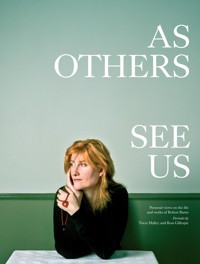
As Others See Us is based on a new photographic exhibition from Tricia Malley and Ross Gillespie, who together form the renowned partnership broad daylight. It forms part of Homecoming 2009, celebrating the 250th anniversary of Robert Burns' birth. The exhibition consists of 20 portraits of prominent and influential Scots, including Eddi Reader, Edwin Morgan, Peter Howson and Janice Galloway. The portraits capture a unique insight into the sitter, enhanced by the accompanying text, as each was asked to contribute their favourite poem from Robert Burns, and to explain why it is special to them and what they think it means to Scots today. REVIEW It is a celebration of Scottish culture, reflecting and conveying through words and pictures the work of this extraordinary man and his relevance today - not only to the people of Scotland but to a wider audience. - THE DRUM
Das E-Book können Sie in Legimi-Apps oder einer beliebigen App lesen, die das folgende Format unterstützen:
Seitenzahl: 60
Veröffentlichungsjahr: 2014
Ähnliche




















The photographers
Award winning photographers Ross Gillespie and Tricia Malley, collectively known as broad daylight, are among Scotland’s most experienced and insightful photographers. Having worked together for almost20years they have an instinctive eye for capturing the character and personality behind their subjects. Tricia’s background as a documentary photographer combined with Ross’s background as an illustrator has created a collaboration which allows art to frequently and successfully mimic life in a seriously powerful fashion.
They have produced several major bodies of portraiture work, one of which features some of Scotland’s most influential power brokers. They have an enormous capacity for empathy with their subjects and as a result get well beyond the superficial. Their portraits tell more than just the immediate story and their work is in the collections of both the Scottish National Portrait Gallery in Edinburgh and the National Portrait Gallery in London.
Their attraction to Scotland’s gritty underbelly led to commissions for the evocative front covers for Ian Rankin’s Rebus novels and a semi-autobiographical picture book entitledRebus’s Scotland… broad daylight simply understands that a picture can tell more than a thousand words.
www.broaddaylightltd.co.uk
AS OTHERS SEE USis supported by:
Homecoming Scotland
Clyde Blowers
FirstGroup Plc
The Leith Agency
broad daylight
Hasselblad
Bowens
Holyrood Magazine
The Scottish Government
Professor Walter Nimmo
Professor David W Purdie and friends
Alan McFarlane
Margaret H Duffy
Michael Staniland
Tommy Dreelan
Bruce Minto
In association with:
The Scottish National Portrait Gallery
Luath Press
The Scottish Parliament is a partnerinAS OTHERS SEE US
Tricia and Ross would like to thank the following for their advice, assistance and patience in producingAS OTHERS SEE US:
John K McGregor; Margaret H Duffy; Mrs M Gillespie; Marjory and Ian Clyde; Mandy Rhodes; Christine Mullin; Ross Hunter, Joe and Tweeter; Focus Management; Joanne Deponio at Homecoming Scotland; Professor James McGonagle; Pam Heaton; Scottish Opera; Gordon Boag and John at Kelvingrove Art Gallery and Museum; Jane Skinner at Secret Music; Paul Rigby, Andy and the team at Palacerigg Country Park; Reverend James Gibson at Bothwell Parish Church; Glasgow Botanic Gardens; Abode Hotel Glasgow; Fiona McDougall, Roy Devon and Alan Rennie at The Scottish Parliament; Christian Howes; Shepperton Studios; Avril Gill and Emma Low of FirstGroup Plc; Angela Sharkey of Clyde Blowers; Brian Coane, Bob Lovie, Nic Siegel and Alan Ainsley of The Leith Agency; Linda Fabiani MSP; Ben Boswell and Paul Waterworth at Hasselblad; Gavin MacDougall at Luath Press; Hamish Barrie; Scott Porter; Graeme Sturroch; John and Frank at Peter Howson’s studio; Julie Lawson and James Holloway at The Scottish National Portrait Gallery.
Burns texts collated by Professor David W Purdie.
And finally… all the sitters for their time, patience and co-operation.
AS OTHERS SEE USis part of the Homecoming2009celebrations
Personal views on the life and works of Robert Burns
Portraits by
Tricia Malley and Ross Gillespie
LuathPress Limited
EDINBURGH
www.luath.co.uk
First published2009
New revised edition2010
eBook 2014
ISBN (print):978-1-906817-52-7
ISBN (eBook): 978-1-909912-75-5
Design by The Leith Agency
Robert Burns by Alexander Nasmyth on page10reproduced courtesy of The Scottish National Portrait Gallery
© Tricia Malley and Ross Gillespie2009,2010
www.broaddaylightltd.co.uk
contact by email: [email protected]
Burns showed me that there was a place for me on this earth – as well as for Caesar...
John Young, Shoemaker, at the Burns Centenary, 1859
His poems and songs, first laid before his family in the farmlands of Ayrshire, were to become the property and the patrimony – of Mankind
Professor David W Purdie
Contents
ForewordJulie Lawson
As Others See Us: IntroductionProfessor David W Purdie
Janice Galloway Novelist
Edwin Morgan Scotland’s National Poet
Patrick Doyle Composer
Eddi Reader Musician, singer & songwriter
Neil Gillon Ayrshire farmer
Christopher Brookmyre Novelist
Alex Fergusson MSP Presiding Officer of the Scottish Parliament
Hardeep Singh Kohli Author & broadcaster
Peter Capaldi Actor
Aamer Anwar Human rights lawyer
Rt Hon Alex Salmond MP MSP First Minister of Scotland
Jim McColl Entrepreneur, Clyde Blowers
Denise Mina Novelist
Sir Moir Lockhead Entrepreneur, FirstGroup Plc
Sir Malcolm MacGregor of MacGregor Clan chief
Liz Lochhead Poet & playwright
Peter Howson Artist
Professor Sir Ian Wilmut Scientist
Professor Janice Kirkpatrick Designer, curator & writer
Andrew O’Hagan Novelist
Tommy Dreelan Mogul
Professor Walter Nimmo Songwriter
Alexander Stoddart HM Sculptor in Ordinary in Scotland
Kirsty Wark Television presenter and journalist
Locations
Reflections
Glossary
Foreword
Robert Burns, Scotland’s National Bard, has an unrivalled place in the affections of the people of Scotland. He is also known all over the world. His birthday on 25 January is celebrated at Burns suppers, and the words of his poem‘Auld Lang Syne’are sung in a spirit of reconciliation and friendship at the last stroke of midnight on the last day of every year on every continent. The poetry of Robert Burns, both in Scots and English, has become an important part of Scottish national identity. His personality, democratic and generous, has also become an ideal for many Scots.
The photographers Ross Gillespie and Tricia Malley have marked the Homecoming celebration by making a series of portraits of prominent Scots and adopted Scots. Each sitter has been asked to select and respond to a quotation from Burns, and to reflect upon the continued relevance of Burns in modern Scotland.
The resulting portraits and commentaries, brought together in this book, make for a celebration of contemporary Scottish culture, and a reinforcement of the values and aspirations that found their perfect expression in the poetry of Robert Burns.
Of the numerous would-be portraits of Robert Burns that have come to light over the years since his death, all but six have proved to be cases of wishful thinking, mistaken identity, copies of copies, or deliberate fakery. Only six are accepted as ‘authentic’ portraits – that is portraits known to have been painted from the life. All six are in the collection of the Scottish National Portrait Gallery. Authenticity in historical portraiture is important, not only because we can be confident about the likeness, but because when we look at such a portrait, we feel that we are looking at the face of a long-dead sitter. It is the business of the portrait to keep the dead, in some sense, alive and present.
The best known portrait of Burns is that painted by his friend Alexander Nasmyth, in 1787. It is instantly recognisable because it has been reproduced so often. As Burns himself remarked, it was as a result of this portrait and the engraving based on it, in the Edinburgh edition of the Poems, that his‘phiz’had become‘sae kenspeckle’.
Like all good portraitists, Nasmyth wanted to show more than the appearance of his subject. Ross and Tricia have carried on this tradition capturing not only a physical likeness of their sitters but also something of their essence.
Nasmyth depicted Burns as the young handsome poet – the large shining eyes denoting a man of sensibility. Trees in the background provide a setting for the man of nature; one, as he said of himself, who had‘unbounded good-will to every creature rational or irrational.’




