


70,99 €
Mehr erfahren.
- Herausgeber: John Wiley & Sons
- Kategorie: Fachliteratur
- Serie: Wiley Finance Editions
- Sprache: Englisch
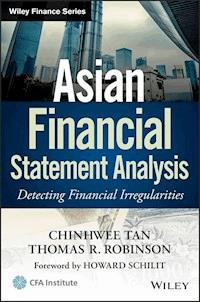
Gain a deeper understanding of Asian financial reporting and how to detect irregularities The Asian region, and particularly China, is becoming a hotbed of investment activity. There have been quite a few accounting scandals in Asia in the recent years - now rivaling those we have seen in the Americas and Europe. Assessing potential or active overseas investments requires reliance on financial statements, the full parameters of which may vary from region to region. To effectively analyze statements, it is necessary to first understand the framework underlying these financial statements and then lay out a protocol for detecting irregularities. It's impossible to create and implement a practical plan without a deeper knowledge of the various factors at play. Asian Statement Analysis: Detecting Financial Irregularities provides a framework for analysis that makes irregularities stand out. Authors Chin Hwee Tan and Thomas R. Robinson discuss international financial reporting standards, including characteristics particular to the Asian region. Tan and Robinson's combined background in academia and Asian finance give them a multi-modal perspective and position them as top authorities on the topic. In the book, they address issues such as: * Detection of irregularities independent of particular accounting rules * The most common irregularities in the Asian market * Similarities and differences between U.S. and Asian accounting techniques * An overarching framework for irregularity detection The book uses real-world examples to illustrate the concepts presented, with the focus on Asian companies. As the first ever in-depth study on manipulation and irregularities in the Asian market, Asian Financial Statement Analysis: Detecting Financial Irregularities is uniquely positioned to be a valuable resource in the move toward the next phase of global reporting standards.
Sie lesen das E-Book in den Legimi-Apps auf:
Seitenzahl: 325
Veröffentlichungsjahr: 2014
Ähnliche



















Contents
Foreword
Genesis of This Book
Acknowledgments
Introduction
Chapter 1: A Framework for Evaluating Financial Irregularities
Articulation of Financial Statements
Accruals and Deferrals
Typical Accounting Games
Parting Comments
Note
References
Chapter 2: Detecting Overstated Earnings
Aggressive Revenue Recognition
Understatement or Deferral of Expenses
Classification of Non-Operating Income
Classification of Non-Operating Expenses
Parting Comments
Case Studies
References
Chapter 3: Detecting Overstated Financial Position
Excluding Both Assets and Liabilities
Other Off-Balance-Sheet Financing/Liabilities
Overstating Assets
Parting Comments
Case Studies
Notes
References
Chapter 4: Detecting Earnings Management
Accruals and Deferrals Revisited
Accounts Receivable (Accrued Revenue) and the Allowance for Doubtful Accounts
Deferred (Unearned) Revenue
Accrued and Deferred (Prepaid) Expenses
Deferred Taxes
Contingencies and Reserves
Parting Comments
Case Studies
References
Chapter 5: Detecting Overstated Operating Cash Flows
Understanding the Cash Flow Statement
Using Cash Flow to Assess the Quality of Earnings
Cash Flow Games
Parting Comments
Case Studies
References
Chapter 6: Evaluating Corporate Governance and Related-Party Issues
Board Governance and Independent Directors
Shareowner Rights
Interlocking Ownership or Directorships
Related-Party Transactions
Excessive Compensation
Personal Use or Expropriation of Assets
Lack of Transparency
Auditor Issues
Parting Comments
Case Studies
Note
References
Chapter 7: Summary and Guidance
Putting It All Together
A Recipe for Detecting Cooked Books
Parting Comments
Case Studies
References
About the Authors
Index
End User License Agreement
List of Exhibits
EXHIBIT I.1 Chinese Stock Market Returns Have Lagged Behind GDP Growth
EXHIBIT 1.1 The Accounting Equation for Financial Statements
EXHIBIT 1.2 Balance Sheet (top), Income Statement (middle), and Cash Flow Statement (bottom)
EXHIBIT 1.3 Increase in Revenue
EXHIBIT 1.4 Balance Sheet Impact
EXHIBIT 1.5 Common Accruals and Deferrals
EXHIBIT 1.6 Categories for Accounting Scandals
EXHIBIT 1.7 Overstating Revenues or Gains
EXHIBIT 1.8 Understating Expenses or Losses
EXHIBIT 1.9 Potential Balance Sheet Impacts
EXHIBIT 1.10 Moving Gains “Up” the Income Statement
EXHIBIT 1.11 Moving Expenses “Down” the Income Statement
EXHIBIT 1.12 Overstating Financial Position on the Balance Sheet
EXHIBIT 2.1 Income Statement Games
EXHIBIT 2.2 Income Statement Impact of Increased Revenue
EXHIBIT 2.3 Balance Sheet Impact of Increased Revenue
EXHIBIT 2.4 Impact of Overstating Earnings on Balance Sheet
EXHIBIT 2.5 Understating Expenses or Losses on the Income Statement
EXHIBIT 2.6 Shifting Gains on the Income Statement
EXHIBIT 2.7 Shifting Expenses on the Income Statement
EXHIBIT 2.8 Checklist of Warning Signs and Analysis Techniques
EXHIBIT 3.1 The Balance Sheet Accounting Equation
EXHIBIT 3.2 Common Balance Sheet Accounting Games
EXHIBIT 3.3 Balance Sheet Impact
EXHIBIT 3.4 International Financial Reporting Standards Treatment of Assets
EXHIBIT 3.5 Checklist of Warning Signs and Analysis Techniques for Overstating Financial Position
EXHIBIT 4.1 Common Accruals and Deferrals
EXHIBIT 4.2 APAI, Inc. Balance Sheet July 2013
EXHIBIT 4.3 APAI Taxable Income and Taxes Payable
EXHIBIT 4.4 APAI Reported Financial Statements
EXHIBIT 4.5 Checklist of Warning Signs and Analysis Techniques for Earnings Management
EXHIBIT 5.1 Hypothetical Company Cash Flow Statement for the Month Ended 31 January 2013
EXHIBIT 5.2 Hypothetical Company Cash Flow Statement for the Month Ended 31 January 2013
EXHIBIT 5.3 Cash Flow Warning Signs
EXHIBIT 6.1 Checklist of Warning Signs and Analysis Techniques
EXHIBIT 7.1 Articulation of Financial Statements
EXHIBIT 7.2 Master Checklist of Warning Signs and Analysis Techniques
Pages
ii
iii
iv
v
vi
xi
xii
xiii
xiv
xv
xvi
1
2
3
4
5
6
7
8
9
10
11
12
13
14
15
16
17
18
19
20
21
22
23
24
25
26
27
28
29
30
31
32
33
34
35
36
37
38
39
40
41
42
43
44
45
46
47
48
49
50
51
52
53
54
55
56
57
58
59
60
61
62
63
64
65
66
67
68
69
70
71
72
73
74
75
76
77
78
79
80
81
82
83
84
85
86
87
88
89
90
91
92
93
94
95
96
97
98
99
100
101
102
103
104
105
106
107
108
109
110
111
112
113
114
115
116
117
118
119
120
121
122
123
124
125
126
127
128
129
130
131
132
133
134
135
136
137
138
139
140
141
142
143
144
145
146
147
148
149
150
151
152
153
154
155
156
157
158
159
160
161
162
163
164
165
166
167
168
169
170
171
172
173
174
175
176
177
178
179
180
181
182
183
184
185
186
187
188
189
190
191
192
Guide
Cover
Table of Contents
Begin Reading
CFA Institute is a global community of investment professionals dedicated to driving industry-wide adoption of the highest ethical and analytical standards. Through our programs, conferences, credentialing, and publications, CFA Institute leads industry thinking, helping members of the investment community deepen their expertise. We believe that fair and effective financial markets led by competent and ethically-centered professionals stimulate economic growth. Together—with our 112,000 members from around the world, including 100,000 CFA charterholders—we are shaping an investment industry that serves the greater good.
www.cfainstitute.org
ASIAN FINANCIAL STATEMENT ANALYSIS
Detecting Financial Irregularities
ChinHwee Tan, CFA, CPA
Thomas R. Robinson, CFA, CPA
Cover image: (top) © iStockphoto.com/loveguli (bottom) © iStockphoto.com/IS_ImageSource
Cover design: Wiley
Copyright © 2014 by CFA Institute. All rights reserved.
Published by John Wiley & Sons, Inc., Hoboken, New Jersey.
Published simultaneously in Canada.
No part of this publication may be reproduced, stored in a retrieval system, or transmitted in any form or by any means, electronic, mechanical, photocopying, recording, scanning, or otherwise, except as permitted under Section 107 or 108 of the 1976 United States Copyright Act, without either the prior written permission of the Publisher, or authorization through payment of the appropriate per-copy fee to the Copyright Clearance Center, Inc., 222 Rosewood Drive, Danvers, MA 01923, (978) 750-8400, fax (978) 646-8600, or on the Web at www.copyright.com. Requests to the Publisher for permission should be addressed to the Permissions Department, John Wiley & Sons, Inc., 111 River Street, Hoboken, NJ 07030, (201) 748-6011, fax (201) 748-6008, or online at www.wiley.com/go/permissions.
Limit of Liability/Disclaimer of Warranty: While the publisher and author have used their best efforts in preparing this book, they make no representations or warranties with respect to the accuracy or completeness of the contents of this book and specifically disclaim any implied warranties of merchantability or fitness for a particular purpose. No warranty may be created or extended by sales representatives or written sales materials. The advice and strategies contained herein may not be suitable for your situation. You should consult with a professional where appropriate. Neither the publisher nor author shall be liable for any loss of profit or any other commercial damages, including but not limited to special, incidental, consequential, or other damages.
For general information on our other products and services or for technical support, please contact our Customer Care Department within the United States at (800) 762-2974, outside the United States at (317) 572-3993, or fax (317) 572-4002.
Wiley publishes in a variety of print and electronic formats and by print-on-demand. Some material included with standard print versions of this book may not be included in e-books or in print-on-demand. If this book refers to media such as a CD or DVD that is not included in the version you purchased, you may download this material at http://booksupport.wiley.com. For more information about Wiley products, visit www.wiley.com.
ISBN 978-1-118-48652-8 (Hardcover)
ISBN 978-1-118-54259-0 (ePDF)
ISBN 978-1-118-48665-8 (ePub)
ChinHwee Tan
To my wife and fellow Chartered Accountant, Michelle Lee—for your constant urging during our university days to study accounting harder, without which this book would never have been written. Thank you for being a good wife and mother to our three lovely children, Brian, Kylie, and Sarah; may they learn the importance of integrity and the dangers of cutting corners from this book.
To my parents, for exposing their children to education in the broadest sense. Your holistic parenting in spite of our financial limitations imbued us with the confidence and abilities to pursue our dreams, be they in the arts or finance.
To my business partner, Girish Kumar, and my colleagues at Apollo Global Management, for their support, and more importantly, our friendship.
Finally, to the many humbling experiences throughout my career, including my first credit default during the Asian Financial Crisis in 1998. Thank you for the perceptiveness and appreciation that learning is a lifelong endeavor.
Thomas R. Robinson
To my wife, Linda, and my late father, Clarence E. Robinson.
To the accounting faculty at Case Western Reserve University that shaped my early thinking on accounting and the importance of high ethical conduct, including but not limited to Gary Previts, Rob Kauer, Tom Sturgis, and Larry Phillips.
To my former colleagues at Deloitte and University of Miami who helped further refine and shape my thinking on the topics in this book, particularly Paul Munter, Kay Tatum, Oscar Holzmann, and Elaine Henry.
Last but not least, to the authors of books required in the CFA curriculum that demonstrated how to practically apply accounting knowledge in evaluating financial statements, including Gerald White, Tony Sohndi, and Howard Schilit.
FOREWORD
Asian Financial Statement Analysis is an important work and a welcome addition to the discipline of forensic accounting and detection of accounting anomalies in financial reports. Tan and Robinson’s major contribution is to show, through recent actual vignettes, how the tricks are played out in Asian companies. Unlike many companies based in the West with a longer tradition (and rules) concerning strong corporate governance, Tan and Robinson show that investors must be even more vigilant in performing due diligence on Asian companies that unfortunately often engage in non-arm’s-length transactions.
The book is written clearly for a non-technical audience, providing (1) user-friendly checklists to be adopted by any securities analyst; (2) lessons to be learned by studying the frauds at Satyam, Sino-Forest, and Olympus, among others; and (3) reviews at the end of each chapter that highlight key lessons learned.
Analysts, auditors, and other stakeholders also benefit by learning lessons from colossal financial reporting failures at companies. Tan and Robinson have provided readers a great service by studying debacles at the often less-studied Asian companies and writing this book, which shares the lessons from such debacles.
Dr. Howard M. Schilit
CEO of Schilit Forensics, LLC
Author of Financial Shenanigans: How to Detect
Accounting Gimmicks & Fraud in Financial Reports
Lesen Sie weiter in der vollständigen Ausgabe!
Lesen Sie weiter in der vollständigen Ausgabe!
Lesen Sie weiter in der vollständigen Ausgabe!
Lesen Sie weiter in der vollständigen Ausgabe!
Lesen Sie weiter in der vollständigen Ausgabe!
Lesen Sie weiter in der vollständigen Ausgabe!
Lesen Sie weiter in der vollständigen Ausgabe!
Lesen Sie weiter in der vollständigen Ausgabe!
Lesen Sie weiter in der vollständigen Ausgabe!
Lesen Sie weiter in der vollständigen Ausgabe!
Lesen Sie weiter in der vollständigen Ausgabe!
Lesen Sie weiter in der vollständigen Ausgabe!
Lesen Sie weiter in der vollständigen Ausgabe!




