


18,49 €
Mehr erfahren.
- Herausgeber: The History Press
- Kategorie: Geisteswissenschaft
- Sprache: Englisch
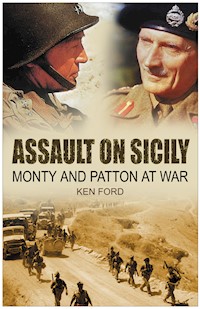
On the night of 9/10 July 1943, an Allied armada of 2,590 vessels launched one of the largest combined operations of the Second World War - the invasion of Sicily, Operation 'Husky'. Over the next thirty-eight days, half a million British, Canadian, American and French soldiers, sailors, and airmen grappled with their German and Italian counterparts for control of this rocky outcrop of Hitler's 'Fortress Europe'. The Allied assault on Sicily featured airborne and amphibious landings; mountain warfare; international rivalry; poorly performing troops; tenacious German resistance; and, improvements in tactical air support and the ultimate Allied victory on the island. Almost the whole of the progress of the Second World War is illustrated by this one campaign. It was the only action where the whole Allied war effort was brought to bear on a single objective, with one army commanded by Patton and one army commanded by Montgomery. Both men were insufferable egoists and insubordinate commanders; they always chose to do their own thing, regardless of others' sensibilities and always with one eye on how history would see them.The seeds of rivalry between these two key Allied commanders that were sown in the Sicily campaign eventually grew to fruition in the battles for Normandy and the Ardennes.
Das E-Book können Sie in Legimi-Apps oder einer beliebigen App lesen, die das folgende Format unterstützen:
Veröffentlichungsjahr: 2007
Ähnliche




















ASSAULT ON SICILY
ASSAULT ON SICILY
MONTY AND PATTON AT WAR
KEN FORD
First published in 2007
The History Press The Mill, Brimscombe Port Stroud, Gloucestershire, GL5 2QGwww.thehistorypress.co.uk
This ebook edition first published in 2013
All rights reserved © Ken Ford, 2007, 2013
The right of Ken Ford to be identified as the Author of this work has been asserted in accordance with the Copyrights, Designs and Patents Act 1988.
This ebook is copyright material and must not be copied, reproduced, transferred, distributed, leased, licensed or publicly performed or used in any way except as specifically permitted in writing by the publishers, as allowed under the terms and conditions under which it was purchased or as strictly permitted by applicable copyright law. Any unauthorised distribution or use of this text may be a direct infringement of the author’s and publisher’s rights, and those responsible may be liable in law accordingly.
EPUB ISBN 978 0 7524 9595 8
Original typesetting by The History Press
Contents
List of Maps
Acknowledgements
Introduction
1.
The Two Generals
2.
Planning the Invasion
3.
Final Plans
4.
Preparations
5.
The Defenders
6.
Invasion: The Airborne Landings
7.
Invasion: The British Landings
8.
Invasion: The American Landings
9.
The Second Day – 11 July
10.
The Third Day – 12 July
11.
Primosole Bridge and the Commando Landings
12.
Monty’s Plan Stalls
13.
Missed Opportunities
14.
The Fall of Mussolini
15.
Breaking the German Line
16.
Whose Victory?
Notes
Bibliography
List of Maps
1
The Mediterranean Theatre
2
Operation ‘Husky’: Original Combined Chiefs of Staff Plan, January 1943
3
Operation ‘Husky’: The Final Plan and Positions of Axis Forces on Sicily
4
British Eighth Army Landings
5
US Seventh Army Landings
6
British Eighth Army Moves up Highway 124 across the American Line of Advance
7
US Seventh Army’s Drive to Palermo
8
The End of the Campaign
9
The Great Escape: Axis Ferry Routes Across the Messina Strait
Acknowledgements
The National Archives at Kew (formerly the Public Record Office) is a great repository of Second World War documents. A student of military history can be overwhelmed by the sheer volume of this resource material from all the theatres over which the conflict was fought, but diligent study and perseverance can eventually track down some remarkable papers. The following categories of records at Kew were found to be the most useful in compiling this book: (PRO) WO214 (Alexander Papers); (PRO) WO169 (Eighth Army War Diaries) and (PRO) CAB 44 and CAB 106 (Historical Section). Thanks are given to The National Archives for the use of this Crown Copyright material and to the Trustees of the Imperial War Museum for permission to reproduce the photographs for which they own the copyright.
Introduction
I was born just at the end of the Second World War and therefore have no personal recollections of the conflict. What I do have through my writing, however, is an insight into the experiences of those who lived through it. I have lost count of the number of veterans of the struggle, British, American and German, that I have met and interviewed over the past twenty-five years, each of whom had very definite opinions about a wide range of events, personalities and decisions that shaped the course of the war.
Most veterans have a high estimation of their own country’s efforts and more than a little disregard for those of other nations, especially their allies. The same is true of their opinions regarding commanders. Prime amongst these are the differences between the soldiers of the two major western Allies, Great Britain and the USA. In Britain, Field Marshal Bernard Montgomery is recognised as the greatest Allied battlefield commander, while in America the vote goes to the audacious General George Patton Jr. If these nation’s veterans are asked to comment on the choice of the other, the results are equally dismissive: in Britain, Patton is seen as a loose cannon, bombastic and arrogant, whose greatest advances were made against sparse enemy forces; in the USA, Montgomery is regarded as being a safe but over-rated general whose victories were achieved only after a slow, ponderous build-up of such strength that defeat was unlikely, if not impossible. Twenty-five years ago my own views similarly ran along nationalistic lines; now they tend to be more pragmatic.
The British people admired Montgomery, for he had given them a great victory at El Alamein in November 1942 when victories were extremely difficult to come by. His success against Rommel in the North African desert coincided with an uplift in British fortunes: Hitler’s forces were facing a disaster at Stalingrad in Russia and vast quantities of men and matériel were starting to cross the Atlantic from the USA. Monty’s triumph in Egypt marked a turning point in the war which led Churchill later to remark: ‘Before Alamein we never had a victory, after Alamein we never had a defeat.’ At the time of the invasion of Sicily in July 1943, Montgomery was the most famous and successful of all Allied commanders.
Loved and admired as he was by the whole nation, Montgomery was actually liked by very few who knew him. Of course most of his fellow commanders had a high regard for him as a leader of men and recognised his first-class grasp of tactics and his ability to organise and train great formations, but his prickly personality caused hostility and resentment. Montgomery was arrogant, boastful and conceited. He dismissed personal criticism of him as being uniformed, made by lesser men who lacked his capabilities. He related at every opportunity how he had beaten Rommel and made his army the best in the world, capable of matching any enemy in the field. He was adamant that the decisions he made in battle were correct and later wrote that every one of his campaigns and actions had turned out just as he had planned, even though events had shown otherwise. All these negative aspects were hidden from the public because the publicity surrounding him was all positive
By the end of the war, Patton had achieved a similar reputation as a battlefield commander. He was a hero to many back in the USA and a villain to a few in the war zone, where his blustering manner and sharp tongue put subordinates in fear of his wrath. In action it was a different story: his aggressive tactics and the wide-sweeping movements of the forces under his unique style of command tore apart great swathes of enemy territory during the war in north-west Europe. Patton was able to supply the American people with victory after victory. He grabbed the headlines and loved every minute of the fighting. Much earlier, back in 1943 at the time of the invasion of Sicily, Patton had yet not achieved this public recognition. The cult of ‘Patton the hero’ was yet to be moulded and he started the campaign as just another, albeit very prominent, senior commander. He went into the Sicilian landings without the legendary status he was to earn later, since up until then his exploits during the invasion of North Africa in November 1942 were against just a few French colonials, and his short tenure of US II Corps during the fighting in Tunisia had earned him only minor headlines. It was the campaign in Sicily that was to shoot him to world prominence.
The Second World War was fought in the first media age, when the combined materials of photographs, film and the radio enabled people at home to follow battlefield events more closely than ever before. By these means both Patton and Montgomery were able to acquire such public acclaim that they eventually became the leading actors in the Allied war effort. Patton deliberately cultivated his image of a swashbuckling military hero. His public persona was of daring general with a fearless, larger-than-life, reputation. He massaged this perception by never missing an opportunity to be photographed close to the action and by having reporters with him wherever he went. Like Patton, Montgomery also courted personal publicity, but his image was more that of a quiet, professional and very competent soldier. He liked to give the impression of being a methodical, all-conquering general who had the complete measure of his enemy.
Almost all of the senior American commanders who came into contact with Montgomery had negative opinions of him. His aloof and condescending attitude caused much resentment. Monty was disdainful of the effectiveness of American troops during their first actions in Tunisia. Like the British back in 1940, it took some time for the American doughboys to hone their battle skills. Their first hostile encounter with German soldiers came as a shock and showed up shortcomings in tactics, command and supply. Then US II Corps’ ignominious debacle at Kasserine in February 1943 dented their confidence and their pride. Changes were made and a more ruthless approach to combat followed. The arrival of George Patton at II Corps HQ shook the formation out of its lethargy and set it on the path of recovery. As the campaign in Tunisia wore on, the fighting efficiency of US troops improved considerably.
By the time of the Sicilian invasion in July 1943, there was still an air of superiority about British attitudes to American fighting prowess. Montgomery in particular had a low opinion of the Allied Supreme Commander in North Africa, Gen Dwight Eisenhower, which for the most part was based on the fact that Eisenhower had never held a combat command. ‘He is a nice chap,’ he wrote to a colleague a short time after meeting the American general, ‘but his knowledge of how to make war, or to fight battles, is definitely NIL.’ Montgomery’s boss in North Africa, Gen Harold Alexander, also shared the opinion that the Americans in 1943 were not up to the required standard, although he did not agree with Monty’s assessment of Eisenhower. In the campaign in Sicily, this mistrust of American capabilities influenced many of Alexander’s strategic decisions which in turn led to wasted opportunities. It was not until Patton personally insisted that his troops be given a more active combat role in the campaign to show just what they were capable of, that these entrenched attitudes among the British began to change.
Patton’s Anglophobic leanings led him to believe that he had little to learn about fighting the Germans from the British. He had intense pride in his American soldiers and knew that if they were properly led they were more than a match for any enemy. Patton did not think that the British could teach him anything about war and was suspicious of their motives in all that they suggested. His diaries are full of angry outbursts regarding British attitudes and the open desire they displayed to run the war to their advantage. Like many Americans, Patton saw Britain as an imperial power bent on shaping the postwar world to its own needs. Patton was furious with Eisenhower for seeming to be in their pocket, giving way to all British demands even when they went against American interests. Montgomery’s uncompromising attitude towards the Americans only exacerbated Patton’s paranoia.
At the time of the Sicilian invasion, all of these underlying suspicions led to both parties often shaping their strategies along nationalistic lines. This led to some strange, and sometimes frankly ludicrous, decisions. Fortunately, this was not the whole picture and there were commanders and men of influence in the Allied camp who realised that they were fighting as a coalition with the ultimate aim of destroying Nazi Germany. For the most part sound common sense ruled the day. Differences were set aside sufficiently well to enable the two great Allies in the Mediterranean to concentrate on an overall policy which ultimately led to victory, but it was not an easy ride.
All of the major players in the Sicilian campaign are now dead. Their memoirs were published many years ago and each of them was written to some personal agenda. The truth is always difficult to discover, for the story of how a battle was fought can be re-written after the event. Historians, most of whom have never had to face the ordeal of being under fire, are able to take a more detached view of the war, relying on paper records to interpret the struggle. They can re-assess at leisure the choices made under duress in the heat of the battle. One thing, however, remains unchanged: the signals sent by commanders at the time stay as they were written. I have tried to use these signals, now housed in The National Archives at Kew (formerly the Public Record Office) to construct my own interpretation of how some of the decisions regarding the Sicilian campaign were arrived at. Not everyone will necessarily agree with me, but these records are openly accessible to all and enable individuals themselves to come to their own conclusions.
Ken Ford
Southampton,
October 2006
CHAPTER 1
The Two Generals
In bright spring sunshine on 14 February 1943, Lieutenant General George S. Patton Jr boarded a B-17 bomber aircraft bound for Tripoli. He left the Tunisian battlefield to fly east to hear Britain’s most famous general give an address on how he had outwitted Germany’s most famous general in the Battle of El Alamein. The next day in Tripoli Patton sat through the two-hour lecture on ‘How to Make War’, given by General Bernard Law Montgomery.
The talk started with Montgomery announcing that there would be no smoking allowed during his lecture which immediately infuriated the chain-smoking Patton who took out a packet of gum. Unimpressed by the monotonous clipped tones of the British general explaining how he had beaten Generalfeldmarschall Rommel, Patton spent the time chewing and yawning. When the gathering broke for lunch, one of Monty’s corps commanders, the amiable Lt-Gen Brian Horrocks, chatted with Patton and asked him what he thought of his master’s talk. ‘Well,’ Patton replied dismissively, ‘I may be old, I may be slow, I may be stoopid, but it just doan mean anything to me!’1 Back in his caravan that night, Montgomery wrote to his boss in London, Gen Alan Brooke, Chief of the Imperial General Staff: ‘The party from Tunisia was very disappointing . . . only one American general has come; an old man of about 60.’2
George Patton, hero of the Moroccan landings of Operation ‘Torch’, had met Bernard Montgomery, hero of the desert, and neither of them appeared to be impressed with the other. More than two years later at the war’s end, after each of them had further enhanced his reputation as a battlefield commander, their opinions of each other had changed little. Immense self-belief in their own military prowess could only find fault with the performance of the other. Their eccentric natures and love of soldiering allowed neither of them to subscribe to many of the common views held by others as to how battles should be fought.
Montgomery and Patton were made for war. Both were blessed with great ability and blighted by considerable conceit. Both were regular soldiers who had made the military not just a career, but their life’s work. They lived to command men and fight battles in their own way, each believing implicitly in his own methods and ideas. Few others ever came up to their own exacting standards; to them virtually all other commanders were to be found wanting in some virtue or other. Both had a sense of history and wished to be seen as being utterly unique. They were insufferable.
The source of the later antagonism between the two generals can be traced back to the invasion of Sicily in July and August 1943 when their armies first fought together as Allies in what should have been a campaign to evict Axis forces from the island. As the battle progressed, there was as much personal quest for glory in their actions as there was determination to annihilate German and Italian formations. While Montgomery and Patton manoeuvred to have their own troops be the first to enter Messina, the enemy slipped away to fight another day.
The campaign in Sicily was the crucible from which developed the future conduct of the war. During this short struggle, just thirty-eight days long, the Allies began to forge an administration that would eventually carry them to victory. It was here that Allied tactics, procedures and support finally came together to formulate the means to carry the fight back to the mainland of Europe. It was also in Sicily that personal relationships would form that would affect the manner and speed of victory.
George Smith Patton Jr was born on 11 November 1885 in the family home near Los Angeles in California. Both of his parents came from well-to-do backgrounds. George’s father was a lawyer, the elected district attorney of Los Angeles County. Home life was idyllic on the family’s 1,000-acre ranch where his loving father spent a great deal of time teaching the young Patton to ride, swim, shoot, hunt and fish. From a very early age George Patton Junior realised that he wanted to be a soldier and follow in the footsteps of his predecessors. His grandfather and seven of his uncles had served as officers in the Confederate Army.
Patton attended the Virginia Military Institute for a year and then went on to West Point. He was a very bright and intelligent scholar, but suffered from what we now know to be dyslexia. He found it very difficult to read and write in his early years and never fully mastered the arts of spelling and mathematics. His studies at West Point were arduous as he struggled to keep up with fellow pupils. His enthusiasm for all matters military, however, never waned and he was always top for military discipline and deportment.3
After graduating in 1909, he was commissioned as a 2nd lieutenant into the 15th Cavalry. His physical condition and his commanding height – he was over six feet tall – led him to excel in sports. He drove himself hard and became accomplished in a range of outdoor activities including swimming, riding, fencing, shooting and polo. He was also good at track events and represented the USA in the military pentathlon at the 1912 Olympic Games in Stockholm. Two years previously he had married Beatrice Dyer, the daughter of a rich industrialist.
Bernard Law Montgomery was born in London in 1887. He was the son of a clergyman who later became the Bishop of Tasmania. Montgomery was the fourth of nine children and spent an unhappy childhood at the hands of a very strict mother. His unruly ways invariably earned some censure; his mother was often heard to remark: ‘Go and find out what Bernard is doing and tell him to stop it.’4 Montgomery attended St Paul’s School in London where his performance was below average, but it bucked up somewhat when he learned that he would have to pass a competitive examination to get into the Royal Military College Sandhurst, for he was desperate to become a soldier. By sheer hard work and application he managed to pass the examination to enter the college. After some eighteen months of study he received a commission into the Army in 1908.
The young subaltern entered the Royal Warwickshire Regiment and soon joined his battalion in India. For the next six years he spent a dispiriting time in the colonial outpost surrounded by officers prematurely tired by the climate and the staid conditions of military service. ‘As for the officers,’ he was later to write, ‘it was not fashionable to study war and we were not allowed to talk about our profession in the Officers’ Mess.’5 His battalion returned to England in 1913 shortly before the start of the Great War. When hostilities broke out he was sent to France and arrived just after the British Expeditionary Force began its retreat from Mons. He was seriously wounded after just two months in battle and was awarded the Distinguished Service Order for his actions. Monty was shipped back to England to recover from his wounds, before once again returning to the front in 1916 as Brigade Major of 104th Infantry Brigade. For the remainder of the war he served in various staff positions and by the war’s end he had risen to Chief of Staff of 47th Division.
In 1916 the young Patton served with Gen Pershing in the skirmishes along the Mexican border against the followers of Pancho Villa and proved himself to be an expert marksman with the Colt revolvers he always had strapped to his waist. In later years these ivory-handled guns became something of a symbol and Patton liked being photographed with the weapons firmly buckled around him. During the Great War Patton served for a time in Gen Pershing’s HQ in France, then moved to the newly formed Tank Corps where he set up a tank training centre. He later commanded the 1st Brigade of the corps as a full colonel during the Meuse-Argonne campaign of 1918 and was awarded America’s second-highest award, the Distinguished Service Cross, for bravery on the battlefield. After the war Patton became one of the USA’s leading specialists in tank warfare and championed the cause of armoured tactics while the bulk of the US Army was still dominated by the cavalry.
Patton was a great military thinker and a well-read student of history; he spent a good deal of his time studying past wars. From his entire enquiry he came to the conclusion that it was the commander himself that was the greatest influence on how a battle was won or lost. He felt that a commander should influence every encounter on the battlefield by his presence and by gaining the trust of his troops. Patton made it his objective to be seen by his men wherever the action was the greatest and to inspire them to success.
Between the wars, in an ever-shrinking American Army, Patton idled away the time playing polo and pursuing a range of sports during his various tours of duty. During these inter-war years, the USA was gradually turning towards isolationism and had little use for a large tank arm. In the late 1930s, this opinion started to change as European armies began experimenting with the tank as an offensive weapon rather than as just a support for infantry. After the start of the Second World War and the exploits of the German panzers in Poland and France, it became clear that America needed an armoured force of its own. Patton was one of the few experienced officers in that field so he was naturally called to Washington and appointed to command the 2nd Armored Brigade at Fort Benning; he was 55 years of age.
After the Great War, Montgomery served as an instructor at Sandhurst and in 1927 married the widow of an officer killed at Gallipoli in 1915. A son was born in 1928, but the marriage lasted just a short ten years and ended when his wife died of blood poisoning after an insect bite. The loss was a great blow to Montgomery and he now completely devoted himself to his profession. The austere Montgomery had few interests outside the military, neither did he drink or smoke or indulge in any social activities. The Army was his entire life. He was promoted to major-general in 1938 to command British forces quelling an uprising by Arabs in Palestine before returning to England to take over the 3rd Infantry Division three days before the start of the Second World War.
Soon Montgomery found himself in France as part of the British Expeditionary Force (BEF). This time, however, he had the chance to acclimatise with his division before the German blow fell. Montgomery was able to exercise his formation and train it to the peak of efficiency before it was called into action. He rooted out any doubtful subordinate commanders and replaced them with those who were compatible with his way of thinking. When the German Blitzkrieg finally broke across the British and French armies in May 1940, Monty’s 3rd Division performed with merit, but the Allies were unable to hold the massive enemy onslaught and the their forces fell back to the coast. For a while it looked as though the BEF would be annihilated. As disaster loomed, changes were made in the British high command which resulted in Monty taking over Lt-Gen Alan Brooke’s II Corps and helping to organise the British withdrawal via Dunkirk. Lt-Gen Harold Alexander did likewise with British I Corps.
Monty’s performance was noted in high places and he was earmarked for future promotion. A corps command in southern England followed and then, in December 1941, Montgomery was appointed to command South-Eastern Army. By this time he had very definite views on the conduct of affairs, insisting that all troops must be physically fit, well trained and their officers competent in all aspects of warfare. He did not tolerate any underachievement in his officers; all had to pass his meticulous examination of their ability. His prickly personality had by then created many detractors and much criticism, but all units serving under his command made great improvements in efficiency and effectiveness. Churchill met Monty while he was serving as a corps commander and was not impressed enough to single him out as being destined for high command. Alan Brooke, by then Chief of the Imperial General Staff, thought differently.
During this same period Patton rose to command 2nd Armored Division and then, in April 1942, I Armored Corps. He trained and exercised these formations with a fanatical zeal which tried hard to simulate the actual conditions of war and in so doing created a great personal reputation as an aggressive and forceful commander and gained the nickname ‘old blood and guts’. Patton was fortunate to have friends in high places, for both the retired but still influential Gen Pershing and the Chief of Staff of the US Army, Gen George Marshall, both admired his ability.
In the third year of the war, Montgomery’s career surged forward through a stroke of extremely bad luck for a fellow general. The campaign in North Africa, against Axis forces including Gen Erwin Rommel’s Afrika Korps, had gone from bad to worse for the British with defeat following defeat. Prime Minister Churchill had decided that there needed to be a shake-up in command in the Middle East, and in particular a new leader for Eighth Army. Gen Claude Auchinleck was to be replaced as Commander-in-Chief, Middle East, by Gen Alexander and Churchill’s suggested that Lt-Gen William Gott, already serving in North Africa as a corps commander, should take over as head of Eighth Army, although Brooke favoured Montgomery for the role. Churchill got his own way and Gott was given the post. Misfortune then befell Gott when his plane was shot down en route and he was killed. In stepped Montgomery at what was a crucial time in the progress of the war.
Britain was at low ebb and desperately needed a victory. Montgomery gave the country one in the Battle of El Alamein in October/November 1942 when he defeated Rommel’s army and put it to flight. His arrival at the head of Eighth Army transformed the morale of the troops and weeded out the dead wood among its commanders. He refused to attack the enemy until his army was numerically stronger than Rommel’s, despite constant urging and great criticism from Churchill. He was the master of the big build-up and set-piece attack and displayed this admirably in the desert at Alamein. With this one triumph Montgomery was catapulted to national and international fame. It was, for Britain, a turning point in the war and was the last great victory achieved solely by British Empire forces before American troops entered the conflict in Europe and North Africa.
When America declared war in December 1941, its politicians and military quickly looked for a theatre in which to commit their as yet untried forces. An attack across the English Channel was deemed to be too hazardous at that time and so, for a variety of reasons, it was decided that an Anglo-American force would be landed in north-west Africa in November 1942 to engage Axis forces.
Operation ‘Torch’, as the invasion was called, began with three landings – at Casablanca, Oran and Algiers – followed by a drive into Tunisia to seize all of French North Africa. Gen Dwight D. Eisenhower was appointed Supreme Commander for the invasion and his forces were grouped under the British Gen Kenneth Anderson in First Army. Patton led the Western Task Force with his I Armored Corps HQ and formed a successful beach-head in Morocco. Little real resistance was met at any of the landings, but when Allied forces moved into Tunisia they found that Axis troops had taken over the country. From then on a desperate struggle developed which lasted until May of the following year.
After Montgomery had routed Axis forces at El Alamein, Rommel led his troops back across North Africa with the British snapping at his heels. Monty never managed to overtake the elusive German field marshal, nor pin him down in another decisive battle, even though British forces out-numbered the enemy by a large margin. At places of Rommel’s choosing, he would turn on Eighth Army and make a stand. Montgomery then waited, built up his strength and attacked. Rommel stood for a while, inflicted a bloody nose on Monty’s army, and then pulled out to continue his retreat towards a link-up with German forces in Tunisia.
The battle for Tunisia took place during a cold wet winter over broken terrain and high mountains. The country was vast and barren and it required a good number of men to try to hold down the elusive enemy. First Army performed adequately, but at no time did it have enough men to do what was expected of it; nowhere did it hold more than isolated positions surrounded by wide open spaces and never was it able to take command of the enemy. The result was a gradually grinding down of men, equipment and morale. The Americans had a cruel baptism into action and took a great deal of time to hone their offensive capabilities. When Rommel arrived in the north of the country, with British Eighth Army in close pursuit, he failed to be intimidated by the fact that the Allies were both in front and behind him. Aggressive as ever, instead of remaining on the defensive, he resorted to the attack and turned on the American sector of the line. Rommel launched a brilliantly executed drive through the mountains and inflicted a very costly defeat on Eisenhower’s forces at Kasserine. American troops of Lt Gen Lloyd Fredendall‘s US II Corps broke and ran and it took some time for order to be restored. British troops were called in to help stop the rot, most notably 6th Armoured Division, in an action which helped to reinforce the idea that the Americans were still short of what was needed to counter the Germans. The failure at Kasserine influenced British opinion into thinking that the US troops and their commanders were inferior.
Eisenhower decided that II Corps needed a new leader with drive to instil some order and pride into the formation and sent George Patton into Tunisia to do the job. Patton’s arrival at II Corps HQ was like a whirlwind; every man in the formation was in no doubt that the top management had been changed. He drove up in a cavalcade of cars, sirens howling, flags streaming, in a cloud of billowing dust. Patton, as ever, was immaculately dressed, helmet highly polished and armed with his ivory-handled revolvers strapped around his waist. He breezed into the headquarters and immediately began to impose his will on all inside. Strict discipline, full Army protocol, smart dress and everything by the book was the order of the new regime. Patton gave an intimidating exhibition of personal leadership to the officers and men of II Corps. He required everyone, officers and enlisted men, to salute smartly, to button buttons, to shave daily and to wear neckties in action. Steel helmets were to be worn at all times by everyone in the corps area, even the nurses in field hospitals. Fines would be imposed on anyone, regardless of rank, who was caught flouting these orders. No one was in doubt that Patton had arrived and everyone hated him.
In contrast to the strict code imposed by the American martinet, Montgomery had a very relaxed attitude to dress. Unique in the British Army, the officers and men of Eighth Army could dress how they pleased. It was common to see a variety of attire on display from silk scarves to bush hats. Montgomery was intent on producing an impression within Eighth Army that labelled it as being special. He made sure that every man in his army had sight of him and felt that they knew him. Fired up by their great victory at Alamein, morale among the officers and men was high. Monty used the press and newsreels to foster a belief that Eighth Army had the measure of the enemy and victory would surely follow victory until the end of the war. Monty was of a like mind; his doctrine was never to attack unless he was sure of success. Once he had built this aura around him as the greatest battlefield commander the British had, he was never about to let it slip. Monty and his army were famous and his men loved him for it.
Patton’s performance in Tunisia with US II Corps started slow and success was hard to come by. It took time before significant accomplishments followed. On 15 April 1943, after five weeks of battle and a restoration of American pride, Patton handed the corps over to Maj Gen Omar Bradley and left to concentrate on a new task that had been placed before him. Eisenhower had given him command of American forces earmarked to land in Sicily once North Africa had been cleared of the enemy. Patton was now to help plan the attack and train the formations allocated to carry it out. He left behind a corps of troops who knew his name, but were unimpressed by his blustering manner and over-the-top theatricals. The officers and men who had served under him basically hated his guts. The cult of Patton the great general had yet to be born. In the meantime, Montgomery continued with the increasingly difficult task of pushing the enemy into the final trap that was to be sprung about them by Anderson’s Anglo-American First Army in Tunisia, while at the same time considering how he might land alongside Patton in Sicily with the British contingent of the invasion.
The Mediterranean Theatre, 1943
CHAPTER 2
Planning the Invasion
Early in 1943, with events in Tunisia moving towards a victory, it was necessary for Britain and the USA to establish future strategy. After the conquest of North Africa, and the elimination of all Axis forces, what was to be their next move? The Americans, most notably their Chief of Staff Gen George Marshall, favoured a cross-Channel invasion in 1943 to strike at Germany along the shortest route: maximum force aimed at the principal enemy. Any other venture, they considered, would be just a diversion that would weaken the main event. Churchill and his Chief of the Imperial General Staff, Gen Brooke, saw things differently for they were convinced that such an undertaking at that stage in the war would be premature and liable to end in disaster. Allied strength in the UK was insufficient to ensure that the assault would be successful. Nor was the infrastructure in place at that time to transport, deliver and protect an Allied army on the shores of France. Germany’s shorter supply lines and greater number of divisions on the continent would enable superior forces to be brought up to counter the landings quicker than the lodgement could be reinforced.
While many of these objections were quite sound militarily, the Americans were suspicious of Churchill’s motives. Britain had more to gain by continuing with a Mediterranean strategy, for by eliminating French and Italian influence in the region Britain’s position postwar would be strengthened. Many of President Roosevelt’s advisors felt that Britain’s intentions were more those of a colonial power than of an equal ally. Marshal Josef Stalin was also suspicious of British motives. While the British and Americans tied down a few German divisions around the periphery of the Axis Empire, Russia was bleeding to death trying to resist the advance of over 150 Nazi divisions. Stalin had been waiting a long time for the opening of the Allied second front, only to be met with promises and side shows. Progress on an agreement for any future strategy was exceedingly slow, as nothing could be formally decided through diplomatic channels. It was now thought that the time had arrived for President Roosevelt and Prime Minister Churchill to meet face to face to sort out just what the western Allies planned to do next.
Churchill and Roosevelt agreed on a top-level conference to be held in Casablanca, in French Morocco, timed to begin on 14 January 1943. Marshal Stalin was invited to attend, for Roosevelt was keen to sit down at the table with the Russians, but he was too busy to leave his country for the long battle for Stalingrad, which had begun in November, was reaching its climax. Also summoned to attend the summit were the British and American Combined Chiefs of Staff so that all the main commanders and their leaders could meet around the table to decide what to do next.
For the American head of state the journey to Africa was long and tortuous. It marked the first time an American president had flown and the first time that such a leader had left the country in time of war. The journey began on 9 January with a train ride from Washington to Florida. In Miami the President and his party boarded a Pan American flying boat bound for Trinidad. The slow-flying amphibious aircraft took ten hours to complete the 1,400-mile trek. The next stage endured by the Americans was a nine-hour flight to Belém in Brazil. Then came the long crossing of the southern Atlantic: nineteen hours of cramped tedium, droning across seemingly endless miles of ocean at 4,000 feet, until they at last arrived at Bathurst in British Gambia. A short rest, then another eight hours of flying took the party northwards over the Atlas Mountains to their final destination at Casablanca. For the partially disabled 61-year-old Roosevelt, the journey seemed interminable.1
The conference was housed in a comfortable forty-room hotel set amid a group of luxurious villas. As the local commander, Gen Patton was given the responsibility of arranging the security and domestic needs of the VIP visitors, but took no part in the formal discussions. He did, however, meet with all of the major players during their stay and dined with most of them after each day’s formal discussions were over.
The question of the next Allied moves was the topic of often heated debate. The British and American staffs had prepared papers for discussion well beforehand and met in conference without the two leaders to try to reach mutually acceptable recommendations. Both principals were kept constantly informed as to any agreements that were reached. When any such settlements were impossible, Roosevelt and Churchill were called into conference to mediate. During the course of the summit, the Combined Chiefs of Staff met in formal session fifteen times without the two leaders and three times with them.
Three main items dominated the discussions: first, something had to be done to engage German forces to help relieve at least a portion of the enemy strength being aimed at Russia; second, the British wished to carry on with operations in the Mediterranean rather than implement a cross-Channel attack before they were completely ready, and third, the Americans’ inclination to switch more resources, especially naval, to the Pacific theatre if the attack on north-west Europe could not be implemented in 1943. As with all conferences between allies, some compromise had to be reached before a final decision on any point could be made.
During the course of the long meetings both sides made concessions. The Americans accepted that a cross-Channel invasion could not go ahead that year and the British acknowledged that more needed to be done in the Pacific theatre, including aid to China. Marshall and his American colleagues eventually agreed that activities in the Mediterranean could continue in a limited way to bring some relief to Russia, secure Allied sea lanes through the Mediterranean and possibly knock Italy out of the war. This green light enabled a final decision to be made on what to do next: after the completion of the campaign in North Africa and the elimination of Axis forces there, Sicily was to be invaded as soon as possible by forces under the supreme command of Gen Eisenhower. Reporting to him would be three British commanders: Gen Harold Alexander, at that time in command of 18th Army Group which contained both First and Eighth Armies, was nominated as commander land forces, Admiral Andrew Cunningham was to be the naval commander and Air Chief Marshal Arthur Tedder the air commander.
Operation ‘Husky’: the original Combined Chiefs of Staff plan, January 1943
Other major military decisions were made regarding such items as raising the priority given to the U-boat war, stepping up supplies to Russia, intensifying the bomber war against Germany and the build-up of American strength in Britain as a forerunner to an invasion of France. The Casablanca Conference also gave rise to a major policy decision, one which was to have far-reaching effect on the conduct of the war. Roosevelt made a statement indicating that nothing short of unconditional surrender by the three Axis powers would be accepted by the Allies. Such a declaration was not universally welcome, as many observers felt that the policy left no room for a negotiated settlement of the war and might prolong Axis resistance.
Gen Eisenhower, as Supreme Commander Allied Forces, lost no time in acting upon the political decision to invade Sicily. The Joint Planning Committee in London had already presented an outline plan for the invasion to the conference and this had been approved by the Combined Chiefs of Staff as the basis for the operation. At that time both Eisenhower and Gen Alexander were tied up running the campaign in Tunisia, so an Anglo-American planning team under the British Maj-Gen Charles Gairdner was organised to begin the preliminary work associated with the invasion which had by now been given the title Operation ‘Husky’. Gairdner was to have the support of Brig Gen Arthur Nevins on his team to put forward the American perspective. The planners had their initial meeting in the St George Hotel in Algiers. As a security measure they decided to name their group after the number of the room where this meeting was being held, and from then on Gairdner’s team became Force 141. For their headquarters they selected the école normale in Bouzarea just outside the capital.
Force 141 began work on the provisional outline plan on 12 February. It had been decided that the invasion of Sicily would require two task forces, one American (Force 343) and one British (Force 545). Early in February the commanders of these forces had been agreed. Gen Sir Bernard Montgomery would lead the British assault force; Lt Gen George Patton Jr would command the American formation. Patton’s force would be assembled and leave from French North African ports while Montgomery’s task force would be mounted from Middle East Command, mainly from ports in Libya and Egypt.
The major problems facing the planners were, what would be the size of the assaulting forces and where were the landings to be made on the the island, but only enough shipping for six divisions in the assault was available. There were other difficulties, for both of the force commanders allocated to the operation were at that moment fully engaged in the fighting in Tunisia, both trying to eliminate the Axis presence from North Africa. Some of the divisions that it was hoped would take part in ‘Husky’ were also still fighting the enemy. As to where the landings would be made, there were a number of beaches suitable, but all had problems associated with them.
Sicily lies at the toe of Italy and is separated from the mainland by a very narrow strip of water, the Strait of Messina, barely 2 miles wide at its narrowest point. Guarding the restricted waterway was the city of Messina itself, the principal port of the island and the point through which virtually all Axis movement to and from the Italian mainland was routed. Messina would be the gateway for enemy reinforcement and the exit for any withdrawal. There were two other major ports on Sicily and several other minor harbours. Palermo on the north-western coast was the island’s second port with Catania on the eastern coast only slightly smaller.
Maj-Gen Gairdner’s initial tasks were twofold: first, to find suitable beaches close enough to Allied airfields in Malta and Tunisia for the landings to be given fighter protection, and, second, to ensure that these beaches were close enough to major ports which could be captured within a very short time of the initial landings. It was imperative that a port be captured immediately so that sufficient supplies could be landed to support operations inland.
Messina was immediately ruled out as a usable port; it was located too far to the north, outside the range of air cover, and the Italian minefields and fortifications defending the city would inevitably prove to be too costly to breach. This left Palermo and Catania. Palermo was large enough to cope with the requirement of handling the 500 tons of supplies per division per day needed to keep formations in the line, providing the port was captured more or less intact. However, an assault directed solely in the north-west area around Palermo would leave the enemy free to reinforce through the eastern ports. Catania was not large enough to cope as the sole supply port, so the decision was made to direct the landings against both of the ports with the Americans concentrating against Palermo and the British against Catania.
There was also a third major factor in deciding on the location of the landing beaches. It was necessary that the airfields on the island be seized as soon as possible to deny their use to enemy aircraft. The mountainous nature of Sicily meant that all of these airfields were located on the coastal plains which ringed the rocky interior of the island. The airfields were sited in three main groupings all within 15 miles of the sea. The most prominent of these clusters was a collection of six landing grounds located in the Catania–Gerbini area, just a short flight away from the Messina Strait. The next group consisted of the three airfields north of Gela along the south-east coast at Comiso, Biscari and Ponte Olivo. The third grouping consisted of six air bases around the north-western tip of the island protecting Palermo. It therefore became a requirement of the landings to be within striking distance of the Gela and the Palermo airfields in the south-east and north-west of the island. Early capture of these airfields would eliminate a great deal of enemy airborne interference and allow them, once captured, to be used to extend the air cover required for the seizure of the ports.
All these factors were taken into consideration when the outline plan for the invasion of Sicily was produced. The plan proposed simultaneous assaults by Eastern and Western Task Forces. The British force would land three divisions on D-Day on the south-eastern coast to secure the airfields at Comiso, Biscari and Ponte Olivo and the small ports of Syracuse and Augusta. Three days later a fourth infantry division would be landed in the Catania area, supported by a brigade group and an airborne division, to seize the eastern group of airfields and that port. The Americans would also land an infantry division on the south-western coast at Sciacca on D-Day to secure the western airfields. Two days after these had been captured for Allied use, a further two divisions would be landed near Palermo and the large port captured. Both of these forces would each be reinforced by the landing of a further division some time later through Catania and Palermo. By D+7 the Allies would have nine divisions ashore.
Throughout February, the planners at Task Force 141 worked on the detail and presented a plan to Gen Eisenhower and his senior commanders for preliminary discussion at their headquarters on 13 March. Not unnaturally, all found fault with the proposal. As commander of ground forces, Alexander thought that there was not enough punch in the proposed landing at Avola in the south-east, stating that the one division landing there was inadequate to take Syracuse and Augusta soon after its assault. Another division would be needed to ensure success. He proposed switching the division that was to land at Gela over to Avola to strengthen the push for the ports. Such a move would, however, leave the southeastern group of airfields at Comiso, Biscari and Ponte Olivo untaken. This, of course, was unacceptable to Air Chief Marshal Tedder who needed the air bases for his own aircraft to support the advance on the ports. Admiral Cunningham was likewise unimpressed. He was not willing to accept the risk of leaving these airfields available for Axis use against his warships which would be anchored just a few miles away.
When Montgomery had sight of the plan he felt that it had no hope of success, claiming that it broke every common sense rule of battle and was completely theoretical. Certainly it was a plan that needed refinement, but Monty’s criticism went much further. He was rattled that his own Eighth Army’s planners were not involved in producing it and thought that Gairdner was not the man for the job.
Montgomery had selected and scrutinised every senior man in his Eighth Army and was suspicious of all others. He was beginning to gain an inflated sense of his own ability since beating Rommel, for the victory had brought him world renown and given him a position unsurpassed in the minds of the British people and the British establishment. It is therefore not surprising that criticism of others and their abilities was starting to come quite naturally to him. He now saw himself as the great oracle on all matters relating to fighting the Germans; in his opinion his methods were the only way.




