


38,99 €
Mehr erfahren.
- Herausgeber: John Wiley & Sons
- Kategorie: Fachliteratur
- Sprache: Englisch
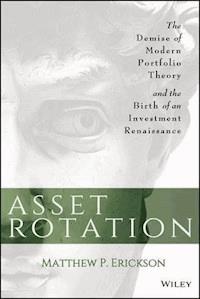
An all-weather, tactical approach to asset management utilizing Exchange Traded Funds (ETFs)
In Asset Rotation, portfolio management pioneer Matthew P. Erickson demonstrates a time-tested approach to asset management that has worked throughout the history of capital markets, in good times and bad. Providing investors with strong participation in rising markets, but more importantly with a discipline to reduce participation in prolonged declines. Over time this revolutionary approach has yielded superior returns, with significantly reduced levels of risk; providing the engine for true, long-term sustainable growth.
The investment world as we know it has changed, and the paradigm has shifted. What has worked in the past may no longer work in the future. No longer may bonds be regarded as a safe haven asset class, as for the first time in generations, investors in fixed income face losses as interest rates rise from historical all-time lows. For those adhering to a conventional Modern Portfolio Theory based investment approach to asset management, what was once regarded as safe and stable, may very well soon become our greatest impediment.
Asset Rotation provides investors with a practical solution for today's real world problems. This tactical approach to asset management provides us with concrete proof that there is indeed a better way.
We are standing on the precipice of an Investment Renaissance. What was previously impossible, is now possible. Find out how.
- Presents an easy-to-understand price momentum-based approach to investing
- Illustrates the benefits of asset rotation
- Offers a systematic approach for securing a sound financial future
- Provides further insights as to how to customize your own asset rotation portfolio
Matthew Erickson gives investors a hands-on resource for how to navigate an increasingly difficult investment landscape, by providing them with keen insights into the most rapidly growing segment of the investment markets.
Sie lesen das E-Book in den Legimi-Apps auf:
Seitenzahl: 322
Veröffentlichungsjahr: 2014
Ähnliche



















Contents
Acknowledgments
Prologue: David & Goliath
Preface: We Stand on the Precipice of an Investment Renaissance
Chapter 1: Taking the 30,000-Foot View
The Individual Investor
The Individual Investor
Ockham’s Razor
Our Current Economic Landscape
The Bottom Line
Chapter 2: When the Paradigm Shifts
A Primer on Modern Portfolio Theory
The Treasury Run
Losing Money in Bonds
The Bottom Line
Chapter 3: Shooting Stars
The Persistence of Manager Performance
The Bottom Line
Chapter 4: Beyond the Stars
The Cost of Investing
Identifying Risk
Assessing the Investment Environment
The Bottom Line
Chapter 5: The Landscape Has Changed
The ETF: What Is It?
A Brief History
The Use of ETFs in a Portfolio
The Bottom Line
Chapter 6: Challenging Convention
A Time-Tested Approach
The 2000s
The 1990s
The 1980s
The 1970s
The 1960s
The 1950s
The 1940s
The Great Depression
From the Great Depression to Today
The Bottom Line
Chapter 7: Building a Better Mousetrap
Building a Better Mousetrap
The 1990s
The 2000s
From 2010 to
23 Years: 1999–2012
Going Toe to Toe with the Best
The Bottom Line
Chapter 8: Choose Your Own Adventure
Choose Your Own Adventure
Additional Factors to Consider: Eligible Risk Assets
Additional Factors to Consider: Eligible Flight to Safety/Fixed-Income Assets
Additional Factors to Consider: Criteria for Investment Selection
Creating a Scoring System
Required Due Diligence
The Bottom Line
Chapter 9: The Anatomy of Change
Benchmarking Success
The Four Seasons
When Equity Markets Rise
When Equity Markets Fall
When Equity Markets Move Sideways
When Equity Markets Move Sideways with Volatility
The Bottom Line
Chapter 10: Letting Go of Your Crutch
Citius, Altius, Fortius
Asset Rotation as a Core Approach
Baby Steps
Supplementing Either Equities or Fixed Income
Adopting a Core/Satellite Approach
The Bottom Line
Chapter 11: The Road Ahead
The Bottom Line
About the Author
Index
End User License Agreement
List of Illustrations
FIGURE 1.1 Historical Performance of the S&P 500, 1990–1999
FIGURE 1.2 Historical Performance of the S&P 500, 2000–2009
FIGURE 2.1 The Efficient Frontier
FIGURE 2.2 Portfolio Allocations along the Efficient Frontier
FIGURE 2.3 The Bull Market in Bonds (1982–2012)
FIGURE 2.4 The Bursting of the Tech Bubble (2000–2002)
FIGURE 2.5 The Great Recession (2008)
FIGURE 2.6 The Tech Bubble and Beyond (2000–2012)
FIGURE 2.7 The Great Depression (October 1, 1929–December 31, 1941)
FIGURE 2.8 The Bear Market in Bonds (1942–1981)
FIGURE 2.9 The Beginning of the Great Unwind? (August 1, 2012–July 31, 2013)
FIGURE 2.10 Who Needs Bonds? (1990–1999)
FIGURE 3.1 Morningstar Ratings by Percentile
FIGURE 3.2 Morningstar Rating Persistence—Percentage of Time that a Stock Fund Maintained Its Rating for at Least 12 Months
FIGURE 3.3 15 Years of Record-Breaking Returns, Statistical Analysis
FIGURE 3.4 15 Years of Record-Breaking Returns, Growth $100,000
FIGURE 3.5 When Giants Fall, Statistical Analysis
FIGURE 3.6 When Giants Fall, Growth of $100,000
FIGURE 3.7 Eight Years of Legendary Returns, Statistical Analysis
FIGURE 3.8 Eight Years of Legendary Returns, Growth of $100,000
FIGURE 3.9 Legends of the Fall, Statistical Analysis
FIGURE 3.10 Legends of the Fall, Growth of $100,000
FIGURE 3.11 Morningstar Fund Manager of the Decade, Statistical Analysis
FIGURE 3.12 Morningstar Fund Manager of the Decade, Growth of $100,000
FIGURE 3.13 Beyond the Accolades, Statistical Analysis
FIGURE 3.14 Beyond the Accolades, Growth of $100,000
FIGURE 4.1 Active vs. Passive, Growth of $100,000
FIGURE 4.2 Active vs. Passive, Calendar-Year Returns
FIGURE 4.3 The Performance of Low Beta vs. Market Beta, Statistics (2008–2012)
FIGURE 4.4 The Performance of Low Beta vs. Market Beta, Annual Returns (2008–2012)
FIGURE 4.5 Low Beta vs. Market Beta—The Great Recession (2008)
FIGURE 4.6 Low Beta vs. Market Beta—The S&P Downgrade (2011)
FIGURE 4.7 Long-Term U.S. Treasury Performance (October 1 2007–July 31, 2012)
FIGURE 5.1 ETF Industry Growth
FIGURE 5.2 Five-Year Growth of $100,000, Leading Tactical Managers vs. the S&P 500
FIGURE 5.3 Calendar-Year Returns, Leading Tactical Managers vs. the S&P 500
FIGURE 6.1 The Lost Decade (2000–2009)
FIGURE 6.2 Historical Equity vs. U.S. Treasury Bond Returns (1929–2012)
FIGURE 6.3 A Simple Two-Asset-Class Rotation (2000–2012)
FIGURE 6.4 A Simple Two-Asset-Class Rotation (1990–1999)
FIGURE 6.5 A Simple Two-Asset-Class Rotation (1980–1989)
FIGURE 6.6 A Simple Two-Asset-Class Rotation Portfolio (1970–1979)
FIGURE 6.7 A Simple Two-Asset-Class Rotation Portfolio (1960–1969)
FIGURE 6.8 A Simple Two-Asset-Class Rotation Portfolio (1950–1959)
FIGURE 6.9 A Simple Two-Asset-Class Rotation Portfolio (1940–1949)
FIGURE 6.10 A Simple Two-Asset-Class Rotation Portfolio (October 1, 1929–December 31, 1939)
FIGURE 6.11 A Simple Two-Asset-Class Rotation Portfolio (October 1, 1929–December 31, 2012)
FIGURE 7.1 14 Years of Sector Returns (1999–2012)
FIGURE 7.2 Two-Asset-Class Sector Rotation Portfolio Returns (1990–1999)
FIGURE 7.3 Two-Asset-Class Sector Rotation Portfolio Returns (2000–2009)
FIGURE 7.4 Two-Asset-Class Sector Rotation Portfolio Returns (2010–2012)
FIGURE 7.5 Two-Asset-Class Sector Rotation Portfolio Returns (1990–2012)
FIGURE 7.6 Two-Asset-Class Sector Rotation Portfolio vs. Good Harbor (2004–2012)
FIGURE 9.1 Two-Asset-Class Sector Rotation and the Credit Suisse Hedge Fund Index (1994–2012)
FIGURE 9.2 Two-Asset-Class Sector Rotation vs. the S&P 500 (2008)
FIGURE 9.3 Two-Asset-Class Sector Rotation vs. the S&P 500 (2011)
FIGURE 10.1 Supplementing Asset Rotation for Either Stocks or Bonds (1990–2012)
FIGURE 10.2 Integrating Asset Rotation in a Core/Satellite Approach
List of Tables
TABLE 1.1 It Pays to Lose Less
TABLE 1.2 Historical Cost Comparison (U.S. City Average)
TABLE 2.1 Inflation Rates during the Bear Market in Bonds (1942–1981)
TABLE 3.1 SPIVA® Scorecard, Year-End 2012
TABLE 3.2 S&P Persistence Scorecard, July 2013
TABLE 3.3 Average Fund Statistics for 36 Months Following Morningstar Rating (June 30, 1992–August 31, 2009)
TABLE 4.1 Evaluating Mutual Fund Expenses
TABLE 5.1 Summary: Notable Differences between ETFs and Mutual Funds
TABLE 6.1 Average Annual Returns by the Decade
TABLE 7.1 Correlation and Performance Attributes, Sectors, and Treasury Bonds (1999–2012)
TABLE 7.2 Asset Class Sector Rotation Portfolio Eligibility
TABLE 7.3 Sample Monthly Ranking (April–May 2010)
TABLE 8.1 The Various Types of Sector ETFs Available
TABLE 8.2 Correlation and Performance Attributes, Countries, and Treasury Bonds (2003–2012)
TABLE 8.3 Correlation and Performance Attributes, Global Equities, and Treasury Bonds (2008–2012)
TABLE 8.4 Correlation and Performance Attributes, Fixed Income (2008–2012)
TABLE 8.5 A Three-Factor Tactical Asset Rotation Scoring System
TABLE 9.1 Two-Asset-Class Sector Rotation Monthly Returns and Underlying Holdings (2008)
TABLE 9.2 Two-Asset-Class Sector Rotation Monthly Returns and Underlying Holdings (2011)
TABLE 9.3 Simple Two-Asset-Class Rotation (2005)
Pages
iii
iv
v
xi
xii
xiii
xiv
xv
xvi
xvii
xviii
1
2
3
4
5
6
7
8
9
10
11
12
13
14
15
16
17
18
19
20
21
22
23
24
25
26
27
28
29
30
31
32
33
34
35
36
37
38
39
40
41
42
43
44
45
46
47
48
49
50
51
52
53
54
55
56
57
58
59
60
61
62
63
64
65
66
67
68
69
70
71
72
73
74
75
76
77
78
79
80
81
82
83
84
85
86
87
88
89
90
91
92
93
94
95
96
97
98
99
100
101
102
103
104
105
106
107
108
109
110
111
112
113
114
115
116
117
118
119
120
121
122
123
124
125
126
127
128
129
130
131
132
133
134
135
136
137
138
139
140
141
142
143
144
145
146
147
148
149
150
151
152
153
154
155
156
157
158
159
160
161
162
163
164
165
166
167
168
169
170
171
172
173
174
175
176
177
178
179
180
181
182
183
184
185
186
187
188
189
190
191
192
193
194
195
196
197
198
199
200
201
202
203
204
205
206
207
208
209
210
211
212
213
214
Guide
Cover
Table of Contents
Begin Reading
ASSET ROTATION
The Demise of Modern Portfolio Theory and the Birth of an Investment Renaissance
Matthew P. Erickson
Cover image: © Linda Huber
Cover design: Wiley
Copyright © 2014 by Matthew P. Erickson. All rights reserved.
Published by John Wiley & Sons, Inc., Hoboken, New Jersey.
Published simultaneously in Canada.
© 2014 Morningstar, Inc. All Rights Reserved. The information contained herein: (1) is proprietary to Morningstar and/or its content providers; (2) may not be copied or distributed; (3) does not constitute investment advice offered by Morningstar; and (4) is not warranted to be accurate, complete or timely. Neither Morningstar nor its content providers are responsible for any damages or losses arising from any use of this information. Past performance is no guarantee of future results. Use of information from Morningstar does not necessarily constitute agreement by Morningstar, Inc. of any investment philosophy or strategy presented in this publication.
No part of this publication may be reproduced, stored in a retrieval system, or transmitted in any form or by any means, electronic, mechanical, photocopying, recording, scanning, or otherwise, except as permitted under Section 107 or 108 of the 1976 United States Copyright Act, without either the prior written permission of the Publisher, or authorization through payment of the appropriate per-copy fee to the Copyright Clearance Center, Inc., 222 Rosewood Drive, Danvers, MA 01923, (978) 750-8400, fax (978) 646-8600, or on the Web at www.copyright.com. Requests to the Publisher for permission should be addressed to the Permissions Department, John Wiley & Sons, Inc., 111 River Street, Hoboken, NJ 07030, (201) 748-6011, fax (201) 748-6008, or online at www.wiley.com/go/permissions.
Limit of Liability/Disclaimer of Warranty: While the publisher and author have used their best efforts in preparing this book, they make no representations or warranties with respect to the accuracy or completeness of the contents of this book and specifically disclaim any implied warranties of merchantability or fitness for a particular purpose. No warranty may be created or extended by sales representatives or written sales materials.The advice and strategies contained herein may not be suitable for your situation. You should consult with a professional where appropriate. Neither the publisher nor author shall be liable for any loss of profit or any other commercial damages, including but not limited to special, incidental, consequential, or other damages.
For general information on our other products and services or for technical support, please contact our Customer Care Department within the United States at (800) 762-2974, outside the United States at (317) 572-3993 or fax (317) 572-4002.
Wiley publishes in a variety of print and electronic formats and by print-on-demand. Some material included with standard print versions of this book may not be included in e-books or in print-on-demand. If this book refers to media such as a CD or DVD that is not included in the version you purchased, you may download this material at http://booksupport.wiley.com. For more information about Wiley products, visit www.wiley.com.
Library of Congress Cataloging-in-Publication Data:
ISBN 9781118779194 (Hardcover)
ISBN 9781118779040 (ePDF)
ISBN 9781118779200 (ePub)
Lesen Sie weiter in der vollständigen Ausgabe!
Lesen Sie weiter in der vollständigen Ausgabe!
Lesen Sie weiter in der vollständigen Ausgabe!
Lesen Sie weiter in der vollständigen Ausgabe!
Lesen Sie weiter in der vollständigen Ausgabe!
Lesen Sie weiter in der vollständigen Ausgabe!
Lesen Sie weiter in der vollständigen Ausgabe!
Lesen Sie weiter in der vollständigen Ausgabe!
Lesen Sie weiter in der vollständigen Ausgabe!
Lesen Sie weiter in der vollständigen Ausgabe!
Lesen Sie weiter in der vollständigen Ausgabe!
Lesen Sie weiter in der vollständigen Ausgabe!
Lesen Sie weiter in der vollständigen Ausgabe!
Lesen Sie weiter in der vollständigen Ausgabe!
Lesen Sie weiter in der vollständigen Ausgabe!
Lesen Sie weiter in der vollständigen Ausgabe!
Lesen Sie weiter in der vollständigen Ausgabe!
Lesen Sie weiter in der vollständigen Ausgabe!




