


Atmospheric Pressure Plasma Treatment of Polymers E-Book
181,99 €
Mehr erfahren.
- Herausgeber: John Wiley & Sons
- Kategorie: Fachliteratur
- Serie: Adhesion and Adhesives - Fundamental and Applied Aspects
- Sprache: Englisch
An indispensable volume detailing the current and potential applications of atmospheric pressure plasma treatment by experts practicing in fields around the world Polymers are used in a wide variety of industries to fabricate legions of products because of their many desirable traits. However, polymers in general (and polyolefins, in particular) are innately not very adhesionable because of the absence of polar or reactive groups on their surfaces and concomitant low surface energy. Surface treatment of polymers, however, is essential to impart reactive chemical groups on their surfaces to enhance their adhesion characteristic. Proper surface treatment can endow polymers with improved adhesion without affecting the bulk properties. A plethora of techniques (ranging from wet to dry, simple to sophisticated, vacuum to non-vacuum) for polymer surface modification have been documented in the literature but the Atmospheric Pressure Plasma (APP) treatment has attracted much attention because it offers many advantages vis-a-vis other techniques, namely uniform treatment, continuous operation, no need for vacuum, simplicity, low cost, no environmental or disposal concern, and applicability to large area samples. Although the emphasis in this book is on the utility of APP treatment for enhancement of polymer adhesion, APP is also applicable and effective to modulate many other surface properties of polymers: superhydrophilicity, superhydrophobicity, anti-fouling, anti-fogging, anti-icing, cell adhesion, biocompatibility, tribological behavior, etc. The key features of Atmospheric Pressure Plasma Treatment of Polymers: * Address design and functions of various types of reactors * Bring out current and potential applications of APP treatment * Represent the cumulative wisdom of many key academic and industry researchers actively engaged in this key and enabling technology
Sie lesen das E-Book in den Legimi-Apps auf:
Seitenzahl: 550
Veröffentlichungsjahr: 2013
Ähnliche




















Contents
Cover
Half Title page
Title page
Copyright page
Preface
Acknowledgements
Part 1: Fundamental Aspects
Chapter 1: Combinatorial Plasma-based Surface Modification of Polymers by Means of Plasma Printing with Gas-Carrying Plasma Stamps at Ambient Pressure
1.1 Introduction
1.2 Experimental
1.3 Results and Discussion
1.4 Conclusions
Acknowledgements
References
Chapter 2: Treatment of Polymer Surfaces with Surface Dielectric Barrier Discharge Plasmas
2.1 Introduction
2.2 A General Overview of Surface Modification Results Obtained with Surface DBDs
2.3 An Overview of Selected Results Obtained at TNO by the SBD
2.4 Conclusions
References
Chapter 3: Selective Surface Modification of Polymeric Materials by Atmospheric Pressure Plasmas: Selective Substitution Reactions on Polymer Surfaces by Different Plasmas
3.1 Introduction
3.2 Defluorination of Poly(tetrafluoroethylene) Surfaces
3.3 Selective Modification of Polymeric Surfaces by Plasma
3.4 Summary
References
Chapter 4: Permanence of Functional Groups at Polyolefin Surfaces Introduced by Dielectric Barrier Discharge Pretreatment in Presence of Aerosols
4.1 Introduction
4.2 Experimental
4.3 Results
4.4 Discussion
4.5 Summary
Acknowlegdements
References
Chapter 5: Achieving Nano-scale Surface Structure on Wool Fabric by Atmospheric Pressure Plasma Treatment
5.1 Introduction
5.2 Experimental
5.3 Results and Discussion
5.4 Conclusions
Acknowledgements
References
Chapter 6: Deposition of Nanosilica Coatings on Plasma Activated Polyethylene Films
6.1 Introduction
6.2 Experimental
6.3 Results and Discussion
6.4 Conclusions
Acknowledgement
References
Chapter 7: Atmospheric Plasma Treatment of Polymers for Biomedical Applications
7.1 Introduction
7.2 Plasma for Materials Processing
7.3 Atmospheric Plasma Sources
7.4 Effects of Plasma on Polymer Surface
7.5 Atmospheric Plasma in Biomedical Applications
7.6 Conclusion
References
Part 2: Adhesion Enhancement
Chapter 8: Atmospheric Pressure Plasma Polymerization Surface Treatments by Dielectric Barrier Discharge for Enhanced Polymer-Polymer and Metal-Polymer Adhesion
8.1 Introduction
8.2 Atmospheric Plasma Polymerization Processes
8.3 Atmospheric Plasma Surface Modification for Enhanced Adhesion
8.4 Applications of Adhesion Improvement Using Atmospheric Pressure Plasma Treatments
8.5 Conclusion
References
Chapter 9: Adhesion Improvement by Nitrogen Functionalization of Polymers Using DBD-based Plasma Sources at Ambient Pressure
9.1 Introduction
9.2 Amino Functionalization with Nitrogen-Containing Gases
9.3 Adhesion Promotion by Amino Functionalization with Nitrogen-Containing Gases
9.4 Conclusion
Acknowledgements
References
Chapter 10: Adhesion Improvement of Polypropylene through Aerosol Assisted Plasma Deposition at Atmospheric Pressure
10.1 Introduction
10.2 Experimental
10.3 Results and Discussion
10.4 Conclusions
Acknowledgments
References
Chapter 11: The Effect of Helium-Air, Helium-Water Vapor, Helium-Oxygen, and Helium-Nitrogen Atmospheric Pressure Plasmas on the Adhesion Strength of Polyethylene
11.1 Introduction
11.2 Experimental Approach
11.3 Results and Discussion
11.4 Conclusion
Acknowledgements
References
Chapter 12: Atmospheric Plasma Surface Treatment of Styrene-Butadiene Rubber: Study of Adhesion and Ageing Effects
12.1 Introduction
12.2 Experimental
12.3 Results and Discussion
12.4 Conclusions
Acknowledgements
References
Chapter 13: Atmospheric Plasma Treatment in Extrusion Coating: Part 1 Surface Wetting and LDPE Adhesion to Paper
13.1 Introduction
13.2 Experimental
13.3 Results and Discussion
13.4 Conclusions
Acknowledgements
References
Chapter 14: Atmospheric Plasma Treatment in Extrusion Coating: Part 2 Surface Modification of LDPE and PP Coated Papers
14.1 Introduction
14.2 Experimental
14.3 Results and Discussion
14.4 Conclusions
Acknowledgements
References
Chapter 15: Achieving Enhanced Fracture Toughness of Adhesively Bonded Cured Composite Joint Systems Using Atmospheric Pressure Plasma Treatments
15.1 Introduction
15.2 Materials and Methods
15.3 Characterisation Techniques
15.4 Results and Discussion
15.5 Conclusions
Acknowledgement
References
Atmospheric Pressure Plasma Treatment of Polymers
Scrivener Publishing100 Cummings Center, Suite 541JBeverly, MA 01915-6106
Adhesion and Adhesives: Fundamental and Applied Aspects
The topics to be covered include, but not limited to, basic and theoretical aspects of adhesion; modeling of adhesion phenomena; mechanisms of adhesion; surface and interfacial analysis and characterization; unraveling of events at interfaces; characterization of interphases; adhesion of thin films and coatings; adhesion aspects in reinforced composites; formation, characterization and durability of adhesive joints; surface preparation methods; polymer surface modification; biological adhesion; particle adhesion; adhesion of metallized plastics; adhesion of diamond-like films; adhesion promoters; contact angle, wettability. and adhesion; superhydrophobicity and superhydrophilicity. With regards to adhesives, the Series will include, but not limited to, green adhesives; novel and high-performance adhesives; and medical adhesive applications.
Series Editor: Dr. K.L. Mittal1983 Route 52,P.O.1280, Hopewell Junction, NY 12533, USAEmail: [email protected]
Publishers at ScrivenerMartin Scrivener ([email protected])Phillip Carmical ([email protected])
Copyright © 2013 by Scrivener Publishing LLC. All rights reserved.
Co-published by John Wiley & Sons, Inc. Hoboken, New Jersey and Scrivener Publishing LLC, Salem, Massachusetts.Published simultaneously in Canada.
No part of this publication may be reproduced, stored in a retrieval system, or transmitted in any form or by any means, electronic, mechanical, photocopying, recording, scanning, or otherwise, except as permitted under Section 107 or 108 of the 1976 United States Copyright Act, without either the prior written permission of the Publisher, or authorization through payment of the appropriate per-copy fee to the Copyright Clearance Center, Inc., 222 Rosewood Drive, Danvers, MA 01923, (978) 750-8400, fax (978) 750-4470, or on the web at www.copyright.com. Requests to the Publisher for permission should be addressed to the Permissions Department, John Wiley & Sons, Inc., 111 River Street, Hoboken, NJ 07030, (201) 748-6011, fax (201) 748-6008, or online at http://www.wiley.com/go/permission.
Limit of Liability/Disclaimer of Warranty: While the publisher and author have used their best efforts in preparing this book, they make no representations or warranties with respect to the accuracy or completeness of the contents of this book and specifically disclaim any implied warranties of merchantability or fitness for a particular purpose. No warranty may be created or extended by sales representatives or written sales materials. The advice and strategies contained herein may not be suitable for your situation. You should consult with a professional where appropriate. Neither the publisher nor author shall be liable for any loss of profit or any other commercial damages, including but not limited to special, incidental, consequential, or other damages.
For general information on our other products and services or for technical support, please contact our Customer Care Department within the United States at (800) 762-2974, outside the United States at (317) 572-3993 or fax (317) 572-4002.
Wiley also publishes its books in a variety of electronic formats. Some content that appears in print may not be available in electronic formats. For more information about Wiley products, visit our web site at www.wiley.com.
For more information about Scrivener products please visit www.scrivenerpublishing.com.
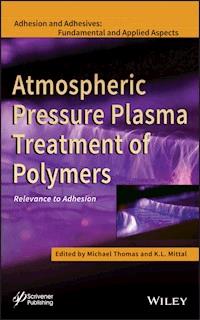
Front cover illustration shows surface functionalization of three-dimensional polymer substrates using AC corona discharge at atmospheric pressure.
Library of Congress Cataloging-in-Publication Data:
ISBN 978-1-118-59621-0
Preface
Polymeric materials are used for a legion of applications in a host of technological areas. However, polymers are innately hydrophobic, low surface energy materials and thus do not adhere well to other materials brought in contact. This necessitates their surface modification/treatment/activation to render them adhesionable. Apropos, surface modification is carried out not only to improve their adhesion characteristics but for a variety of other reasons too, for example to increase their hydrophilicity or hydrophobicity, to modify their tribological behavior, to render them flame resistant, etc.
A plethora of techniques (ranging from vacuum to atmospheric-pressure, wet to dry, simple to sophisticated, and inexpensive to sumptuous) have been employed to attain the required functional characteristics of polymers. Low-pressure (vacuum) plasma has been used for quite some time for polymer surface modification, but in the past decade there has been explosive growth of interest in atmospheric-pressure plasma (APP) processes because of their technological and economic advantages. They require no vacuum, need no expensive equipment, are easy to handle, can be used in a continuous mode, have a very good scalability, and can be simply integrated in existing process lines. Concomitantly, APP technology has been effectively utilized to treat polymers, paper, rubber, wool, fabrics, steel, glass and fiber-reinforced composites. Also, there has been much activity in ameliorating the existing processes, plasma sources and reactors or in devising new and improved ways to implement APP technology.
Besides plasma-based surface modification (activation, functionalization) using a number of gases, researchers have also been working on coating processes using atmospheric-pressure plasmas. Three different kinds of processes for coating deposition using atmospheric-pressure plasmas are being actively pursued. First is the grafting process where, after suitable plasma activation of the surface, the monomer is coupled on the surface using a subsequent wet-chemical step or gas-phase reaction. The second process is aerosol-based in which the precursor is directly sprayed into the plasma zone. The third kind of process is the plasma enhanced chemical vapor deposition (PECVD) in which a precursor, frequently together with a suitable process gas, is introduced into the discharge. It should be mentioned that besides the dielectric barrier discharge (DBD), other plasma sources (e.g., surface barrier discharge (SBD), coplanar barrier discharge (CBD), plasma jets, AC corona discharges, etc.) working at atmospheric pressure are of great interest.
Now coming to this book (containing 15 invited articles) it is divided into two parts:
Part 1: Fundamental Aspects and
Part 2: Adhesion Enhancement.
Topics covered include: combinatorial plasma-based surface modification of polymers; treatment of polymer surfaces with surface dielectric barrier discharge plasmas; selective substitution reactions on polymer surfaces by different plasmas; dielectric barrier discharge pretreatment of polymers in presence of aerosols; nanoscale surface structures on wool fabrics by atmospheric-pressure plasma treatment; nanosilica coatings on plasma activated polymers; biomedical applications of atmospheric plasma treatment of polymers; atmospheric-pressure plasma polymerization surface treatments for enhanced polymer-polymer and metal-polymer adhesion; functionalization and adhesion enhancement of various polymers using atmospheric pressure plasmas; atmospheric plasma treatment in extrusion coating; and enhancement of fracture toughness of adhesively bonded systems using atmospheric-pressure plasma treatment.
It should be recorded that all manuscripts were rigorously peer-reviewed, properly edited and suitably revised (some twice or thrice) before inclusion in this book.
This book representing the cumulative wisdom of a number of key researchers provides an overview and highlights the latest developments in APP technology. The book should be of much value to anyone interested in harnessing the potential of APP technology in enhancing adhesion in a variety of industries, namely printing, packaging, aerospace, automotive, composites, microelectronics, biological and biomedical, and others. As we delve further into the working of APP technology, new application vistas will emerge. This covers the large area treatment, e.g. internal coating of closed polymer bags or microfluidic devices and microplasmas for area-selective treatment of polymers. Moreover, treatment of skin for wound dressing is a very promising technology, which is under investigation and could be introduced into the market soon.
As a side comment, APP sources find their way into household applications. Kash Mittal has even heard that a company is planning to come up with an APP device for in-situ treatment of lips to enhance lipstick adhesion and of nails to enhance nail polish adhesion. What an interesting and exciting application!
Acknowledgements
First of all we would like to express our sincere thanks to the authors for their contribution, interest, enthusiasm and cooperation without which this book would not have seen the light of day. Second, we are very thankful to the unsung heroes (reviewers) for their invaluable comments which definitely improved the quality of these articles. Michael Thomas would like to express his thanks to Prof. Claus-Peter Klages for supporting this book project. Last, but not least, our appreciation goes to Martin Scrivener (Scrivener Publishing) for his earnest interest and important role in materializing this book.
Michael ThomasFraunhofer Institute for Surface Engineering and Thin Film IST, GermanyE-mail: [email protected]. MittalHopewell Junction, NY, USAE-mail: [email protected]
PART 1
FUNDAMENTAL ASPECTS
Chapter 1
Combinatorial Plasma-based Surface Modification of Polymers by Means of Plasma Printing with Gas-Carrying Plasma Stamps at Ambient Pressure
Alena Hinze1, Andrew Marchesseault2, Stephanus Büttgenbach2, Michael Thomas3 and Claus-Peter Klages1,3
1Technische Universität Braunschweig, Institut für Oberflächentechnik (IOT), Braunschweig, Germany
2Technische Universität Braunschweig, Institut für Mikrotechnik (IMT), Braunschweig, Germany
3Fraunhofer Institute for Surface Engineering and Thin Films IST, Braunschweig, Germany
Abstract
In this work a new method of achieving combinatorial area-selective modification of polymer surfaces is presented, utilizing atmospheric-pressure plasma printing with novel gas permeable electrodes. In these “plasma stamps” a microporous gas-carrying layer provides exchange of gaseous species from the gas stream to the individual microcavity discharges. Additionally, the electrodes can be fed with two (or more) different gases from spatially separate locations, allowing the generation of spot arrays with controlled gradients of physicochemical surface properties. Plasma-printed gradient surfaces can be used for combinatorial studies, for example in biomedical or polymer electronic research. In combination with spatially resolved surface characterization methods, the investigation of plasma-surface interaction processes can be significantly simplified. In the present contribution, gradient spot arrays were applied to optimize gas composition and functionalization parameters to provide optimal nucleation and growth of an electroless metal coating on a polymeric substrate. Locally plasma-modified surfaces were quantitatively characterized applying chemical derivatization (CD) followed by FTIR-ATR or SEM-EDX analyses in order to determine the area densities and spatial distributions of functional groups which are reactive towards the derivatization reagents used. Two chemical derivatization techniques were utilized: gas-phase derivatization (i) with 4-(trifluoromethyl)benzaldehyde (TFBA), forming a stable Schiff base with primary – but not secondary- amino groups, and (ii) with 4-(trifluoromethyl)phenyl isothiocyanate (TFMPITC) which is able to react with both primary and secondary amino groups forming thioureas, but – under the conditions used – not hydroxyl groups. It was, however, recently pointed out by us that other nitrogen-bearing functional groups such as imines can be captured by these methods as well.
Keywords: Dielectric barrier discharges, plasma printing, microplasmas, porous plasma stamps, polymer surface modification, gradient arrays, combinatorial plasma chemistry
1.1 Introduction
The term “plasma printing” stands for patterned surface modification or plasma-enhanced film deposition using ambient-pressure microplasmas enclosed in sub-millimeter sized cavities [1]. In early investigations, ceramic plates with laser- or mechanically drilled cylindrical through-holes covered by a fine metal mesh were used in order to allow diffusive gas exchange between the cavities and ambient. The mesh simultaneously served as one of two discharge electrodes, providing the electric field necessary to ignite a barrier discharge within the cavity. Using such an arrangement, the process gas can be transported by a stagnant flow and diffuse through the mesh into the cavities below it, enabling surface treatment with larger amounts of gas than available in the enclosed cavity volume. Different kinds of thin films with thicknesses up to several 100 nm have been deposited with arrangements of this kind [2, 3].
Lesen Sie weiter in der vollständigen Ausgabe!
Lesen Sie weiter in der vollständigen Ausgabe!
Lesen Sie weiter in der vollständigen Ausgabe!
Lesen Sie weiter in der vollständigen Ausgabe!
Lesen Sie weiter in der vollständigen Ausgabe!
Lesen Sie weiter in der vollständigen Ausgabe!
Lesen Sie weiter in der vollständigen Ausgabe!
Lesen Sie weiter in der vollständigen Ausgabe!
Lesen Sie weiter in der vollständigen Ausgabe!
Lesen Sie weiter in der vollständigen Ausgabe!
Lesen Sie weiter in der vollständigen Ausgabe!
Lesen Sie weiter in der vollständigen Ausgabe!
Lesen Sie weiter in der vollständigen Ausgabe!
Lesen Sie weiter in der vollständigen Ausgabe!
Lesen Sie weiter in der vollständigen Ausgabe!
Lesen Sie weiter in der vollständigen Ausgabe!




