


188,99 €
Mehr erfahren.
- Herausgeber: John Wiley & Sons
- Kategorie: Fachliteratur
- Sprache: Englisch
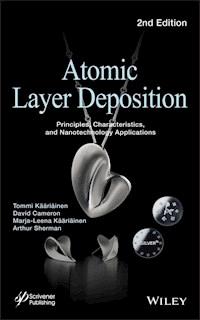
Since the first edition was published in 2008, Atomic Layer Deposition (ALD) has emerged as a powerful, and sometimes preferred, deposition technology. The new edition of this groundbreaking monograph is the first text to review the subject of ALD comprehensively from a practical perspective. It covers ALD's application to microelectronics (MEMS) and nanotechnology; many important new and emerging applications; thermal processes for ALD growth of nanometer thick films of semiconductors, oxides, metals and nitrides; and the formation of organic and hybrid materials.
Sie lesen das E-Book in den Legimi-Apps auf:
Seitenzahl: 405
Veröffentlichungsjahr: 2013
Ähnliche



















Contents
Cover
Half Title page
Title page
Copyright page
Acknowledgements
Foreword
Preface
Preface to First Edition
Preface to Second Edition
Chapter 1: Fundamentals of Atomic Layer Deposition
1.1 Chemical Vapour Deposition
1.2 Vapour Adsorption
1.3 Atomic Layer Deposition (ALD)
References
Chapter 2: Elemental Semiconductor Epitaxial Films
2.1 Epitaxial Silicon
References
Chapter 3: III-V Semiconductor Films
3.1 Gallium Arsenide
3.2 Other III-V Semiconductor Films
3.3 Applications
References
Chapter 4: Oxide films
4.1 Introduction
4.2 Aluminum Oxide
4.3 Titanium Dioxide
4.4 Zinc Oxide
4.5 Zirconium Dioxide
4.6 Hafnium Dioxide
4.7 Other Oxides
4.8 Mixed Oxides and Nanolaminates
4.9 Multilayers
References
Chapter 5: Nitrides and Other Compounds
5.1 Introduction
5.2 Nitrides
5.3 Chalcogenides
5.4 Other Compounds
References
Chapter 6: Metals
6.1 Introduction
6.2 Noble Metals
6.3 Titanium
6.4 Tantalum
6.5 Aluminum
6.6 Copper
6.7 Other Transition Metals
References
Chapter 7: Organic and Hybrid Materials
7.1 Introduction
7.2 Organic layers
7.3 Hybrid Organic-inorganic Layers.
7.4 Applications of Organic and Hybrid Films
References
Chapter 8: ALD Applications and Industry
8.1 Introduction
8.2 MEMS/NEMS
8.3 Thin Film Magnetic Heads
8.4 Coating Nanoparticles, Nanomaterials and Porous Objects
8.5 Optical Coatings
8.6 Thin Film Electroluminescent Displays
8.7 Solar Cells
8.8 Anti-corrosion Layers
8.9 Opportunities in Organic Electronics
8.10 ALD Tool Manufacturers and Coating Providers
References
Index
Atomic Layer Deposition
Scrivener Publishing100 Cummings Center, Suite 541JBeverly, MA 01915-6106
Publishers at ScrivenerMartin Scrivener ([email protected])Phillip Carmical ([email protected])
Copyright © 2013 by Scrivener Publishing LLC. All rights reserved.
Co-published by John Wiley & Sons, Inc. Hoboken, New Jersey, and Scrivener Publishing LLC, Salem, Massachusetts.Published simultaneously in Canada.
No part of this publication may be reproduced, stored in a retrieval system, or transmitted in any form or by any means, electronic, mechanical, photocopying, recording, scanning, or otherwise, except as permitted under Section 107 or 108 of the 1976 United States Copyright Act, without either the prior written permission of the Publisher, or authorization through payment of the appropriate per-copy fee to the Copyright Clearance Center, Inc., 222 Rosewood Drive, Danvers, MA 01923, (978) 750-8400, fax (978) 750-4470, or on the web at www.copyright.com. Requests to the Publisher for permission should be addressed to the Permissions Department, John Wiley & Sons, Inc., 111 River Street, Hoboken, NJ 07030, (201) 748-6011, fax (201) 748-6008, or online at http://www.wiley.com/go/permission.
Limit of Liability/Disclaimer of Warranty: While the publisher and author have used their best efforts in preparing this book, they make no representations or warranties with respect to the accuracy or completeness of the contents of this book and specifically disclaim any implied warranties of merchantability or fitness for a particular purpose. No warranty may be created or extended by sales representatives or written sales materials. The advice and strategies contained herein may not be suitable for your situation. You should consult with a professional where appropriate. Neither the publisher nor author shall be liable for any loss of profit or any other commercial damages, including but not limited to special, incidental, consequential, or other damages.
For general information on our other products and services or for technical support, please contact our Customer Care Department within the United States at (800) 762-2974, outside the United States at (317) 572-3993 or fax (317) 572-4002.
Wiley also publishes its books in a variety of electronic formats. Some content that appears in print may not be available in electronic formats. For more information about Wiley products, visit our web site at www.wiley.com.
For more information about Scrivener products please visit www.scrivenerpublishing.com.
Library of Congress Cataloging-in-Publication Data:
ISBN 978-1-118-06277-7
Acknowledgements
Tommi and Marja-Leena Kääriäinen are grateful for their children Emil, Elsa, and Elias and would like to thank for their love and inspiring moments in life.
David Cameron dedicates this work to his wife, Eileen, for her unfailing love and support and to his children Petra and Alasdair and granddaughter, Rose.
Arthur Sherman would like to acknowledge the support of his family (daughters Linda and Jan, and son Douglas, as well as four beautiful grandchildren Ashley, Daniil, Andrew and Sara). An affectionate thank you is also extended to Sandra Tenenbaum
Foreword
The field of atomic layer deposition (ALD) has experienced tremendous growth over the past ten years. The Web of Science reveals that nearly 900 publications in 2012 and over 5000 publications since 2002 had “atomic layer deposition” in their abstracts or key words. If we include the earlier use of “atomic layer epitaxy” to refer to the field, then we can add over 1500 more publications from the past thirty years. Why has the growth of ALD increased so dramatically over the past ten years? There are many contributing factors that include the development of new ALD materials and the availability of commercial ALD reactors. The wealth of ALD materials means that many applications can be addressed with known ALD chemistries to deposit the thin film. The many companies selling ALD reactors means that ALD practitioners can concentrate on their applications and do not need to worry about building their own ALD reactors.
Another important factor to explain the dramatic growth of ALD over the past ten years is that more people are becoming aware of the superior features of ALD and the importance of these features to nanofabrication technology. These characteristics have been well known since their introduction by Suntola in the early 1980s. The virtue of sequential, self-limiting surface chemistry to achieve conformal and atomic layer controlled growth was presented over thirty years ago. Although many important ideas are recorded in the literature, only a few really come to fruition and become the basis for an entire industry. One key event that stimulated interest in ALD and subsequent recognition for ALD was the semiconductor industry realizing that they needed ALD for high K gate oxides to replace SiO2. This pivotal event occurred approximately 10–12 years ago when ALD was placed prominently on the semiconductor roadmap for high K gate oxides.
This revised book on ALD is a welcome addition to the field of ALD and will be very useful for experts and beginners alike. The book provides an up-to-date review of ALD including the rapidly developing plasma ALD and spatial ALD processes. The core of the book provides a description of the variety of ALD chemistries for semiconductor, oxide, nitride, metal and hybrid material films. Many of these ALD chemistries did not even exist ten years ago. One chapter is dedicated to semiconductor epitaxial films and reviews the early work on silicon and germanium ALD. Another chapter describes the important oxide ALD films that have pioneered many of the important applications for ALD over the last ten years. The book ends with a summary of the current ALD applications that are driving the field and leading to new ALD commercialization. Most of these applications were only on the drawing board ten years ago.
This book should also serve as a springboard for future developments of ALD. Knowledge of the past is an important foundation for moving into the future. As the ALD field moves forward, we will want to identify: the key challenges that are currently limiting progress in ALD; the critical developments that are needed to advance ALD state-of-the-art; and the new applications that may benefit from ALD methods. This book provides the present ALD status quo that will provide a baseline to measure future progress. The last ten years have brought tremendous progress, and continued growth is on the horizon. One thing is for certain: ALD will continue to be an integral part of nanofabrication technology as we move into the future.
Steven GeorgeMarch 2013
Preface
Preface to First Edition
More than 25 years ago, researchers in Finland realized that films only nanometers thick could be deposited uniformly by chemical reactions on surfaces, by a novel new process. This process made use of the fact that, in general, when a substrate within a vacuum chamber is exposed to a reactive gas, that substrate will retain a single monolayer of that gas even when the gas is evacuated from the chamber. When this monolayer is exposed to a second reactive gas, causing a chemical reaction whose products include a solid species, a monolayer of this solid is formed. Repeating this process allows films to be grown one monolayer at a time, and is referred to as Atomic Layer Deposition or ALD. Over the years the ability of this process to deposit thin films conformally, with extraordinary thickness control, and uniformly over substantial areas, has led to an increasing level of research and development. In fact, the number of published scientific articles on ALD has more than doubled over the last five years.
Since this new technology is quite interdisciplinary, a review of it from the point of view of a single author would be very useful. That is the motivation that has led me to put this text together. Although an attempt has been made to cover most important films and processes, it definitely has not been my intention to draft an encyclopedic text. Just enough material has been included as was felt necessary to convey the important concepts underlying ALD.
Arthur ShermanJanuary 2008
Preface to Second Edition
Since publication of the first edition of this book, research into atomic layer deposition has continued to expand; the annual number of publications explicitly mentioning atomic layer deposition, ALD or molecular layer deposition as a topic has grown by two thirds between 2008 and 2012 and many more research groups are becoming involved in this field. In addition, it has become well established for many industrial applications. The long-established commercial application of ALD to electroluminescent displays has been followed by integration into, for example, microelectronics and magnetic recording head production. In addition, other new areas such as protective coatings for jewelry have grown up, and the application of ALD to many diverse end products is being pursued vigorously.
There have also been numerous developments in the ALD process itself. The number of materials which have been produced is now very large and continues to grow. New precursor chemicals are being developed to improve their ease of handling, reduce their temperature requirements and facilitate the chemistry of the process. The use of reactive-enhanced ALD has seen continued improvement and the availability of spatial ALD making possible roll-to-roll systems is an exciting development. At the same time, deposition of organic and hybrid organic-inorganic layers is now a popular area which promises interesting and useful capabilities. Finally, the availability of well-engineered ALD systems has enabled turnkey operation, and has reduced the hurdles for entry to the technology.
In the light of these developments, there are many people for whom an updated text dealing with the principles, technology and applications of ALD would be valuable. With this in mind, the structure of the book has been somewhat altered. Chapter 1 still deals with the fundamentals of the process, but greater emphasis has been put on reactive-enhanced ALD and the principles of spatial ALD are now outlined. There has been limited development in the epitaxial growth of elemental and compound semiconductors, therefore Chapters 2 and 3 are relatively unchanged. Chapter 4 on oxide coatings has been extensively updated to take account of recent work and new precursors. Reactive-enhanced ALD processes have been integrated into this and other chapters rather than occupying a separate chapter. An expanded chapter 5 deals with nitrides and other compound materials. Metal film deposition has greatly developed in recent years and Chapter 6 is devoted to this alone. Chapter 7 deals with organic and hybrid layers, which is a rapidly expanding area. To conclude, Chapter 8 describes applications and examples of industrial use together with a list of some ALD equipment suppliers.
We are aware that the field of ALD is rapidly developing, and that many new applications and process developments will occur. The aim of this text is to introduce the reader to the principles, characteristics, capabilities and possibilities of ALD in an edition which also provides a guide to where more detailed information can be obtained. We trust that our readers will find that we have achieved this goal.
Tommi KääriäinenDavid C CameronMarja-Leena KääriäinenArthur ShermanMarch 2013
Chapter 1
Fundamentals of Atomic Layer Deposition
1.1 Chemical Vapour Deposition
Atomic Layer Deposition (ALD) is a more recent variation on the older technology referred to as Chemical Vapor Deposition (CVD) [1]. In CVD, which was originally developed in the 1920s, a mixture of gases flows over a heated substrate causing a thin solid film to grow on the surface. This heated surface has to be hot enough to allow the surface reaction to proceed rapidly, so that commercially acceptable deposition rates are achieved. In the ideal case, there will be no reaction between the reactant gases in the gas phase, in other words no homogeneous reactions, which would cause the formation of particulates. The gases approaching the heated surface will be heated by gas phase conduction and should not react until they impinge on the surface where they form a solid film of deposited material by a heterogenoeous reaction. If a homogenoeous reaction takes place, in the worst case one can have particles forming in the gas phase and ending up embedded in the growing thin film, clearly an unacceptable result.
The optimum choice of reactants for a CVD process is generally a mixture of the most reactive gases available. This allows film deposition at the highest rates, and at the lowest substrate temperatures. Unfortunately, this choice leads to a high probability of gas phase reactions, which as noted can compromise the deposited film quality. It is this dichotomy which has fueled much of the CVD research over the last thirty years.
The present book will be a review of CVD’s newer variant, ALD. In this technique, the presentation of the two reactants to the heated surface is separated into two steps. In step one, the substrate is exposed to the first reactant after which this reactant is pumped away. During this exposure a monolayer of the first reactant adsorbs to the substrate, and remains after the chamber is evacuated. Then a second reactant is introduced into the chamber, and it reacts with the monolayer of the first reactant. This then forms one layer (generally less than one complete monolayer) of the solid film being sought. After this, the remaining second reactant and any gas phase reaction products are removed from the chamber. This process is repeated as many times as necessary to grow a film of the desired thickness. The conformality of the film is also excellent, since film growth depends only on the formation of monolayers on the surface and not on the arrival rate of reactants. The time necessary to form such a layer can be increased if necessary for a complex-shaped substrate and the arrival of excess reactant is not important. Clearly with this process, gas phase reactions should not occur, so that one is free to choose the most reactive reactants available and film deposition temperatures can be lower. However, the one disadvantage is that the film deposition rate may be slow. For those applications where thin, uniform and highly conformal films are of interest, this becomes less of a limitation and ALD is an important process.
Lesen Sie weiter in der vollständigen Ausgabe!
Lesen Sie weiter in der vollständigen Ausgabe!
Lesen Sie weiter in der vollständigen Ausgabe!
Lesen Sie weiter in der vollständigen Ausgabe!
Lesen Sie weiter in der vollständigen Ausgabe!
Lesen Sie weiter in der vollständigen Ausgabe!
Lesen Sie weiter in der vollständigen Ausgabe!
Lesen Sie weiter in der vollständigen Ausgabe!
Lesen Sie weiter in der vollständigen Ausgabe!




