


Erhalten Sie Zugang zu diesem und mehr als 300000 Büchern ab EUR 5,99 monatlich.
- Herausgeber: Luath Press
- Kategorie: Geisteswissenschaft
- Sprache: Englisch
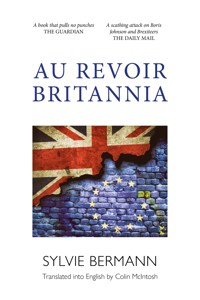
From her unique perspective as former French ambassador to the UK, Sylvie Bermann examines the mistruths told by politicians surrounding the fateful 2016 Brexit referendum. Au Revoir Britannia asks the question 'How did this happen?' and exposes what she sees as the 'unrepenting' and 'inveterate' lies of the now pm, Boris Johnson. This first English edition includes a new preface exploring the future of post-Brexit Europe and Britain, and the uncertain implications of the Russian invasion of Ukraine.
Sie lesen das E-Book in den Legimi-Apps auf:
Seitenzahl: 325
Veröffentlichungsjahr: 2022
Das E-Book (TTS) können Sie hören im Abo „Legimi Premium” in Legimi-Apps auf:
Ähnliche




















SYLVIE BERMANN is a career diplomat and was the French ambassador to the United Kingdom between 2014 and 2017. She grew up in Lyon, and studied history at Paris-Sorbonne and then specialised in oriental languages. Later she studied at the Beijing Language and Culture University, where she had her first taste of diplomacy as a closely monitored exchange student after the end of the Cultural Revolution in 1976. She became the first female French ambassador to China in 2011. She was Director for the United Nations, International Organisations, Human Rights and Francophonie from 2005 to 2011. She also became the ambassador for France in Russia in 2017, before she retired from the French foreign ministry in 2020. In July 2021 she was appointed by OSCE as a mediator and coordinator of the political branch of the trilateral contact group in charge of the implementation of the Minsk agreement on Donbas.
COLIN McINTOSH, a UK national, is a retired lawyer and translator currently living in France. Born in Germany and raised in Scotland, he studied Law at the University of Edinburgh (LLB Hons) and the University of McGill in Canada (LLM). Soon after qualifying, he went to work at the Court of Justice of the European Communities in Luxembourg, first as Deputy Head of Personnel and then as part of a small team of lawyers undertaking background research for the judges. After five years, he moved to the Organisation for Economic Co-operation and Development (OECD) in Paris, working first in the Legal Affairs Section of the Nuclear Energy Agency and then, for many years, in the Translation Division. Here he combined translation and revision work with the duties of Registrar of the OECD’s Administrative Tribunal. Retired since 2011, he continues to take on occasional translation work and to follow British politics from afar.
First published in French by Editions Stock 2021
First published in English by Luath Press 2022
ISBN: 978-1-80425-029-7
The author’s right to be identified as author of this book under the Copyright, Designs and Patents Act 1988 has been asserted.
Typeset in 11.5 point Sabon by Lapiz
© Sylvie Bermann 2021, 2022
Contents
Preface
Introduction
CHAPTER 1 The Day Before: London, New City of the World
CHAPTER 2 An Island Nation: British Exceptionalism
CHAPTER 3 ‘That Sweet Enemy’
CHAPTER 4 The Campaign: Emotion Versus Reason
CHAPTER 5 ‘Whodunit’? The Guilty Parties
CHAPTER 6 The Day – Days, Weeks, Months, Years – After
CHAPTER 7 Goodbye European Union; Hello Post-COVID, Post-Brexit World
Afterword
Endnotes
Bibliography
Filmography
Preface to the UK Edition
I AM DELIGHTED THAT my book, Au Revoir Britannia, has been published in English.
It was originally written in order to describe to my compatriots the astonishing period of Brexit as witnessed from my privileged position as Ambassador of France. I relayed what I had seen and, most importantly, heard, albeit without always revealing my sources. British readers will of course be familiar with the events described. The analysis, by a French diplomat who is both an Anglophile and a Europhile, is of the historic moment when a country enjoying enviable prosperity decided to change course overnight. I looked on as the United Kingdom, flourishing and self-confident, turned into a profoundly divided country where the prevailing atmosphere, tinged with xenophobia, was one of bitterness in which Europeans, and the French in particular, seemed to have become its enemies. The book also endeavoured to explain that, although the European Union had served as a catalyst in relation to existing – but until then, hidden – frustrations, there were many other factors at play as well. Additionally, I felt that France could perhaps learn lessons from this surge of populism.
More than five years have passed since the day in June 2016 that was a game changer for both the United Kingdom and the European Union. When I returned to London in the weeks preceding the lockdown, I was surprised to find, not that Brexit had become a reality now accepted by everyone since there was no alternative, but rather a fairly general feeling that because it had happened, it was difficult to fathom that there could have been a different outcome. Brexit had somehow become the country’s destiny, to the point where I began to doubt my own recollections, detailed as they were, so historic had been the event.
The very great majority of those with whom I had come into contact before the referendum, whether in London or in the provinces, Remainers or Brexiteers (including Boris Johnson himself) did not believe Brexit would happen. One member of Parliament, after listing all the reasons why he felt the United Kingdom should leave, told me he knew very well the British would remain in the EU, adding with a mischievous air that they would continue to annoy the Europeans, and wondered whether the latter were sure they really wanted them to stay. When, 15 days after the referendum, I reminded him of his unequivocal opinions, he confessed he would have bet everything he owned that Remain would win the day. During an interview I gave on the occasion of the fifth anniversary of Brexit, the French-speaking Belgian channel, RTBF, rebroadcast the BBC’s announcement of the result, describing it as extraordinary and a veritable earthquake. This took me back to the state of shock we were all in at the time.
If I was so astonished by the result it was because almost everyone, from pollsters to bookmakers – including politicians and the media – was convinced that Brexit would not happen. Although I did not visit the Nissan factory in Sunderland, which turned out to be the epicentre of the Leave vote, I did go to the plant where Airbus wings were manufactured and where there was a very strong French presence. It is true that there were mixed feelings there about how they perceived the European Union and how they intended to vote. I made a point of travelling around the provinces as often as possible, when I was not obliged by my work to remain in the capital, but London, one of the stellar capitals of the world, enjoys an almost vampire-like dominance in the country. I confess that I did not see much of the suburbs, but in London itself, I was constantly meeting with members of Parliament from all sides. And unlike their French counterparts, British MPS return every weekend to their constituencies in order to ‘take the pulse’ of their constituents and keep in touch with local concerns. How is it that they failed completely to pick up on the prevailing mood? And what is to be said about David Cameron’s conviction that he would win the referendum?
I finished writing my book in early January 2021, but subsequent developments have done nothing to alter its conclusions or the many interrogations raised within it. When analysing history in the making, it is difficult to adopt a standpoint of detached objectivity. Nothing is ever definitively settled. Since my book was published, several excellent volumes written by knowledgeable British observers – such as Philip Stephens’ Britain Alone: the Path From Suez to Brexit (2021),1 or Peter Ricketts’ Hard Choices (2021)2 – have analysed the underlying causes of Brexit and tried, as far as possible, to predict what will happen next.
Success or failure? A good decision or a mistake? Even Dominic Cummings, the architect of Brexit, has been openly asking himself these questions. In any event, as things stand, it is difficult to identify any advantages that Brexit has brought. On the contrary, the United Kingdom now has a lower ranking in the classification of G20 countries; a drastic reduction in trade with Europe; the need for companies to set up subsidiaries on the continent; and serious difficulties for fishermen and farmers, as well as for small and medium-sized enterprises in general. The City has been overtaken by the Amsterdam stock exchange as regards share transactions; there is an increase in bureaucracy rather than the hoped for reduction – the list goes on. The rush to conclude free trade agreements with the rest of the world has resulted in ‘cut, copy and paste’ versions of the ones previously concluded by the European Union. The one exception is the agreement concluded with Australia, hailed as the UK’s first sovereignty agreement. But it has been calculated that this agreement will result in an increase in Gross Domestic Product (GDP) of between only 0.01 and 0.02 per cent, while its terms are favourable to the Australians at the expense of Britain’s livestock farmers. Strangely, a new minister, Jacob Rees-Mogg has been appointed in order to seek opportunities from Brexit. Naturally, the United Kingdom has many assets which could enable it to bounce back but whatever happens, the consequences of Brexit will be a loss in terms not only of relative earning power but also of geopolitical influence.
It is of course true that the United Kingdom’s COVID-19 vaccination campaign has been a success but, contrary to what is claimed by some, this has nothing to do with Brexit – matters of health fall under national jurisdiction. The campaign itself began, and massive orders for vaccines were made, while the United Kingdom was in the transition period and therefore still bound by EU rules. The European Union, slow to get started and not benefitting from the vaccines produced in British laboratories, opted for a policy of solidarity in order to ensure that the smallest European countries were also able to acquire vaccines, thus enabling a return to free movement. The EU, which has vaccinated more than half its population, has also exported half the doses produced in Europe to developing countries, thereby becoming the world’s pharmacy at a time when it has become evident that the virus will not disappear until citizens of all the world’s countries have been vaccinated.
‘Global Britain’ is having difficulty making its mark: the aircraft carrier Queen Elizabeth, sent with great fanfare into the Indo–Pacific region, avoided the Taiwan Strait so as not to provoke China; the G7 chaired in June 2021 by Boris Johnson was perturbed by the key question of implementation of the Northern Ireland Protocol. Just before the summit, Joe Biden asked for assurance that the agreement would be complied with. Biden also publicly stated his appreciation for the European Union as a strong and vibrant entity – clearly size does matter. What is at stake – over and above preserving peace in Northern Ireland where tensions still run high and, for the European Union, protecting the single market – is the value that can be put on the United Kingdom’s signature.
The United Kingdom’s relationship with Europe has been deeply and permanently affected. Brexit is by no means an amicable, mutual consent divorce and there is a great deal of bitterness on both sides. As far as the Europeans are concerned, there are many other priorities to be addressed: the implementation of a recovery plan; the migrant crisis; a new transatlantic agenda; the complex relationship with China, Russia and Turkey; and agreeing on a strategic compass. On the British side there is the normal and legitimate wish to make a success of Brexit. As they say in Britain, ‘we are where we are’. But there is a tendency, with such an obsessional approach, to want to blot Europe out, as shown by the extremely marginal place allocated to it in the Integrated Review of spring 2021. This borders on the absurd when the Government boasts about an agreement to allow British performers to circulate freely in Lichtenstein, whereas this same right, generously offered by the European Union, was turned down flat by London. Or again, when armed British patrol boats threaten French fishing vessels off Jersey, where I had been so warmly welcomed ‘comme chez moi’ when I was Ambassador in London (and where the courts apply the Norman law as studied by the island’s lawyers in the University of Caen). All these episodes demonstrate that it will take time to rebuild relations with the European Union as a whole and individually with France, Germany and other partners. For rebuild they must since, as Napoleon said, ‘the only thing that doesn’t change in history is geography’ and our interests and values remain close in a world dominated by continent-sized states, some of them autocratic regimes.
Isn’t absolute sovereignty an illusion today given the global challenges existing in an increasingly uncertain multipolar world?
Since publication of my book in France in January 2021, a major event has occurred, a real game-changer in Europe and on the world stage: the war of aggression launched by Vladimir Putin against Ukraine.
The Russian President, isolated for almost two years in a psychological ghetto – as well as a physical one because of his fear of COVID – was apparently brooding over his old obsessions: the first being the denial of the existence of Ukraine as a nation; the second, the presence of NATO on the borders of Russia which he considers to be a threat to national security. During this period, he interacted almost exclusively with a small entourage who shared his obsessions or who were, at any rate, afraid to contradict him. After witnessing the American debacle in Kabul in August 2021, he was convinced that the West was weak. Joe Biden had said prior to the invasion that the US wouldn’t interfere, so Putin no doubt thought his time had come.
To most people, this war was literally unthinkable, and up until the last moment, the authorities and people of Ukraine refused to countenance the possibility of a major invasion targeting Kyiv. As the moderator of the OSCE (Organization for Security and Co-operation in Europe) and coordinator of the political working group of the TCG (Trilateral Contact Group), responsible for implementation of the Minsk agreement,i I was witness to this myself since I was in Kyiv three weeks before the war and kept in contact with my Ukrainian counterparts till the very day before the invasion was launched. Although cyber warfare has become almost commonplace, nobody thought there would be a conventional conflict in Europe along the lines of the Second World War.
It is, of course, a tragedy for the Ukrainian people but neither is it in the interests of Russia, which has much to lose. Putin wanted to turn Ukraine into a vassal state and make it pro-Russian whereas, in fact, he reinforced the feeling of national identity and provoked widespread hatred of the Russian people. He wanted to weaken NATO, but instead he gave it a raison d’être. He hoped to divide the EU, which he despises, but instead succeeded in unifying it. It is worth noting that the EU, for the first time, decided unanimously and swiftly not only to give humanitarian as well as financial assistance and impose unprecedented sanctions, but also to provide defensive weapons in order to help Ukraine exercise its right to defend itself.
As this book goes to press, the war is not over but European countries from now on will have to think the unthinkable. Even if it appears (so far) to have been something of a bluff, there has been an implicit threat of resorting to nuclear weapons. The strategic compass adopted in March 2022 by the EU has been adapted to this new environment. It will inevitably require more brainstorming and also more concertation with the UK, which cannot be satisfied with simply following the American position. This war took place in Europe and it is Europe that will suffer many of the consequences: sanctions, vulnerability of neighbouring countries, refugees and so forth. In these circumstances, even if it is only a personal regret, and it is in the past, I cannot help thinking that the EU would have been stronger with the participation of London and that the UK would have greater influence if it were still a member of the EU.
After the war, there will inevitably be negotiations with Russia with a view at least to ensuring strong guarantees regarding a possible status of neutrality for Ukraine, and more generally to design a new architecture for security in Europe. In the longer run, ‘the West’ will also have to take greater account of ‘the Rest’, as they say in United Nations circles, meaning the largest part of the world – including China in particular which, although embarrassed by this war, will want to keep its partnership with Russia, knowing that it is still Washington’s primary target. ‘The Rest’ also includes India, Pakistan, Brazil, South Africa and the 17 African countries that abstained in the vote condemning the Russian invasion in the UN General Assembly in March 2022, and which do not necessarily share our views on this new Cold War between democracies and autocracies
* * *
Anglophile through my love of British culture and humour and Europhile because the European Union serves as a multiplier of national power, I nonetheless retain my French identity which inevitably colours my vision of England and the United Kingdom. But I think that a vision from another standpoint, whether one agrees with it or not, is always instructive.
i The Minsk agreement was formed to facilitate peace in the Ukraine by creating dialogue with Russia.
Introduction
IN LEWIS CARROLL’S 1865 classic, Alice’s Adventures in Wonderland, the White Queen authorised Alice to tell six lies or believe ‘six impossible things’ before breakfast.1 The fictional Queen would be pleased, as more than six lies were told during the referendum campaign on whether the United Kingdom should remain in the European Union, during which the subjects of her Gracious Majesty lived in a sort of make-believe world. Waking up on the morning after the referendum of 23 June 2016 was painful. But for all that, reality did not reclaim centre stage. The result was that, for the following three and a half years, the British were plunged into the absurd universe of Alice in Wonderland, or even Monty Python. There was veritable chaos, and often a political circus involving some highly colourful characters such as Speaker of the House of Commons John Bercow at Westminster, the so-called ‘mother of parliaments’. His frequent shouts for ‘ORDEEER’ will go down in history.
On 1st April 2019, a comical event occurred when young ecological activists from Extinction Rebellion glued themselves, almost naked, to the windows of the Visitors’ Gallery in the House of Commons during yet another inconclusive debate on Brexit. This gave rise to several sarcastic, or disenchanted, comments on social media – if only it was the most ridiculous or nonsensical thing to have taken place in this forum over the last five years.
Only the triumphant, and somewhat paradoxical, election in December 2019 of Boris Johnson – whose campaign slogan was ‘Get Brexit Done’ in a country where the polls gave a slight majority for remaining in the European Union – put an end to the debate once and for all.
Meanwhile, the world continued to move forward, the COVID pandemic bringing into focus some of the changing patterns of power.
When I arrived at the Court of St James in August 2014 – ambassadors are accredited to the Queen and not to the prime minister – quite a few British people told me I would be bored after the years I had spent in China where I witnessed the accession to power of Xi Jinping and China’s growing assertiveness on the international stage. The feeling was that I was coming back to a quiet, uneventful post in old Europe. To their great astonishment and amusement, I replied that I did not think I would be bored since the British were, in my eyes at least, as culturally different as the Chinese, if not more so. The royal family and the parade of monarchy; the Queen’s hats; the pomp of the Tudors at Westminster; the judges in their powdered wigs; the ‘old boys’ clubs; horse racing at Ascot; the annual City Guild parades; cricket matches; the pubs; a myriad of accents, from Cockney to the very posh; the smell of fish and chips in the street; bookmakers; and, as always, the humour – all these ‘so British’ idiosyncrasies. All so well and entertainingly described in the 1930s and again the 1960s by a former attaché to the French Embassy in London, Paul Morand:2
A Frenchman used to spending his holidays in Italy or Spain will, on crossing the Channel, be immediately transported into a foreign world where the urban landscapes and customs are so different from those of continental Europe – so near and yet so far, neighbours that in fact we know so little.
I was not, however, expecting to bear witness to a revolution – to live through history in the making. This is a period that will be remembered 50 or 100 years from now and which has indeed already inspired many novels such as Middle England by Jonathan Coe,3 who captured so well the spirit of the time; or even in the form of parodies of quintessential English children’s literature: Five on Brexit Island,4 and Alice in Brexitland,5 the latter with the clear warning of ‘You don’t have to be mad to live here but it helps….’
In the autumn of 2019, with the final decision on the departure of the United Kingdom approaching, two new books, resolutely hostile to Brexit, expressed the anger of their authors. In a short, Kafkaesque dystopia entitled The Cockroach, which also evokes Jonathan Swift, Ian McEwan describes the metamorphosis of Prime Minister Boris Johnson into a cockroach ‘in order to pursue “reversalism”, the most futile and masochistic ambition ever imagined in the history of the British Isles, a long journey back to a mere shadow of what we were.’6 John le Carré, himself a committed European, put Brexit, which he thought to be pure folly, at the heart of his latest spy novel, Agent Running in the Field.7
The result of the referendum in June 2016 on whether the United Kingdom should remain in the European Union did indeed constitute a revolution in this nation de boutiquier, (nation of shopkeepers) to use Napoleon’s disdainful expression (but one that was willingly assumed by members of the Tory Party, for whom money and therefore economic interests were supposed to take precedence over all other considerations). Emotion, in fact, prevailed over reason; ideology and dogmatism over pragmatism. It overturned the perception and the conviction of the country’s political leaders that their compatriots were viscerally attached to the status quo.
For British commentators, the break with Europe brought to mind past occasions when the country’s destiny had changed radically. While the most common reference was to the Suez crisis in 1956, some went back to the Blitz and the Battle of Britain in 1940 – I even heard a comparison with the American War of Independence, which demonstrates the depth of the trauma. The word ‘tragedy’ was frequently used. An unusual revolution nevertheless since, unlike the case of the election of Donald Trump in the United States, the ‘revolutionaries’ did not accede to power immediately. The summer of 2016 saw a succession of winners, struggling to come to terms with their victory, stabbing each other in the back, day after day, in a series of burlesque events worthy of Shakespeare.
It was, in fact, a Conservative former Remainer (albeit a rather half-hearted one) who became prime minister. The Times published a memorable cartoon by Peter Brookes where she is shown in her signature pointed leopard print shoes, stepping over the bodies of her rivals lying in a pool of blood, each one having been stabbed.8
The victory of Theresa May, without the need for any campaign since she had no challengers, was something of a relief, since reason seemed to have won the day over the impending collapse of the political establishment. But since she had not been a Brexiteer during the referendum campaign, Theresa May now felt the need to overcompensate in order to prove that she was the right person to lead the country in its divorce from the European Union. Initially, her decision to appoint the three ‘Brexit Musketeers’ to senior, and to some degree competing, posts was seen as a stroke of genius, and not without humour. There was Foreign Secretary Boris Johnson, Secretary of State for Exiting the European Union David Davis, and Secretary of State for International Trade Liam Fox. In this way, she seemed to have pushed their backs to the wall, condemning them to fail in an impossible mission.
The new Prime Minister, on every possible occasion, repeated the now-famous (and sometimes ridiculed) mantra, ‘Brexit means Brexit.’ Under pressure from her European partners – particularly France, seemingly impatient to wind up divorce proceedings – she invoked the now-famous Article 50 of the EU Treaty thereby triggering the withdrawal procedure on 30 March 2017, before there was any clear decision as to the mechanism, strategy, or even definition of Brexit. The two-year countdown was set in motion even though the French and German elections, scheduled for the spring and early autumn of 2017 respectively, could have been used as a pretext for giving more time for preparation.
I shall never forget the evening or the sleepless night of the referendum which, in my diplomatic correspondence preceding the results of the vote, I had termed ‘the longest night’. As far as the prediction I was expected to give was concerned, I concluded on the cautious note expressed by the Remainers I had met in the days immediately preceding: ‘Fingers crossed.’
The financial director of the Remain campaign, Roland Rudd, had invited me to watch the proceedings in a St James’s club. A few ministers, businessmen and lawyers were there as well as my opposite numbers from Germany, Italy and Ireland – the last-mentioned having been very active in the campaign both because of the one million Irish people living in the United Kingdom, with the right to vote, and also because of the risks of Brexit for Ireland. Everyone was relaxed. After some fluctuations in the polls in the preceding weeks, the shock caused by the tragic murder some days earlier of the Remainer Member of Parliament for Labour Jo Cox, in a climate of nationalistic hate and exaltation, seemed to have calmed things down and closed the ranks. Both Remainers and Brexiteers were convinced, the former with satisfaction and the latter with despair, that the result would be in favour of remaining in the EU. At 10pm, the informal exit polls, commissioned by the City, gave 52 per cent in favour of Remain. Nigel Farage, the leader of the UK Independence Party (UKIP), at this point conceded defeat while asserting that this would not be the end of the debate, given the narrow margin of victory for the Remainers (he said that it was not over since the Remainers had [only] 52 per cent, so the matter was not settled and he was not going to stay quiet). Eighty members of Parliament, from both sides then wrote to David Cameron to ask him to stay on as prime minister, whatever the result.
There was a similar atmosphere in Number 10 – the Prime Minister’s unassuming residence in Downing Street – as David Cameron’s close associates had been invited for a supper to celebrate his victory, given that Director of Politics and Communications Craig Oliver (reported that no negative signals had been picked up during the day.9 It was only after midnight that the Prime Minister texted him to ask, ‘How worried should we be?’
The Chancellor of the Exchequer George Osborne left Downing Street briefly around 10.30pm to join us and we all congratulated each other, even though the Chancellor feared that the result might, in fact, be closer. Asked, nevertheless, to say a few words, he said that this proved that it was possible to discuss the European Union in this country and, turning towards me, that I could transmit this message to Paris. I didn’t have the time.
What happened next is well-known. After returning to the French Residence in Kensington Palace Gardens, I watched the results in real time on television with members of my team. The first results were in line with expectations, with 96 per cent in favour of Remain in Gibraltar. But things quickly began to change since, even in places where the Remain vote won, the margin was smaller than predicted. Then the storm broke around 1.00am in Sunderland, an industrial city of the North East, home of the Nissan complex (the leading local employer) where, against all expectations, the Leave vote won by a large majority. Scenes of the exultant victors embracing each other were shown over and over again in the early morning. I decided to snatch an hour’s sleep, set the alarm for 3am and to go back to bed if the results were reassuring. They were not. Even though Paola, my young colleague in charge of European affairs, tried to reassure us by pointing out that the London and Manchester results were not yet in, the party was over. Paul, my Chef de Cabinet, arrived at 5.00am in a black cab – the driver, a Remainer, had confessed that he had not voted since he thought Remain was going to win. At this juncture, Senator Fabienne Keller, vice-chair of the Commission for European Affairs, arrived. She had agreed to spend the night on Sky News and comment on the results from a French point of view alongside the father of Boris, Stanley Johnson, who was wearing his environmental (and especially European) convictions on his T-shirt. The shock was huge and the coffee and croissants left a bitter taste in my mouth.
Many subjects of Her Majesty who had gone to bed confident were even more stupefied. While Brexiteers couldn’t believe their ears, some Remainers, though perhaps not prone to outbursts of emotion, were in tears. In the morning, many people, including some amongst the so-called victors, looked distinctly haggard.
The week following, the think tanks were in full swing, organising early breakfast meetings in one club or another in an attempt to understand. In fact, for more than five years, the British have tried hard to make sense of what had happened, rerunning the film over and over, wondering how it had come to this. ‘WTF’ (What the fuck) was the expressive and provocative title of the book by journalist and political editor, Robert Peston.10 There were many who remained, for a long time, in denial, in mourning or – for the most courageous – in resistance mode. Some hoped that it would be possible to reverse the decision by way of a second referendum on the outcome of the negotiations. This became more likely when Theresa May lost her majority in Parliament and her authority over her Cabinet following the surprise result of the early general election she called for on 8 June 2017. This was followed by resignations from the Cabinet after the Chequers meeting of July 2018 and then the setbacks in the House of Commons, which continued until a few weeks, even days, before the scheduled date of departure.
The country became obsessed with a single subject to the exclusion of all others: Brexit at breakfast, Brexit at lunch, Brexit at dinner (reminiscent in some ways of conversations at tables in France at the time of the Dreyfus affair). I was able to observe this at the Residence, where my guests replayed the match over and over again using the same arguments, expressing the same anger and the same intolerance. The country was deeply divided: between its constituent nations, metropolitan and rural areas, social classes, ethnic minorities, parties, generations, even families. Reports circulated of an increase in petitions for divorce and in the number of best friends falling out, as well as of grandchildren who no longer spoke to their grandparents, whom they accused of stealing their future.
Demons had been let loose; xenophobia and racism legitimised. There were instances of insults, intimidation and death threats being made on the street and more visibly on social media, where internet trolls gave vent to their feelings without restraint or any of the reserve for which the British are renowned. Residents from Europe no longer felt welcome in a country where some had lived for more than 20 years. Some said that they went from being happy and well-integrated Londoners on 23 June 2016, to foreigners the next day. In the United Kingdom – a model of representative democracy and fair play admired throughout the world, the country of Burke, critic of the follies of the French Revolution of 1789 and its clean slate approach – terms such as ‘enemies of the people’ or ‘saboteurs’, reminiscent rather of La Terreur following the French Revolution, or of Stalin’s reign of terror, made the front page of the Daily Mail on 4 November 2016, alongside photos of the accused. These included the highest authorities of the land: ministers, members of Parliament and judges who had, until then, enjoyed great respect.
But was it, in fact, the European Union that was the root of the referendum defeat, or was it a convenient and obvious scapegoat? Ironically, the day following, ‘EU’ was the most searched term on the internet. What was this institution that they had just decided to leave?i Many people had, in fact, no idea.
A few years earlier, although not enjoying particularly strong support, the European Union came only ninth or tenth on the list of concerns of the British public. I remember a journey taken in 2005 by the Political and Security Committee of the European Union (chaired at the time by the United Kingdom and where I represented France) on an RAF plane from Brussels which landed at the Northwood military base. After a moment of panic on seeing the European flag fluttering next to the Union Jack at the airport, the UK Ambassador breathed a sigh of relief, remarking that luckily it couldn’t be seen from the street. This was perhaps the tacit consensus, that membership of the EU should not be seen from the street. Otherwise, everything was going well. The Government had, over two years, drawn up a detailed and rigorous report – since forgotten, of course – on the various competencies in all areas of the European project, a report which concluded that the system served the interests of the United Kingdom perfectly. However, by linking the European Union to immigration (a subject of primary concern to the British) and blaming the principle of the free movement of workers imposed by membership for the arrival of nearly one million Polish nationals after the enlargement of the union, which was encouraged, it may be said, by Tony Blair, Nigel Farage was able to use the EU as a scapegoat. This played an important role in the referendum even though the main target, as expressed by many partisans of Brexit, seemed to be non-white immigrants, whether from Africa or elsewhere. Such immigration was often from Commonwealth countries and therefore had nothing to do with the EU principle of the free movement of workers.
The greatest possible confusion prevailed, opening the door to all sorts of lies, for example the supposed tens of millions of Turks – most of the Turkish population in fact – who were suddenly going to invade the United Kingdom following an accession, which wasn’t even on the agenda, and over which London had a right of veto. In addition to this, by an unfortunate coincidence, the year 2015 saw the peak of the refugee crisis in Europe.
The United Kingdom was then the champion, and even embodiment, of successful globalisation; the wind fully in its sails, the most dynamic economy of the G7, its capital a new world city after the success of the Olympic Games, self-confident and in many ways more creative than New York. It was the financial capital of Europe and the world; capital of international arbitration and law; epicentre of the world’s leading media, like the Financial Times, The Economist and the BBC; and the European headquarters of American, Middle Eastern and Asian companies. How did this country, one whose influence in Brussels had been decisive, that had the temerity to roll out the red carpet for French entrepreneurs and that, in October 2015, Xi Jinping had chosen as the gateway to Europe at the dawn of a golden era – how did it come to scupper itself in this way?
David Cameron attempted to convince people that the United Kingdom did indeed have the best of both worlds – access to the single market, which it had helped to create without the constraints of the Schengen rules on travel or the single currency – but he failed in his attempt. What’s more, the UK had just succeeded in obtaining additional and not insignificant concessions from its European partners. One day, in a conference organised by the French Chamber of Great Britain, an Englishman asked what picture Brexit conjured up for me. The one that came to my mind was the recurring scene in Astérix and Obélix in which pirates, noticing the two heroes approaching in the distance, begin furiously to destroy their ship that they had only just finished repairing and making good as new. The cartoon following is that of the same pirates clinging onto a plank in the middle of the ocean saying bitterly, ‘Now we don’t even need the Gaulois to make us look ridiculous.’
David Cameron, who should have chaired the EU in triumph in the second quarter of 2017, will go down in history as the prime minister who took his country out of the EU ‘by accident’, as the Speaker of the House of Commons said one day to a delegation of French parliamentarians. Was it then an inevitable accident waiting to happen, as claimed by some? Or a campaign that failed to connect with the real issues given that the Prime Minister’s main objective was to get on with the next phase of bringing his party together? Because the irony is that the whole Brexit affair was all to do with the toxic situation in the Tory Party, caused by a few who were virulently Europhobic. Convinced that he had the opportunity to settle this old quarrel, which had cost the Conservatives so dearly electorally, once and for all, David Cameron led a somewhat lacklustre campaign, concentrating rather on what was, to him, the more significant ‘second round’ (as did Lionel Jospin in France in 2002). He took his adversaries on with one hand tied behind his back, without really countering their arguments, failing to understand that his abstract slogan that Britain would be ‘stronger, safer and better off’ in the EU didn’t have the same emotional impact as the Brexiteers’ promise of taking back control or ‘independence day’. Not to mention their flagrant lies such as the emblematic sum of £350 million painted on the red bus driven around the country by Boris Johnson. This was supposed to represent the amount paid every week to the EU and it was claimed it could be paid instead to the National Health Service (NHS), a veritable sacred cow in the United Kingdom.




