


4,99 €
Mehr erfahren.
- Herausgeber: BookRix
- Kategorie: Lebensstil
- Sprache: Englisch
Master Microcurrent Therapy with the Definitive Avazzia Pro Sport III Guide
Unlock the full potential of your Avazzia Pro Sport III with this comprehensive, professional handbook designed for both beginners and experienced practitioners.
Whether you're a healthcare professional, athlete, or home user seeking effective pain relief and recovery solutions, this step-by-step guide provides everything you need to confidently use microcurrent therapy for optimal results.
Inside You'll Discover:
• Complete device setup and operation instructions with illustrated tutorials
• Professional treatment protocols for pain management, injury recovery, and performance enhancement
• Advanced techniques for frequency adjustment, waveform selection, and custom therapies
• Anatomical placement guides for targeting specific conditions and body areas
• Evidence-based explanations of how microcurrent therapy works at the cellular level
• Safety guidelines, troubleshooting tips, and best practices for effective treatment • Real-world applications for sports recovery, chronic pain, and therapeutic wellness
• Beginner-friendly routines to advanced clinical protocols
This is not just a manual—it's your complete companion for transforming how you approach healing, recovery, and pain management with cutting-edge bioelectric technology. From your first treatment to mastering advanced therapeutic techniques, every page is designed to build your confidence and expertise.
Buy your copy now and start experiencing the remarkable benefits of professional microcurrent therapy today!
Das E-Book können Sie in Legimi-Apps oder einer beliebigen App lesen, die das folgende Format unterstützen:
Veröffentlichungsjahr: 2026
Ähnliche




















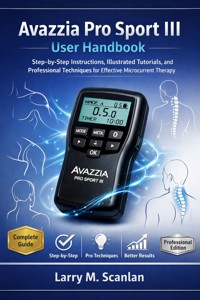
Avazzia Pro Sport III User Handbook
Step-by-Step Instructions, Illustrated Tutorials, and Professional Techniques for Effective Microcurrent Therapy
Larry M. Scanlan
Copyrights and Legal Notice
© 2026 All rights reserved.
No part of this publication may be reproduced, stored in a retrieval system, or transmitted in any form or by any means—electronic, mechanical, photocopying, recording, scanning, or otherwise—without prior written permission from the author or publisher, except for brief quotations in critical reviews or academic references.
Disclaimer
This handbook is intended for educational and informational purposes only. It does not substitute medical advice. Always consult a qualified healthcare professional before beginning, altering, or discontinuing any treatment program. The author and publisher disclaim any liability, loss, or risk incurred as a consequence, directly or indirectly, of the use and application of any of the contents of this book.
All device names, features, and trademarks mentioned herein—including Avazzia® and Pro Sport III®—are the property of Avazzia, Inc. and are used under fair educational reference. This book is an independent educational guide and is not affiliated with or endorsed by Avazzia, Inc. Official Avazzia product manuals and medical guidance should always be consulted for certified operation and regulatory compliance.
Introduction
A New Era of Healing Begins
Every once in a while, a device comes along that quietly reshapes the way we think about the body, pain, and the healing process. The Avazzia Pro Sport III is one of those rare innovations. Designed at the intersection of modern biofeedback technology and ancient healing principles, it embodies a profound idea: that the human body is capable of extraordinary self-repair when given the right stimulus. This handbook is written to help you understand, harness, and master that stimulus.
Microcurrent therapy is not new—it has roots that reach back decades—but what Avazzia has accomplished is far beyond incremental improvement. The Pro Sport III represents an evolution of bio-electrical therapy that uses intelligent, adaptive feedback to communicate with the nervous system in real time. In essence, this small handheld device speaks the body’s own electrical language. Instead of overriding natural processes with brute force (as many traditional electrotherapy devices do), it listens, interprets, and responds—helping restore balance where pain, injury, or dysfunction has disrupted it.
This guidebook is not just a technical manual. It is a companion on your journey toward confident, informed, and effective use of the Avazzia Pro Sport III. Whether you are a healthcare professional, athlete, therapist, or an individual simply seeking natural pain relief, this book will equip you with both the knowledge and the practical skill to use your device to its full potential. It combines clear step-by-step instruction with physiological understanding, professional insights, and user-friendly illustrations.
Why Microcurrent Matters
To appreciate the Avazzia Pro Sport III, it’s important to grasp what makes microcurrent therapy so remarkable. The human body functions through electrical communication. Every thought, every muscle movement, every cell repair signal is mediated through minute electrical impulses that travel along nerves and across cell membranes. When the body experiences trauma—be it from injury, stress, inflammation, or chronic disease—these natural bioelectrical signals can become distorted or blocked. The result? Pain, delayed healing, stiffness, or systemic imbalance.
Microcurrent therapy works by delivering electrical currents that mimic the body’s own bioelectric frequencies, measured in microamperes—millionths of an ampere. These gentle currents are below the threshold of sensation; they don’t “shock” or stimulate muscles like conventional TENS units. Instead, they communicate. The microcurrents act as corrective signals, prompting the body to restore proper cellular voltage, enhance ATP (adenosine triphosphate) production, and accelerate tissue repair. This therapy aligns beautifully with the body’s inherent intelligence—supporting rather than suppressing natural function.
What distinguishes the Avazzia Pro Sport III from other microcurrent devices is its built-in real-time feedback system. It reads the skin’s changing electrical resistance and adapts its output dynamically. This means the device doesn’t just “send” current; it also listens and modifies the signal based on how your body is responding. The result is more efficient communication with the nervous system, more accurate targeting of dysfunctional areas, and a deeper therapeutic effect.
From Passive Treatment to Active Partnership
Traditional medical models often place the patient in a passive role. Treatments are administered to them, and their bodies are seen as recipients rather than participants. The philosophy behind the Avazzia Pro Sport III—and the purpose of this handbook—is to change that paradigm. When you understand how your body communicates and how this device interacts with it, you move from being a passive recipient to an active partner in your own healing process.
Using the Avazzia Pro Sport III can feel transformative because it invites you to listen. You begin to notice subtle differences in sensation, shifts in tension, or patterns in pain that once felt mysterious. You become aware of feedback loops within your own physiology. Many experienced practitioners describe it as learning to “speak the body’s language.” This awareness not only enhances your results with the device but also deepens your overall relationship with your health and wellbeing.
The Pro Sport III doesn’t rely on guesswork. Its sophisticated software measures variations in skin impedance—tiny fluctuations that reveal how the nervous system is reacting to stimulation. These measurements help guide you to the most responsive areas for treatment, allowing precise application. The device’s adaptive output means it automatically adjusts to your body’s changing needs, making each session unique, responsive, and safe.
Who This Book Is For
This handbook is designed for a wide range of users, from beginners taking their first steps with microcurrent therapy to seasoned professionals integrating Avazzia technology into clinical practice. Each group will find information tailored to their needs:
Beginners will learn the foundational principles—how microcurrent therapy works, how to set up and operate the device, and how to use it safely for everyday pain and wellness applications.
Home users and athletes will find practical routines for recovery, relaxation, and performance enhancement, along with step-by-step examples of electrode placement and mode selection.
Therapists and clinicians will appreciate the advanced sections on frequency adjustment, waveform selection, and custom protocols that can be adapted for specific conditions or clients.
Researchers and educators will find references to the science behind the technology, including published studies, neurophysiological explanations, and comparative analyses between microcurrent, TENS, and other modalities.
By the end of this book, you will not only understand what the Avazzia Pro Sport III does, but also why it works, and most importantly, how to use it effectively.
Bridging Science and Intuition
Microcurrent therapy occupies a fascinating space between rigorous science and experiential practice. On one hand, it’s firmly rooted in measurable biophysics: current density, waveform shape, frequency response, and impedance. On the other hand, it relies on the user’s ability to sense and interpret the body’s subtle cues. The Pro Sport III elegantly bridges these two worlds.
This book encourages you to approach microcurrent therapy as both an art and a science. While the technical sections will explain precise settings and operating procedures, you’ll also be guided to develop an intuitive understanding of your body’s feedback. For instance, a sudden change in skin texture, temperature, or electrode “stickiness” often indicates an area of high electrical resistance—your body’s way of pointing to imbalance. Over time, you’ll learn to recognize these signs instinctively and use them to adjust your treatment flow.
Avazzia’s design philosophy supports this dual approach. The Pro Sport III gives you the freedom to customize frequencies, pulse widths, and durations, yet it also simplifies the process through intelligent presets. Whether you prefer to follow structured programs or adapt on the fly, the device meets you where you are—allowing both precision and flexibility.
Inside This Handbook
This guide is structured progressively to help you build confidence and mastery. Each chapter takes you deeper into understanding and applying your Avazzia Pro Sport III effectively.
Chapter 1 introduces the device, its background, and its components. You’ll learn how to set up your unit, navigate its controls, and understand its features.
Chapter 2 explores the science of microcurrent therapy—how it interacts with the nervous system and cellular processes, and what makes it different from other forms of electrical stimulation.
Chapter 3 focuses on navigating the interface, understanding modes, and adjusting key parameters like intensity and frequency.
Chapter 4 teaches you the art of application—where and how to place electrodes, and how to tailor treatments for different body regions.
Chapter 5 moves into advanced customization for professional users, including program creation and interpretation of feedback data.
Chapter 6 covers safety, maintenance, and troubleshooting—ensuring your device remains reliable for years.
Chapter 7 provides condition-specific therapy protocols, case studies, and recovery plans.
Chapter 8 helps you expand your learning, integrate complementary practices, and stay updated as technology evolves.
Throughout the book, you’ll find illustrated examples, practical exercises, and step-by-step tutorials to reinforce understanding. Every technical explanation is paired with a real-world context so that learning feels natural, not mechanical.
The Body Electric — A Foundation of Healing
The concept of the body as an electrical organism may sound poetic, but it’s scientifically precise. Each of the trillions of cells in your body maintains an electrical potential difference across its membrane—typically around -70 millivolts. This voltage is essential for nutrient transport, communication, and repair. When tissue is injured, this voltage collapses, impairing the cell’s ability to heal. Restoring proper electrical potential is therefore fundamental to recovery.
Microcurrent therapy assists this process by gently re-establishing normal electrical conditions. Research shows that microcurrent stimulation can increase ATP production by up to 500%, boost protein synthesis, and accelerate ion exchange across membranes. This means that tissues regenerate faster, inflammation subsides more efficiently, and pain signals are modulated more effectively.
But it’s not just about electricity—it’s about information. Your body operates on a continuous conversation of bio-signals. The Avazzia Pro Sport III helps reintroduce coherence into that conversation. It’s like tuning a radio that has drifted off frequency: once the signal is clear again, communication flows, and the system naturally corrects itself.
The Role of Feedback
At the heart of Avazzia’s innovation is the concept of biofeedback. The device doesn’t just emit current; it reads how your body reacts to it. This closed-loop communication is critical for personalized therapy. Every time the device detects a change in skin impedance, it adjusts the waveform output accordingly. You can observe these shifts in the device’s readings, which reflect your body’s dynamic electrical state.
This real-time feedback allows the Pro Sport III to target areas that need attention with pinpoint accuracy. Instead of guessing where to place electrodes or how long to treat, you can let your body’s signals guide the process. Many practitioners describe the experience as “listening with your fingertips”—an intuitive partnership between technology and biology.
This concept also underscores an important principle of healing: the body is not static. Pain patterns, muscle tension, and inflammation evolve from moment to moment. A feedback-driven device adapts alongside those changes, maintaining effectiveness throughout the session. It’s a living dialogue, not a one-way instruction.
Precision Meets Practicality
The Pro Sport III is both sophisticated and approachable. While it includes features that appeal to medical professionals—variable frequency outputs, advanced waveform control, data feedback—the learning curve remains manageable for non-experts. The user interface is intentionally clear, and the handbook you’re reading ensures that every function becomes intuitive through guided steps and visual cues.
Throughout this manual, technical explanations will always be balanced by plain-language interpretations. When you see terms like impedance, waveform polarity, or frequency sweep, you’ll find adjacent text that translates these into what they mean for you in real-life use. The goal is to empower you to think beyond pressing buttons—to understand what each adjustment does and why it matters.
By the time you’ve completed this guide, you’ll feel comfortable experimenting with customized sessions, interpreting feedback readings, and designing targeted programs for everything from acute injuries to chronic tension. You’ll have a working grasp of both the physics and the feel of microcurrent therapy.
Safety and Confidence First
Because the Avazzia Pro Sport III works with microamperage currents—so low they’re often below the threshold of sensation—it is inherently safe for most users when operated correctly. However, any device that interacts with the body’s electrical system deserves respect and proper understanding. That’s why this guide dedicates entire chapters to safety, maintenance, and contraindications.
You’ll learn how to recognize when and where microcurrent therapy is appropriate, how to avoid interference with medical implants, and how to maintain clean, reliable contact between electrodes and skin. The book will also help you troubleshoot common issues—such as poor signal conductivity, battery irregularities, or reading inconsistencies—so that your sessions remain smooth and effective.
The overarching theme of this book is empowerment through knowledge. When you understand how your device works, safety becomes second nature, and confidence replaces uncertainty.
Microcurrent in Everyday Life
One of the most beautiful aspects of using the Avazzia Pro Sport III is how seamlessly it integrates into daily living. Whether you’re managing chronic pain, recovering from surgery, training for athletics, or seeking relaxation after long work hours, the device adapts to your needs.
For pain management, microcurrent provides a gentle, non-invasive option that complements medical care.
For recovery, it reduces swelling and accelerates tissue repair, making it invaluable for post-injury or post-exercise recovery.
For stress, the calming effect on the nervous system promotes better sleep and emotional balance.
For beauty and wellness, low-frequency microcurrent applications can tone facial muscles, improve skin texture, and stimulate circulation.
You’ll find detailed, safe procedures for all these applications throughout the later chapters. By understanding the principles now, you’ll appreciate the versatility that lies ahead.
From Curiosity to Mastery
Every experienced user begins the same way: curious, cautious, and eager to learn. The Avazzia Pro Sport III rewards that curiosity with consistent, visible progress. In your first sessions, you may focus on relieving a specific area of discomfort. Soon, you’ll notice that you’re learning to read your body’s signals more accurately. You’ll start experimenting with different frequencies, discovering that each one evokes a unique response—relaxation, energy, warmth, or relief.
Mastery doesn’t come from memorizing settings; it comes from observation, repetition, and engagement. This handbook is structured to facilitate that journey. Each technique you’ll learn builds upon the last, creating a natural learning curve that transforms you from novice to confident practitioner.
By the time you reach the final chapters, you’ll understand not only how to use the Avazzia Pro Sport III effectively but also how to integrate it into a holistic approach to wellness—one that values prevention, awareness, and lifelong care.
A Message to the Reader
Before you turn the page, pause and consider what brought you here. Perhaps you’ve struggled with pain that traditional treatments couldn’t fully resolve. Maybe you’re a therapist seeking better tools for your clients. Or perhaps you’re simply fascinated by how technology can align with natural healing. Whatever your motivation, you are part of a growing movement that recognizes the body’s intelligence and seeks to work with it rather than against it.
This book was written with that philosophy in mind. Each section is built to inspire confidence, respect, and curiosity. You’ll see that the Avazzia Pro Sport III is more than a device—it’s a bridge between science and self-awareness. Every time you turn it on, you initiate a conversation with your body. Every reading, every pulse, every subtle change is part of that dialogue. And like any meaningful conversation, the more you listen, the more you understand.
As you move forward through the chapters, remember that healing is rarely linear. Some days you’ll notice immediate results; other days, progress may feel subtle. Both are signs of movement and adaptation. Consistency, attention, and patience are the keys. Microcurrent therapy honors the body’s natural timing—it doesn’t rush, it restores.
The Commitment to Excellence
Avazzia’s commitment to quality is reflected not only in the design of the Pro Sport III but also in the community surrounding it. Around the world, medical professionals, sports trainers, and home users alike share a growing appreciation for the way this device blends clinical precision with user accessibility. Avazzia’s continuous research and development ensure that the technology stays at the forefront of biofeedback therapy.
This handbook reflects that same dedication. Every chapter was crafted with accuracy, clarity, and real-world applicability in mind. You’ll find procedures tested in clinics, insights gathered from professional practitioners, and instructions refined through hands-on experience. The goal is to give you not just a manual—but a learning experience that evolves with your practice.
How to Use This Book
You don’t have to read this guide in one sitting. Think of it as a layered resource.
Beginners can start with Chapters 1 through 4 for foundational use and safety.
Intermediate users can explore Chapters 5 and 7 for advanced customization and therapy applications.
Professionals can dive into Chapters 6 and 8 to integrate Avazzia into a broader clinical or wellness practice.
Each section ends with practical tips, summarized insights, and a sketch illustration prompt that visually reinforces what you’ve learned. Whether you’re reading digitally or in print, take notes, highlight key passages, and revisit sections as your experience deepens.
The Journey Ahead
As you begin your exploration of microcurrent therapy, remember that the Avazzia Pro Sport III is not merely a tool—it’s a teacher. It reflects back the signals your body sends, guiding you toward awareness and equilibrium. Every session is a chance to learn something new about how your body responds, recovers, and regenerates.
In a world where quick fixes and invasive treatments dominate, microcurrent therapy represents a quiet revolution—gentle, intelligent, and deeply aligned with life itself. The chapters ahead will equip you with the knowledge, skill, and confidence to participate in that revolution effectively.
So take a deep breath. Turn the page. You’re about to embark on a journey that merges technology with touch, science with sensitivity, and knowledge with empowerment. The future of intelligent healing is in your hands—and it starts now.
Avazzia Pro Sport III
Laying the Foundation for Intelligent Healing
When you first hold the Avazzia Pro Sport III, it’s hard not to notice how deceptively simple it looks. It’s compact, hand-sized, and unassuming—yet behind that small screen and few buttons lies a system of remarkable sophistication. The Avazzia line of devices, particularly the Pro Sport III, represents decades of evolution in the field of microcurrent therapy—a branch of medical technology that has steadily gained respect among clinicians, physiotherapists, athletes, and holistic practitioners alike.
This chapter lays the groundwork for everything that follows. Before you learn how to select frequencies, interpret readings, or apply electrodes, it’s vital to understand why this technology exists and how it evolved. You’ll see that the Avazzia Pro Sport III isn’t merely another pain relief gadget; it’s a clinical-grade communication tool designed to interact with one of the most intricate systems on Earth—the human nervous system.
The Evolution of Microcurrent Technology
From the Spark of Discovery to Modern Bioelectrics
The concept of using electricity for healing predates the modern era by centuries. Ancient physicians in Greece and Rome are known to have used electric fish—such as the torpedo ray—to deliver mild electric shocks for the relief of pain and gout. Although crude by today’s standards, the idea was sound: the body responds to electrical energy in complex and therapeutic ways.
By the 18th century, the discovery of electricity’s physiological effects by scientists such as Luigi Galvani and Alessandro Volta laid the foundation for what we now call bioelectrical medicine. Galvani’s experiments showed that frog muscles could contract in response to electrical current, introducing the concept of “animal electricity.” These findings inspired the study of electrophysiology—the electrical behavior of living tissues.
Over the next two centuries, the medical use of electricity evolved into various therapeutic devices, ranging from early electrostatic machines to direct current stimulators. However, it wasn’t until the mid-20th century that microcurrent therapy began to take its modern form.
The Birth of Microcurrent Therapy
Microcurrent therapy arose from the realization that the human body itself operates on extremely low levels of electrical current—far lower than most early electrotherapy machines produced. Researchers found that while milliamperage currents (like those used in traditional TENS units) could override pain signals by stimulating nerves, microamperage currents could actually promote healing by restoring normal cellular voltage.
This was a revolutionary shift in thinking. Rather than forcing the body to react, microcurrent sought to communicate with it. By mimicking the body’s own bioelectric language, microcurrent therapy could trigger natural processes of repair, regeneration, and balance.
In the 1970s and 1980s, groundbreaking studies conducted by Dr. Björn Nordenström and Dr. Robert Becker—the latter author of The Body Electric—helped validate this principle scientifically. Becker’s research demonstrated that electrical potentials play a crucial role in tissue regeneration, particularly in bone and nerve repair. Nordenström’s work in “bioelectrical circuits” proposed that the body’s electrical fields regulate not only healing but also disease states.
These discoveries gave rise to medical microcurrent devices used for wound healing, pain management, and even bone regeneration. The technology quickly expanded into sports medicine, aesthetic therapy, and neurotherapy—each field adopting microcurrent for its own unique applications.
The Need for Precision and Feedback
Early microcurrent devices were powerful but limited. They delivered fixed-frequency signals without accounting for individual variation. Every patient received the same output, regardless of how their body responded. As clinicians observed, not all sessions produced consistent results. What was missing was feedback—a way for the device to know what was happening in real time.
Pain, inflammation, and injury all create localized changes in electrical resistance across the skin. Without measuring that resistance, the device is essentially operating “blind.” This realization led to the integration of biofeedback technology into microcurrent systems—allowing the machine to measure skin impedance and adapt accordingly. This innovation dramatically improved therapeutic precision and user confidence.
Enter Avazzia.
Avazzia and the Biofeedback Revolution
In the early 2000s, electrical engineer Tim Smith, formerly of Texas Instruments, began exploring ways to combine medical-grade microcurrent with adaptive feedback control. Drawing on decades of experience in signal processing, Smith designed a device that could read and respond to changes in skin impedance instantaneously. His goal was to develop a system that could listen to the body, not just stimulate it.
From that vision came the first generation of Avazzia microcurrent devices, and eventually, the Pro Sport III—a culmination of hardware engineering, medical insight, and user-centric design. The addition of interactive biofeedback transformed microcurrent therapy from a static treatment to a dynamic, personalized conversation between device and body.
What makes this so profound is that the Pro Sport III doesn’t rely on pre-programmed assumptions about your physiology. Instead, it continuously measures and recalibrates its output based on how your skin’s electrical characteristics shift during treatment. This is what gives Avazzia its reputation for adaptability and clinical accuracy.
From Niche Therapy to Mainstream Recognition
As more practitioners began to use microcurrent devices, results accumulated. Studies documented significant benefits for chronic pain, neuropathy, musculoskeletal injuries, and even post-surgical recovery. Unlike high-voltage therapies, microcurrent proved safe for long-term use and effective in supporting natural healing mechanisms.
Professional athletes began incorporating microcurrent into their recovery protocols. Chiropractors and physical therapists used it to accelerate muscle repair. Dermatologists adopted microcurrent for facial toning and lymphatic drainage. By the time the Avazzia Pro Sport III was introduced, the field had matured from a niche alternative to a respected modality.
Today, microcurrent therapy is recognized as a clinically valuable approach in pain management and rehabilitation. It bridges the gap between modern medical technology and the body’s intrinsic healing intelligence—a partnership that the Avazzia Pro Sport III perfects through precision engineering and continuous adaptation.
The Pro Sport III as the Pinnacle of Evolution
The Avazzia Pro Sport III stands as the flagship of Avazzia’s technology line because it unites everything the industry has learned about microcurrent therapy into one portable instrument:
True microamperage output that matches biological current flow.
Real-time impedance measurement for adaptive treatment.
Multiple waveforms and modes for varied therapeutic needs.
Clinically validated presets alongside customizable programs.
Ergonomic design suitable for handheld or professional use.
In other words, the device represents not just the evolution of technology—but the evolution of philosophy. It’s about respect for the body’s intelligence. It’s about precision without complexity, power without aggression. It is, in every sense, the modern face of bioelectrical healing.
Why This History Matters
Understanding where microcurrent technology came from helps you appreciate what makes Avazzia different. Each advancement—from Galvani’s frogs to Becker’s research to Avazzia’s feedback loop—reflects a deeper truth: the body’s language is electrical, and communication, not coercion, is the path to health.
When you use the Pro Sport III, you are participating in that lineage of exploration. You’re part of a scientific conversation that began centuries ago and continues to evolve with every pulse, every reading, every healing moment.
Understanding the Avazzia Brand and Bio-Feedback System
Engineering Meets Empathy
Avazzia was founded with a clear purpose: to make advanced bioelectrical therapy accessible, intelligent, and safe. From the start, its engineers and medical advisors shared a philosophy that separated them from other device manufacturers. They didn’t want to simply build machines—they wanted to build relationships between humans and technology.
The Pro Sport III embodies that philosophy. Every detail—from the feel of the control dial to the readability of the LCD screen—reflects a human-centered design process. Yet what truly defines the Avazzia brand is its bio-feedback system, the feature that allows the device to “learn” from the body it’s treating.
What Is Biofeedback, and Why It Matters
The term biofeedback refers to the process of gaining awareness of physiological functions—such as heart rate, muscle tension, or skin conductance—in order to control them voluntarily. In the context of the Avazzia Pro Sport III, biofeedback is built directly into the circuitry. It continuously monitors the skin’s electrical resistance (impedance) and adjusts its output accordingly.
Here’s why this is important:
Every person’s body is different. Skin thickness, hydration, and tissue composition affect how current travels.
Pain and injury change conductivity. In areas of stress or inflammation, skin impedance rises.
Dynamic adaptation enhances results. As the body begins to respond, impedance changes again—so the device must adapt in real time.
Without feedback, you might over-treat or under-treat an area. With feedback, the device maintains optimal communication, always balancing stimulus and response.
How Avazzia’s Biofeedback Works
Inside the Avazzia Pro Sport III lies a microprocessor that sends microamperage signals through the skin and simultaneously measures how those signals are received. This creates a feedback loop, similar to how sonar reads ocean depth or radar maps terrain. The device is constantly “pinging” the tissue and reading its echo.
When you move the electrode across the skin, the display shows variations in readings—often expressed as changing resistance values or “sticky” sensations felt on the electrode pads. Areas of higher resistance typically correlate with physiological dysfunction, such as tight muscles, nerve irritation, or inflammation.
The Pro Sport III’s processor interprets this data in real time. If impedance increases, it modifies the output waveform slightly, seeking to normalize tissue response. As the area’s conductivity improves, the readings stabilize, signaling a therapeutic effect.
This interaction—device, tissue, response—is what makes Avazzia’s system intelligent rather than mechanical. It transforms therapy from a blind procedure into a guided conversation.
Avazzia’s Design Philosophy
Beyond the hardware, Avazzia’s philosophy rests on three principles:
Listen First. The device must respond to the body’s needs rather than impose fixed assumptions.
Respect the Body’s Intelligence. Healing is a biological process, not an electrical one. The current merely facilitates what the body is already designed to do.
Empower the User. Technology should simplify complex processes so that anyone—from patient to practitioner—can use it safely and effectively.
This mindset is evident throughout Avazzia’s product line, from entry-level units like the Blue devices to professional-grade systems like the Pro Sport III. Each step up in the range adds functionality, but all maintain the same core philosophy: precision, feedback, and respect for natural healing.
Inside the Avazzia Ecosystem
The Pro Sport III belongs to a family of devices that share compatible electrodes, cables, and software design. Users who start with a basic model often upgrade to the Pro Sport III for its expanded frequency options, digital readouts, and multi-mode operation. The brand’s ecosystem supports both personal and clinical use, bridging home wellness and professional therapy.
Key components include:
Handheld unit: The main body containing the display, control dial, and output ports.
Electrode accessories: Pads, probes, or comb attachments that deliver current to targeted areas.
Firmware system: Embedded software governing signal algorithms and feedback interpretation.
Optional training resources: Workshops and certification programs that teach advanced application techniques.
This ecosystem encourages progression. As users become more skilled, the device grows with them—unlocking deeper levels of control and customization.
The Signature Waveforms
One of Avazzia’s most distinguishing technical features is its waveform diversity. The Pro Sport III can produce several output waveforms, each designed for specific therapeutic purposes. While the manual provides exact specifications, a basic understanding helps you appreciate the sophistication behind the system.
Standard (SCENAR-type) waveform: Used for general pain relief and neuromodulation.
Modulated microcurrent waveform: Varies frequency automatically to prevent accommodation and maintain tissue responsiveness.
Avazzia proprietary waveforms: Include adaptive signal modulation designed to maximize ATP production while maintaining comfort.
This diversity allows the practitioner to target different physiological mechanisms—pain gating, muscle relaxation, or tissue repair—with the same device. It’s like having multiple therapies in one instrument.
The Human Element of Feedback
Although the Pro Sport III automates feedback reading, your awareness as the user remains vital. By observing how the skin feels under the electrode—smooth, sticky, or resistant—you can confirm what the device is detecting. This sensory feedback complements the numerical data, creating a richer understanding of what’s happening beneath the surface.
For example:
A “sticky” drag sensation often indicates increased skin impedance.
A sudden release or softening suggests improved conductivity and tissue response.
Subtle changes in warmth or tingling can indicate restored microcirculation.
Learning to recognize these cues enhances your skill as a practitioner. Over time, you’ll develop an intuitive connection with the feedback process, allowing you to interpret results faster and more accurately.
Clinical Integrity and Regulatory Standards




