


16,99 €
Mehr erfahren.
- Herausgeber: John Wiley & Sons
- Kategorie: Fachliteratur
- Sprache: Englisch
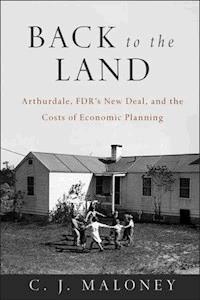
How New Deal economic policies played out in the small town of Arthurdale, West Virginia Today, the U.S. government is again moving to embrace New Deal-like economic policies. While much has been written about the New Deal from a macro perspective, little has been written about how New Deal programs played out on the ground. In Back to the Land, author CJ Maloney tells the true story of Arthurdale, West Virginia, a town created as a "pet project" of the Roosevelts. Designed to be (in the words of Eleanor Roosevelt) "a human experiment station", she was to create a "New American" citizen who would embrace a collectivist form of life. This book tells the story of what happened to the people resettled in Arthurdale and how the policies implemented there shaped America as we know it. Arthurdale was the foundation upon which modern America was built. * Details economic history at the micro level, revealing the true effects of New Deal economic policies on everyday life * Addresses the pros and cons of federal government economic policies * Describes how good intentions and grand ideas can result in disastrous consequences, not only in purely materialistic terms but, most important, in respect for the rule of law Back to the Land is a valuable addition to economic and historical literature.
Sie lesen das E-Book in den Legimi-Apps auf:
Seitenzahl: 488
Veröffentlichungsjahr: 2011
Ähnliche



















Table of Contents
Cover
Table of Contents
Title page
Copyright page
Dedication
Arthurdale from 1933 to 1947
Acronyms Used in the Book
Road Song of the Bandar-Log
Map of West Virginia
Introduction
Chapter 1 The Damnedest Cesspool of Human Misery
The Great Coal Bubble
The Hell of Peace
The Agreement That Wasn’t
Scotts Run Turns Bloody
Bottom of the Barrel: Life in the Coal Camps
Misery beyond Description: Private Charity in Scotts Run
American Friends Service Committee
In the Thick of It All
Chapter 2 The Angel of Arthurdale Arrives
Getting Down with the Sickness
Interpreting a Dream
Chapter 3 The Definition of Insanity
Man Plans, God Laughs
Lather, Rise, Repeat: Previous Farm Colonies
Slipping By in the Crowd—Legislating Arthurdale
Chapter 4 We Lucky Few
Rotting from the Head
Choosing the Lucky
Chapter 5 “Spending Money . . . Like Drunken Sailors”
The Blind Leading the Blind
Money Pit
“Living in a Fish Bowl”
A Potemkin Village, American Style
The Angel of Arthurdale
Chapter 6 The Darkening of the Light
At One with the Land
The Other Half of the Equation: Wage Employment
Cooperation, Debt, and Losses
Pleasantville
Chapter 7 “A Human Experiment Station”
Machine of the Gods
Progressive School, Progressive Man
A Little Village in Itself
“This Highly Restricted Mode of Life”
The Jamestown Effect
Chapter 8 At Long Last, Arcadia
The Sleep of the Just
The End and the Beginning
Epilogue: To the Victor, the Spoils
Collective Dispossession
Flowers for Algernon
Back to the Future
Acknowledgments
Bibliography
Newspapers
Magazines/Journals
Pamphlets/Bulletins
Archives
Government Reports
Unpublished Manuscripts
Interviews Conducted with Author from Fall 2009 to Spring 2010
Interviews Conducted by Arthurdale Heritage Inc. from Late 1980s to Early 1990s
Multimedia
Books
About the Author
Index
Plates
Copyright © 2011 by C.J. Maloney. All rights reserved.
Published by John Wiley & Sons, Inc., Hoboken, New Jersey.
Published simultaneously in Canada.
No part of this publication may be reproduced, stored in a retrieval system, or transmitted in any form or by any means, electronic, mechanical, photocopying, recording, scanning, or otherwise, except as permitted under Section 107 or 108 of the 1976 United States Copyright Act, without either the prior written permission of the Publisher, or authorization through payment of the appropriate per-copy fee to the Copyright Clearance Center, Inc., 222 Rosewood Drive, Danvers, MA 01923, (978) 750-8400, fax (978) 646-8600, or on the Web at www.copyright.com. Requests to the Publisher for permission should be addressed to the Permissions Department, John Wiley & Sons, Inc., 111 River Street, Hoboken, NJ 07030, (201) 748-6011, fax (201) 748-6008, or online at http://www.wiley.com/go/permissions.
Limit of Liability/Disclaimer of Warranty: While the publisher and author have used their best efforts in preparing this book, they make no representations or warranties with respect to the accuracy or completeness of the contents of this book and specifically disclaim any implied warranties of merchantability or fitness for a particular purpose. No warranty may be created or extended by sales representatives or written sales materials. The advice and strategies contained herein may not be suitable for your situation. You should consult with a professional where appropriate. Neither the publisher nor author shall be liable for any loss of profit or any other commercial damages, including but not limited to special, incidental, consequential, or other damages.
For general information on our other products and services or for technical support, please contact our Customer Care Department within the United States at (800) 762-2974, outside the United States at (317) 572-3993 or fax (317) 572-4002.
Wiley also publishes its books in a variety of electronic formats. Some content that appears in print may not be available in electronic books. For more information about Wiley products, visit our web site at www.wiley.com.
Library of Congress Cataloging-in-Publication Data
Maloney, C. J., 1969–
Back to the land : Arthurdale, FDR’s New Deal, and the costs of economic planning / C. J. Maloney.
p. cm.
Includes bibliographical references and index.
ISBN 978-0-470-61063-3 (cloth); ISBN 978-1-118-02353-2 (ebk); ISBN 978-1-118-02356-3 (ebk); ISBN 978-1-118-02357-0 (ebk)
1. Subsistence farming—West Virginia—Arthurdale. 2. Land settlement—West Virginia—Arthurdale. 3. Frontier and pioneer life—West Virginia—Arthurdale. 4. New Deal, 1933–1939. I. Title.
S451.W4M35 2011
307.1´4120975482—dc22
2010045672
For Moma and Casey
Arthurdale from 1933 to 1947
Federal Agencies that Administered Arthurdale
Division of Subsistence Homesteads, Department of the InteriorJuly 1933–May 1935Division of Subsistence Homesteads, Resettlement AdministrationMay 1935–December 1936Resettlement Administration, Department of AgricultureJanuary 1937–August 1937Farm Security Administration, Department of AgricultureSeptember 1937–September 1942National Housing Agency, Federal Public Housing AuthorityOctober 1942–April 1947Arthurdale Community Project Managers
Bushrod GrimesNovember 1933–April 1934Ornan B. SmartApril 1934–October 1934G. M. FlynnOctober 1934–February 1937Glenn WorkMarch 1937–July 1941Milford MottDecember 1941–April 1947Acronyms Used in the Book
Here we sit in a branchy row, thinking of beautiful things we know,
Dreaming of deeds that we mean to do, all complete in a minute or two—
Something noble and wise and good, done by merely wishing we could!
By the rubbish in our wake, and the noble noise we make,
Be sure, be sure, we’re going to do some splendid things!
—Rudyard Kipling, “Road Song of the Bandar-Log,” The Jungle Book
Map of West Virginia.
Source: Thomas Maloney, 2010.
Introduction
Arthurdale today does not, at least on first glance, seem to be much of a place at all.
—Michael Byers, Preservation1
The story of Arthurdale begins just outside of Morgantown, West Virginia, in a five-mile long hollow* called Scotts Run. Like almost everything wretched, the tragedy that was visited upon the people who lived in Scotts Run was birthed in the turmoil of war, specifically in this case World War I, fought mostly in Europe from 1914 to 1919. Historian Niall Ferguson wondered aloud in The Pity of War why America does not seem to take much of an interest regarding that conflict’s “effect at the time on American society.”2 He is correct; we have yet to take full measure of what President Woodrow Wilson’s crusade cost us.
War of a modern scale continues to claim victims long after it ends and far from where it was fought. So it was that on a cold winter day in 1932 America a writer for the New York Times witnessed the burial of a little Scotts Run girl—she had died of exposure, a condition brought on in her case through a fatal combination of bitter winter and a lack of warm clothing.3 Without a doubt, although she was born long after the Guns of August had fallen silent, it would have been entirely accurate for her family to say “She died in the war.” If the innumerable contemporary accounts of all that took place in that hollow are to be believed, she was far from the only one.
The immense suffering experienced by the coal-mining peoples of America, a cataclysm that centered on West Virginia, Pennsylvania, and Kentucky, was a direct result of that conflict. The war that at first seemed a blessing for the miners became a biblical plague upon those who could, for the most part, only wonder what in the world had happened. When the Roosevelt administration stumbled across Scotts Run during 1933 and the first lady, Eleanor Roosevelt, saw firsthand the miners’ destitution, she demanded of her husband, President Franklin Delano Roosevelt, that something be done for them. The town of Arthurdale, West Virginia, created and sustained expressly on FDR’s command, was that something. The town took life as part of one of the New Deal’s lesser-known but most influential components—the Division of Subsistence Homesteads.
Arthurdale was the culmination of a long-cherished dream for population resettlement held by FDR and the circle of like-minded men he had gathered about him as he ascended to power. Despite being dressed with the thin veneer of “charity,” the town was something else entirely. Through careful planning of the physical environment by the federal authorities and education of the resettled (both young and old), the town was to introduce a “new American way of life,” in the vision of its sponsors it was to build a new American man.
Openly touted by Eleanor Roosevelt (the town’s most prominent booster) as a “human experiment station,”4 never before (or in many ways since) have federal politicians ever meddled in the intimate details of the people’s everyday lives to such a degree as at Arthurdale. Never have a group of American citizens been subject to such an “experiment.” In the vast, discretionary powers allowed to the political class, the Division of Subsistence Homesteads was a battle between the ideals of the Old Republic and those of the New Deal.
The small band of dreamers who brought the town to life—FDR, the land economists Rexford Tugwell and M. L. Wilson, along with their allies—were not the kind to let a crisis go to waste, so to speak, and Arthurdale owes its very existence to Scotts Run. Without the tragedy that took place in the hollow, without all its gun battles and dynamite blasts and hungry children with distended bellies, Arthurdale would have remained just a dream for those who would eventually build it.
It was mostly from the pool of destitute coal miners in Scotts Run that it was populated, all the families resettled as part of a larger federal program that would build around 99 similar colonies across the nation.*
Arthurdale was the first, the most lavish, and the most publicized of the resettlement colonies built by the Division of Subsistence Homesteads. With the maturation of still photography and the growth in the movie industry during the early 1930s, stark images from the Run were broadcast nationally, as was the emergence of Arthurdale. The Run would become the poster child for the horrors of the Great Depression; Arthurdale the poster child for the beneficence of the New Deal and the man, FDR, who made it possible.
Lesen Sie weiter in der vollständigen Ausgabe!
Lesen Sie weiter in der vollständigen Ausgabe!
Lesen Sie weiter in der vollständigen Ausgabe!
Lesen Sie weiter in der vollständigen Ausgabe!
Lesen Sie weiter in der vollständigen Ausgabe!
Lesen Sie weiter in der vollständigen Ausgabe!
Lesen Sie weiter in der vollständigen Ausgabe!
Lesen Sie weiter in der vollständigen Ausgabe!
Lesen Sie weiter in der vollständigen Ausgabe!
Lesen Sie weiter in der vollständigen Ausgabe!
Lesen Sie weiter in der vollständigen Ausgabe!
Lesen Sie weiter in der vollständigen Ausgabe!
Lesen Sie weiter in der vollständigen Ausgabe!
Lesen Sie weiter in der vollständigen Ausgabe!




